A Narrowing Margin: Qatar Braces for a U.S. Strike as Its Media and Its Diplomats Speak to Different Audiences
Qatar now sits inside the radius of a possible new U.S.-Iran round, and its room to act as a neutral broker is shrinking. President Trump said on October 24 that a strike on Iran could come within days or give way to a large deal, and the State Department is reducing staff at its embassy in Doha after the Director of National Intelligence warned of advanced Iranian plotting against Americans. Doha’s answer, set out in an Al-Watan editorial, is that contacts between Washington and Tehran continue and that Iranian threats to Gulf infrastructure are a reason to press harder for a settlement. At the same time, Qatar’s condemnations of Houthi and Iranian attacks keep moving it into the Gulf camp, which costs it standing in Tehran. Qatari-funded media portray Washington as the aggressor while official Doha stays warm toward it, and the embassy’s campaign in the United States has taken a combative, personal turn.
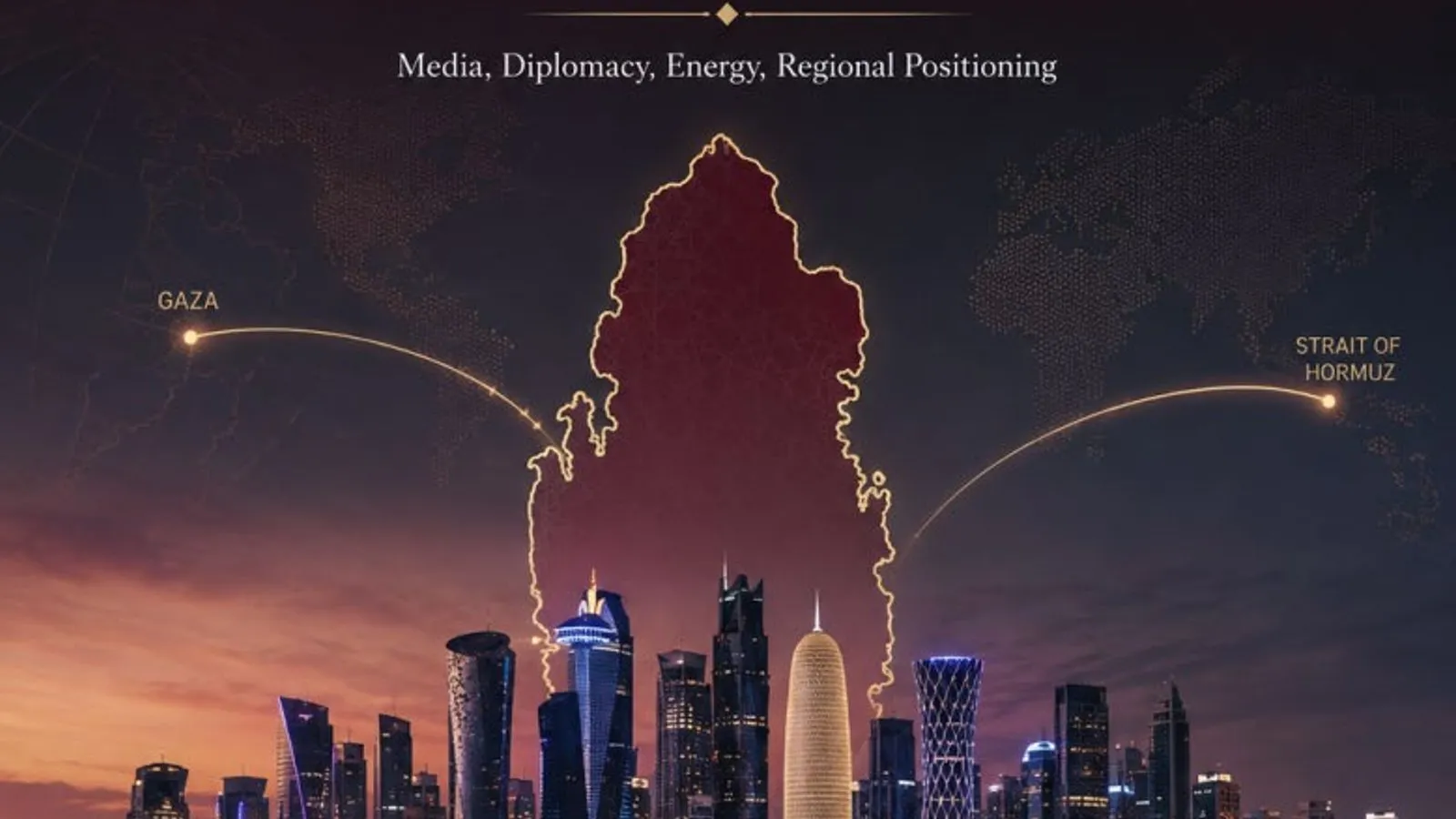
Mediation in the Shadow of a Possible Strike
The path toward escalation moved faster than the path toward a settlement over the past 24 hours. President Trump said Washington was weighing a strike that could come as soon as the next day, and he added that the United States would win whether it struck or reached a deal. Iranian President Masoud Pezeshkian told state television that the Americans had wrecked the talks, although he said a new attempt at an agreement was still needed. Al-Araby Al-Jadeed reported that Tom Barrack, the U.S. ambassador to Türkiye, did not rule out a strike before the end of the week. Citing The Wall Street Journal, the paper also reported that the carrier USS George Washington is loading long-range land-attack missiles and bunker-busting bombs.
Washington is also preparing its personnel for retaliation. A memo from Director of National Intelligence Jay Clayton to Secretary of State Marco Rubio says Iran has sharply increased efforts to target U.S. personnel and that lethal plotting has reached advanced stages. According to PBS and the Associated Press, the State Department is reducing staff at its embassies in Qatar, Jordan, Lebanon, and the UAE, which remain open under restricted operations. The department cited Houthi threats, and three officials linked the move to both Iran and the Houthis. Our Hormuz-axis daily for October 25 covers the military preparations in more detail.
Al-Watan’s unsigned editorial, “Continuing Efforts,” is the clearest statement of Doha’s position. It says contacts, visits, and messages between Washington and Tehran have not stopped, while acknowledging that the mediation has produced no new agreement. It cites Iranian talk of targeting internet cables in Hormuz, along with continuing attacks on ships, as reasons to intensify the effort, and it warns that any negative turn in the Gulf would serve no state in the region. Qatar and Pakistan have carried proposals between the two capitals since mid-October. No cable incident has been reported.
The report assesses with moderate confidence that a U.S. strike within days is possible and that Qatar would fall within the zone of Iranian retaliation. The White House earlier ruled out action before the November 3 midterms, a pledge we noted in our October 24 brief, and that pledge now looks weaker. Doha faces pressure from both sides. Washington treats Qatar as a likely target, which is the practical meaning of the staffing cut. Tehran, for its part, is testing whether mediation still buys Doha any protection. The editorial reads as an effort to keep the channel credible in both capitals without taking a position on the substance.
Drifting Toward the Gulf Camp
The Yemen front escalated through the weekend. Coalition statements carried by Al-Sharq reported interceptions of Houthi ballistic missiles aimed at Riyadh, Taif, and Yanbu, and of a cruise missile aimed at Khamis Mushait on October 25. Al-Araby reported Houthi fire at Aden airport, about 20 Saudi air strikes on Mocha according to the Houthi channel Al-Masirah, and strikes on Sanaa that the Houthi health ministry says killed ten people.
The report found no public evidence that Qatari money is financing the Turkish and Pakistani deployments in support of Saudi Arabia. Qatar is not a member of the Mecca defense pact among Saudi Arabia, Türkiye, and Pakistan, and its defense-industrial ties with Ankara and Islamabad run through the separate Badr memorandum. What has changed is Doha’s rhetoric. It has repeatedly condemned Houthi strikes on Saudi territory, and the Qatar-France statement of October 21 backed efforts to stop Houthi attacks on Saudi civilian and energy sites.
The report judges with moderate confidence that Qatar’s channel to Tehran remains open but carries less weight. Each statement against Iran’s allies signals to Tehran that Doha’s neutrality has limits, which makes Qatar less useful as a mediator in any later round. The cost accumulates gradually, and the Al-Watan editorial’s emphasis on Hormuz and Gulf security fits the same drift.
Two Messages on Washington
Qatar-linked media now carry three critical narratives about the United States at once. The first is a president pushing the region toward war. Al Jazeera’s news copy frames the conflict as a U.S.-Israeli war on Iran and reports Trump’s statements as claims. In its opinion section, economist Jeffrey Sachs and Sybil Fares argue that Washington and Israel are preparing another round and urge Arab states to deny their territory and airspace for attacks on Iran. In their words, the U.S. bases in the Gulf “turned their host countries into targets.” The piece praises Qatar for keeping mediation channels open. Gulf Times, meanwhile, led its opinion page with a Reuters analysis on how the Iran war is raising prices and hurting Trump before the midterms.
The second narrative is a U.S. military presence that endangers its hosts, and the third is a president intervening in Israel’s October 27 election. An Al Jazeera analysis described Trump’s October 18 endorsement as explicit support for Benjamin Netanyahu’s campaign. Emad Hajjaj’s cartoon in Al-Araby Al-Jadeed draws the Israeli ballot box in blood, built from shrouded bodies. Al-Araby’s U.S. coverage is negative throughout the edition, from the war to Trump’s domestic disputes and his backing for the Bolsonaro family in Brazil’s run-off.
None of this appears in official Qatari statements, which continue to thank Washington for its security commitments. The report judges with high confidence that Qatari-funded media remain hostile to Trump and to the U.S. military presence while the government’s line stays warm. The divergence lets Doha speak to Arab and Muslim audiences while its diplomats keep the bilateral channel in good repair. Al Jazeera will enter its fourth decade on November 1 with three channels, including a new breaking-news service, Al Jazeera Now, and 33 new programs. The dedicated breaking-news channel will give the network more airtime for rolling war coverage at a moment when its framing of the United States is at its harshest.
The same outlets cover the wider region in a consistent register. Al-Araby leads its West Bank reporting with an Israeli operation in Hebron that the municipality says has displaced some 1,500 people, and it treats Lebanon and Syria as a single theater in which Washington restrains Israel only at the margins. Qatari outlets agreed in condemning the October 23 attack on a church in Jordan’s Karak governorate, which Qatar’s foreign ministry also condemned. They differed on attribution: Al-Watan and Al-Araby’s op-eds called it terrorism, while Al-Araby’s news pages kept open the possibility of an Israeli link.
Why Macron Came Now
French Ambassador Arnaud Pescheux explained the timing of the October 20 to 21 state visit at a press conference in Doha. He said Paris came to thank Qatar’s armed forces for protecting French residents during the war and to secure energy supplies. QatarEnergy and TotalEnergies agreed on winter LNG deliveries to France of two terawatt-hours a month, and QatarEnergy is in talks with Engie on further volumes. Three more tracks are under discussion: help securing some ships, an insurance mechanism to lower transport costs, and land corridors that bypass Hormuz. On defense, he cited Rafale upgrades and a letter of intent for an armored-vehicle program for Qatar’s land forces. Our October 22 brief covered the visit itself.
A regular Al-Sharq columnist, Sheikh Dr. Saud bin Nasser Al Thani, offered a different reading. He argued that the visit, announced only hours before it began, was closely linked to unrest inside France, accused Paris of scapegoating its Muslim population, and described Qatari gas as a lifeline for a cold French winter. Contributing columnists in Al-Araby traced the French unrest to living costs, public debt above 113 percent of GDP, and fuel shortages caused by the closure of Hormuz.
The report judges with high confidence that the visit was driven by energy and security, with French unrest acting as an accelerant, since energy prices feed the protests. No Qatari or French source in the reporting window connects the visit to the Muslim Brotherhood. The only Islam-related framing comes from the Qatari columnist, who turns it into a charge against Paris.
The Washington Campaign Turns Personal
Qatar’s image campaign in the United States now relies on registered American advocates and an increasingly combative embassy voice. On October 24, The Hill published an op-ed by William J. Bennett, the former Secretary of Education, defending Qatari-funded Arabic programs in U.S. schools. His opening line discloses that he consults for the Qatari embassy on education. Bennett argues that Qatar Foundation International, which announced in June that it was ending its U.S. operations, funded Arabic instruction transparently while schools kept control of the curriculum. He rebuts two cases that critics cite, compares the grants with German, Spanish, Italian, and Japanese language support, and says he has resigned from the Middle East Media Research Institute over its treatment of Qatar. Bennett registered under FARA in July 2025 as an adviser to the embassy. The report could not verify whether a current registration covers his 2026 work.
Deputy chief of mission Hamad Al-Muftah promoted the op-ed on X. Later that day he attacked researcher Eitan Fischberger in personal terms, mocking his dual nationality, suggesting he was taking direction from a handler, and boasting that Bennett is among the consultants working around the clock for the embassy. He also suggested that Fischberger’s network should register under FARA. Separately, after Senator Ted Cruz accused Georgetown of taking Qatari money instead of doing its job, Al-Muftah replied with Qatar’s investment in Texas, including the Golden Pass LNG venture at Sabine Pass, and its aid after Hurricanes Katrina and Harvey, without addressing the Muslim Brotherhood issue Cruz had raised.
The report judges with high confidence that this tone risks feeding the FARA and influence narrative it is meant to rebut. Bennett’s disclosure and Al-Muftah’s boast give critics fresh material, and the remark about dual nationality is likely to be quoted back at the embassy. The reply to Cruz follows Doha’s familiar method of answering ideological charges with economic ones.
The Section 117 case is unchanged. No new court filing, ruling, or Qatari response surfaced after October 22, and the temporary restraining order that bars the Education Department from publishing individual donor names expires on October 29. Our Section 117 special report explains the order.
A Recovery Story Priced on Hormuz
Qatar is using its wartime balance sheet to court global capital. Al-Watan reports that IMF projections compiled by fDi Intelligence rank Qatar second in the world for expected 2027 growth, at 18.8 percent, after a projected contraction of 15.6 percent this year. The baseline assumes that Hormuz traffic normalizes gradually from March 2027, a date no party has agreed. The projected rebound is the mirror image of the damage done by eight months of disrupted LNG exports.
Doha is selling that recovery story. The ninth World Investment Forum, hosted with UN Trade and Development, opens in Doha today and runs through October 27, and Brookfield announced a Doha office for its global credit platform. CNN’s “Global Perspectives” forum follows on October 29, two days after Israel votes. The report judges with moderate confidence that this courtship of capital depends on Hormuz reopening.
QatarEnergy is also becoming a buyer of American gas to protect its delivery record while Hormuz constrains Ras Laffan. After the Cheniere agreement, which we examined in our October 23 brief, Reuters reported advanced talks with Venture Global for at least 3 million tons a year and talks with Woodside’s Louisiana LNG for up to 3 million tons a year. Neither deal is signed. Pezeshkian travels to Moscow for the Gas Exporting Countries Forum summit on October 27, and since the forum is headquartered in Doha, the level of Qatar’s representation will show how closely it wants to appear beside Tehran and Moscow. Brent settled at $116.72 and WTI at $103.27 on October 23, and the Qatar Exchange index closed at 8,611.10.
Key Points
- A U.S. strike on Iran within days is possible, and Qatar would sit inside the zone of Iranian retaliation; the White House pledge of no action before November 3 now looks weaker (moderate confidence).
- Qatar’s mediation channel to Tehran remains open but is losing weight, as Doha’s alignment with Riyadh and Paris against Iranian and Houthi attacks narrows its standing in Tehran (moderate confidence).
- Qatari-funded media remain hostile to Trump and to the U.S. military presence while Doha’s official line stays warm (high confidence).
- The Macron visit was driven by energy and security, with French unrest as an accelerant; no source ties it to the Muslim Brotherhood (high confidence).
- Qatar is using its wartime balance sheet to court global capital, a strategy contingent on Hormuz reopening (moderate confidence).
- No new court action or Qatari response emerged on Section 117 (high confidence).
- Qatar’s U.S. image campaign now leans on registered American advocates and a combative embassy voice, which risks feeding the influence narrative it seeks to rebut (high confidence).
What to Watch
- Qatari investment announcements and the participation of the Amir or the prime minister at the World Investment Forum, October 25 to 27.
- Israel’s October 27 election, and Qatar’s level of representation at the Gas Exporting Countries Forum summit in Moscow the same day.
- CNN’s October 29 forum in Doha, and the expiry of the Section 117 restraining order on the same date.
- Al Jazeera’s 30th anniversary and the launch of Al Jazeera Now on November 1.
- Any U.S. strike on Iran before or after the November 3 midterms, and Iranian retaliation against Gulf infrastructure, including undersea cables and Qatari facilities.
- The Qatari-Pakistani mediation, Houthi strikes on Saudi Arabia, the displacement in Hebron, and the U.S. embassy’s posture in Doha.
- Whether a FARA registration covers Bennett’s current work for the embassy, and any congressional reaction to Al-Muftah’s posts.
This post summarizes the Qatar Watch daily intelligence monitoring report for October 25, 2026, with information as of 12:00 Doha time. The report draws on Al Jazeera Arabic, PBS and the Associated Press, the October 25 print editions of Al-Araby Al-Jadeed, Al-Watan, Al-Sharq, Al Raya, Gulf Times, and Qatar Tribune, Reuters, The Hill, Jewish Insider, UNCTAD, and posts on X by Qatari diplomats, Senator Cruz, and energy commentators. The USS George Washington report rests on Al-Araby’s account of The Wall Street Journal, the Venture Global and Woodside volumes are unsigned, and whether Bennett’s current work is covered by a FARA registration was not verified. Signed opinion pieces are attributed commentary and do not set Qatari state policy.