A Wider Net, a Thinner Channel: Qatar's Gulf Alignment Strains the Trust Its Iran Mediation Needs
Each step Qatar took this week to strengthen its Gulf security also thinned the trust that its mediation with Iran depends on. President Macron’s state visit ended with Doha and Paris condemning Iranian attacks on regional states and demanding free, fee-free passage through Hormuz. Qatar also signed a defense-industry memorandum with Turkey, Pakistan, and Indonesia and joined the OSCE as a partner. Tehran, meanwhile, has told mediators that a new U.S. strike would bring attacks on airports, pipelines, and civilian targets in Gulf states, so mediation no longer buys Doha any assumed immunity. The energy picture is also less comfortable than Doha’s official story suggests: Kpler data show Qatar’s share of India’s LNG imports falling from 45 percent to 3 percent. On October 29, CNN brings its first Middle East forum to Doha, giving Qatar an American stage while Qatar-linked outlets attack President Trump.
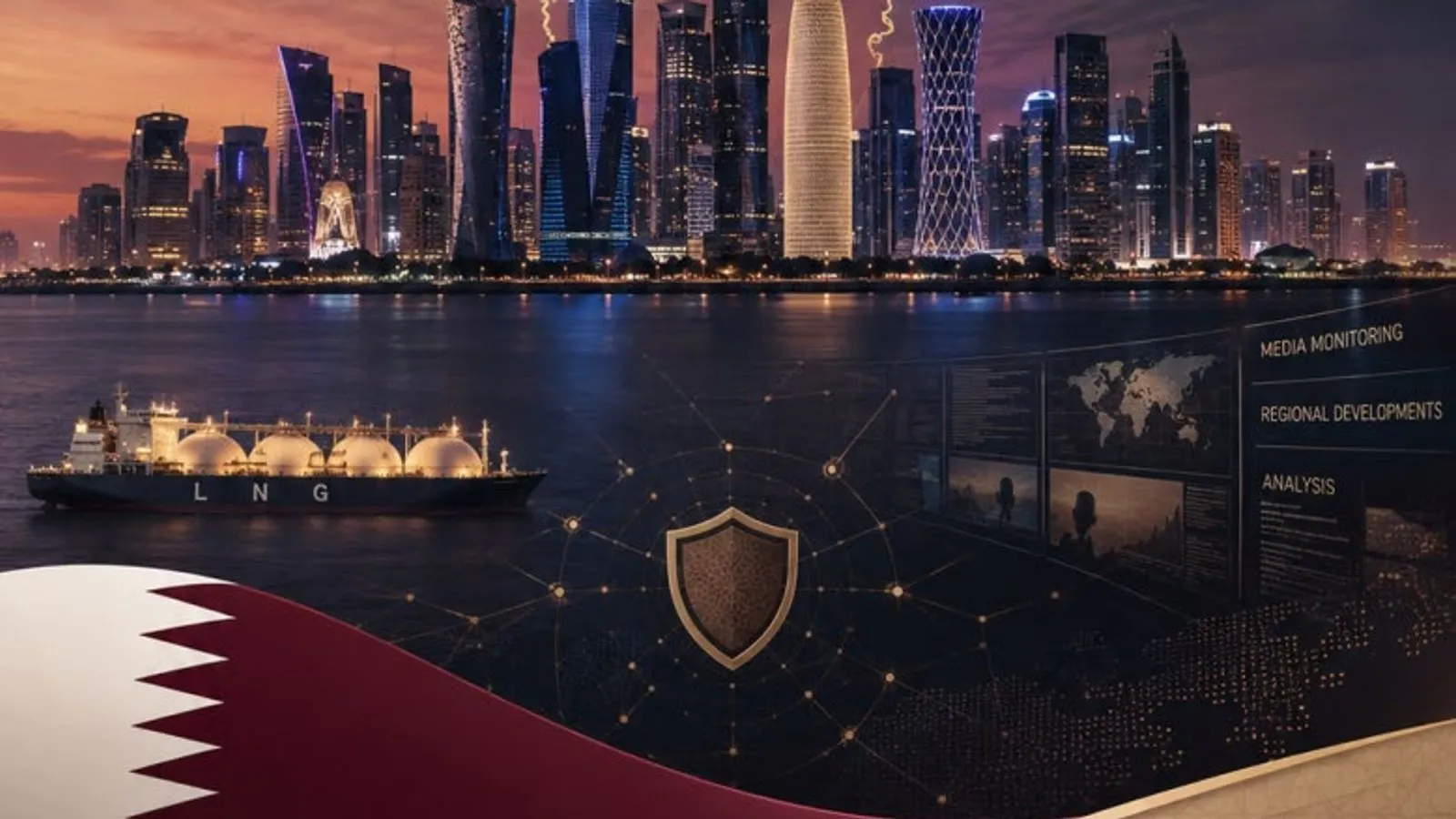
France, Badr, and a Layered Security Net
The clearest result of Macron’s October 20 to 21 visit is a joint position on Iran and maritime security. Qatar and France condemned Iranian attacks on regional countries and called the restoration of free passage through Hormuz, without constraints or fees, a shared priority. Their fourth Strategic Dialogue declaration also condemned Houthi attacks on Saudi civilian and energy facilities and threats to shipping near Bab al-Mandab. The wording stands out because Doha has long kept channels to Tehran and usually prefers the vocabulary of mediation. We covered the security pledges themselves in our October 22 brief.
Paris is also adding to Qatar’s conventional deterrence. A letter of intent designates KNDS France and John Cockerill Defense to modernize Qatar’s land forces, and the communiqués refer to radar and communications-satellite contracts, operational coordination, and further training. Bilateral trade exceeded €1.52 billion in 2025, and Qatari holdings in France span luxury goods, telecommunications, real estate, industry, health care, and financial services. On October 24, the Qatar Fund for Development said it would extend the partnership into humanitarian and development work.
These French commitments sit alongside the “Badr” memorandum that Qatar signed in Doha on October 21 with Turkey, Pakistan, and Indonesia. It covers joint defense production, research, and technology, and it contains no mutual-defense clause. Qatar has also stayed out of the Saudi-Turkish-Pakistani pact concluded in Mecca. The report judges, with high confidence, that Doha is adding partners around its U.S. anchor while avoiding any mutual-defense pledge that would end its channel to Iran.
The home front shows what Qatar fears most. Al Raya’s coverage of the Milipol exhibition, which closed on October 22, highlighted Rheinmetall’s Skyranger counter-drone system, which a local distributor said is already in service in Qatar, and an autonomous underwater vehicle rated to 600 meters. Pakistan’s BSS Aerospace exhibited surveillance drones for the first time and said it wants to enter the Qatari market. The emphasis on counter-drone defense and seabed surveillance matches the threats Qatar has faced since the war began. Qatar was also admitted as the OSCE’s twelfth Partner for Co-operation, which gives it a standing link to a Euro-Atlantic security body.
Iran’s Threat Reaches Gulf Civilian Infrastructure
The U.S.-Qatar channel remains active. In an October 22 call with Prime Minister and Foreign Minister Sheikh Mohammed bin Abdulrahman Al Thani, Secretary of State Marco Rubio reaffirmed the U.S. commitment to Qatar’s security and to navigation through Hormuz and thanked Doha for its mediation. Qatar’s readout stressed regional de-escalation and a comprehensive settlement. In short, Washington spoke of guarantees, and Doha spoke of diplomacy.
The threat picture widened over October 22 to 24. Citing The Wall Street Journal, Al-Araby Al-Jadeed reported that Tehran told mediators it would answer any new U.S. strike by hitting airports, pipelines, and other civilian targets in neighboring Gulf states, in addition to U.S. bases and warships. Qatar’s foreign ministry had already warned on October 20 that sabotage of undersea internet cables, mines, or oil spills would harm every Gulf society, Iran included. Reuters later reported Iranian security officials describing preparations for cable attacks if U.S.-Israeli strikes resume. No cable strike or confirmed disruption has been reported. Our Hormuz-axis daily for October 24 covers these threats from Tehran’s side.
The near-term risk is lower than the rhetoric suggests. White House deputy press secretary Anna Kelly said on October 22 that the United States would not attack Iran before the November 3 midterms. However, for a country that hosts Al Udeid Air Base and shares the North Field with Iran, the Iranian message removes the assumption that mediation provides protection. The report assesses this risk with moderate confidence.
The compromise that Qatar and Pakistan put to both capitals on October 20 remains unanswered. Under it, Iran would accept unannounced IAEA inspections and receive the interest on about $6 billion of its funds frozen in Qatar. Neither government has accepted it publicly. The diplomatic field is also getting crowded. Germany, France, and Britain have offered Tehran negotiations after meetings in Istanbul of the E3 and the “R4” group of Saudi Arabia, Egypt, Turkey, and Pakistan. Qatar is not part of the R4, and the report notes that a durable mechanism that leaves Doha out would erode its convening power over time.
Houthi pressure on Saudi Arabia continues. The coalition said on October 24 that it intercepted two ballistic missiles fired at Taif and Yanbu, and Saudi Aramco evacuated its Dhahran headquarters on October 22. Qatar’s official language has moved closer to GCC positions. The public record shows no Qatari money behind Pakistani or Turkish military support for Saudi Arabia.
The Energy Shock Qualifies Qatar’s Story
India’s supply data are the week’s main Qatar-specific energy indicator. The Economic Times, citing Kpler, reports that India’s LNG imports rose 9 percent year on year from March to September 2026 despite the disruption of Gulf supply. Over the same period, Qatar’s share fell from 45 percent to 3 percent, while the United States, Oman, and Nigeria together rose from 25 percent to about 68 percent. These figures compare seven-month market shares. They do not measure Qatar’s total exports or show that contracts have been permanently lost.
Buyers can replace Qatari cargoes, but at a price. Asian spot LNG trades near $30 per million British thermal units, compared with about $14 for oil-linked contract supply at Brent of $110. The cost falls on price-sensitive manufacturers and on India’s fertilizer subsidies, and it pushes New Delhi to diversify away from single suppliers. Qatar retains advantages in long-term contracting and low-cost liquefaction, but disrupted deliveries erode its reputation for reliability. The report judges with moderate confidence that Qatar is losing Indian market share and hedging with U.S. supply.
That hedge is the Cheniere deal, which we examined in our October 23 brief. QatarEnergy will buy up to 4 million tons a year from Sabine Pass and Corpus Christi from 2031 to 2054, volumes that never pass through Hormuz. Al-Kaabi called the agreements “an important milestone” in the company’s LNG strategy. The purchase also sends a commercial signal to Washington.
Oil prices took on another risk premium. Brent settled at $116.72 on October 23, up about 6 percent on the week and its highest settlement since April 29, and WTI settled at $103.27. Houthi attacks on Saudi energy sites and an oil spill off Umm Al Quwain drove the move. The Qatar Exchange closed its last session at 8,611.10, and the riyal held its peg at 3.64 to the dollar. High prices do not translate directly into Qatari revenue while maritime security is costly and export logistics are constrained.
Two Voices on Washington
Qatar-linked media paint a far harsher picture of the United States than official diplomacy does. In Al Jazeera’s Arabic opinion pages, Jordanian analyst Oraib al-Rantawi called Trump’s endorsement of Benjamin Netanyahu an unusually blatant intervention in Israel’s October 27 election, while noting that earlier presidents had also favored candidates. He expects a unity or rotation government, followed by a new round against Iran. Mazen al-Najjar tied Israel’s operation in Hebron to Netanyahu’s campaign. Al-Araby Al-Jadeed’s front page framed the same operation as a war waged for electoral purposes. The attack that killed two Israeli soldiers and the Israeli response are the reported facts; the electoral motive is the paper’s interpretation.
Al-Araby’s opinion page went further on U.S. politics. Jordanian writer Mahmoud al-Rimawi urged Arab and Muslim Americans to vote for Democrats in the congressional elections and accused Trump of open hostility to Islam. Al Jazeera states that its opinion pieces do not necessarily reflect its editorial line, and the network plans to launch three new channels on November 1 for its 30th anniversary.
The government’s narrative runs the other way. It stays anchored in the U.S. security guarantee, Rubio’s thanks for Qatari mediation, President Trump’s Gaza plan, which the Qatar-France communiqué endorsed alongside UN Security Council Resolution 2803, and now long-term purchases of American gas. The report judges with high confidence that media hostility to Trump runs alongside official courtship of Washington. The two voices serve Doha with different audiences, although the evidence does not show state instruction to individual authors.
CNN in Doha and the Soft-Power Calendar
CNN’s “Global Perspectives: In Doha” takes place on October 29 at the Rosewood Doha. It is the network’s first such event in the Middle East, and it falls two days after Israel votes and five days before the U.S. midterms. Media City Qatar is the host partner, and the prime minister attends as distinguished guest. The speakers include Qatar Investment Authority chief executive Mohammed Saif Al-Sowaidi and Sheikha Al Mayassa bint Hamad, chair of Qatar Museums, alongside Wolf Blitzer, Christiane Amanpour, Richard Quest, and Becky Anderson. CNN says news-making interviews will run across its platforms and that it will return to Doha in 2027.
On October 19, The Washington Free Beacon reported that CNN had quietly removed lines praising Qatar from the agenda after an open-source researcher posted screenshots. CNN did not comment. The report judges with high confidence that the forum is the week’s main soft-power instrument aimed at American elites. It gives Doha a U.S. network’s stage to present its mediation, investment, and culture while Qatar-funded outlets campaign against the U.S. president.
The rest of the calendar serves the same effort. Qatar will host the last three FIFA Intercontinental Cup matches from December 9 to 16, MotoGP on November 6 to 8, and Formula One on November 27 to 29. The FIA says it considers Qatar secure, with Imola on standby, but Reuters has reported rider concern over regional security, and late changes remain possible. The Years of Culture program now has partners through 2030, and Qatar Museums reopens the restored Fahd bin Ali Palace on October 26.
In Washington, the Section 117 case is unchanged. Judge Tanya Chutkan’s restraining order barring the Education Department from publishing donor names expires on October 29 unless extended, and no ruling had appeared after the October 21 hearing. Our Section 117 special report explains the order.
Lebanon, Syria, and Gaza
Lebanon is a growing Qatari portfolio tied to France. The leaders backed the trilateral framework, Lebanese sovereignty, Hezbollah’s disarmament, and full Israeli withdrawal, and they pledged support to the Lebanese army after UNIFIL’s mandate ends. Doha’s own track runs through energy: the plan reported by Reuters envisages two 825-megawatt gas plants and 20 years of QatarEnergy LNG supply. The declarations also commit Qatar and France to joint work with Syrian authorities on stabilization, economic recovery, and support for the Syrian Civil Defense. The report rates this portfolio with moderate confidence, because it is exposed to regional fighting and to the unresolved politics of disarmament.
On Gaza, Doha and Paris reiterated support for the ceasefire framework, unimpeded aid, and Palestinian elections, and they rejected West Bank annexation and settler violence. Neither statement announced a new mechanism for Gaza’s second phase. Qatar also condemned an attack on a church in Jordan’s Karak governorate.
Key Points
- Qatar is building a layered security net of French, Turkish, Pakistani, Indonesian, and OSCE ties around the U.S. anchor, and it is staying out of the Mecca pact to avoid a mutual-defense pledge that would end its Iran channel (high confidence).
- Iran’s threat to Gulf civilian infrastructure puts Qatar at risk despite its mediation, although the White House pledge of no strike before November 3 lowers the near-term risk (moderate confidence).
- Qatar is losing Indian market share and hedging with U.S. supply through the Cheniere agreements (moderate confidence).
- Qatar-linked media hostility to Trump runs alongside official courtship of Washington (high confidence).
- CNN’s Doha forum is the week’s main soft-power instrument aimed at U.S. elites, and the reported agenda edits show CNN’s sensitivity to the Qatar link (high confidence).
- Lebanon and Syria are a growing Qatari portfolio tied to France (moderate confidence).
What to Watch
- Any Iranian reply to Qatar’s cable warning, confirmed damage to communications lines, or new transit-permit or fee demands in Hormuz.
- Iranian or U.S. responses to the Qatar-Pakistan proposal on frozen funds and inspections.
- Saudi and Qatari statements on Houthi attacks, follow-on steps under Badr and the French letters of intent, and GCC defense decisions that narrow Qatar’s room to deal with Tehran.
- Any ruling on the Section 117 injunction before the restraining order expires on October 29.
- Kpler’s October data on India’s LNG imports, the restoration of Qatari LNG exports, and follow-up to the Cheniere agreements.
- Speeches by the prime minister and the QIA chief at CNN’s October 29 forum and their reception in the United States.
- Al Jazeera and Al-Araby Al-Jadeed coverage of Israel’s October 27 election and the November 3 midterms, and security decisions on the November MotoGP and Formula One races.
This post summarizes the Qatar Watch daily political, security, economic, and media review for October 24, 2026, with information as of 13:30 Doha time. The report draws on the Qatar News Agency, the State Department, the Élysée, Al Jazeera Arabic, the October 24 print editions of Al-Araby Al-Jadeed and Al Raya, Reuters, The Economic Times citing Kpler, the CNN Press Room, Arab News, The Washington Free Beacon, Reason, FDD, Qatar Tribune, and RacingNews365. Iran’s message to mediators rests on Al-Araby Al-Jadeed’s account of a Wall Street Journal report, and the Qatar-Pakistan proposal has not been confirmed by either government. Signed opinion pieces are attributed commentary and do not set Qatari state policy.