Twelve Hours in Tehran: Qatar Moves the U.S.-Iran Talks to Doha as Tankers Burn in Hormuz
Qatar is now running the most active channel between Washington and Tehran. Its mediators spent more than 12 hours in Tehran on October 30, their second visit in less than a week, and the talks moved to Doha on October 31. A diplomatic source described positive progress, and Qatar is pressing a phased plan in which Iran would admit UN inspectors to its bombed nuclear sites in exchange for a first tranche of sanctions relief. However, Iran’s leadership publicly restated its seven conditions the same morning, and the IRGC reported a series of tanker fires in the Strait of Hormuz. The report judges that Doha’s value lies in its access to both sides and its ability to keep them talking. A negotiated settlement remains a long way off. Israel’s election dispute, Al Jazeera’s 30th-anniversary overhaul, and QatarEnergy’s overseas LNG purchases complete the picture of a state using every channel it has during a war it cannot afford to see widen.
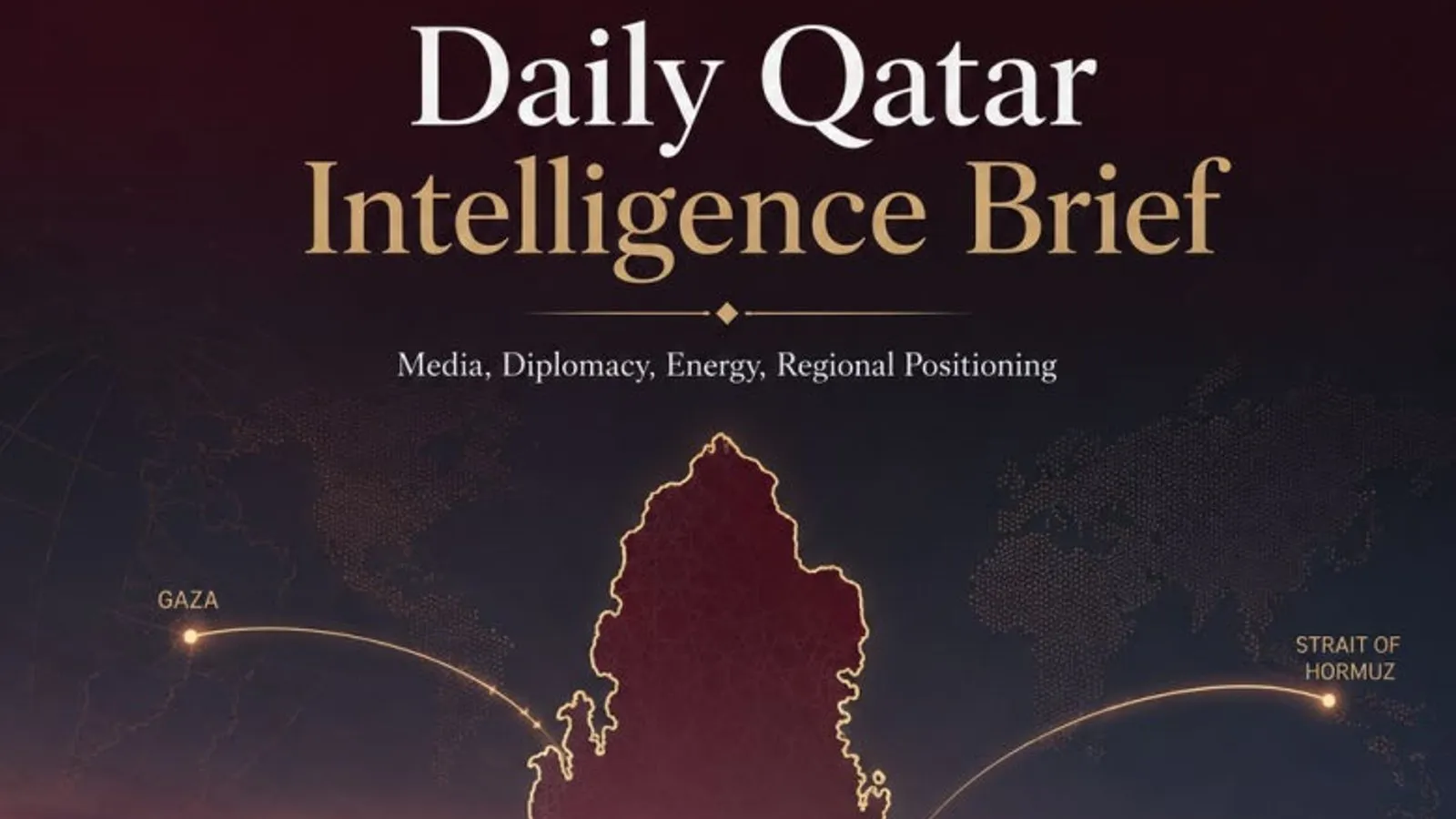
Qatar’s Tehran Shuttle
A delegation led by a senior adviser to Prime Minister and Foreign Minister Sheikh Mohammed bin Abdulrahman Al-Thani arrived in Tehran on October 30. IRNA and ISNA described the agenda only as bilateral relations and regional developments. Reuters and Al-Araby Al-Jadeed supplied the substance. Doha had submitted a draft peace plan on October 25, its consultations were coordinated with Washington, and the visit followed a message from Vice President JD Vance to Mohsen Rezaei, the head of Iran’s Supreme National Security Council. We covered the draft’s delivery in our October 30 brief.
Press accounts citing U.S. officials say Vance framed his message as a possible structure for negotiations that appealed to each side’s national interest. Its more respectful tone reportedly mattered in Tehran, where officials are sensitive to any public demand for capitulation. The report is careful about what this shows. The accounts establish intense contact, but they do not show that Iran has accepted the initiative.
After the Friday session, which lasted more than 12 hours, the talks moved to Doha on Saturday. Accounts based on diplomatic sources say Qatar is trying to sequence reciprocal steps over several days. Tehran would admit UN inspectors to the nuclear sites struck earlier in the war, and Washington would ease an initial set of sanctions. The same reporting describes a divided U.S. team. Vance, envoy Steve Witkoff, and Jared Kushner favor a return to negotiations. Defense Secretary Pete Hegseth and Secretary of State Marco Rubio doubt that Iran’s leadership will accept a meaningful deal, and Treasury Secretary Scott Bessent wants the sanctions campaign known as Operation Economic Outcast kept in place. Egypt, Turkey, Iraq, Pakistan, and Saudi Arabia are all urging Tehran to agree to talks before the U.S. midterm elections on November 3.
Speaking at CNN’s Global Perspectives forum in Doha, U.S. envoy Tom Barrack credited Qatar, Pakistan, and other partners with working to bring the two sides into the same room. He suggested they were close to a possible temporary reduction in hostilities and named trust and the first move as the main obstacles. The report reads his remarks as a sign that Washington treats the Qatari process as part of its current diplomacy. It cautions that they should be weighed against continued U.S. military preparations and reported CENTCOM briefings to President Trump, and should not be taken as confirmation of a deal.
Seven Conditions and the Verification Gap
The central obstacle is the order of concessions. Parliament Speaker Mohammad Bagher Qalibaf said on October 30 that negotiations would move only when Washington accepted Iran’s seven conditions, and he wrote on X that a carrot-and-stick policy has no effect on Iran. Coverage identifies four of the demands with some consistency: a region-wide end to hostilities, the release of frozen assets, relief from oil sanctions, and an end to the U.S. maritime blockade. The report notes that the remaining items appear in varying versions and should not be presented as an authenticated list.
Washington, for its part, wants nuclear guarantees and inspection terms at the front of any process. The unresolved questions include access to sensitive sites and the fate of roughly 440 kilograms of uranium enriched to 60 percent. Tehran has resisted shipping that material abroad and wants the sanctions and blockade lifted first. The report judges that this asymmetry explains why the June framework collapsed. It also suggests that any breakthrough in the coming days may be limited to procedural understandings. A ceasefire with weak terms on shipping inspection, sanctions relief, and nuclear monitoring could postpone the confrontation without resolving it.
Tehran’s public line hardened as the talks moved. Supreme Leader Mojtaba Khamenei warned on his Telegram channel on Saturday morning that if Iran’s enemies attack again, the armed forces and the Iranian nation will decide when and on what terms the fighting ends. A senior Iranian official involved in the talks told Reuters that the Qatari package contained unacceptable ideas and that there is no flexibility on the nuclear file. The report identifies the distance between the mediators’ account of progress and Iran’s declared position as the central uncertainty of the next 72 hours. Our Hormuz-axis daily for October 31 follows the Iranian and U.S. positions in more detail.
Tankers, Mines, and the Contest for the Strait
The maritime picture gives the diplomacy its urgency. On October 30 the IRGC navy announced a series of explosions involving tankers on what it calls the “unauthorized route” through Hormuz. Two vessels were halted in the morning and two more were set on fire by mines. By evening the IRGC reported that a supertanker carrying more than two million barrels of crude had become the fourth tanker to burn that day after ignoring radio warnings. Oman’s navy evacuated 25 crew from a burning Panama-flagged ship off Ras Musandam, and the UAE reported containing an oil spill from the tanker GEM NO. 2. The UKMTO counted just over 30 attacks on shipping in October, the highest monthly total since the war began.
Military signals are running in both directions. Citing Israel’s public broadcaster, Al-Araby reports that ten U.S. transport aircraft landed at Negev air bases on Thursday evening. It adds that the Israeli military worries Washington could open a short combat round next month and close it with a deal that leaves Israel’s goals unmet, while Netanyahu is reported to be urging a joint operation right after the midterms. Trump told a Kansas City radio interviewer that the war would be wrapped up soon and that the United States needs a guarantee that Iran will never have a nuclear weapon. Tehran has warned that new strikes on its energy infrastructure would bring retaliation against oil and gas facilities across the Gulf, including in Qatar. As a result, the report judges, mediation now serves Doha as direct insurance for its own infrastructure as well as a diplomatic asset.
Qatar’s UN representative has also rejected any use of the strait as a bargaining chip and called for unconditional freedom of navigation. Doha therefore wants an agreement whose maritime terms deliver real predictability. A lasting Iranian system of permits and vessel restrictions would prolong the commercial risk to Qatar’s main export route.
Israel’s Election and the Qatari Narrative
Israel’s October 27 election created a second, reputational challenge. Allegations circulated that Qatari money had reached Arab voters through intermediaries, and Israel’s electoral authority asked for a security investigation of suspected foreign interference. On October 29, Foreign Ministry spokesman Majed Al-Ansari categorically rejected the claims. He said Qatar had become a recurring accusation across Israel’s rival political camps and warned against using Doha as a scapegoat.
Qatar-linked media framed the dispute in consistent terms. Al Jazeera Arabic described it as an effort to criminalize the Arab lists after their breakthrough, and Al Jazeera English stressed that the allegations had been made without public evidence. Al-Araby’s October 31 political pages emphasized record Arab mobilization, with turnout at its highest since 1999, and what the paper calls a campaign of incitement by Netanyahu and Itamar Ben Gvir to keep the Arab lists from deciding who governs. A cartoon on page 14 shows Netanyahu wedged behind a narrow electoral opening. The report concludes that the observable effect is narrative amplification. The stronger claim, that Qatari money shaped the result, would require evidence that is not currently available, and the two questions should be tested separately.
Washington, Universities, and Political Access
The next legal date in the campus-funding dispute is November 13. The Association of American Universities reports that Judge Tanya Chutkan extended the restraining order on October 27 for 14 days. The order blocks the Department of Education from publishing the names and addresses of private foreign donors reported under Section 117 while the court weighs further relief. It does not suspend universities’ reporting duties, and it is not a ruling on the legality of Qatari funding. Our Section 117 special report explains the case.
Qatar is the largest country of origin in cumulative U.S. foreign-gift and contract data, at about $8.98 billion across 1,338 disclosures and 67 institutions, according to a Middle East Forum summary. Most of that total reflects contracts tied to U.S. branch campuses in Doha’s Education City. The report cautions against treating it as unrestricted money sent to campuses in the United States or as evidence of political direction. Similarly, a 2026 FARA listing shows Qatar Foundation represented by Venable LLP. This documents lawful lobbying activity, but it does not show donations to candidates or an effort to influence the midterms. The report finds no public record of a current Qatari state payment to a U.S. campaign.
Media Reach: CNN in Doha and Al Jazeera at Thirty
CNN held the first Middle East edition of Global Perspectives at the Rosewood Doha on October 29, with Media City Qatar as its partner. More than 600 people attended. The prime minister opened the event alongside CNN chairman Mark Thompson, and speakers included Sheikha Al Mayassa, QIA chief executive Mohammed Saif Al-Sowaidi, John Kerry, and Barrack. The report judges that CNN gains a regional venue and sponsorship, while Qatar gains regular access to global editorial conversations and elite networks. The partnership alone does not show that Doha directs CNN’s reporting, but it does strengthen Qatar’s convening power and its image as mediator, investor, and cultural hub.
Al Jazeera, which turns 30 on November 1, has announced a major reorganization of its Arabic output. The flagship channel will focus on investigation and analysis, Mubasher on continuous live coverage, and the new Al Jazeera Now on fast-moving news without a fixed bulletin schedule. The plan includes 33 programs, new local and regional digital operations, and an AI workflow program built with Google Cloud. Al-Raya devoted pages 8 and 9 to the anniversary. Meanwhile, Al-Araby’s opinion pages were broadly critical of Trump, even as the Qatari government cooperates closely with Washington. The report treats this gap between editorial tone and state policy as central to understanding Qatar’s two-track influence.
Qatar is also a target of hostile campaigns. An Al Jazeera investigation published October 30 described a multi-country advertising campaign spreading anti-Qatar and Islamophobic material and suggested possible Israeli links, though its attribution rests on metadata analysis and not on an official finding. Separately, Al-Araby, drawing on Le Monde, reports a paid operation under the ShukID label that has pushed anti-Qatar, anti-Muslim, and anti-migrant content to French audiences since 2024. It has drawn roughly 830 million views and an estimated budget above 10 million euros (about $11 million). Its sponsors have not been conclusively identified.
Energy: LNG Hedges, Moscow, and Subsea Cables
Reuters reported on October 29 that QatarEnergy is buying LNG from the United States and other suppliers so it can keep trading if Iran again closes or constrains Hormuz. The cited deals total about 7 million tonnes per year, with 3 million linked to Woodside and up to 4 million with Cheniere, and some deliveries begin in later years. The report stresses that this is a portfolio and trading strategy. It gives Qatar no physical alternative route for its own Ras Laffan exports, where two damaged trains account for about 17 percent of export capacity and could take about three years to repair.
The Amir attended the Gas Exporting Countries Forum summit in Moscow on October 27 and met President Vladimir Putin. Energy Minister Saad al-Kaabi called for protecting gas infrastructure and shipping routes. The report sees shared producer interests and a Russian bridge to Tehran, but it finds no basis for inferring a single Qatar-Russia-Iran negotiating bloc.
The war risk now extends to the seabed. Al-Araby reports that the IRGC has named seven subsea internet cables under the strait as potential targets if strikes on Iran resume. Qatar, Kuwait, Bahrain, and Iraq have no marine cable route that bypasses Hormuz, while the UAE and Oman have landings outside the Gulf. Analysts quoted by the paper warn that banking would be hit first and that war exclusions in insurance contracts would leave Gulf governments to carry the costs. More than $250 billion in announced Gulf AI and data-center projects, including a $20 billion Qatari partnership, depend on this connectivity. Oil markets continue to price the risk. Brent’s expiring December contract settled at $117.64 on October 30, while the more liquid January contract closed at $113.43, and the report advises against treating either alone as the spot price.
The Wider Region
In Lebanon, the military prosecutor charged eight identified Hezbollah members and five other suspects over an explosives shipment seized near Dahr al-Baydar. Hezbollah defended the cargo as part of its resistance effort, while Prime Minister Nawaf Salam’s government insisted on the primacy of state law. The report judges that the case could strengthen Lebanon’s state institutions, or deepen polarization if it is handled as a partisan fight.
In Yemen, Al-Araby covered renewed fighting in Lahj and Saudi air strikes. Saudi air defenses destroyed a drone over the Riyadh region early on October 31, after a day in which Saudi forces intercepted Houthi drones and a missile and two missiles reportedly struck the presidential palace compound in Aden. Turkey, Saudi Arabia, and Pakistan are advancing a collective defense arrangement, though Turkish officials say ratification does not mean automatic deployments to Yemen. The report finds no credible documentary evidence for claims that Qatar is secretly financing such a campaign. On Syria, Barrack stressed the security guarantees that reconstruction investment would require, and no specific Qatari financing commitment was announced. On Gaza, Qatar continues to link ceasefire implementation, reconstruction, and Palestinian political rights, with no new ceasefire breakthrough.
Key Points
- Qatar is the most active intermediary between Washington and Tehran, and the move of the talks to Doha shows both sides still value the channel. A negotiated settlement is not in sight (high confidence on the channel, moderate on the outlook).
- The proposed trade of UN inspections for initial sanctions relief is the most concrete sequencing idea reported so far, but Iran’s restated seven conditions and its refusal of nuclear flexibility make a quick breakthrough unlikely before November 3 (moderate confidence).
- Any near-term agreement is likely to be procedural, and a ceasefire with weak maritime, sanctions, and verification terms would postpone the confrontation without settling it (moderate confidence).
- Tehran’s threat to Gulf energy facilities, including Qatar’s, makes the mediation a direct form of self-protection for Doha (moderate confidence).
- The record on alleged Qatari financing in Israel’s election still shows an open inquiry and political allegations, with no documented payment. The visible Qatari effect is media amplification (high confidence on the state of the record).
- The Section 117 order and the FARA listing document access and lawful lobbying, and they do not establish partisan electoral control in the United States (moderate confidence).
- QatarEnergy’s roughly 7 mtpa of overseas LNG purchases protect its trading position and customers, but they cannot replace lost Ras Laffan output in the short term (high confidence).
What to Watch
- Whether the inspection-for-sanctions-relief sequence survives Tehran’s restated conditions, and whether Iran gives a formal response before the November 3 midterms.
- Signs of a jointly acknowledged sequence on sanctions, maritime access, regional hostilities, and nuclear verification, measured against vessel movements and blockade arrangements, and not against speeches alone.
- Further tanker incidents, mine reports, and UKMTO counts in Hormuz, and any move against the subsea cables.
- Any independent evidence, for or against, in the Israeli foreign-funding inquiry.
- The Section 117 restraining order, which expires on November 13.
- Delivery schedules for QatarEnergy’s foreign LNG supply, the pace of Ras Laffan repairs, the Brent forward curve, and marine insurance terms.
- The launch of Al Jazeera’s new program slate and Al Jazeera Now on November 1.
This post summarizes the Qatar Watch daily strategic and media review for October 31, 2026, with information as of 12:30 UTC. The report draws on Reuters, the Financial Times, Axios-based reporting, CBS News live coverage, AP, Anadolu, Middle East Monitor, IRNA, ISNA, QNA, The Peninsula, Gulf Times, the CNN press room, Al Jazeera Arabic and English, the October 31 print editions of Al-Araby Al-Jadeed and Al-Raya, Le Monde as cited by Al-Araby, the Association of American Universities, the Department of Education, the Middle East Forum, the FARA registry, Human Rights Watch, and posts on X. Accounts of progress in the Doha talks rest on unnamed diplomatic sources, and the full list of Iran’s seven conditions has not been authenticated. Tanker incidents are reported by the IRGC and regional authorities and have not all been independently confirmed. Oil prices are dated settlements and can change quickly. Signed opinion pieces are attributed commentary and do not set Qatari state policy. The report does not assign formal confidence levels, so the levels in the Key Points reflect Iran Dossier’s reading of its evidentiary basis.