Three Files, One Question: Qatar Between Oman's Door and the Mecca Pact
Qatar is no longer positioning itself as a detached mediator. Its media system spent the August 9-10 window defending three assets at once: the Gaza mediation track, freedom of navigation through Hormuz, and Doha’s brand as the region’s indispensable problem-solver. The organizing question of the day is no longer any single file. It is whether Qatar can keep all three in balance as the Mecca pact pulls it toward Ankara at the same moment it still needs Muscat and Tehran to keep Hormuz manageable. A week ago these read as separate stories; today they form a single question about Doha’s alignment. This post summarizes our Qatar Watch report for August 10; the full report, with the complete linked source register and confidence assessments, is available as a PDF.
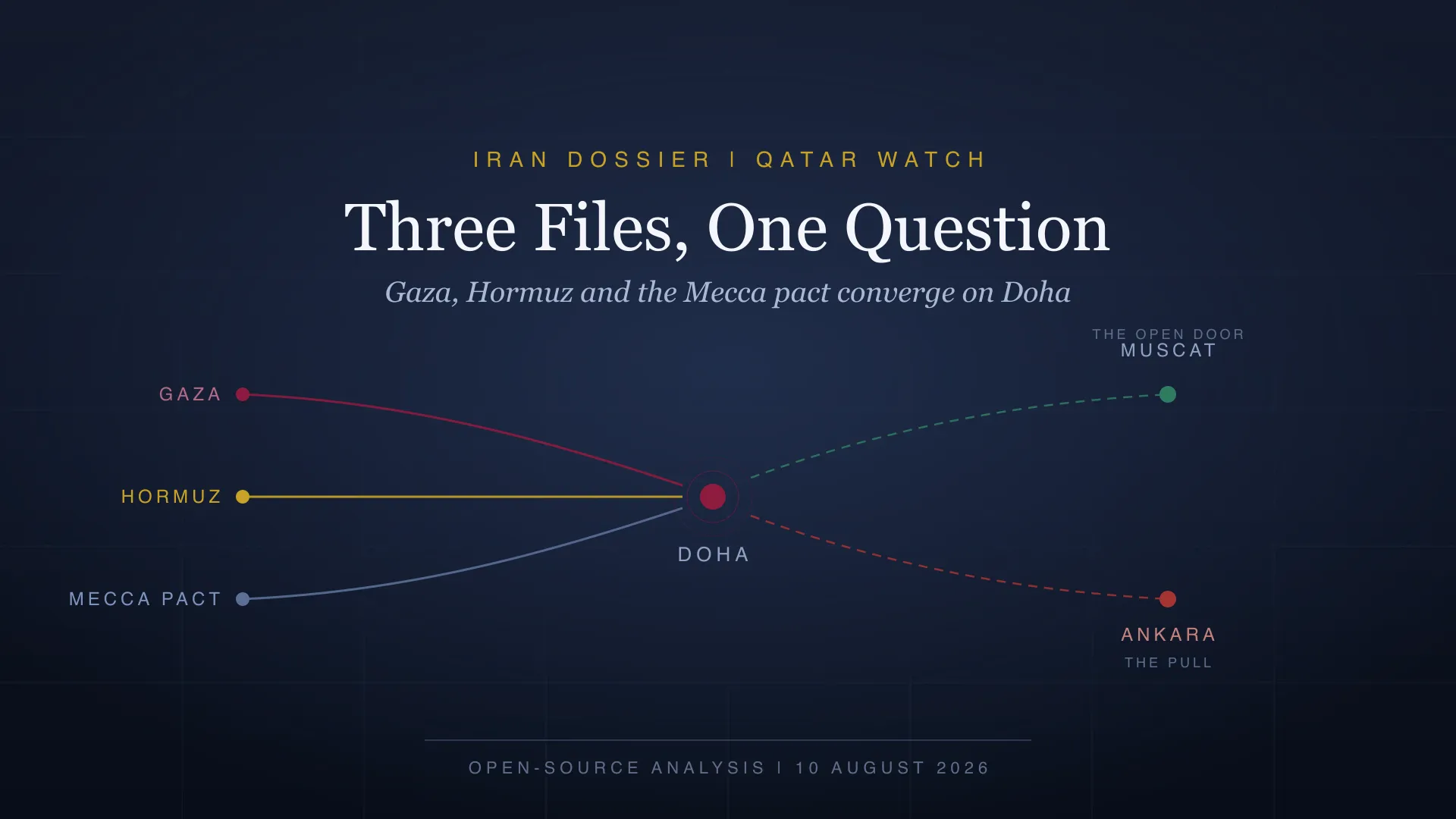
One Question Instead of Three
The cost of Qatari ambiguity is rising. The Mecca pact, the Hormuz disruption and Israel’s reported objection to a Qatari-Turkish verification role in Gaza now converge into one strategic choice: remain the broker on the fence, or drift toward a Türkiye-centred bloc that would harden Doha’s line on Israel and erode its value as a neutral channel. The report’s near-term risk assessment is worth quoting in spirit: the danger is not a dramatic realignment but behavioural convergence with Ankara that quietly narrows the space in which Qatar has built its influence, the space between actors that do not speak to one another.
Oman’s Door
The local press told the story through placement as much as content. QNA put the Amir’s meeting with the Sultan of Oman high on the page, and in context that is more than protocol: Muscat is the channel most associated with the Hormuz track, and Doha is signalling that Oman remains central to its de-escalation toolkit. Meanwhile the ADNOC tanker file stayed hot. QNA’s condemnation of the Iranian strike, amplified on Qatar Tribune’s front page and in Al-Raya, rejected use of the strait as a pressure tool and called freedom of navigation non-negotiable, language that was unusually firm toward Iran yet carefully confined to the maritime violation and solidarity with the UAE.
Al Jazeera’s own commentary set the dilemma’s terms with unusual clarity. A Kuwaiti columnist argued that Iran’s strikes on energy targets are an attempt to make itself indispensable to any future settlement on navigation and energy, and that Gulf mediation is the tool to stop energy becoming a permanent instrument of extortion. A Hormuz explainer supplied the mechanism, citing US Energy Information Administration figures of roughly 20 million barrels a day through the strait in 2024: Iran need not close Hormuz for it to carry strategic value, because merely raising the risk of passage lifts insurance premiums, reroutes shipping and prices in shortage before anything happens. Read together, the two pieces describe coercion that works below the threshold of open war, precisely the band in which a Washington that Doha reads as hesitant is least able to deter.
For Qatar the exposure is acute and specific: its LNG transits the same waters, so a strategy of raising passage risk taxes Doha whether or not a single Qatari cargo is ever touched. That is why the Qatari answer is Oman rather than confrontation. Open alignment against Tehran would forfeit the Iran channel that underwrites Qatar’s mediation brand and invite exactly the pressure on shipping Doha most fears. The report’s assessment: Oman keeps the door to Tehran open, the Mecca pact risks closing it, and managing that contradiction is now the central task of Qatari Gulf policy.
The Fence Test, Continued
A brief QNA item, Al Misnad’s meeting with the Turkish ambassador, landed inside a much larger moment: Al Jazeera English has named Qatar as a Gulf state to watch for possible entry into the Mecca pact, and two Al Jazeera Arabic blogs gave the debate its intellectual shape. One frames the pact as a working synthesis of collective security and balance of power, its attack-on-one clause read against NATO’s Article 5, fusing Pakistani nuclear weight, Saudi financial and religious legitimacy, and Turkish defence industry and alliance experience. The other adds the moral register, opening on the pre-Islamic Hilf al-Fudul, placing Iran inside a triangle bounded by Türkiye, Pakistan and Saudi Arabia, warning against letting the pact harden into a Sunni sectarian axis, and ending on the open question of the fourth member. Both make the move that matters for Doha: they treat the pact as the moment the confrontation with Israel shifts from armed factions to states, and both note that Israel has already begun working to weaken it. The coverage is also notable for how consistently it routes the argument through Islamic legitimacy, a signal of the audience being addressed.
One caution flag from the same cluster: an Al Jazeera Arabic blog asserted that Saudi Arabia announced qualitative strikes with the US military against militias in Iraq. That claim appears only inside an opinion blog and is not independently confirmed; if it were borne out, it would mark Arab states stepping directly into a role Washington once held alone, and would sharpen Doha’s dilemma rather than ease it.
Gaza Through the Pact
The Gaza frame in Qatari media was familiar: Israel violates, Palestinians absorb the harm, and the roadmap is blocked by Israeli sequencing demands, with QNA reporting wounded Palestinians in Khan Younis, a West Bank item broadening the file beyond the Strip, and Al-Raya’s Arabic headlines running hotter than the English outlets. Al Jazeera Arabic supplied the political layer, and its Gaza-plan analysis contained the window’s most Qatar-specific point: Netanyahu’s rejection of the roadmap reorders implementation so the Palestinian side moves first while Israel decides on withdrawal later, and Israel refuses any role for Qatar and Türkiye in verification. The sourcing caveat matters, since the detail of Israeli objections reaches us through Al Jazeera’s own reporting, but the reframing is real: Qatar moves from host of the talks to contested actor inside the implementation architecture.
The report identifies three channels linking Gaza to the pact: the factions-to-states shift in deterrence framing; the verification bridge, where the reported Israeli refusal becomes the hinge on which the Gaza file and the pact together turn (if Qatar aligns behind the pact, Israel gains a ready argument to exclude it; if Israel excludes it, Qatar is pushed further toward the pact); and narrative convergence, with Al Jazeera knitting the files into one story of a post-American order in which Sunni states, not factions, underwrite the Palestinian position. Gaza will not be transformed by the pact in the near term, but the pact changes the frame around Gaza in Doha’s favour and raises the stakes of the verification fight. The earliest indicator: whether Qatari and Al Jazeera Gaza language begins echoing the pact’s state-to-state framing.
Silence as Signal
The Muslim Brotherhood file, opened publicly on August 5, has been upgraded, because the Qatar dimension is now explicit. The Senate Judiciary subcommittee hearing, chaired by Ted Cruz, was boycotted by all five Democratic members, who called it a political creepshow aimed at the American Muslim community; Cruz was the only senator present. The witnesses, including a retired FBI agent from the Holy Land Foundation case, urged reopened investigations, closing the loophole that lets designated groups relaunch under new names, and tougher enforcement of material-support statutes. Part of the presentation cast Doha as both arsonist and firefighter, funding influence while presenting itself as a partner. And the hearing sits downstream of a wider Washington campaign: an executive order designating Brotherhood chapters in Egypt, Jordan and Lebanon, a July Treasury action against a senior Egyptian Brotherhood figure over Hamas financing, and pending bills to designate the Brotherhood and review the status of the Council on American-Islamic Relations.
Inside the window, neither QNA nor Al Jazeera published a direct rebuttal. That silence is itself the finding. Doha is choosing not to elevate a story that would spotlight the Qatar-Brotherhood linkage at the very moment it is protecting the Gaza mediation and Hormuz files and courting a verification role Israel is trying to deny it. The restraint is tactical, consistent with a Qatari preference for absorbing this pressure quietly rather than contesting it in public. The file moves from watch to active; the indicator to track is whether Al Jazeera shifts from silence to organised rebuttal.
No New Money for Gaza
One negative finding rounds out the picture. Qatar Charity was active in the window, but not on Gaza: a memorandum with Mauritania’s health ministry and a cochlear-implant project in Khartoum. The Qatari welfare network is durable access infrastructure, building reputational capital across fragile arenas, which is what makes the absence notable: no new Gaza-specific QFFD or Qatar Charity package appeared, even though Gaza is usually the most visible stage for Qatari welfare diplomacy. The day’s Gaza signal ran through media and mediation politics rather than through fresh money.
Key Points
- Structural pressure on Qatari ambiguity is rising (high confidence): the Mecca pact, the Hormuz disruption and the reported Israeli objection to a Qatar-Türkiye verification role now converge into one strategic choice between the fence and a Türkiye-centred bloc.
- The Hormuz dilemma is sharpening (high confidence): Qatari platforms treat Iranian pressure on Gulf shipping as a red line while framing the American posture as hesitant, and Doha’s answer is to hedge through Oman rather than align openly against Tehran, which would forfeit its Iran channel and expose its own gas exports.
- Gaza is now coupled to the Mecca pact (moderate confidence): commentary frames the pact as lifting the Israel confrontation from factions to states, and if Qatar and Türkiye converge behind a single line on verification and governance, Gaza stops being a mediation Doha manages and becomes a position Doha holds.
- The US congressional track is live and names Qatar directly (high confidence): Doha and Al Jazeera chose not to answer inside the window, a deliberate signal rather than an absence of exposure, and for now a slow-burn reputational risk rather than a near-term policy threat.
- No Gaza aid surge appeared (high confidence): Qatari welfare activity pointed outward to Mauritania and Sudan, so the Gaza signal ran through media and mediation politics rather than fresh money.
What to Watch
- Any Qatari official statement on joining, or not joining, the Mecca pact: the shift from media debate to state positioning. Continued silence preserves flexibility.
- Qatar-Türkiye contact at defence or intelligence level, beyond diplomatic protocol.
- Doha’s reaction to Israel’s reported refusal of a Qatar-Türkiye verification role: tactical dispute, or attempt to exclude it from the post-war mechanism.
- Al Jazeera Gaza language echoing the pact’s state-to-state frame, the earliest sign the Gaza file is moving inside the pact’s orbit.
- Al Jazeera moving from silence to organised rebuttal of the Senate hearing.
- QNA terminology on Iran after the ADNOC episode: sustained hard wording versus a return to mediation language.
- Independent confirmation, or not, of the blog-level claim of Saudi and US strikes on militias in Iraq.
This post summarizes the Iran Dossier Qatar Watch report for August 10, 2026, covering the August 9-10 reporting window with local Qatari sources prioritized and international wires used only for external verification. The full report, including the press review, the Al Jazeera barometer, the indicators table and analytic confidence levels, is available here: Qatar Watch, 10 August 2026 (PDF).