The Shrinking Fence: The Mecca Defence Pact Redraws Qatar's Map
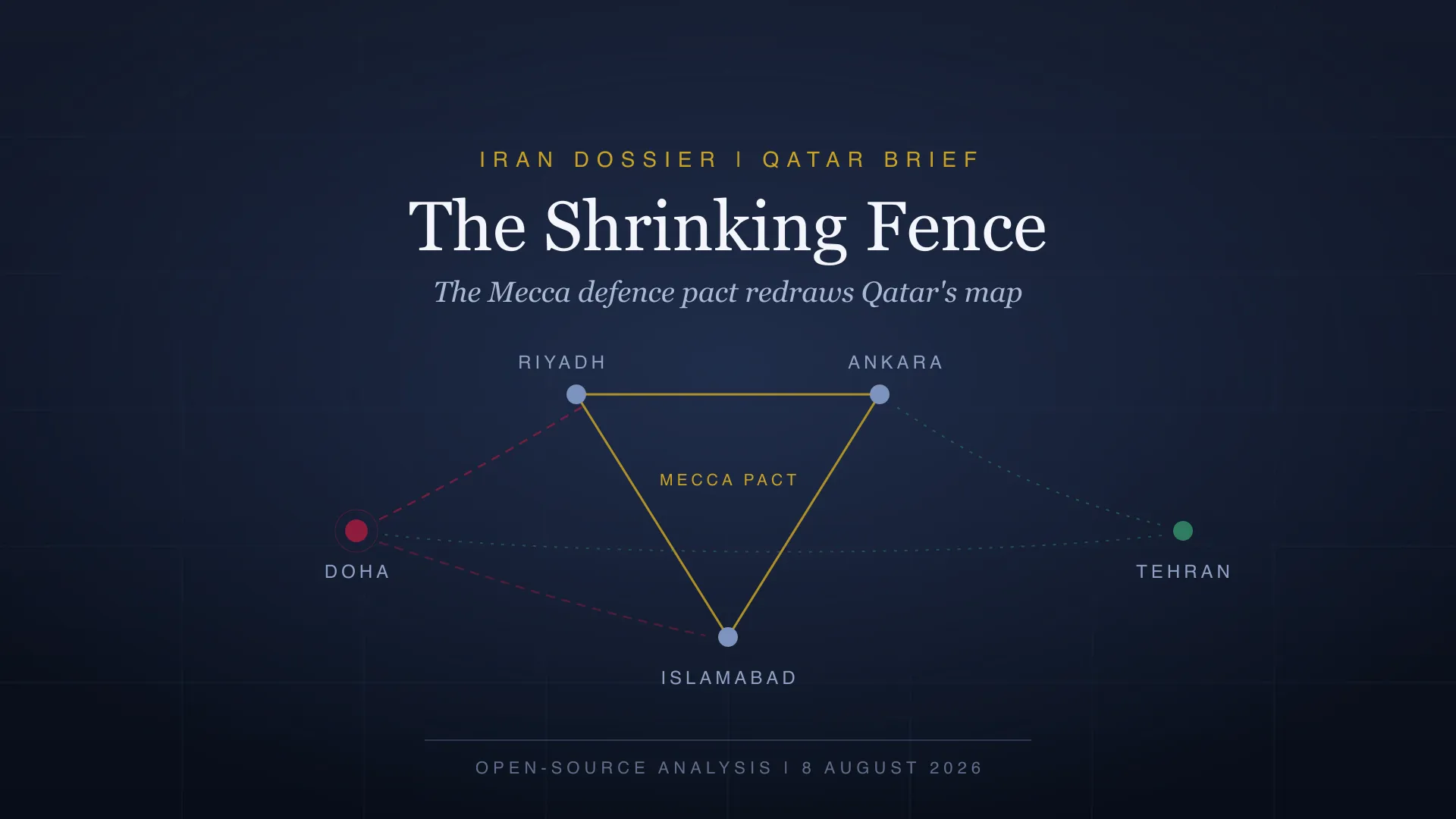
The largest regional development in the August 7-8 window did not happen in Doha, and that is precisely why it matters to Doha. In Mecca, Saudi Arabia, Türkiye and Pakistan formalized a joint defence pact under which an attack on one is to be treated as an attack on all. Qatar is not a signatory. But Al Jazeera Arabic cited a Turkish analyst naming Qatar among Ankara’s core regional partners, Al Jazeera English explicitly raised future expansion to Qatar, and QNA chose the same moment to condemn the Houthi attack on Najran as a violation of Saudi sovereignty. None of that is accession. All of it is drift, and it poses the sharpest version yet of the question that has defined Qatari strategy for a decade: how long can Doha balance between competing camps without being forced to choose?
A Pact Signed in Mecca
Reuters describes the Mecca Joint Defence Pact as a mutual-defence arrangement between Saudi Arabia, Türkiye and Pakistan under which an attack on one is treated as an attack on all. The signatories say the pact is defensive and not directed at a specific state. In practice, it emerges from a security environment shaped by Iranian attacks and coercion, Israeli military activism, and declining confidence that the United States alone will underwrite regional security. It combines Saudi financial power, the Turkish defence industry and Pakistani military and nuclear capability, and it dominated Al Jazeera’s output in both languages.
The two services framed it differently, and the difference is instructive. Al Jazeera Arabic presented the pact as a turning point in deterrence architecture, stressing military complementarity and a wider Turkish network that explicitly includes Qatar. Al Jazeera English stressed uncertainty, US unreliability, and something more unusual: its analysis carried expert claims that Israel, with Iran close behind, is the largest regional threat to all three signatories, and raised possible expansion to Egypt, Qatar, Syria and the UAE. The English service, in other words, normalized discussion of a security bloc that could be wary of both Tehran and Jerusalem, rather than positioning the pact as simply anti-Iranian.
Where That Leaves Doha
The distinction to preserve: Qatar has not joined, announced accession to, or negotiated membership in the pact, and no evidence in the window suggests otherwise. Both Al Jazeera services’ references to Qatar are analytical propositions, not reporting on talks.
Doha’s own new action was narrower and, read carefully, revealing. QNA announced that Qatar condemned the Houthi attacks on Najran, calling them a serious violation of Saudi sovereignty and international law and a dangerous escalation. Set against the pact’s signing in the same window, the statement places Qatar firmly on the Saudi side of the sovereignty question, rhetorically, at exactly the moment Riyadh is formalizing deeper defence ties with Ankara and Islamabad, while committing Doha to nothing.
The strategic problem is structural. For most of the past decade Qatar has preserved room for maneuver by being simultaneously inside several overlapping networks: close security ties with the United States, a deep strategic relationship with Türkiye, workable channels with Iran, and a distinct mediator role on Gaza. A polarizing regional order narrows that space. The Turkish dimension is the strongest pull: Doha’s relationship with Ankara rests on years of political coordination, defence cooperation, economic ties and broadly compatible regional instincts, and if Türkiye becomes the central military and political pillar of a new Sunni alignment, Qatar will feel increasing gravitational pressure in Ankara’s direction. That does not mean abandoning the Iran channel; it means the same degree of equidistance becomes progressively harder to maintain.
There is a sectarian consequence too. Whatever the signatories say about the pact’s defensive character, the consolidation of a stronger Sunni security bloc led by Türkiye, Saudi Arabia and Pakistan will inevitably be viewed in Tehran through a strategic and, to some extent, sectarian lens, despite the conciliatory language the Iranian president has used in recent days. Even a pact that never names Iran deepens Iranian suspicions and reinforces bloc politics across the Gulf. And there is an Israel consequence: a Qatar drawn more firmly into a Turkey-centered framework would likely reinforce Doha’s already critical posture on Gaza, Jerusalem and the Palestinian file, and align Qatari diplomacy with Ankara’s effort to make that file a central condition for normalization and broader security arrangements. Qatar’s value as a mediator would persist, but its ability to present itself as a relatively neutral intermediary between Israel and its adversaries could gradually erode.
The key indicator is therefore not formal accession. It is behavior: closer defence coordination with Türkiye, greater convergence with Ankara and Riyadh on Iran, more explicit identification with Sunni regional security concerns, and a harder collective line toward Israel. If those trends deepen, Doha may discover that the regional environment no longer allows it to remain comfortably on the fence.
The Press Follows the Statement
The eight-state statement of August 6 continued to shape the Qatari press cycle, and the strongest new signal is editorial, not governmental. Al-Sharq converted the statement into its own editorial line, under the paper’s institutional voice, arguing that continued Israeli action breaches international law and the Trump plan, threatens phase two, extends to settlements and Jerusalem, and should draw international legal and moral accountability. The migration of a joint diplomatic statement into the Arabic editorial line, from reporting a position to demanding enforcement, is an escalation in its own right.
The rest of the landscape was more heterogeneous. Al-Watan kept the eight-state condemnation prominent as collective pressure. Qatar Tribune led a Gaza item with UNICEF’s claim that a child has been killed every day since the ceasefire and described the war as “genocidal,” humanitarian rather than diplomatic content, but with markedly accusatory vocabulary for the English-language Qatari environment. Doha News mixed official messaging, its most-read Najran condemnation, with adversarial Israel-Qatar content: a video headline saying Naftali Bennett blames Qatar for the ICC case as his party slips in the polls, an amplification item whose underlying allegation the accessible page does not substantiate. Gulf Times stayed news-led, stressing the gap between claims of progress on disarmament and conditions on the ground.
The Verification Trap Comes for Qatar
Buried in Al Jazeera Arabic’s Gaza coverage was the window’s most Qatar-specific analytical point. Summarizing a Foreign Policy analysis of why Israel rejected the framework Hamas accepted, the piece reports that the possible role of Qatar and Türkiye in monitoring Hamas disarmament is itself a source of Israeli resistance, because broad sectors in Israel view both as unacceptable security partners. That framing places Doha not merely as mediator but as a prospective verification actor whose legitimacy is contested by one of the parties. If that concept moves from media analysis into actual negotiations, it would elevate Qatar from facilitator to part of the security-verification architecture, a far more contentious role, and one Israel has every incentive to resist.
The underlying verification gap is unchanged: the Qatari and regional narrative emphasizes political acceptance of the roadmap, Israel’s narrative emphasizes verified implementation, and Reuters’ reporting of continuing Hamas rearmament and tunnel construction remains the hard counter-position. The two are not equivalent, and the current media cycle often blurs the distinction.
Hormuz, Reread
On Iran, the notable shift was tonal and came from the English service. An Al Jazeera English opinion piece argued that Iran’s grip on trade is a potent weapon with an expiry date: Tehran can exploit dependence on Hormuz in the short term, but prolonged disruption erodes the value of that leverage by encouraging diversification, alternative routes and counter-coalitions. For Qatar, whose LNG model depends heavily on Hormuz, that argument cuts usefully in Doha’s direction: it reinforces the case for de-escalation while resisting normalization of unilateral Iranian control, without Doha having to say so itself. Iran’s earlier warning that Gulf infrastructure could be targeted if regional governments fail to pressure Washington still shapes Qatar’s risk calculus, and remains the hard constraint on how far Doha can lean toward any Sunni bloc.
Key Points
- The Mecca Joint Defence Pact is the largest new regional development of the window. Qatar is not a signatory, but both Al Jazeera services placed Doha inside the pact’s conceptual orbit, and QNA’s Najran condemnation aligned Qatar rhetorically with Saudi sovereignty at the moment of signing.
- The pact narrows Qatar’s traditional operating space. As the region polarizes into a Sunni security bloc facing Iran, with Israel treated by the bloc’s analysts as a parallel threat, the formula of being simultaneously inside American, Turkish and Iranian networks becomes harder to sustain.
- The Turkish relationship is the decisive vector: if Ankara becomes the military and political pillar of the new alignment, gravitational pressure on Doha grows, with consequences for its Iran equidistance and its posture toward Israel.
- The pact will sharpen the Sunni-Shia divide regardless of its stated defensive intent; Tehran will read it strategically and sectarianly, deepening bloc politics across the Gulf.
- The strongest new Qatari media signal is Al-Sharq’s conversion of the eight-state statement into an editorial demand for accountability: the Gaza position is migrating from diplomacy into the press’s own voice.
- The reported Israeli objection to Qatar and Türkiye as disarmament monitors is the file to watch: it would transform Doha from facilitator into contested verification actor, and Israel’s rejection of that role is already being used to explain the impasse.
- Watch behavior, not membership: closer Qatari defence coordination with Türkiye, convergence with Riyadh on Iran, harder collective language toward Israel, or a formal Qatari comment on the pact would each signal the fence is giving way.
What to Watch
- Any formal Qatari comment on the Mecca Joint Defence Pact, especially language about collective security, interoperability or future membership.
- Whether Qatar and Türkiye are formally proposed as monitors or guarantors of Hamas weapons confinement in Gaza.
- Whether QNA or the Foreign Ministry hardens language on Iran and Hormuz beyond de-escalation and freedom-of-navigation themes.
- Whether Arabic Qatari editorials continue shifting from reporting the Gaza joint statement to demanding enforcement or accountability measures against Israel.
- Whether Al Jazeera English sustains the new “regional order” framing in which both Israel and Iran are treated as security threats and US reliability is questioned.
This analysis is based on an open-source review of the August 7-8 reporting window: Reuters reporting on the Saudi-Türkiye-Pakistan joint defence pact and on Iran’s warning to Gulf states, QNA’s condemnation of the Houthi attacks on Najran, the Al-Sharq editorial and the Al-Watan, Qatar Tribune, Doha News and Gulf Times pages, and the Mecca pact, Gaza disarmament and Hormuz coverage of Al Jazeera Arabic and English.