Hidden in Plain Sight: Qatar's Brotherhood Question Reaches the Senate
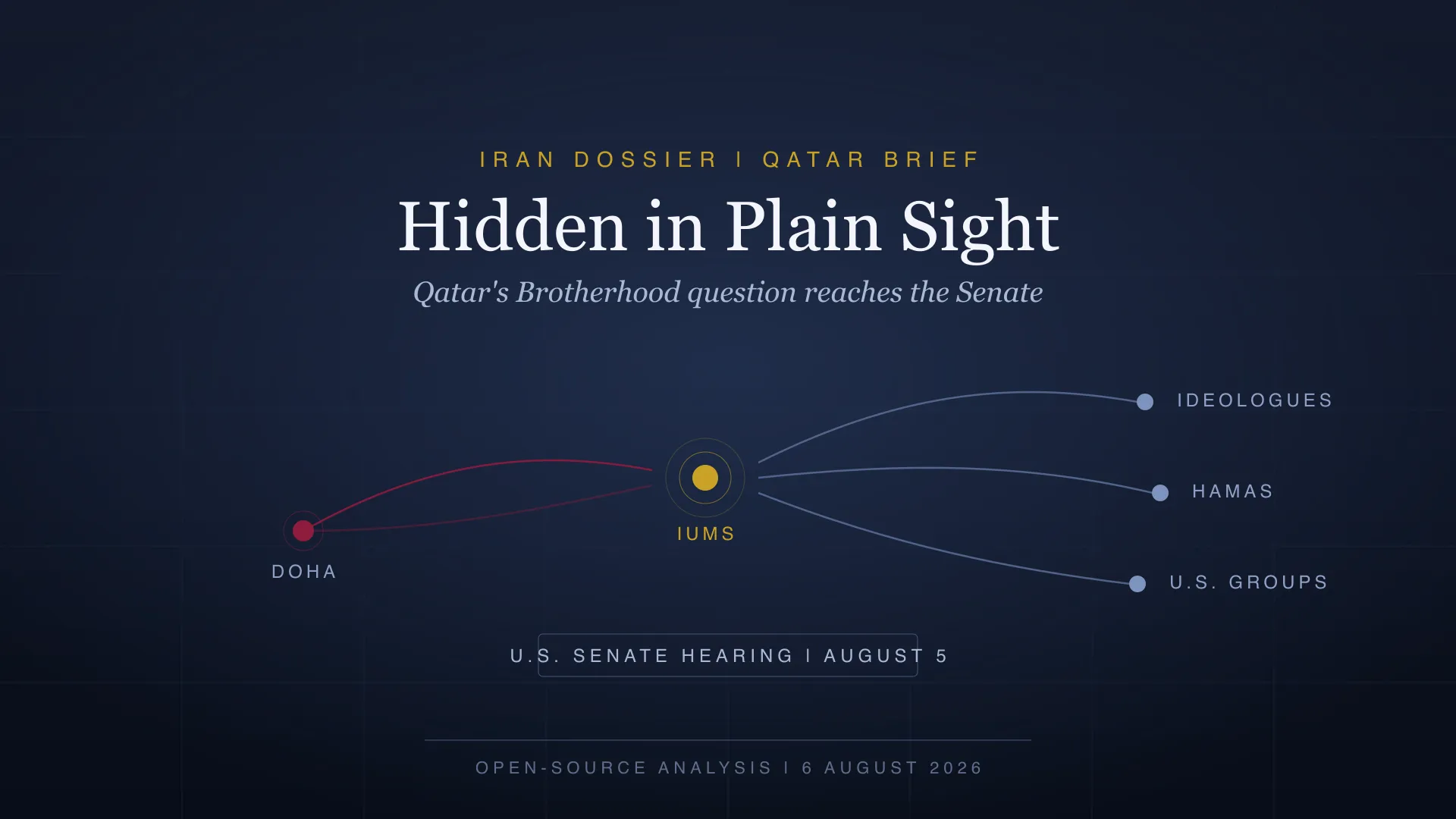
On August 5, a Senate Judiciary subcommittee held a hearing titled “Hidden in Plain Sight,” on the Muslim Brotherhood’s network in America. It produced no formal finding against Qatar, and that caveat matters. But two of the three witnesses placed a Doha-based institution, the International Union of Muslim Scholars, at the center of a documented chain linking Brotherhood ideologues, Hamas leaders and American Muslim organizations. For a state whose regional strategy rests on the claim that hosting Islamists is a mediation asset, that is a new kind of exposure: not in Gaza, not in the Gulf, but in Washington. It lands in the same week Doha is pressing Israel over the Gaza roadmap and watching Iran and Oman shape a Hormuz deal, and it is the most consequential development in today’s file.
The Hearing
The Senate Judiciary Subcommittee on Federal Courts, Oversight, Agency Action, and Federal Rights convened the hearing, “Hidden in Plain Sight: Confronting the Muslim Brotherhood Network in America,” with three witnesses: retired FBI special agent Lara Burns, litigation counsel Arielle F. Klepach, and counterterrorism analyst Kyle Shideler.
Burns’s testimony treated the Qatar-based International Union of Muslim Scholars (IUMS) as a bridge. She testified that CAIR’s executive director was identified in Arabic-language sources at meetings with the IUMS between 2012 and at least 2022, that he was received by the IUMS secretary-general, Ali al-Qaradaghi, and that the IUMS issued religious rulings after October 7 and hosted Ismail Haniyeh’s participation in a 2024 conference in Qatar titled “The Al-Aqsa Flood and the Role of the Islamic Nation.”
Klepach described a “symbiotic relationship” between CAIR and the IUMS: the Union republishes CAIR press releases, Islamophobia reports and statements by CAIR officials, giving them global amplification through its scholarly network. Her testimony also pointed to al-Qaradaghi’s Qatari citizenship, his role at Qatar University, and Qatar’s public support for Hamas, and recalled CAIR’s executive director appearing alongside Yusuf al-Qaradawi in Qatar.
The composite picture the witnesses drew is not one of wire transfers. It is one of infrastructure: a Doha-based clearing house that connects Brotherhood-aligned scholars, Hamas figures and US organizations, and amplifies their messaging through a body with religious authority.
What the Record Establishes, and What It Does Not
Precision matters here more than anywhere else in today’s file, because the hearing will be cited loosely by everyone with an agenda.
What the hearing record documents is meetings, conferences, institutional affiliations and content amplification, presented in written witness testimony. What it does not establish: the Senate issued no formal report or finding against Qatar by this morning’s cutoff; the testimony links activity to institutions operating in Qatar but does not itself prove that each act was ordered by the Qatari government; and broader assertions that Qatar is the principal funder of the American Brotherhood network remain witness or expert assessments unless supported by financial records, regulatory findings, Treasury action or a formal congressional report.
There is an organized counter-frame. CAIR and the Muslim Public Affairs Council had demanded the hearing’s cancellation in advance, characterizing its premise as anti-Muslim conspiracy rhetoric that stigmatizes ordinary Muslim civic participation. And there is a notable silence: no Qatari government, QNA or Al Jazeera response to the completed hearing was visible by the cutoff. Silence lets Doha avoid elevating the hearing, at the cost of leaving the critics’ framing uncontested through the first US news cycle.
The strategic significance is the reframing. US policymakers now have a template for evaluating Qatar that does not depend on tracing a check: the question shifts from whether Doha directly finances a specific organization to whether it supplies the institutional sanctuary, legitimacy, amplification and connectivity that allow a Brotherhood-aligned ecosystem to operate across borders. That framework, unlike a funding allegation, is fed by exactly the activity Qatar considers its diplomatic asset: hosting.
Gaza: Fresh Condemnation, Same Trap
While the Senate examined Doha’s guests, Doha examined Israel. On August 5 Qatar’s Foreign Ministry issued a strong condemnation of what it called the new Israeli aggression against Gaza, citing deaths and injuries and demanding urgent international action to stop attacks on civilians, especially women and children. The pattern is the one we described in The Mediator’s Shield: humanitarian and legal language that places responsibility on Israel while keeping Qatar inside the Trump-sponsored framework. No new Qatari military or economic measure against Israel appeared in the reviewed record; the campaign remains diplomatic and narrative.
The implementation bargain itself remains stuck exactly where yesterday’s analysis left it. The US-backed plan links a halt to Israeli strikes and initial withdrawal to Hamas beginning the weapons process; the Associated Press reported that Netanyahu says Israel did not agree to the draft and will not withdraw until Hamas has completely disarmed; the Wall Street Journal described the plan as already endangered by continuing strikes and widening disagreement over sequencing. The mediator framing has Hamas able to begin a Palestinian-controlled storage or decommissioning process after Israeli compliance; the Israeli framing demands complete, verifiable disarmament before further withdrawal, with freedom of action reserved against imminent threats. On the reported halt to assassinations, the evidence still supports a negotiated demand and a possible operational pause, not a verified, durable Israeli directive abandoning targeted killings.
Al-Hayya, Between Two Patrons
The Hamas leadership picture also holds steady, and the Senate hearing gives it a sharper edge. Khalil al-Hayya remains the central negotiating interlocutor, based in Doha, described as maintaining strong relations with Iran, Hamas’s principal military and financial patron. Qatar’s leverage depends on hosting Hamas leaders and demonstrating it can deliver behavioral change; Iran’s rests on weapons, financing, ideological affinity and integration into the Axis of Resistance. If al-Hayya accepts Qatari protection and diplomatic access while letting Tehran shape Hamas’s strategic choices, Doha retains proximity while losing influence over outcomes, which would weaken its value to Washington and the credibility of its mediator shield.
The evidence continues to support a potential Qatar-Iran competition for influence, not an established Qatar-Hamas rupture: no reliable public evidence shows Qatar opposed al-Hayya’s election. And Al Jazeera Arabic’s terminology continues to do quiet work in the background, routinely using Hamas’s full name, the Islamic Resistance Movement, and placing the group within the category of “the resistance,” a vocabulary that legitimizes it as a national resistance actor. After August 5, that vocabulary is no longer just a regional media story; it is the kind of amplification the Senate witnesses were describing.
Hormuz: A Deal Taking Shape Without Doha
On Iran, the decisive drafting is happening elsewhere. Iran and Oman were reported close to a temporary Hormuz arrangement in which inbound traffic would use an Iranian-controlled route and outbound traffic an Omani-controlled one, with disagreement over US acceptance and over service fees. Reuters cautioned that the unresolved fee and control issues make an imminent durable settlement uncertain.
Qatar remained an active political facilitator, discussing the bridging of Washington-Tehran differences with President Trump, and Qatari markets rose on mediation optimism. But Doha’s interest is specific: a verifiable reopening that protects LNG exports and predictable maritime access. An arrangement that normalizes unilateral Iranian authority, discretionary fees or repeated closure threats is one Qatar is unlikely to accept, whatever its public support for dialogue. Qatar’s roles here remain what they were: substantive mediator, but not the sole channel; cautious balancer; and above all a directly exposed stakeholder.
Key Points
- The August 5 Senate hearing is the most consequential new development of the window. It issued no formal finding against Qatar, but it gave US policymakers a durable framework in which Doha’s hosting of Islamist institutions is read as infrastructure for a transnational Brotherhood ecosystem rather than as a mediation asset.
- The evidentiary boundary is critical: the hearing record documents meetings, affiliations and amplification through witness testimony. Claims that the Senate established Qatari state funding or direction of the US Brotherhood network are not supported by the record at this point.
- Qatar’s non-response by the cutoff is a choice, not an oversight: staying silent avoids elevating the hearing, but leaves the “influence node” framing of the IUMS uncontested in the first news cycle. Watch whether QNA or Al Jazeera engages.
- The Gaza bargain remains unstable for the same structural reason as before: Israel conditions withdrawal on complete disarmament, the plan conditions Hamas’s weapons process on Israeli compliance, and no joint verification mechanism exists. The reported halt to assassinations is still a conditional requirement and possible pause, not a verified Israeli policy.
- Al-Hayya’s position continues to set up a Qatar-Iran competition over who converts access into strategic influence, and his continued residence and negotiating role in Doha remain Qatar’s principal counter-leverage against Tehran.
- On Hormuz, the operative draft is being shaped by Iran and Oman, not Qatar. Doha supports the channel but needs a verifiable reopening that protects LNG exports; it cannot afford an arrangement that legitimizes unilateral Iranian control or fees.
What to Watch
- Any formal Senate follow-up requesting Treasury, DOJ, FBI or Department of Education investigations into Qatar-linked financing, the IUMS, CAIR or university funding.
- A Qatari, QNA or Al Jazeera response challenging the hearing, its witnesses or the description of the IUMS as a Brotherhood influence node.
- A verified Israeli directive limiting targeted killings, especially against negotiating personnel in Gaza or abroad.
- Evidence that al-Hayya is adopting Iranian positions on weapons and regional alignment despite Qatari mediation pressure.
- Concrete Hormuz indicators: sustained ship transits, falling war-risk premiums, mine clearance, absence of Iranian fees and regular Qatari LNG cargo movement.
This analysis is based on an open-source review of the August 5-6 reporting window: the Senate Judiciary subcommittee hearing page and the written testimony of Lara Burns, Arielle F. Klepach and Kyle Shideler, the Qatari Foreign Ministry’s August 5 statement on Gaza, CAIR-MPAC statements opposing the hearing, Al Jazeera Arabic coverage of the mediator proposals, and Reuters, Associated Press and Wall Street Journal reporting on the Gaza roadmap and the Iran-Oman Hormuz negotiations.