The Cabinet Adopts the Emir's Roadmap: Doha Binds Its Security to Riyadh as Europe Writes Off Qatari LNG Until December
Qatar has moved from words to policy on the emir’s October 13 speech, and it has publicly tied its own security to Saudi Arabia’s. On October 14, Prime Minister Sheikh Mohammed bin Abdulrahman Al Thani told ministers to treat the address as a roadmap and to draft plans to carry it out. The same cabinet session condemned the Houthi strikes on Riyadh’s airport and described the kingdom’s security as “an integral part of Qatar’s security.” Tehran has not answered the emir directly, and its message channel to Washington still runs through Doha. However, Iranian officials now say their campaign against shipping extends into waters off Qatar, and the Italian utility Edison expects no Qatari LNG cargoes before December. In Washington, Qatar’s deputy ambassador has opened a public counterattack on the research groups that link Qatar to campus antisemitism.
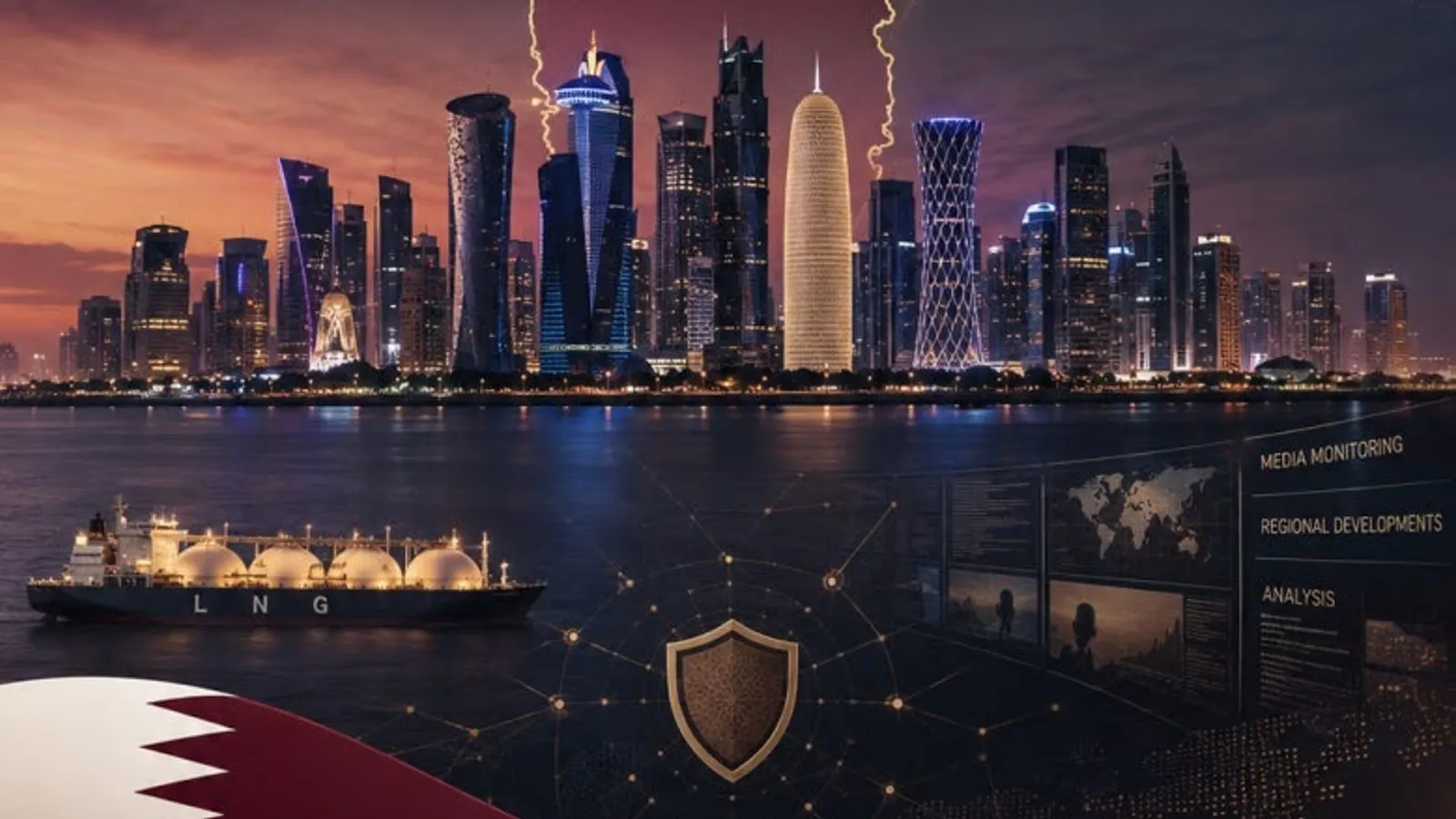
From Speech to Government Program
Our previous brief covered the emir’s Shura Council address, in which Sheikh Tamim named Iran as the country that attacked Qatar, pledged to defend the country without entering the war, and kept the door to diplomacy open. The government acted on it the next day. Chairing the cabinet at the Amiri Diwan, the prime minister instructed ministers to treat the speech as a roadmap and to prepare plans and programs to implement it. The cabinet named preparedness, economic diversification, institutional efficiency, and social solidarity as the foundations of national resilience. The Peninsula’s October 15 editorial made the same case.
The report notes a difference in emphasis between Qatar’s English-language and Arabic-language coverage. English outlets stress resilience, preparedness, and implementation. Arabic outlets, above all Al Jazeera and Al-Araby Al-Jadeed, give more space to the war around Qatar, the limits of U.S. deterrence, and the pressure to reopen shipping. The report judges that these are two registers of the same message and that nothing in them points to competing state policies.
Tehran has still not responded to the emir by name. The only official Iranian line in the reporting window came from Foreign Ministry spokesman Esmaeil Baghaei, who said on October 13 that Iran respects the sovereignty and territorial integrity of the countries of the region. The working channel remains intact. On October 4, Baghaei said Tehran had sent its reply to the latest U.S. proposal through Qatar.
Doha Ties Its Security to Riyadh
The Houthi campaign against Saudi Arabia has changed the setting for the whole Gulf. Reuters reported heavy damage to the upper floors of Aramco’s administrative headquarters in Dhahran, while Saudi authorities described a limited fire and said operations continued. The October 10 strike on Riyadh’s King Khalid International Airport killed 13 people, and the Houthi military spokesman has promised more attacks on airports and energy sites. None of this yet amounts to a confirmed interruption of Saudi crude output.
Qatar’s position has hardened in response. The cabinet called the airport attacks a grave violation of Saudi sovereignty, expressed full solidarity with Riyadh, and declared Saudi security part of Qatar’s own. On October 13, Minister of State for Foreign Affairs Sultan bin Saad Al Muraikhi also spoke by phone with Yemen’s foreign minister.
The report again finds no evidence of Qatari money behind Turkish or Pakistani military support for Saudi Arabia. On October 5, the top committee of the Saudi-Turkish-Pakistani defense pact agreed in Riyadh to deploy Pakistani and Turkish forces to the kingdom. Pakistan’s defense minister has described a supporting role, mainly reconnaissance. Turkey has not confirmed a deployment, and its parliament has yet to ratify the pact, as our latest Turkey Watch describes. No transfer, budget line, official statement, or corroborated report links Qatari funds to either country’s role. Qatar’s visible contribution is political: its condemnations, the October 11 energy memorandum with Riyadh, and now the cabinet’s security language.
Others are trying to broker a pause. Al-Araby Al-Jadeed’s October 15 lead reports Omani, Russian, and Chinese efforts to arrange a Saudi-Houthi ceasefire, quoting Houthi political bureau member Mohammed al-Bukhaiti as welcoming mediation that ends both the war and the blockade. Qatar’s official news agency gave prominence to Omani-Pakistani consultations on Hormuz, the Bab el-Mandeb, Gaza, and the U.S.-Iran war. Doha faces a real dilemma. Active help against the Houthis would erode the trust it needs in Tehran, while reluctance to back Saudi security would put it at odds with its neighbors. The cabinet statement shows which way Doha leans when it must choose. Meanwhile, the Élysée has announced that President Emmanuel Macron will visit Kuwait, the UAE, Bahrain, and Qatar on October 19-21, with energy supply at the center of the trip.
Iran’s Maritime Campaign Reaches Qatari Waters
Two senior Iranian officials told Reuters that Tehran changed the type and tempo of its attacks on shipping about ten days ago, on a decision taken at the top of the leadership. One said the aim is to defeat U.S. efforts to bring oil prices down before the November 3 midterm elections. Operations are to extend beyond Hormuz into the Gulf of Oman and further out, including waters off Qatar and the UAE. A U.S. military official confirmed a change in Iranian methods, including the use of small unarmed boats as spotters, but did not confirm the broader strategic claim.
The tempo is visible on the water. A container ship and a dry bulk carrier sank near the strait after being hit by projectiles, and Central Command rejected Iranian claims that the waterway is under Iranian control. An IRGC general claimed that the Persian Gulf is now free of foreign military forces, a claim no independent source supports. Our Hormuz-axis update for October 15 covers the incidents in detail. For Qatar, the spread of danger beyond the strait means that partial passage through Hormuz will not restore predictable insurance, scheduling, or delivery.
Al Jazeera Arabic’s news pages describe the conflict as a U.S.-Israeli war on Iran and present Trump’s statements as claims without endorsing them. Its opinion section is sharper. In a guest essay, Saudi political scientist Saleh bin Mohammed Al-Khuthlan urged Gulf states to prepare for resumed military operations and to build a regional security structure that reduces their reliance on Washington. Signed opinion belongs to its authors and cannot be read as a Qatari state position.
Britain’s Gulf posture is also under review. Al-Araby Al-Jadeed reports that the House of Commons Defence Committee opened an inquiry on September 9 into British defense interests in the Gulf, with written evidence due by November 4. Parliamentary records cited by the paper put the UK’s annual cost at Al Udeid at about £3.7 million. A Ministry of Defence spokesman told the paper that Britain’s commitment to its Gulf partners remains firm.
Washington: The 747 and the Embassy’s Counterattack
Campaigning in Bullhead City, Arizona, on October 14, as the former Qatari jet flew over the airport, President Trump defended accepting the 747 and said the emir had offered it as a gift after he asked to borrow it. The episode keeps Qatar in the U.S. campaign conversation as a symbol of elite access, although there is no legal finding of improper influence. No other on-record statement on Qatar by a senior U.S. official was identified in the past 24 hours.
The more significant development came from Qatar’s embassy. On the evening of October 14, deputy chief of mission Hamad Al-Muftah posted a nine-part thread on X responding to the claim that Qatar drives antisemitism and unrest on U.S. campuses. He named the Institute for the Study of Global Antisemitism and Policy (ISGAP) and the Foundation for Defense of Democracies (FDD), accused them of building that narrative through reports lacking evidence and briefings to congressional offices, and said officials who challenge it face coordinated smear campaigns. Two infographics accompanied the thread. One sets five allegations against official records, including congressional testimony and a statement by Senator Chris Murphy. The other maps funding and testimony links from six organizations, including an unnamed foreign government, to four congressional and state venues. Read alongside his later suggestion that a critic was acting on instructions from others, the report judges that the insinuation points at Israel.
In follow-up posts, Al-Muftah responded to researcher Eitan Fischberger, who had circulated a 1999 press report in which then Foreign Minister Hamad bin Jassim said the United States and Israel had no role in Qatar’s reception of four senior Hamas leaders. Al-Muftah dismissed the post as cherry-picking and pointed to later occasions when Washington and Israel asked Qatar to keep the Hamas office open and used the channel to free hostages. The report notes that his reply does not dispute the 1999 statement itself.
The report assesses that the thread marks an escalation. The embassy’s September rebuttals of Ambassador Mike Huckabee and of Prime Minister Netanyahu’s UN speech defended the funding and stressed that the money runs the Doha campuses. This time, a senior diplomat named U.S. research organizations, mapped their ties to Congress, hinted at a foreign government behind them, and framed the campus issue as an organized campaign. The diagrams rest on real official records, but they omit the Section 117 totals that make Qatar the largest reported foreign funder of U.S. universities. The timing matters as well, since the material he attacks circulates in the congressional offices that will shape the next round of the Section 117 dispute. The report judges that a public reply from ISGAP, FDD, or their allies in Congress is likely.
On the litigation itself, nothing new has surfaced. The temporary restraining order barring the Education Department from publishing previously undisclosed foreign-donor identities runs to October 29, and the Association of American Universities’ reply brief is due October 20. Our Section 117 special report explains the order. Commercial diplomacy continued in parallel. The central bank governor and the chairman of the Qatar Investment Authority met BlackRock vice chairman Philipp Hildebrand in Bangkok on the margins of the IMF and World Bank meetings.
The LNG Outage Reshapes European Supply
Edison’s decisions show how the outage is now shaping European contracts. In Milan on October 14, chief executive Nicola Monti said QatarEnergy had told the Italian utility it would deliver no cargoes until at least the first half of December. Qatari gas made up about 40 percent of Edison’s portfolio and has been replaced since April mostly with U.S. spot LNG. Monti said he hopes deliveries can resume early next year but has no visibility at this stage. EDF, Edison’s owner, has paused the planned sale of a stake in the company. The report observes that each month of substitution makes U.S. cargoes a more settled part of European procurement.
Qatar’s financial system remains liquid, although earnings are diverging. Bank assets reached QAR 2.194 trillion in August, up 2.3 percent from the end of 2025, and loans rose 3.5 percent. Deposits fell 0.8 percent on the month. The simple loan-to-deposit ratio rose to 140 percent, but on the central bank’s method, which treats stable funding differently, it stayed below the 100 percent regulatory limit. Qatar Islamic Bank reported nine-month profit of QAR 3.525 billion, up 2.0 percent, while Doha Bank’s profit fell 8.65 percent and the fuel distributor WOQOD’s rose 13.3 percent. Brent crude traded at $104.35 a barrel on Thursday morning and WTI near $94. The Qatar Exchange index fell 0.7 percent on October 14 as investors reacted to the Aramco strike and shipping risk. The IMF projects a 15.6 percent contraction in Qatar’s real GDP in 2026.
Qatari-Funded Media on Trump and Israel
Al-Araby Al-Jadeed’s October 15 edition treated Washington harshly. It gave almost its entire cartoon page to Trump’s failure to win the Nobel Peace Prize, which went to South African jurist Navi Pillay. The paper also ran a senior Ukrainian official’s charge that Washington withheld warning of Russian strikes, and presented the U.S.-Iran standoff as a slide back toward war. Only its Saudi-Houthi coverage treated U.S. policy in neutral terms. The front page and a two-page spread presented Mandate-era British files as evidence of a continuous pattern of Zionist militant violence. The documents may have real historical value, but the selection and the present-day framing are the paper’s editorial choices. A culture column attacked Jerry Seinfeld over his response to a pro-Palestinian protester, attributing to him a remark for which the paper offers no recording or other source.
On Al Jazeera’s opinion pages, Khalid al-Jaber of the Doha-based Middle East Council on Global Affairs argued that Trump’s grip on the Republican Party has become a liability before the midterms. Mahjoob Zweiri of Qatar University described U.S.-Iran diplomacy as a contest of mutual distrust in which each side demands the other move first, and concluded that a lasting deal needs a third party able to guarantee both sides. The report reads that as an argument for Qatari mediation made by a Qatar University scholar. Al Jazeera’s coverage of the French school and university protests continued to present them as a secular social movement, with no Islamic dimension and no suggestion of Muslim Brotherhood involvement.
Gaza, Soft Power, and Rights
Delivery of the 1.3 million liters of Qatari-funded fuel for Gaza’s hospitals remains unconfirmed. The last public word from the UN Office for Project Services, on September 18, was that its teams were working to bring the fuel in, and later UNOPS updates describe it as planned support with no delivered volume. Qatar maintains that its aid reaches civilians through UN channels and rejects claims that it funds Hamas.
Qatar’s soft power continued through education and culture. United Development Company and Carnegie Mellon University in Qatar signed a memorandum on research and education, and the Doha Film Festival will screen four Qatari-backed features in November, one co-produced with Al Jazeera Documentary. The report judges that the record supports the existence of these contractual ties, while claims about their effect on specific academic decisions require case-specific proof. No new Qatar-specific finding from human rights groups appeared in the past 24 hours. The thread to follow remains the shift of war risk at sea onto crews from countries with weaker protections.
Key Points
- Doha has turned the emir’s speech into a government program and publicly tied its security to Saudi Arabia’s, through the cabinet’s roadmap instruction and its renewed condemnation of the Houthi strikes (high confidence).
- Qatar’s channel to Tehran survives, but at a higher price. Iran has not rebutted the emir directly and sent its reply to the latest U.S. proposal through Qatar on October 4, yet its revised maritime campaign now reaches waters off Qatar (moderate confidence).
- Claims that Qatar finances Turkish or Pakistani support for Riyadh remain unsupported. Pakistan describes a supporting role, Turkey has confirmed no deployment, and nothing links Qatar to the cost (moderate confidence).
- Qatar’s LNG outage is reshaping European supply into 2027. Edison expects no Qatari cargoes before December and has replaced them mainly with U.S. spot LNG (high confidence).
- The banking system is liquid, but earnings diverge, with QIB’s profit up and Doha Bank’s down (high confidence).
- Coverage of Trump in Qatari-funded media is predominantly negative, led by Al-Araby Al-Jadeed’s Nobel cartoon page and Al Jazeera’s commentary on the midterms (high confidence).
- Qatar’s embassy in Washington has moved to an open counterattack against its campus critics, naming ISGAP and FDD and mapping their links to Congress (high confidence).
- There has been no new court action in the Section 117 case, and the restraining order remains in force through October 29 (moderate confidence).
- Delivery of the Qatari-funded fuel to Gaza remains unverified (moderate confidence).
What to Watch
- Cabinet follow-through on the emir’s roadmap, any Iranian official response to the emir, and whether Doha’s support for Saudi Arabia moves from solidarity to material help.
- Attacks on vessels near Qatar, insurance premiums, and the gap between actual cargo movements and rival claims of control over Hormuz.
- QatarEnergy notices to European buyers before December, progress on Ras Laffan repairs, and whether U.S. spot cargoes become a fixed part of European procurement.
- Energy or LNG agreements signed in Doha during Macron’s October 19-21 Gulf tour.
- A dated UNOPS delivery figure for the 1.3 million liters of fuel, set against hospital needs.
- Replies from ISGAP, FDD, or congressional offices to the Al-Muftah thread, and whether Ambassador Sheikh Meshal bin Hamad Al Thani or the Foreign Ministry adopts its line.
- Further Trump remarks on the 747, Section 117 filings by October 20 and any extension before October 29, and any Commerce or Justice Department action on the cybermercenary firms flagged in September.
- How Al Jazeera and Al-Araby Al-Jadeed treat Trump as the midterms approach, and Saudi Arabia as the Houthi war widens.
This post summarizes the Qatar Watch daily intelligence report for October 15, 2026. The report draws on QNA, Qatar Tribune, and The Peninsula; Tasnim and Report.az; Reuters, AP, and Fox News live coverage; Al Jazeera Arabic and English; the October 15 print edition of Al-Araby Al-Jadeed; posts on X by Hamad Al-Muftah and Senator Chris Murphy; QIB, Trading Economics, and FXStreet market data; Association of American Universities and APLU materials; UNOPS and the Qatari Foreign Ministry; and Human Rights Watch. Iranian officials’ account of their shipping strategy rests on anonymous sourcing and was only partly confirmed by a U.S. official. Battlefield claims by the Houthis, the Saudi-led coalition, and the IRGC are unverified. Signed opinion pieces are attributed commentary and do not set Qatari state policy. Earlier posts in the series are collected on the Qatar Watch hub.