The Emir Names Iran: Qatar Puts Gulf Security First as the War Cuts State Revenue by 42 Percent
Qatar’s emir has put Iran on the formal record as the country that attacked Qatar, and he has placed Gulf security ahead of mediation in his stated strategy. Opening the Shura Council’s 55th annual session on October 13, Sheikh Tamim bin Hamad Al Thani also gave the first official measure of the war’s fiscal cost: state revenue fell 42 percent in the first half of 2026 and public spending fell 14 percent. The speech came as Saudi-led strikes hit Houthi oil sites in Yemen and President Trump said he might ask Turkey to support Saudi Arabia. Doha still carries messages between Washington and Tehran, but each public step toward the Gulf camp reduces its value as a broker. At the same time, Qatar’s LNG recovery increasingly depends on the U.S. Navy and on U.S. gas supplies, even as the outlets it funds portray Trump as reckless and unreliable.
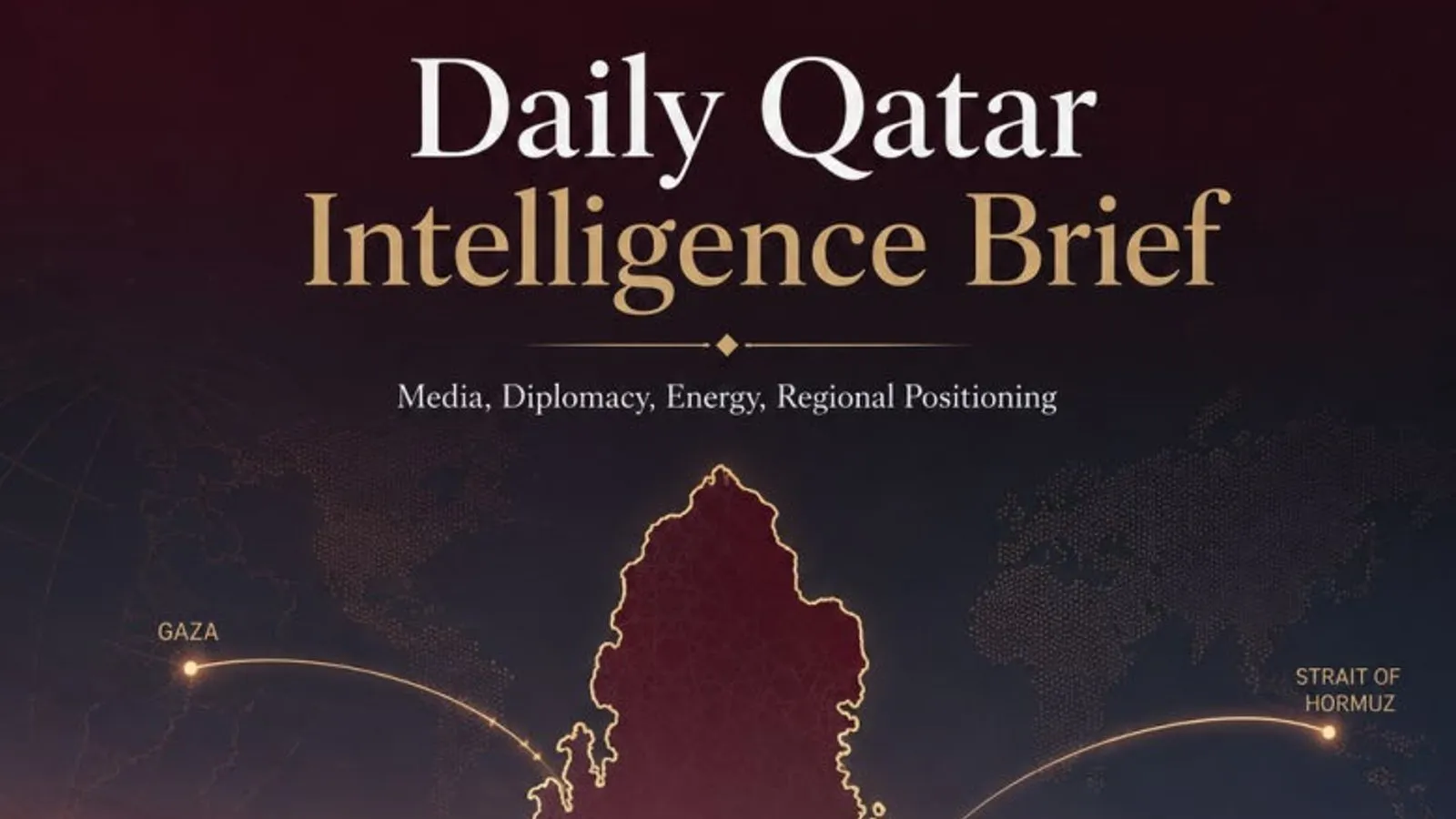
The Emir Puts Iran on the Record
The Shura Council address gave the fullest public account so far of what the war has cost Qatar. “Qatar was attacked on its territory by Iran,” the emir said, describing the attack as a blatant violation of Qatari sovereignty. He paid tribute to the armed forces and to those who were killed. He then set out a four-part strategy. Qatar will defend itself firmly without being drawn into war, keep services and supply chains running, contribute to efforts for a ceasefire and the reopening of waterways, and press for a return to negotiations.
The sharpest language came in the passage on the Gulf. The emir said the security, sovereignty, and stability of the GCC states admit no compromise, and he called for greater efforts to secure navigation in the Gulf and the Strait of Hormuz and to protect offshore energy and water facilities. On Palestine, he described the war in Gaza as genocide and said its perpetrators must not escape accountability. He also restated Qatar’s support for political settlements in Sudan, Libya, Yemen, and Somalia.
The economic passage put official figures on the damage. Revenue fell 42 percent in the first half of the year, while spending fell 14 percent without cuts to essential services. The emir attributed the shock to the closure of Hormuz and to direct damage at Ras Laffan Industrial City. He noted that non-hydrocarbon sectors now account for about 80 percent of real GDP and that real growth reached 2.9 percent in 2025. He credited reserves, lower public debt, and conservative budget assumptions for cushioning the blow. He announced a five-year portfolio of projects and investment opportunities worth about QAR 221 billion (roughly $60.7 billion), said the North Field expansion is on schedule, and cited progress at the Golden Pass LNG project in Texas.
The report highlights three points for readers in Washington. First, naming Iran from the Shura podium puts Qatar’s grievance on the formal record, and Tehran will read it alongside Doha’s October 11 energy memorandum with Riyadh and Qatar Airways’ October 13 suspension of Saudi routes. Second, the 42 percent figure is the first official measure of the fiscal hit, and the decision to protect services while cutting spending signals to citizens that the social contract holds. Third, mediation survives in the strategy, but it now comes fourth, after defense, the domestic economy, and the ceasefire effort.
Qatari outlets treated the speech as the event of the political year. Al-Watan built a full package around it, and Al-Araby Al-Jadeed ran it across the foot of its front page with a full report and an economic reading inside. Al Jazeera’s analysis presented sovereignty and diplomacy as compatible. Writing on Al Jazeera’s opinion page, Qatar University’s Abdullah Bandar Al-Otaibi read the speech as the outline of a Gulf foreign policy built on indivisible Gulf security. He named neither Iran nor the United States, and the report reads the second omission as a quiet argument for reducing dependence on Washington. In Iran, Khabaronline led with the emir’s call for a return to talks. The report identified no official Iranian response at the time of writing.
Between Tehran and Riyadh
The Saudi-Houthi war widened on October 13. The Saudi-led coalition struck the Yemeni Oil Company’s station in Sanaa, along with storage tanks at Ras Isa and an oil station in Hodeidah. Coalition spokesman Turki al-Maliki said the sites held missiles and drones, while the Yemeni company said the tanks were empty. Hours later, a Houthi strike set fire to an Aramco administrative building in Dhahran without casualties, and debris from intercepted missiles injured four people in Riyadh. King Khalid International Airport remains closed through October 17 after the October 10 strike that killed at least 13 people.
Washington and Ankara moved closer to Riyadh. President Trump said the Houthis are behaving very badly and that he might ask President Erdoğan to step in on Saudi Arabia’s behalf. On Truth Social, he suggested the Houthis had resurfaced at Iran’s behest. Erdoğan told Crown Prince Mohammed bin Salman that Turkey will stand by the kingdom, and Foreign Minister Hakan Fidan said Ankara is assessing how to help. Egypt’s foreign minister offered Cairo’s full support and urged his Iranian counterpart to halt the attacks.
The report found no financial record, official statement, or corroborated report linking Qatari funds to Turkish or Pakistani military support for Riyadh. What is visible is political and economic alignment: the energy memorandum, the aviation suspension, Qatar’s condemnation of each Houthi strike, and now the emir’s Gulf-first language. Any claim of Qatari financing should be treated as unverified until a transfer, a budget line, or an official acknowledgment appears.
The cost to mediation is the larger issue. Qatar’s leverage with Tehran rests on being seen as outside the fight. Within 72 hours, Doha signed an energy agreement with Riyadh, grounded flights to Saudi cities, and heard its head of state name Iran as an aggressor before a national audience. Citing the Wall Street Journal, Al-Araby Al-Jadeed reports that Iran has warned Arab officials it could strike Saudi oil facilities if fighting resumes. In that climate, Iranian officials have less reason to treat Doha as neutral ground, even though Qatar keeps the Washington-Tehran message channel open.
Qatar-linked media reflected both sides of the debate. Al Jazeera’s opinion page gave space to Yemen’s ambassador to Lebanon, Abdullah Abdulkarim Al-Duais, who presented the Saudi-backed “Dawn of Yemen” offensive as a campaign to restore the Yemeni state and confront Iranian influence, with Sanaa as its final objective. Publishing that case sits comfortably beside the emir’s Gulf-first line and further from Doha’s role as a channel to Tehran. By contrast, Marwan Kabalan of the Doha-based Arab Center for Research and Policy Studies argued in Al-Araby Al-Jadeed that sending Syrian forces to fight in Yemen, if the reports are true, would be a strategic mistake that drags Syria into a sectarian regional war.
Washington in Qatari Media
Qatari-funded media treated the United States harshly this week. The October 14 edition of Al-Araby Al-Jadeed gave Trump heavy and mostly negative coverage. The only item that placed him close to Arab interests was his remark on the Houthis. Elsewhere, the paper reported Washington preparing for renewed war with Iran while clearing China and Russia of supporting Tehran, ran a column accusing Trump of abandoning Ukraine, and covered European press criticism of his policy. Emad Hajjaj’s cartoon showed Trump riding a rolling oil barrel stamped “110” that is crushing an Iranian commander. The report reads it as a war that has become an oil-price barrel neither capital controls, with the United States carried along by a crisis it started.
Al Jazeera Arabic presented the United States as a power with overwhelming force and shrinking legitimacy. A guest essay by Fadel Abdul Ghany of the Syrian Network for Human Rights described the October 9 Treasury sanctions on the International Criminal Court as coercion. A blog post asked whether American hegemony is declining and concluded that military superiority alone cannot settle questions of sovereignty and legitimacy. Russian commentator Alexander Kuznetsov argued that the U.S. military presence in the Gulf made the host states targets of Iranian attacks. This was the week’s only Al Jazeera text that linked U.S. bases to the Gulf’s exposure. No content this week addressed Al Udeid directly.
The official relationship runs the other way. Bloomberg reports that Qatar’s first wartime LNG cargo crossed Hormuz with U.S. Navy security assurances, that Qatar already buys from Golden Pass, and that Doha is in advanced talks to buy millions of tons a year from U.S. export projects in Louisiana and Texas. No new on-record statement about Qatar by a senior U.S. official was identified in the reporting window.
The War Economy and the Saudi Bypass
Bloomberg’s October 14 account gives the clearest picture yet of Qatar’s export workaround. LNG exports from April to September fell almost 90 percent from the same months of 2025, and each week without exports costs Qatar about $1 billion in sales. The first cargo out sailed on the 29-year-old Al Rayyan, which crossed Hormuz without lights or transponders and transferred its load at Sohar in Oman on September 10. About 20 Qatari carriers left the Gulf over the following four weeks, lifting deliveries to about a third of prewar levels by the end of September. A further attack last week on a tanker linked to QatarEnergy has slowed transits again. The two trains damaged in the March strikes need about three years of repair.
Qatar is paying heavily to keep cargoes moving. It recalled older leased-out tankers because they are cheaper to insure, chartered third-party ships at about ten times market rates, and hired Indonesian crews at two to three times normal pay. The Philippines moved in September to bar its seafarers from vessels transiting the strait after two Filipino crew members were killed in the August 31 attack on the tanker Sidr. The report flags the shift of war risk onto crews from countries with weaker protections as a pattern to watch. No Indonesian government statement on the recruitment was identified.
The IMF now projects that Qatar’s economy will contract by 15.6 percent in 2026 and rebound by 18.8 percent in 2027, according to The National. The World Bank’s 2026 estimate is a contraction of 20.9 percent. Brent crude traded at $105.60 a barrel and WTI at $94.47 on October 14, and the European gas benchmark stood near €85 per megawatt-hour.
Saudi Arabia’s response highlights Qatar’s constraint. Al-Araby Al-Jadeed reports that Riyadh plans to raise the capacity of its East-West pipeline to the Red Sea toward 10 million barrels a day within two to three years, and that Aramco will convert a gas line to carry about 1.2 million barrels a day of crude within weeks. Saudi crude can be piped around Hormuz, but Qatar’s LNG trains on the Gulf coast have no overland route out. As a result, Qatar’s recovery depends on the strait, on naval protection, and on charter and insurance costs that Saudi oil can partly avoid. Our previous brief put September loadings at about a quarter of prewar levels.
Elsewhere in Qatari-Funded Media
Al-Araby Al-Jadeed’s cover story examined foreign nationals serving in the Israeli army. Citing Declassified UK data, the paper reported that about 47,000 Israeli soldiers held a second nationality as of March 2025, including 12,135 U.S. and 6,127 French nationals. It framed service by Europeans as a legal question for their home governments. A separate column drew on a Haaretz investigation to describe abuse of Palestinian detainees in Israeli prisons. On the Gulf economy, columnist Mustafa Abdel-Salam noted that no Gulf bank, airline, or major investment company has failed despite losses he estimated at about $2 billion a day early in the war.
Al-Watan’s coverage of the speech was celebratory and offered no critical reading. Its page 17 carried an essay on Presidential Decree No. 4, which cancels the November 2026 Palestinian legislative elections and sets joint presidential and legislative polls for September 2027. The author proposed a 12-month transitional plan with an independent advisory council.
The report also tracks how Qatari outlets frame the protest movement in France. Al-Araby Al-Jadeed covered the fifth wave of school and university protests as a secular, left-wing education dispute, with no Islamic framing and no suggestion of Muslim Brotherhood involvement. The Brotherhood did appear elsewhere in the same edition, in a column defending the Syrian Muslim Brotherhood against calls to dissolve itself during Syria’s transition. The paper is giving space to the Brotherhood’s own case in a debate where the new authorities in Damascus are pressing organized factions to disband.
Section 117 and Soft Power
No new court action in the Section 117 case is publicly visible. The temporary restraining order that bars the Education Department from publishing the identities of foreign donors runs to October 29 and does not cover the 92 foreign entities published on July 15. The government’s opposition to the Association of American Universities’ preliminary-injunction motion was due on October 13, but no filing had appeared in public reporting. The association’s reply is due on October 20. Qatar remains the largest reported source of foreign funding on the department’s dashboard, at about $8.8 billion as of May. Our Section 117 special report explains the order.
Qatari soft power continued through cultural channels. Al-Araby Al-Jadeed featured “All That Is Unseen,” an immersive exhibition at Northwestern University in Qatar’s Media Majlis museum, staged with Australia’s ACMI. The exhibition is cultural programming, but it places a U.S. university’s Doha campus at the center of positive Arabic-language coverage while that campus sits inside the U.S. debate on Qatari funding. Qatar Museums will host a 20-year retrospective of the London fashion house Erdem from October 27. In London, an AlRayan Bank UK survey found that 94 percent of Qatari high-net-worth respondents view UK property as attractive and 38 percent invested in London over the past year, the highest share of the three Gulf markets surveyed. No major Qatar Foundation announcement fell in the reporting window.
Key Points
- The emir publicly named Iran as the aggressor and put GCC security first, which narrows Qatar’s room to act as a neutral broker. Mediation now appears last among four strategic elements, and no official Iranian response has been identified (high confidence).
- Qatar’s fiscal shock now has official figures. Revenue fell 42 percent and spending fell 14 percent in the first half of 2026, essential services were protected, and a QAR 221 billion pipeline aims to draw in private capital (high confidence).
- LNG exports are recovering slowly from a very low base, and Qatar has no bypass route comparable to Saudi Arabia’s Red Sea pipeline (high confidence).
- Washington is becoming part of Qatar’s energy recovery through naval security assurances and talks on U.S. LNG purchases, even as Qatari-funded media attack Trump (high confidence).
- Claims that Qatar funds Turkish or Pakistani support for Riyadh remain unsupported. The statements by Trump and Erdoğan on October 13 name no Qatari role (moderate confidence).
- No new court action in the Section 117 case is publicly visible, and the restraining order remains in force through October 29 (moderate confidence).
- Qatari-funded media frame the French protests as a secular education dispute with no Islamic or Muslim Brotherhood angle (moderate confidence).
- Qatari soft power continues through Education City, museums, and London property investment (moderate confidence).
What to Watch
- Any official Iranian response to the emir’s naming of Iran, especially from the Foreign Ministry spokesman, and whether Tehran keeps using Doha as a channel.
- Turkish or Pakistani steps beyond statements in support of Saudi Arabia, any Syrian deployment to Yemen, and Qatari statements after further strikes on Saudi energy sites.
- Whether the prime minister arrives in Beirut on October 15, as Al-Araby Al-Jadeed reported, and his agenda with Lebanese leaders.
- Daily LNG loadings at Ras Laffan, further attacks on Qatar-linked tankers, and a signed deal for U.S. LNG.
- Budget measures following the 42 percent revenue fall and the first projects from the QAR 221 billion pipeline.
- The government’s Section 117 filing, the October 20 reply, and any extension of the restraining order before October 29.
- Al-Araby Al-Jadeed’s and Al Jazeera’s treatment of Trump as the U.S. midterm elections approach.
- Indonesian or Philippine government reaction to the recruitment of seafarers for Hormuz transits.
This post summarizes the Qatar Watch daily intelligence report for October 14, 2026, with information current to 08:30 UTC. The report draws on the emir’s Shura Council address as carried by The Peninsula, Qatar Tribune, and Euronews; the October 14 print editions of Al-Araby Al-Jadeed and Al-Watan; Al Jazeera Arabic and English; Khabaronline; Bloomberg via Energy Connects, The National, and Trading Economics; Al Arabiya and WION; Association of American Universities case filings; and Seatrade Maritime and Human Rights Watch. Battlefield claims by the Saudi-led coalition and the Houthis are unverified, and the prime minister’s Beirut visit rests on a single press report. Signed opinion pieces are attributed commentary and do not set Qatari state policy. Our Hormuz-axis update for October 14 covers the day’s Iranian side of the picture, and earlier posts in the series are collected on the Qatar Watch hub.