Red Lines and Quiet Rooms: Doha Condemns the Mecca Attempt, Is Reported in a CENTCOM Room With Israel, and Rebuilds Its LNG Portfolio on US Gas
Qatar hardened its public line on attacks against Saudi Arabia on September 16, and that shift is the strongest new political signal in the Qatar Watch review for September 17. The Cabinet condemned the Houthi missile and drone attacks on Khamis Mushait, Abha, and Taif and, in a separate clause, the drone strike on the East-West oil pipeline launched from Iraq. The Foreign Ministry then condemned the reported Houthi drone attempt against Mecca in categorical religious and moral language and pledged full solidarity with Riyadh. The posture has a quieter military layer. Axios reported on September 15 that Qatar’s chief of staff sat with his Israeli, Saudi, Emirati, Bahraini, Kuwaiti, Jordanian, and Egyptian counterparts at a CENTCOM-hosted conference in Germany on the Iran war, the first such meeting since February. The report treats that attendance as probable and unconfirmed by Doha. At the same time, Qatar is positioning itself for the diplomatic phase of the war, with preparations for the UN General Assembly complete and mediation and freedom of navigation as its declared priorities. The war economy remains the binding constraint. Reuters counted four Hormuz crossings on September 15 against a ten-day average of 18, Asian spot LNG near $26 per million British thermal units is destroying demand, and the Qatar Central Bank raised its policy rates by 25 basis points. QatarEnergy’s answer, described by Al-Araby Al-Jadeed and corroborated by Reuters, is to convert emergency cover into a structural portfolio built on long-term US LNG purchases and its 70 percent stake in Golden Pass. On the influence file, the report documents durable Qatari institutional access in Venice and a state-media platform for CAIR, and it finds no evidence that Qatar shaped the NAZA jury award. This post summarizes the Qatar Watch daily intelligence review for September 17.
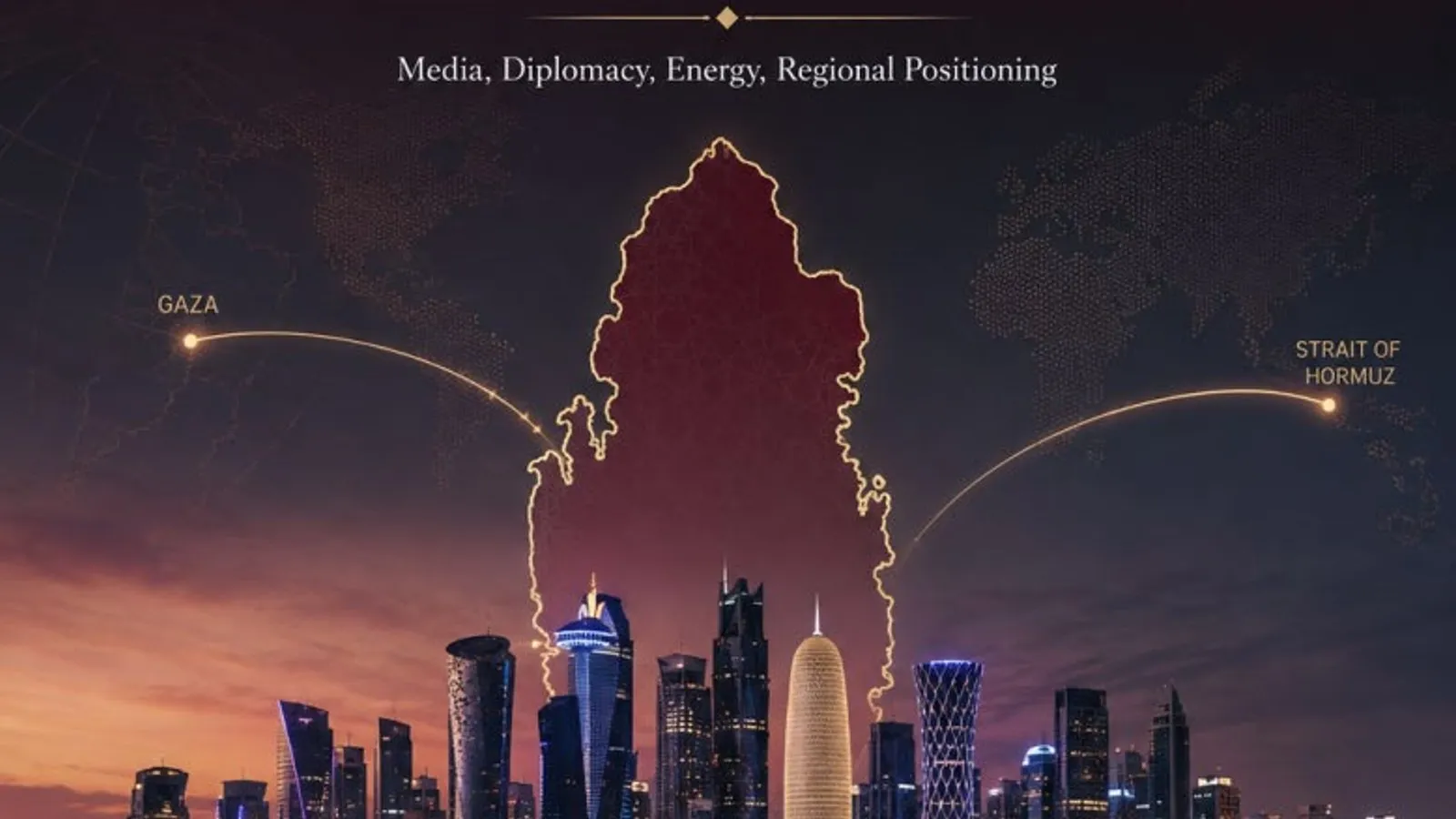
Gulf Solidarity Hardens: Mecca and the Iraqi Vector
The Cabinet’s weekly communiqué of September 16 went further than the Foreign Ministry statement described in The Mecca Test. It condemned the Houthi attacks on Saudi civilian targets, and in a separate clause it condemned the drone strike on the East-West pipeline launched from Iraq. The report reads the pairing as the important development. Doha is no longer treating the Saudi energy-security crisis as a distant Yemen file. It is now naming the northern Iraqi vector alongside the southern Houthi one in a single security narrative.
The Foreign Ministry then answered the question the previous review left open. Qatar described the reported Houthi drone attempt against Mecca as “a grave crossing of religious, moral and humanitarian red lines,” expressed full solidarity with Saudi Arabia, and backed the measures Riyadh takes in response. The formulation places the sanctity of Mecca outside Doha’s usual balancing language. The Houthis continue to deny the attempt, and a politburo member dismissed the accusation as a fabrication, so the underlying incident remains a contested claim between belligerents. Qatar’s position on it is not contested. Former GCC Secretary-General Abdulrahman Al Attiyah added a sharp condemnation in Al-Sharq, describing the Houthi attacks as evidence of strategic imbalance and loss of direction. Turkish Foreign Minister Hakan Fidan, speaking after his Syria visit, said that striking Saudi Arabia from the south and from attackers based in Iraq is unacceptable, a line consistent with Ankara’s position in the latest Turkey Watch.
The report’s assessment is that Doha is moving closer to a collective Gulf-security frame whenever Saudi civilian or religious targets are involved. That does not erase Qatar’s mediation posture toward Iran. It does reduce the political space for neutrality toward proxy attacks that threaten Gulf energy infrastructure or Islamic holy sites, and it narrows the room Doha has to keep its public distance from the Yemen war while the Tehran channel stays open.
A Room in Germany: Qatar’s Military Chief and Israel’s
Axios reported on September 15, citing two Israeli officials, that the military chiefs of the United States, Israel, Saudi Arabia, the UAE, Bahrain, Kuwait, Qatar, Jordan, and Egypt met the previous week at a secluded German ski resort under CENTCOM commander Admiral Brad Cooper. CENTCOM confirmed that it hosted senior military leaders from eight nations at a scheduled conference in Germany, without naming them. According to the report, Cooper reassured participants that US forces would not withdraw despite Iranian strikes on US bases and briefed the plan to expand Hormuz shipping, while Israeli Chief of Staff Eyal Zamir briefed IDF operations on all fronts. It was the first such gathering since the joint campaign against Iran began in February. None of the Arab participants acknowledged the meeting, and Qatari media did not carry the story.
The evidentiary standing matters. Qatar’s attendance is single-sourced to Israeli officials plus a non-denial from CENTCOM, and the report treats it as probable and not confirmed by Doha. The assessment is nonetheless clear. This is the second time a Qatari military channel with Israel has surfaced through US convening, and it coexists with Doha’s public line that Israel is the obstacle in Gaza and with Al Jazeera’s genocide vocabulary. Hormuz reopening, Houthi containment, and Iranian targeting are shared problems, and Qatar’s attendance shows that Doha separates its Iran-war security interest from its Palestine messaging. The disclosure by Israeli officials will be read in Doha as a leak meant to embarrass the Arab participants. The report expects no Qatari confirmation and possibly a Foreign Ministry deflection at the next weekly briefing.
Positioning for the Diplomatic Phase
Doha is preparing for the negotiating phase of the war in parallel. Majed Al Ansari told the Qatar News Agency on September 17 that preparations for high-level participation in the 81st UN General Assembly are complete. He listed the delegation’s priorities as international peace and security, dialogue and mediation, respect for the UN Charter, multilateralism, humanitarian delivery, and continued mediation despite the crises facing the region. The agency’s September 16 feed carried a special report presenting Qatar as a leading advocate of nuclear disarmament and covered Al Ansari’s appearance at a Washington forum. The message is consistent with the freedom-of-navigation line set out a day earlier. Qatar wants a rules-based diplomatic exit from the Iran conflict and protection for maritime traffic, and Gulf Times gave the English-language version its clearest statement with a front page reporting that Qatar backs diplomacy for lasting peace.
The Singapore track reinforces that core interest. The agency published the joint statement of the third meeting of the Qatar-Singapore Implementation Monitoring Mechanism in Doha, and The Peninsula reported that Deputy Prime Minister and Minister of State for Defense Affairs Sheikh Saoud bin Abdulrahman Al Thani received Singapore’s foreign minister on September 16. The report reads the relationship as a maritime-security channel with substance beyond trade formalities, since both states depend on safe, continuous passage through chokepoints and on a negotiated end state to the war.
Qatar’s humanitarian instruments are active alongside its diplomacy. Qatar Charity committed an initial $1 million for Yemeni refugees in Djibouti after renewed fighting displaced more than 85,000 people inside Yemen and pushed more than 2,000 across the sea. The package covers shelter, food, water, primary healthcare, sanitation, and maternal and child nutrition. The intervention is modest by the standards of Qatar’s major aid programs, and the report judges it politically useful, because it gives Doha a visible humanitarian role in the same Yemen crisis in which it is taking a harder diplomatic line against Houthi escalation. Al-Arab gave the allocation prominent space alongside Sheikha Hind bint Hamad Al Thani’s call for a global coalition using sport for social development, and the two items together illustrate Qatar’s preferred influence model of state-linked philanthropy and global convening platforms. The domestic press otherwise ran the resilience frame. Al-Sharq, Al-Watan, the Qatar Tribune, and Lusail all gave prominent space to Qatar Tourism’s calendar of more than 560 events and 780 partners, Al-Watan carried the Gaza building collapse as its regional headline, and Al-Sharq reported the departure of the high-level UNGA delegation.
The War Economy: A Rate Hike, Four Transits, and a Portfolio Rebuilt on US Gas
The domestic economic news of the window was a monetary tightening. The Qatar Central Bank raised all three policy rates by 25 basis points effective September 17, taking the deposit rate to 4.10 percent, the lending rate to 4.60 percent, and the repo rate to 4.35 percent. The report reads the move alongside war-related pressure on LNG revenue and elevated global energy prices, and it flags transmission into domestic credit, banking liquidity, real estate, and private-sector financing as the indicator to follow.
Physical access to the strait has not improved. Reuters’ September 16 vessel count showed four Hormuz crossings on Tuesday against a ten-day average of 18, and none of the four observed ships was an LNG tanker. Transponder-dark transits mean the count is not exhaustive, and the report still treats it as a strong indicator that normalization remains distant. About 17 percent of Qatari liquefaction capacity, roughly 12.8 million tonnes per year, remains offline from the March damage, so reopening Hormuz alone cannot restore full export capacity. Brent settled at $105.83 on September 16 as Saudi Arabia increased exports through Oman, and it traded near $105.90 on the morning of September 17, with WTI near $102 after a rise in US inventories. High oil prices support hydrocarbon-linked revenue, but Qatar cannot monetize LNG it cannot produce or ship, so the fiscal question is volume as well as price.
The strategic response is now visible from two directions. Al-Araby Al-Jadeed’s September 17 edition reports that QatarEnergy is re-engineering its energy portfolio around US gas, moving into long-term purchases from US markets and investment in liquefaction capacity led by its 70 percent stake in Golden Pass. Experts quoted by the paper, including Jalal Qanas of Qatar University, describe a qualitative change from producer and exporter to global trader and intermediary, with external assets serving as strategic insurance against Gulf chokepoint risk. Their figures put Qatari output at about 77 million tonnes per year against a target of 142 million by the end of the decade, Golden Pass exports at about 25 million tonnes per year at full capacity after a start in April, and European storage at 67 percent against an 80 percent historical average. The paper also lists the fallback menu of more Dolphin pipeline gas to the UAE and Oman, diversion of gas to petrochemicals and reinjection, rerouted shipping, and a long-term pipeline to Fujairah or the Gulf of Oman with coastal liquefaction. Reuters independently reports that QatarEnergy is negotiating multi-year US LNG purchases through 2031 and is seeking roughly 2 to 3 million tonnes per year. The rationale is to defend long-term customer relationships while 12.8 million tonnes of capacity is unavailable and Hormuz remains unreliable. The report judges that the replacement gas is more expensive and cannot fully offset lost production.
The market is adapting around constrained Qatari supply, and that is the strategic danger. Reuters’ September 17 analysis puts Asian spot LNG around $26 per million British thermal units and September Asian imports on track for their weakest month since 2018, with Europe absorbing more cargoes as price-sensitive Asian demand retreats. Equinor said on September 16 that it plans to expand its LNG portfolio to 10 to 15 million tonnes per year in the early 2030s and is courting Asian buyers. Competitors are using Qatar’s disruption to build relationships that may survive the war, and the supply shock can accelerate fuel switching, renewables, and customer diversification in the Asian markets central to the North Field expansion. Tehran’s reading of the same energy picture appears in the day’s Economic Press Review.
Al-Araby’s Front Page: Houthi Reassurances, a Collapsed Building, and Beijing’s Words
Al-Araby Al-Jadeed’s September 17 edition led with Yemen. The banner headline reported Houthi reassurances to Washington, with sub-decks on the Muscat meeting, the Houthi pledge not to attack US and Israeli ships, solidarity with Saudi Arabia after the Mecca accusation, and fighting on the Taiz, west coast, Marib, Jawf, and Bayda fronts. The page-2 account, citing five Reuters sources, reports that US embassy staff met Houthi representatives in Muscat with Oman arranging the meeting. The Houthis said they do not intend to attack US ships and remain committed to the 2025 ceasefire, and a Yemeni source added that they would not attack Israeli or commercial ships except Saudi ones. The report checked the account against Reuters and found it a faithful rendering with no independent sourcing. The State Department declined to confirm the meeting and restated freedom of navigation as a core US interest. The paper set the private US contact against Waltz’s public warning at the Security Council, gave Qatar’s Mecca statement in full, and placed it before the GCC secretary-general’s line that Saudi security is indivisible from the security of the Council states. The report reads that placement as a Qatari-funded paper signaling Doha’s ownership of the position.
The lead image was Gaza. A hand reaching through the rubble of a collapsed seven-story building carried a headline calling the collapse a continuing Israeli massacre, and the inside pages presented restrictions on construction materials and heavy equipment as a mechanism of slow killing, citing roughly 2,000 damaged buildings sheltering families, about 400 at risk of collapse, and 61 million tonnes of rubble. Economy editor Mustafa Abdel Salam tied the collapse to the blockade and cited a $70 billion reconstruction bill. The foreign-policy section led with verbal Chinese support for Iran, quoting Abbas Araghchi calling China a close friend and strategic partner and Wang Yi calling the US war illegal and urging effective measures to reopen Hormuz as soon as possible. For Qatar Watch the point is editorial. A Qatar-funded voice is giving substantial space to a China-mediated exit that would directly serve Qatar’s LNG interests, and to the US domestic constraint on the war, reporting the House’s 220-204 passage of a nonbinding war-powers resolution with seven Republicans joining Democrats. Beijing’s call and Tehran’s response are examined from the Iranian side in the day’s Hormuz-axis daily.
Two page-6 items deserve a note. The paper reported Otzma Yehudit’s petition to disqualify Balad chairman Sami Abu Shehadeh from the Knesset elections, resting mainly on an article he published in Al-Araby Al-Jadeed on October 8, 2023, and it cited polling from the Arab Center for Research and Policy Studies, the Doha institution headed by the paper’s own chairman Azmi Bishara, without flagging either link. The paper is reporting a case in which its own opinion page is the evidence. The opinion pages were unusually rich on files that touch Qatar. Egyptian writer Ahmed al-Jundi, using Kpler data, wrote that Yanbu exports rose from 0.13 to 3.22 million barrels per day during the crisis and that all Saudi crude bound for Asia now moves through Bab al-Mandab against 2 percent before the war. He argued that Israel is turning the fragility of the maritime corridors into leverage for normalization through the IMEC corridor and a proposed Saudi pipeline to Eilat. Emad Hajjaj’s cartoon shows an oil barrel on its side with a wrench wedged across its open end and two thin streams escaping like the outlines of a strait. The report reads it as the paper treating chokepoint control as the decisive variable of the war without assigning the wrench to any single actor.
On Al Jazeera, the Arabic opinion platform again proved the more permissive arena. Arib al-Rantawi argued on September 16 that the Palestinian national project should be redefined around a single democratic secular state, with the two-state formula at most a shorter-term program, and he explicitly called for dismantling Israel as a system and linked the project to anti-normalization and boycott activism. That is author opinion and not a formal Al Jazeera or Qatari position, and no comparable English-language piece carried the thesis. On NAZA the two platforms converged. Al Jazeera English reported Culture Minister Miki Zohar’s move to strip the filmmakers of citizenship and the chief of staff’s legal probe, describing the film’s subject as Israel’s genocidal war in the outlet’s own voice, while The New Arab carried Reuters on Netanyahu’s pledge to pass two bills on citizenship revocation and defamation damages. The report judges that amplifying the Israeli reaction as the story is a more defensible editorial position for Doha than amplifying the film’s allegations, because the Israeli government is generating the news. Tehran’s press for the same cycle is summarized in the Iranian Press Monitor.
The Influence File: Venice, CAIR, the Board of Peace, and a Palace Arabist in Doha
The report examines the Qatar link to the Venice controversy and draws a careful line. No evidence located shows that Qatar selected the jury, financed NAZA, or caused its Special Jury Prize. The documented structural relationship is nevertheless substantial. Qatar Museums secured a permanent national pavilion in the Giardini, described by Italian press as a 90-year concession. Qatar donated 50 million euros to the municipality after a 2024 cooperation protocol, direct Doha-Venice flights resumed alongside the partnership, and Venice Mayor Luigi Brugnaro was vice president of the Biennale’s board when the relationship was formalized. The film-financing layer is documented as well. The Doha Film Institute had eight supported projects at Venice 2026 and a record twelve in 2025, and competition juror Kaouther Ben Hania directed the institute-backed film on Hind Rajab that won the Silver Lion in 2025. NAZA does not appear on the institute’s list of supported projects. The report’s assessment is that the Qatar angle should be framed as institutional positioning, not jury manipulation. Doha has bought durable cultural access and runs a financing pipeline inside the ecosystem that confers legitimacy on politically salient films, which creates long-term agenda-setting opportunities. The practical implication is that the next Gaza film to reach Venice is more likely than not to carry institute money, and the report advises checking credits before the award instead of after it. Confidence is high on institutional access, moderate to high on the financing and jury-adjacent network, and low on any link to the award.
Two US-facing items add to the standing file. On September 15 the Qatar News Agency published a Washington-datelined special report on the 32nd annual conference of the Council on American-Islamic Relations, built on exclusive statements from Nihad Awad and Edward Ahmed Mitchell, and CAIR listed the piece in its own media round-up the next day. The report treats it as the first item in this file in which Qatar’s state news agency, and not a Qatari-funded university or think tank, gives CAIR’s national leadership a platform. The November 2025 executive order on Muslim Brotherhood designations and the January 2026 designations of the Egyptian, Jordanian, and Lebanese branches remain the frame in which CAIR’s critics place the organization. The item shows narrative alignment. It is no evidence of Qatari funding, and the report files it as such. Separately, a Board of Peace official told The Times of Israel that Netanyahu largely cooperated with the Board for a year, that cooperation ceased when the campaign began, and that the Board’s leverage will return after the October 27 election regardless of who wins. No Qatari statement citing the Board was located. The assessment nevertheless converges with Al Ansari’s standing line that responsibility for the stalled second phase rests with Israel, and the report expects Doha to cite it at the General Assembly as third-party corroboration. The Section 117 baseline is unchanged. The Education Department’s portal shows Qatar as the largest foreign source of reportable gifts and contracts to US universities, at about $6.6 billion cumulatively and about $1.1 billion in 2025, and the report continues to separate funding scale, legal reporting duties, donor disclosure, and demonstrated influence, as it did in the September 13 review.
Ankara’s new envoy rounds out the file. Qatar received the credentials of Turkish ambassador Yakup Caymazoglu on September 16. He is a palace Arabist who did not come up through the Foreign Ministry. He holds degrees in Arabic and Islamic civilization from Tunisia, has published on Salafi thought in Turkey, and spent more than a decade as Erdogan’s Arab-affairs aide and interpreter before nineteen months as ambassador in Amman. Defense Minister Yasar Guler received him before his departure, an unusual courtesy that points to the defense weight of the Doha post. The report reads the appointment as a palace-to-palace channel that fits a relationship run between Erdogan and Sheikh Tamim, a Turkish base in Qatar, and a joint Gaza mediation role on the Board of Peace’s executive committee. It flags his early engagements with the Defense Ministry, Qatar Charity, and the Gaza reconstruction file as items to log.
Key Points
- Qatar has moved to an explicit Gulf-solidarity line on Saudi security, covering the Mecca attempt and the Iraqi launch vector. The line narrows Doha’s room for neutrality toward Iranian proxies without ending its mediation posture toward Tehran (high confidence).
- Qatar’s chief of staff attended a CENTCOM-hosted meeting with Israel and six Arab states on the Iran war, according to Axios and a CENTCOM confirmation that named no countries. It is a military channel Doha has not acknowledged (moderate confidence, since the attendance is single-sourced to Israeli officials).
- QatarEnergy is converting emergency cover into a structural portfolio built on US LNG and Golden Pass, accepting a higher cost base to protect its customer base (high confidence).
- Hormuz normalization remains distant, and Asian demand is eroding at current prices. Whether customer losses to Equinor, US, and other suppliers prove durable is the open question (moderate confidence).
- The central bank’s 25 basis point increase tightens domestic financial conditions during an LNG and fiscal shock (high confidence on the rates, with transmission still to be observed).
- Qatar holds durable institutional access in Venice through the pavilion, the donation, the Doha Film Institute pipeline, and juror adjacency. Access is documented, while influence over the NAZA award is unsupported by any evidence located (high confidence on access, low on the award).
- QNA’s amplification of CAIR is a new state-media touchpoint in the US Brotherhood file. It adds narrative evidence but no funding evidence (high confidence).
- Qatar’s claim that Israel is the obstacle to Gaza phase two is partly echoed by an anonymous Board of Peace official, which strengthens Doha’s UNGA narrative before October 27 (moderate confidence).
- The new Turkish ambassador is a presidential-palace Arabist, signaling a palace-to-palace channel between Ankara and Doha (high confidence).
What to Watch
- Whether Qatar’s condemnation of attacks launched from Iraq produces direct pressure on Baghdad, Iraqi militias, or Iran beyond declaratory statements.
- Whether Doha’s General Assembly diplomacy yields a concrete Hormuz formula, an Iran-US contact channel, or a Gulf security proposal.
- Any sustained sequence of laden Qatari LNG carrier departures through Hormuz and any change in war-risk insurance terms.
- QatarEnergy’s procurement volumes, contract durations, and counterparties in the United States, especially whether 2 to 3 million tonnes per year becomes a firm multi-year portfolio.
- Whether Asian buyers convert emergency diversification away from Qatar into long-term contracts with Equinor, US, Canadian, or other suppliers.
- Transmission of the rate increase into domestic credit, banking liquidity, real estate, and private-sector financing.
- Expansion of Qatar Charity’s Yemen and Djibouti package beyond the initial $1 million, and whether the Qatar Fund for Development or the Qatar Red Crescent joins the response.
- Governance, programming, and partnerships of Qatar’s permanent Venice pavilion, with a strict distinction between institutional access and evidence of influence over specific jury or curatorial decisions, and Doha Film Institute grant lists for any Gaza-themed project headed to Berlin, Cannes, or Venice.
- New Qatar-specific Section 117 records, donor disclosure litigation, or measurable academic-policy effects, further QNA or Al Jazeera platforms for CAIR leadership, and any US move to extend Brotherhood designations to Qatar- or Turkey-based entities.
- Whether Doha confirms, deflects, or denies the CENTCOM meeting at the next Foreign Ministry weekly briefing, and whether Qatari officials cite the Board of Peace’s assessment at the General Assembly.
- Ambassador Caymazoglu’s first engagements in Doha, particularly with the Defense Ministry, Qatar Charity, and the Gaza reconstruction file.
This post summarizes the Qatar Watch daily intelligence review for September 17, 2026. Primary sourcing is Qatari: the Qatar News Agency’s Arabic and English feeds for the Cabinet communiqué, the Mecca statement, the Qatar Charity allocation, the central bank decision, the UNGA preparations, the Qatar-Singapore joint statement, the nuclear-disarmament report, the CAIR special report, and the Turkish ambassador’s credentials; Al-Sharq, Al-Arab, Al-Watan, Al-Rayah, and Lusail for the Arabic domestic press; Gulf Times, the Qatar Tribune, The Peninsula, and Doha News for the English-language press; and Al Jazeera Arabic and English together with Al-Araby Al-Jadeed’s September 17 print edition and The New Arab for the media barometer, the Yemen spread, the NAZA coverage, the opinion pages, and the cartoon. External verification rests on Reuters and Kpler for Hormuz traffic, on Reuters for the QatarEnergy purchase talks, the Equinor expansion, the Asian LNG price analysis, and oil prices, on Axios, The Times of Israel, and CENTCOM’s statement for the Germany meeting, on The Times of Israel for the Board of Peace official and the Muscat contact, on La Biennale, Qatar Museums, the Venice City Council record, Domani, Qatar Living, and Variety for the Venice file, on the Turkish Foreign Ministry biography, the Official Gazette, Sozcu, and ANKA for the ambassador, and on the US Education Department’s Section 117 portal, Inside Higher Ed, the Washington Times, ISGAP, and FDD for the academic-funding baseline. The report’s evidentiary flags are preserved here. Confidence is high on Qatar’s official positions, the central bank rates, the Qatar Charity allocation, the Venice institutional relationship, the Doha Film Institute financing record, the Turkish ambassador’s biography, and the broad LNG disruption. It is moderate on the durability of customer diversification, on Qatar’s CENTCOM attendance, which is sourced to Israeli officials, and on the Board of Peace’s stated view of Netanyahu, which comes from an anonymous official. It is low on any claim of Qatari involvement in NAZA’s selection or award, because no supporting evidence was located. The ISGAP figure for Cornell’s Qatari total is advocacy-sourced and should be checked against the Section 117 portal before use, and Al-Araby Al-Jadeed’s account of the Muscat meeting adds no sourcing beyond Reuters.