Iranian Press Monitor - Thursday, 17 September 2026 (Day 198)
Thursday, 17 September 2026 · پنجشنبه ۲۶ شهریور ۱۴۰۵ · 4 Rabi’ al-Thani 1448 - Ten front pages of 26 Shahrivar 1405, read alongside nine outlet channels; Tehran Times was not available at the time of compilation.
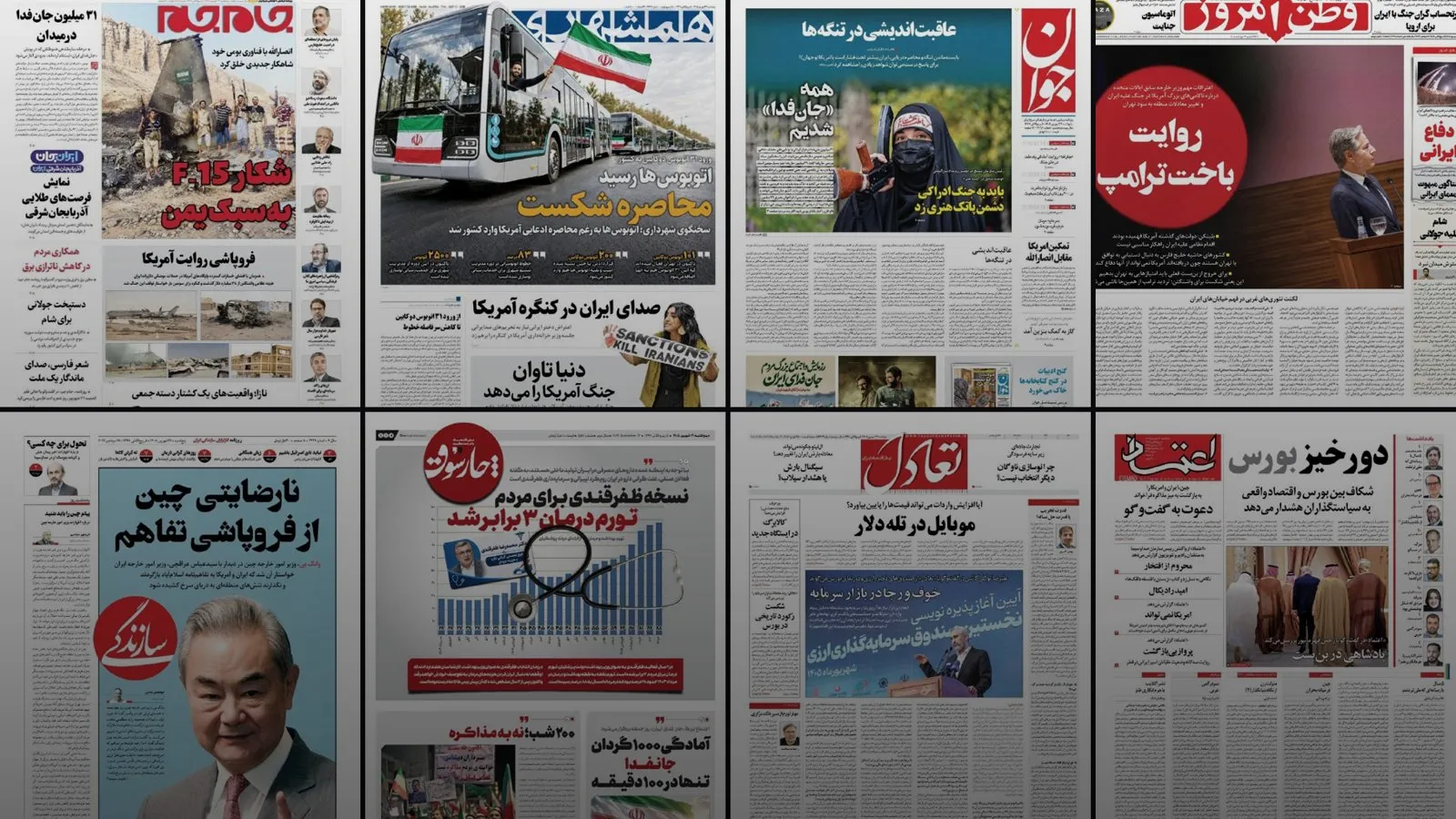
Bottom line: One sentence from the Chinese foreign minister reached four Iranian front pages this morning as four different sentences, and the paper that had the least reason to hesitate, the IRGC-affiliated daily, responded by putting the closure of the Strait of Hormuz back on its own cover as a question.
Executive Summary
The lead judgment of this edition concerns the chokepoint file, and it rests on a question mark. Javan, the IRGC-affiliated daily, gave its cover to «عاقبتاندیشی در تنگهها», thinking about consequences in the straits, under a standfirst that asks directly: with the strait staying closed and a naval blockade in place, is Iran under more pressure, or America and the world? The paper then says the answer can be found in the evidence. Closure of the Strait of Hormuz is not an ordinary policy in this system; it was set out personally by the serving Leader in his first message in March 2026 as a tool of pressure to be maintained. A Guard-affiliated newspaper does not put the cost-benefit of that policy into interrogative form on page one unless the policy is being argued about somewhere above the paper. This monitor has spent four cycles recording chokepoint advocacy moving down-market, from institutional voices to cartography to academic interviews. Today it moved further: into a question.
The occasion is Chinese. Wang Yi met Abbas Araghchi in Beijing on 16 September and said China is willing to strengthen dialogue and cooperation with Iran and to safeguard Iran’s legitimate rights and interests; that Beijing does not wish to see regional tensions spilling over into Yemen and the Red Sea; and that Iran and the United States should stay rational and restrained. Four Iranian surfaces printed that statement this morning and no two printed the same thing. Kayhan’s channel makes China a guarantor: «آمادهایم قاطعانه از حقوق ایران دفاع کنیم», we are ready to defend Iran’s rights resolutely, with both restraint clauses removed. Sazandegi gives its entire cover to «نارضایتی چین از فروپاشی تفاهم», China’s displeasure at the collapse of the understanding, and reads the same words as a reprimand. Etemad files it under «دعوت به گفتوگو», an invitation to dialogue. Iran Daily, the government’s own English surface, prints safeguard inside scare quotes and commissions an analyst to call the Chinese move “low-cost, low-risk mediation”. One statement, four Iranian meanings, distributed exactly along the fault line the chokepoint file runs on.
The most important sentence in the batch is in Sazandegi’s day-column and it is single-sourced. Fereydoun Majlesi, a former Iranian diplomat, opens «پیام چین را باید شنید», China’s message must be heard, by attributing to Wang Yi remarks on «ضرورت بازگشایی تنگه هرمز», the necessity of reopening the Strait of Hormuz, alongside a return to the Islamabad memorandum and an end to the Red Sea crisis, and says these should be read as a serious warning rather than as ordinary diplomacy. No other Iranian surface in the batch prints a Chinese request to reopen the strait. The wire record does not contain that formulation in those words, though at least one Western outlet framed the Beijing visit as Chinese pressure to open the strait. This monitor carries the attribution as Sazandegi’s and not as a verified Chinese text. If it is accurate, the largest buyer of Iranian oil asked Tehran to end the closure four days before its president meets the American president, and Kayhan printed the same meeting as a promise of protection.
Against the argument about leverage stands a fact about leverage that reached no front page at all. Bloomberg reported on 16 September that Saudi Aramco is working to restore about half the capacity of the East-West pipeline within days, with full capacity targeted in roughly six weeks, after the line was shut on 10 September following drone attacks. That pipeline is Riyadh’s route around Hormuz to the Red Sea, and its closure has been a standing element of the coercion case this monitor has tracked since early September. The item ran this morning on Vatan-e Emrooz’s own Telegram channel, attributed to Bloomberg, and did not appear on Vatan-e Emrooz’s front page or on any other. A hardline daily that has built covers out of adversary documents for two consecutive cycles declined to print the one adversary document that subtracts from the argument. Negative evidence of this kind is a finding, not a gap.
The domestic half of the edition escalated by a factor this monitor cannot check. Jam-e Jam banners «۳۱ میلیون جانفدا در میدان», 31 million jan-feda in the field, and says the organising phase for registrants in the «جان فدای ایران» campaign begins shortly; Javan’s body text carries the same 31 million figure with a campaign spokesman attached. One cycle ago the largest figure in this campaign’s vicinity was 600,000 registrations, sourced to the IRGC’s Tehran commander. Charsoogh repeats the thousand-battalions-in-a-hundred-minutes claim that has now travelled unchanged between three titles in three cycles. The Friday rally itself is confirmed and dated: the Muhammad Rasulullah Corps of Greater Tehran’s advertisement, which ran at the foot of Etemad’s front page on 16 September, now runs on Javan, same route, same hour, Imam Hossein Square to Navvab Crossroads, 8 a.m. on Friday 27 Shahrivar, dedicated «به نیابت از آقای شهید ایران», on behalf of Iran’s martyred Aqa. A number that grows fiftyfold in one cycle without acquiring a register is a claim about confidence rather than a count of people, and the route and the hour remain the only testable part of it.
The Red Sea file that Wang Yi named is moving in the opposite direction from the file he asked about. The Houthi military spokesman Yahya Saree announced on 16 September that Yemeni forces had shot down a Royal Saudi Air Force F-15 over Marib with a locally made munition; al-Masirah aired footage, Riyadh has not responded and the claim is not independently verified. Jam-e Jam gave that claim its entire cover photograph, Kayhan added a taunt to Saudi pilots, and Javan’s rail runs «تمکین امریکا مقابل انصارالله», America’s submission before Ansarullah. In the same window Ansarullah rejected Saudi accusations that it had targeted Mecca, Vatan-e Emrooz’s channel carried «انصارالله خطاب به عربستان: تقدسنمایی مانع حملات ما نخواهد شد», and Yemen’s Supreme Political Council escalated the religious register further. Tehran’s press is amplifying a widening Yemen-Saudi front on the same morning that its most important trading partner asked it to keep regional tensions out of the Red Sea.
The succession’s silence held for a fourth consecutive cycle and was tested against a harder case than yesterday’s. No message, speech or quoted remark from the Leader appears on any of the ten front pages or in any of the nine channels read. The occasion available was a great-power intervention on the maritime file that the Leader personally defined in March, on the eve of a scheduled Xi-Trump meeting at which the war and the strait are expected to be discussed. The office that set the policy said nothing about the first serious external pressure on it, while the mobilisation campaign filling the same front pages is dedicated to his assassinated predecessor by name.
Two findings cut across the camps rather than along them. First, sourcing quality split inside a single front page: Vatan-e Emrooz banners Ursula von der Leyen’s 90 billion euro figure for extra EU fossil-fuel imports, which is accurate and checkable, directly above a cover built on three Antony Blinken quotations for which no primary text, venue or date could be located. Jomhouri Eslami prints the same European figure with the payer identified correctly; Hamshahri prints an equivalent order of magnitude, 100 billion dollars, and attaches it to «آمریکاییها», Americans. Second, the institutional argument is being made by a paper that is not reformist: Jomhouri Eslami runs Iran’s election to the IAEA General Committee and the third US House war powers resolution in adjacent columns, both of which are arguments for remaining inside the institutions the hardline front pages have been arguing to leave.
Net assessment: this is the first edition in the monitored series in which the pressure on the chokepoint policy is external, specific and printed. The war coverage is unchanged in volume and largely unchanged in claim, the mobilisation numbers are larger and no better sourced, and the economic dailies have again run a self-contained agenda in which the exchange rate, not the strait, is the operative variable, with Ta’adol carrying no war content on page one at all and leading instead on the launch of Iran’s first foreign-currency investment fund. What is new is that a great power with standing asked, that the request was reported four different ways in one morning, and that the Guard’s own daily answered it by reopening the argument rather than by closing it. The risk of overreading is that Javan has posed rhetorical questions before and answered them in the expected direction, and that the Chinese reopening request rests on one columnist’s paraphrase. The risk of underreading is that the last time this monitor saw a policy move, it moved through exactly this sequence: argument widened to a domestic audience, institutional voices withdrawn, then a question on a friendly front page.
Key Points
- KJ-1 [HIGH] The closure of the Strait of Hormuz is being argued about inside the system, and the evidence is that the IRGC-affiliated daily put its cost-benefit on page one as a question. Javan’s cover is «عاقبتاندیشی در تنگهها», thinking about consequences in the straits, under «نگاهی به راهبرد کنترل آبراههها» and a standfirst that asks whether the closed strait and the naval blockade press harder on Iran or on America and the world, then says the evidence supplies the answer. The policy was set out personally by the serving Leader in his first message of 12 March 2026 as a tool of pressure to be maintained. Across four cycles this monitor has watched the case for it migrate from institutional voices to cartography to an academic interview to a foreign citation; an interrogative headline on a Guard-affiliated surface is the next step in that sequence, not a departure from it. The alternative reading, that Javan poses rhetorical questions in order to answer them in the expected direction, is real and the page does argue for the closure. What the alternative does not explain is the timing: the question appears the morning after Beijing pressed Tehran on that exact file. The significance is that the strongest domestic constituency for the closure is now publishing the argument for it rather than the assertion of it, which is what a position looks like shortly before it is traded.
- KJ-2 [HIGH] One Chinese statement produced four incompatible Iranian meanings in a single morning, and the spread maps onto the chokepoint dispute rather than onto editorial temperament. Wang Yi’s Beijing remarks of 16 September, verified against wire reporting, contained three elements: willingness to safeguard Iran’s legitimate rights and interests, unwillingness to see regional tensions spill into Yemen and the Red Sea, and a call for Iran and the United States to stay rational and restrained. Kayhan’s channel prints only the first, hardened into «آمادهایم قاطعانه از حقوق ایران دفاع کنیم». Sazandegi prints the second and third as the story and leads its whole cover «نارضایتی چین از فروپاشی تفاهم». Etemad files it as «دعوت به گفتوگو». Iran Daily quarantines safeguard in scare quotes and prints an analyst calling the mediation low-cost and low-risk. On 16 September this monitor read four readings of one Pentagon document as opportunistic convergence. Today’s four readings are of a text that constrains Iran rather than indicting its adversary, which is why the divergence is informative: outlets discard the clauses that cost their camp something. The significance is that the Iranian press has just shown, in a single cycle, which parts of a great-power offer each institutional family is prepared to carry.
- KJ-3 [MODERATE] Beijing may have asked Tehran to reopen the Strait of Hormuz, and only one Iranian surface says so. Sazandegi’s day-column by the former diplomat Fereydoun Majlesi opens on Wang Yi’s remarks concerning «ضرورت بازگشایی تنگه هرمز», the necessity of reopening the Strait of Hormuz, together with a return to the Islamabad memorandum and an end to the Red Sea crisis, and instructs readers to treat them as a serious warning rather than as routine diplomacy. Sazandegi’s own front-page deck carries the memorandum and the Red Sea but not the reopening. No other title in the batch carries it in any form. The wire record of the meeting does not contain that formulation, although at least one Western outlet characterised the visit as Chinese pressure to open the strait, which is consistent with the column without confirming its wording. The confidence is held at moderate because a single columnist’s paraphrase is the entire Iranian evidentiary base, and because a reformist paper has an obvious interest in the claim being true. The significance is that if it is accurate, the constituency for reopening now includes Iran’s principal oil customer, four days before a scheduled Xi-Trump meeting at which the war and the strait are expected to be raised, and the indicator to watch is whether any official Iranian source repeats the formulation or denies it.
- KJ-4 [HIGH] Negative evidence, and it is the sharpest of the cycle: the restoration of the Hormuz bypass reached an Iranian channel and no Iranian front page. Bloomberg reported on 16 September that Saudi Aramco is working to bypass a damaged section and return about half the East-West pipeline’s capacity within days, with full capability targeted in roughly six weeks, after the 1,200-kilometre line was shut on 10 September following drone attacks launched from Iraq; the US energy secretary said on 14 September that the bypass would reopen soon. Vatan-e Emrooz posted the Bloomberg item to its own Telegram channel this morning and printed neither it nor any version of it on its front page, which instead carried unverifiable quotations attributed to a former American secretary of state. No other title in the batch mentions the pipeline. The same paper built covers out of adversary documents on 16 September and again today, so the omission is not a sourcing limitation but a selection. The significance is that the physical premise of the coercion argument, Riyadh having no way around the strait, is being removed while the argument continues to be printed, and the gap between the two is now measurable in days.
- KJ-5 [MODERATE-HIGH] The mobilisation figure grew roughly fiftyfold in one cycle without acquiring a source, which is evidence about confidence rather than about turnout. Jam-e Jam banners «۳۱ میلیون جانفدا در میدان» with the organising phase said to begin shortly; Javan carries the same 31 million with a campaign spokesman; Vatan-e Emrooz’s channel adds a press briefing by the campaign’s headquarters spokesman and the claim that nearly all top-tier officials have registered. One cycle earlier the operative number was 600,000 registrations for a related exercise, sourced to a named IRGC commander. Charsoogh again prints a thousand jan-feda battalions ready in a hundred minutes, a figure that has now moved unchanged between three titles across three cycles. No register, sample or verification mechanism is offered for any of it. The benign reading is that a national campaign genuinely scaled after two hundred nights of nightly gatherings and that 31 million is a cumulative sign-up count of low commitment. The significance either way is the same: the testable part of the campaign is Friday’s assembly, and its attendance against a claimed 31 million registrants is the measurement this edition sets up.
- KJ-6 [HIGH] The Friday mass mobilisation is confirmed at T-1 on a second surface with an unchanged route, hour and dedication. The Muhammad Rasulullah Corps of Greater Tehran’s advertisement, «رزمایش و اجتماع بزرگ مردم / جان فدای ایران / به نیابت از آقای شهید ایران», an exercise and grand popular assembly on behalf of Iran’s martyred Aqa, ran at the foot of Etemad’s front page on 16 September and today runs on Javan: Friday 27 Shahrivar 1405, 18 September, 8 a.m., Imam Hossein Square to Navvab Crossroads. Charsoogh carries the assembly in its own copy. Yesterday this monitor read the placement on a reformist surface as the Guard buying reach it does not hold; the move to a Guard-affiliated surface at T-1 is consistent with saturation rather than with reconsideration. The significance is that this remains the edition’s one hard forward indicator with a time and a route attached, that it carries an exercise component and not only an assembly, and that its dedication names the assassinated predecessor and not the serving Leader.
- KJ-7 [MODERATE-HIGH] The Yemen-Saudi front is being amplified in Tehran on the morning Beijing asked for it to be contained, and the lead item is an unverified claim. The Houthi military spokesman Yahya Saree announced on 16 September that Yemeni forces downed a Royal Saudi Air Force F-15 over Marib using a locally made munition; al-Masirah aired footage showing a launch, wreckage and armed men beside a tail section with Saudi markings; the claim is not independently verified and Riyadh has not responded. Jam-e Jam gave it the entire cover photograph under «شکار F-15 به سبک یمن», Kayhan’s channel added «یمن به خلبانان عربستان: پرواز با شما برگشتنتان با ما», and Javan’s rail ran «تمکین امریکا مقابل انصارالله». In the same cycle Ansarullah publicly denied targeting Mecca and told Riyadh that «تقدسنمایی» will not stop its operations, and Yemen’s Supreme Political Council escalated in religious terms. Wang Yi said explicitly that China does not wish to see tensions spill into Yemen and the Red Sea. The significance is that the Iranian press is investing its most valuable front-page space in the one theatre its principal partner named as the thing to avoid, and that it is doing so on a claim whose evidentiary basis is a video.
- KJ-8 [MODERATE-HIGH] Negative evidence, fourth consecutive cycle and now tested against a harder case: the Leader is absent from every surface read. No message, speech, decree or quoted remark attributed to the Leader appears on any of the ten front pages or in any of the nine outlet channels. The occasion available today was the first substantial external pressure on the maritime policy he personally announced in March 2026, on the eve of a scheduled Xi-Trump meeting at which the war and the strait are expected to be discussed; on 16 September the occasion was the two hundredth night of the gatherings. Meanwhile the mobilisation campaign that fills these same front pages is dedicated in an IRGC corps’ own advertising copy to «آقای شهید ایران», Iran’s martyred Aqa. khamenei.ir was not reachable at compile time, so this rests on the absence of any relay across eleven Iranian surfaces rather than on a check of the office’s publication record, which is a weaker form of the finding and is reported as such. The significance is that the office is not spending its voice on the file where its voice would carry the most weight, and a fifth consecutive silence would make this the most durable negative finding in the series.
- KJ-9 [MODERATE-HIGH] Sourcing discipline is now varying within single front pages rather than between camps, and today’s clearest case is on one page. Vatan-e Emrooz banners «رئیس کمیسیون اروپا:… ۹۰ میلیارد یورو هزینه اضافه», which is accurate: Ursula von der Leyen put the EU’s additional fossil-fuel import bill since late February at 90 billion euros and cited Strait of Hormuz shipping restrictions, in an argument for domestic clean energy. Directly beneath it the paper builds its whole cover on three quotations attributed to Antony Blinken about American failure and Gulf states seeking terms with Tehran, for which no primary text, venue or date could be located at compile time; the nearest verified item is Blinken’s public rejection, in March 2026, of a Trump characterisation of his position on military action. Jomhouri Eslami prints the same European figure with the payer identified correctly and then spoils an otherwise checkable page with an unsourced global opinion poll. Hamshahri prints an equivalent magnitude, 100 billion dollars, and attaches it to «آمریکاییها». The significance is that the frequency of externally-verifiable sourcing has been this monitor’s best proxy for editorial confidence, and a page that mixes both registers is evidence of a newsroom reaching for authority it does not have for its lead.
- KJ-10 [MODERATE] The case for staying inside international institutions is now being made by a non-reformist front page. Jomhouri Eslami runs «شکست آمریکا در کنفرانس عمومی آژانس», reporting Iran’s election to the General Committee of the IAEA General Conference, in an adjacent column to «تصویب سومین قطعنامه در مجلس نمایندگان آمریکا برای پایان دادن جنگ با ایران». Both are verified: Iran was elected by secret ballot at the 70th General Conference on 15 September over reported US objections, and the House passed a war powers resolution 220-204 the same day, the third such vote, sponsored by Seth Moulton with seven Republicans crossing. Both are also arguments against the hardline programme printed on other pages: an Agency Iran is winning inside is not an Agency to withdraw from, and an American legislature voting three times to end the war is a reason to wait it out rather than to escalate. On 16 September the same counter-argument appeared on the principlist Sobh-e No. Two non-reformist surfaces in two cycles is a pattern rather than an exception. The caveat is that Jomhouri Eslami is editorially independent of both blocs and its positions do not predict the principlist camp’s. The significance is that the withdrawal case is now answering opponents inside its own half of the press.
- KJ-11 [MODERATE-HIGH] The Iranian press converted a non-binding congressional vote into an American capitulation signal, and two titles did it in the same cycle. Jam-e Jam’s deck says Washington’s military cost has passed 38 billion dollars and «کنگره برای سومین بار خواستار توقف این جنگ شد»; Jomhouri Eslami prints «تصویب سومین قطعنامه در مجلس نمایندگان آمریکا برای پایان دادن جنگ با ایران». The vote is real: 220-204 in the House on 15 September. What both pages omit is that it is a concurrent resolution, is not presented to the president, that the Senate has not passed its own, and that the preceding two votes in June and July changed nothing. The 38 billion dollar figure also continues the arithmetic drift this monitor flagged on 16 September, when the government daily’s channel carried it against the Pentagon Inspector General’s audited 33.4 billion; the number has now moved from a channel to a front page without acquiring a source. The significance is that Tehran is building an expectation of American withdrawal on procedural events that cannot produce one, and expectations built that way are expensive to unwind when the Senate does not act.
- KJ-12 [MODERATE] The economic press printed no war and one new instrument, and the instrument is the more informative of the two. Ta’adol’s front page on day 198 contains no war content: handset prices treated as a currency problem under «موبایل در تله دلار», a record on the exchange, and a photograph of the launch of subscriptions for Iran’s first foreign-currency investment fund in Shahrivar 1405 under «خوف و رجا در بازار سرمایه». Charsoogh names the sitting health minister Mohammad-Reza Zafarghandi and charts a tripling of treatment inflation, its second consecutive cover naming a minister against a labelled series. Etemad leads on the gap between the exchange and the real economy as a warning to policymakers. A state that opens a legal channel for households to hold hard currency is usually responding to households already holding it illegally, and it is doing so in the same week that two economic dailies put named ministers and labelled inflation series on their covers. The significance is that the domestic financial file is generating concrete policy events while the diplomatic file generates readings of one sentence, and the economic press has stopped treating the war as the explanation for either.
- KJ-13 [LOW-MODERATE] Hamshahri’s blockade-defiance cover is the softest reading of the siege available in the Iranian press, and it depends on Chinese supply. «اتوبوسها رسید، محاصره شکست», the buses arrived, the siege is broken, gives the top half of a municipal daily’s front page to the arrival of 31 articulated buses, attributed to the municipality spokesman as having entered «بهرغم محاصره ادعایی آمریکا», despite America’s claimed siege. The quotation panels state that 200 further articulated buses are under contract with China. The word «ادعایی», claimed, applied to the blockade by a Tehran municipality daily is a notable register: it treats the siege as an American assertion rather than as a condition. The reading is held at low-moderate confidence because a municipal daily celebrating a municipal delivery is the least political explanation available and probably the correct one. The significance is that the one front page in the batch that measures the blockade against a physical delivery concludes it is broken, and that the delivery came from the state whose foreign minister spent the same morning asking Tehran to change course.
Macro Trends
- One external statement, four institutional translations. Kayhan makes China a guarantor by deleting the restraint clauses, Sazandegi makes it a reprimand and leads its whole cover on it, Etemad makes it an invitation to talks, and the government’s English surface holds it at arm’s length with scare quotes and an analyst calling the mediation low-cost and low-risk. On 16 September this monitor distinguished opportunistic convergence, four newsrooms reading one document four ways, from directed convergence, six titles attacking one broadcast in identical terms. Today’s spread is the first case in the series where the divergence tracks a live policy dispute rather than editorial temperament, which makes it diagnostic rather than merely varied.
- The chokepoint argument reached the question stage. Over four cycles the case for the closed strait has moved from institutional statements to a satellite map, then to an academic interview, then to a Washington Post citation, and now to an interrogative headline on the IRGC-affiliated daily. Etemad’s note column runs «بازی با کارت گلوگاهها», playing the chokepoint card, on the same morning. Kayhan’s only maritime line is that no vessel escapes Iranian surveillance, which is a capability claim and not a position. Four consecutive cycles in which the Leader’s office daily has had the file available in its strongest form and stated no position on it.
- The material basis of the leverage is being restored, and nobody printed it. Saudi Aramco is working to return about half of the East-West pipeline within days after its 10 September shutdown, with full capacity targeted in about six weeks; the US energy secretary said on 14 September that the Hormuz bypass would reopen soon. Vatan-e Emrooz carried the Bloomberg report on its own channel and kept it off its front page. No other title carried it at all. The press that has spent a month arguing that the bypass being shut proves the coercion works has declined to report the bypass reopening.
- Mobilisation numbers are growing faster than their sourcing. 600,000 registrations on 16 September, sourced to a named IRGC commander, became 31 million on 17 September across two titles with a campaign spokesman and no register. The thousand-battalions-in-a-hundred-minutes claim has now moved unchanged between Hamshahri, Sobh-e No and Charsoogh across three cycles. The only element that is dated, routed and testable is the Friday assembly itself, now advertised on a second surface at T-1.
- The Yemen-Saudi front is widening while Beijing asks for the opposite. An unverified Houthi claim to have downed a Saudi F-15 took a full front-page photograph on the state broadcaster’s daily and a taunt on Kayhan’s channel; Ansarullah publicly rejected Saudi accusations of targeting Mecca; Yemen’s Supreme Political Council escalated in religious terms. Wang Yi’s stated concern was precisely that regional tensions should not spill into Yemen and the Red Sea. Riyadh continues to be handled across the spectrum as an isolate, with Etemad’s «پادشاهی در بنبست» a fourth consecutive cycle of that framing.
- Sourcing quality is now bifurcating inside single front pages. Vatan-e Emrooz banners a checkable European Commission figure above a cover built on three unverifiable quotations attributed to a former US Secretary of State. Jomhouri Eslami builds an entire page from a European figure, an IAEA election, a US House vote and a presidential meeting, all verifiable, and spoils it with an unsourced global opinion poll. Hamshahri takes a European cost figure and attaches it to Americans. The variance is no longer between camps; it is within pages.
- The economic press is running a war-free agenda. Ta’adol’s front page carries no war content at all on day 198: handset prices as a currency problem, the launch of Iran’s first foreign-currency investment fund, a record on the exchange. Charsoogh names the sitting health minister and charts a tripling of treatment inflation, its second consecutive cover naming a minister with a labelled series. Etemad, a political daily, leads on the gap between the exchange and the real economy. Three titles, three variations on the same proposition: the dollar, not the strait, is the operative variable.
Front-Page Snapshot
- Sazandegi - “China’s displeasure at the collapse of the understanding” (Reformist (Kargozaran party)) - Beijing as pressure to re-enter the Islamabad memorandum [LOW-MODERATE]
- Iran Daily - “China FM says willing to ‘safeguard’ Iran’s rights” (Government English-language daily (IRNA)) - Chinese mediation relayed with visible reservation; no Hormuz position for a fifth cycle [LOW]
- Etemad - “The bourse’s run-up” (Reformist daily of record) - Asset-price warning above an invitation to dialogue; chokepoint treated as a card [LOW-MODERATE]
- Kayhan (channel) - “China’s foreign minister: we are ready to defend Iran’s rights resolutely” (Hardline, Leader’s office appointee as managing editor) - China as guarantor, restraint clauses removed; Hormuz reduced to a surveillance claim [HIGH]
- Javan - “Thinking about consequences in the straits” (Hardline principlist, IRGC-affiliated) - Cost-benefit of the closed strait reopened as a question; Friday rally advertised at T-1 [MODERATE-HIGH]
- Jam-e Jam - “Hunting the F-15, Yemeni style” (State broadcaster’s daily (IRIB)) - Unverified Yemeni shootdown claim as cover art, plus 31 million mobilisation registrations [HIGH]
- Vatan-e Emrooz - “The narrative of Trump’s defeat” (Hardline principlist) - American strategic defeat narrated through unverifiable Blinken quotations, above a verified European cost figure [MODERATE-HIGH]
- Jomhouri Eslami - “The consequence of America’s war on Iran: global protests intensify over the unbridled rise in fuel prices” (Traditional clerical establishment, editorially independent) - The war’s cost to the West, plus Iran’s IAEA election and the third US House resolution [MODERATE]
- Hamshahri - “The buses arrived, the siege is broken” (Tehran municipality daily, centrist) - Blockade defiance demonstrated through a municipal bus delivery contracted with China [LOW-MODERATE]
- Charsoogh - “Zafarghandi’s prescription for the people: treatment inflation tripled” (Economic daily) - Named minister and a labelled health-inflation series, beside «two hundred nights: no to negotiation» [MODERATE]
- Ta’adol - “Mobile phones in the dollar trap” (Economic daily) - No war content on page one; currency, the exchange, and Iran’s first foreign-currency investment fund [LOW]
Monitoring notes
- Whether any official Iranian source repeats or denies the reopening formulation. Sazandegi’s day-column is the only Iranian surface carrying a Chinese call to reopen the Strait of Hormuz. A foreign ministry readout, a Nour News relay or a Kayhan rebuttal would all settle it; continued silence across the camps would suggest the formulation is being left to a columnist on purpose.
- Friday 18 September, 8 a.m., Imam Hossein Square to Navvab Crossroads. The assembly is now advertised on two surfaces at T-1 against a claimed 31 million registrations. Turnout, and which titles print a figure for it on Saturday, is the one measurable test this edition sets up.
- Whether the East-West pipeline restoration reaches a front page. It ran this morning on Vatan-e Emrooz’s channel and on no Iranian cover. If the Saudi bypass returns to capacity without any Iranian front page reporting it, the coercion argument is being run on a premise its own carriers know is gone.
- The Xi-Trump meeting. Chinese and American principals are scheduled to meet within the week with the war and the strait on the agenda. Which Iranian titles preview it, and in whose voice, will show whether the four readings of Wang Yi’s sentence consolidate.
- A fifth cycle of the Leader’s silence. Four consecutive cycles with no message on any surface, against a great-power intervention on the policy the office itself set. A message on the Chinese file closes the thread; a fifth silence makes it the most durable negative finding in this series.
- Whether Javan answers its own question. An interrogative chokepoint headline on a Guard-affiliated daily is new. Its follow-up, or its disappearance, is the cheapest available read on whether the closure is being reconsidered.
Full report
The complete edition - per-paper front-page analysis and full translation appendices - is available as a PDF: Download the full report.
Compiled from Iranian front pages and outlet channels via open-source monitoring. Translations are editorial; named-figure attributions are verified against the source pages where possible.