Not a Bargaining Chip: Qatar Hardens on Iran and Debates the Mecca Pact
The Qatari media picture in the August 8-9 window is not primarily about Qatar mediating a distant regional crisis. It is about Doha reassessing its own security environment. The clearest new signal is a marked hardening toward Iranian coercion at sea, joined by an increasingly open Qatari debate over a more autonomous Gulf security architecture built around Saudi Arabia, Türkiye and Pakistan. Gaza remains part of Qatar’s identity and media narrative, but the immediate press agenda has shifted to the security of the Gulf itself. This post summarizes our Qatar Watch report for August 9; the full report, with the complete source register, is available as a PDF.
A Red Line in the Water
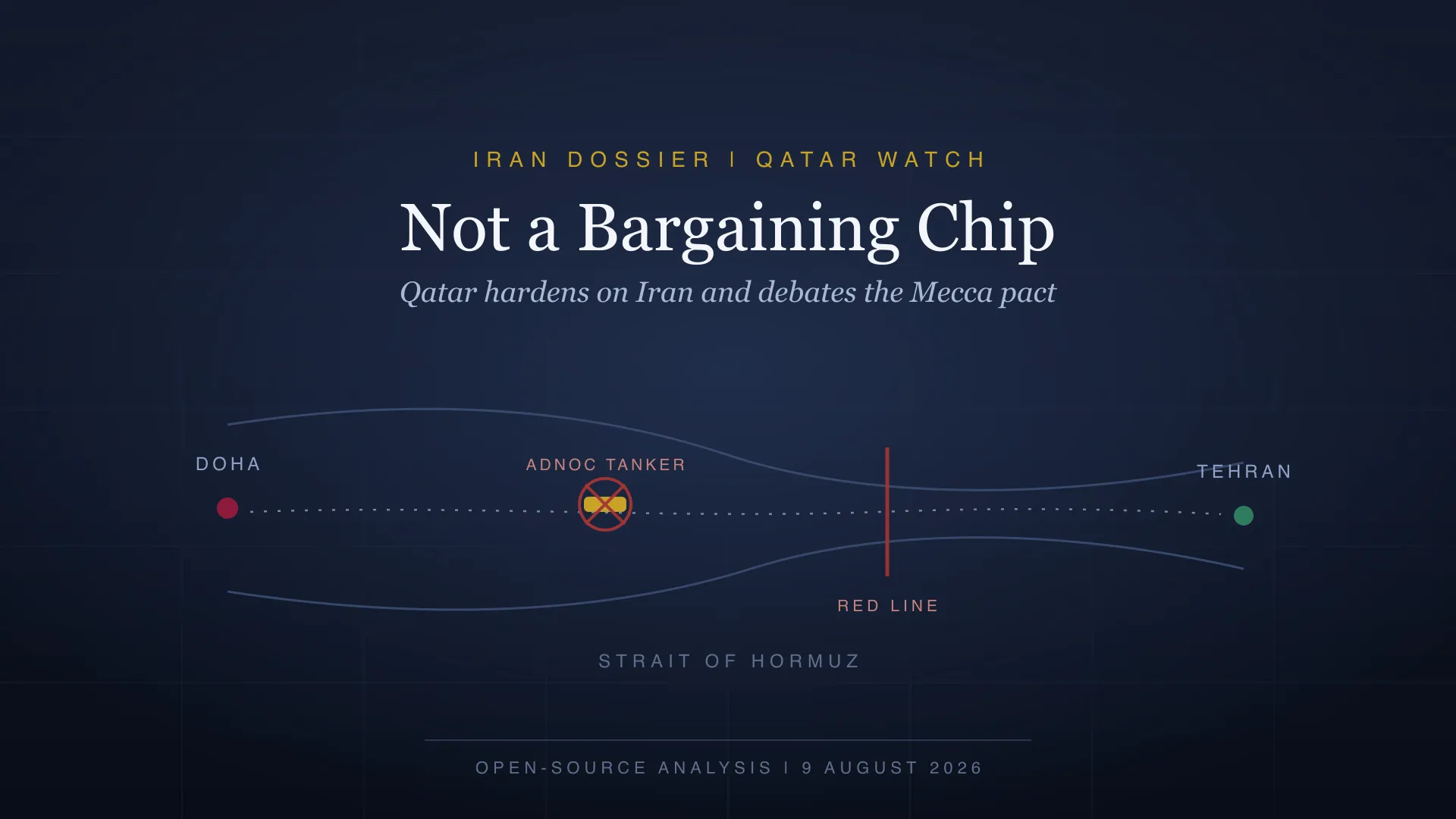
The strongest press indicator in the window is Al-Sharq’s formal editorial, “The Strait of Hormuz Is Not a Bargaining Chip.” The newspaper’s institutional voice calls the Iranian missile strike on an ADNOC-affiliated Emirati tanker an unjustified attack and a breach of international law, endorses Qatar’s demand that Hormuz be reopened without conditions, and says maritime freedom cannot be traded for political concessions, while still supporting the Oman-Iran negotiation track. The message is disciplined but firm: diplomacy remains the method, yet Iran’s maritime coercion is no longer treated as an understandable negotiating tactic.
Official messaging moved in the same direction. Qatar Tribune carried two August 8 statements that sharpen the government line: Qatar strongly condemned the tanker strike as a flagrant violation of international law and demanded the unconditional reopening of Hormuz, and Doha welcomed the UN Security Council’s condemnation of Houthi attacks on Saudi Arabia while declaring Saudi security an integral part of Qatari and GCC security. Together these move the public Qatari line beyond generic de-escalation toward explicit Gulf solidarity against Iranian and Iran-aligned coercion.
External reporting supports the factual background rather than generating it: Reuters reported the UAE’s attribution of the tanker strike to Iran, Iranian statements that a technical Oman route arrangement was close but would not by itself reopen the strait, and the IRGC’s public position that reopening depends on American concessions.
The Debate Doha Wasn’t Having Last Week
The second signal is that alignment with the Mecca defence pact has moved from foreign analysis into Qatar’s own opinion pages, and into elite intervention. Multiple Al-Sharq columns published late on August 8 treat the pact as a potentially historic step in regional deterrence: one places Qatar’s existing military relationship with Türkiye inside an emerging Gulf security system; another assesses the pact as the possible nucleus of a new regional order built on collective defence, intelligence sharing, joint exercises and defence-industrial integration; a third, more openly enthusiastic, blames the present insecurity on hostile regional actors and external powers alike; a fourth links Bab al-Mandab and Hormuz as a single strategic maritime theatre.
The most consequential intervention came from outside the papers’ opinion pages. Former prime minister Sheikh Hamad bin Jassim bin Jaber Al Thani publicly welcomed the Mecca pact and urged the remaining GCC states to join it, arguing the arrangement should be permanent and should develop into a shared defence strategy covering defence manufacturing, armament, planning and operational preparedness. That is not an official government statement, but it is one of Qatar’s most influential former decision-makers directly raising the question of Qatari participation.
Notably, the emerging Qatari threat model is multi-directional. Al-Sharq’s writers identify the IRGC, the Houthis and Iraqi militias as threats, but also cite Israeli military policy and the weakening reliability of the US security umbrella. The preferred answer running through the debate is diversified regional deterrence, neither alignment with Tehran nor complete dependence on Washington.
The Trilemma
Underneath the harder tone sits a real trilemma, and the three pulls do not reconcile. Tehran is a partner Doha cannot discard: Qatar shares the world’s largest gas field with Iran, needs open water through Hormuz, and keeps a working line to Hamas through Khalil al-Hayya’s presence in the city. Ankara is the pole Qatar is now leaning toward, the natural bridge into the Saudi-Turkish-Pakistani architecture that its own opinion pages are urging it to join. Washington is the guarantor of last resort, host of Al Udeid, the power that named Qatar a major non-NATO ally in 2022, and the reason Doha has sat under a security umbrella at all. In a calmer period Qatar could serve all three at once. The autonomy debate now running through Al-Sharq and Al Jazeera forces the choice it has spent a decade avoiding.
The Ankara pull carries a hardening risk. As Doha aligns more closely with the Turkish-led architecture, its own posture tends to run harder: the line on Israel sharpens, receptivity to the resistance axis grows, and the US-anchored order starts to be described as something to be constrained rather than relied upon. That erodes the mediator credibility that is Qatar’s core asset and invites friction with Washington, including renewed congressional scrutiny of Brotherhood-linked networks. Washington’s stake is concrete, and its signal to Doha has been steady: hedge if you must, but do not build the exit.
Al Jazeera Builds the Case
Al Jazeera should be read separately from formal government messaging, but in this window both services concentrated on the same story, and the direction of the output is unmistakable. On the Arabic side, Khaled Mohammed Batarfi presented the pact as the possible foundation of a more independent Islamic defence system, stressing deterrence against missiles, drones and cross-border militias while arguing the pact should keep dialogue with Iran open, which is close to the Doha line word for word: autonomous, Turkish-anchored deterrence as a natural Islamic project.
Al Jazeera English went further. Nawaf Obaid’s opinion essay, “The post-American Middle East is beginning to take shape,” argues explicitly that the American era is ending, that the rest of the Gulf should join the pact, and that the new architecture should impose strategic limits on both Iranian coercion and Israeli military adventurism. Its warning that staying outside the main regional defence architecture could create strategic isolation reads as direct pressure on Doha to commit. A separate AJE news analysis quietly set expectations, naming Qatar and Kuwait as the most plausible next members and citing Qatar’s longstanding relationship with Türkiye as the reason. Meanwhile AJE’s Hormuz coverage gave notably more space to Tehran’s bargaining logic than the state papers allowed, preserving the division of labor this series has tracked before: the state speaks to the Gulf, the network speaks to the wider resistance-sympathetic audience.
Gaza Recedes, For a Day
The Gaza file did not disappear, and the established line remains intact: Qatar and its media treat the Trump plan as a mechanism that should produce Israeli withdrawal, reconstruction and transition to Palestinian civilian governance, while arguing that Israel’s continuing attacks obstruct implementation. Al Jazeera Arabic’s vocabulary remains politically meaningful, introducing Hamas as the Islamic Resistance Movement and discussing Palestinian armed actors within “the resistance.” But the strongest fresh Qatari press signal of this 24-hour cycle was not a new Gaza initiative; it was the reordering of priorities. Doha’s emerging public-security narrative is an attempt to hold two positions simultaneously: sustained political pressure on Israel, and stronger collective deterrence against threats to Gulf sovereignty and maritime trade.
Key Points
- The strongest new Qatari media signal is a harder line toward Iran on maritime security, visible in a formal Al-Sharq editorial rather than merely in wire copy: Doha is preserving dialogue while drawing a clearer red line around Gulf sovereignty, shipping and energy security.
- A genuine Qatari debate is emerging over participation in, or alignment with, the Saudi-Turkish-Pakistani security architecture. The discussion has moved into Qatari opinion pages and been joined by former prime minister Hamad bin Jassim’s call for GCC accession.
- Türkiye is the key bridge: Qatar’s existing defence relationship with Ankara can connect it to the emerging system without formal accession, which is why Doha does not need to choose immediately.
- The Qatari threat model is becoming explicitly multi-directional: Iranian coercion and Axis actors as immediate military threats, Israeli military activism as a parallel strategic risk, and US protection as important but insufficient on its own.
- Gaza remains a central ideological and diplomatic file, but the August 8-9 press pulse shows Gulf self-defence and maritime sovereignty at the top of the agenda.
- The autonomy debate carries a radicalisation risk Doha will have to manage: the closer Qatar aligns with the Turkish-led architecture, the harder its posture tends to run on Israel and on the US-anchored order, eroding the mediator credibility that is its core asset.
What to Watch
- Any formal Qatari government comment on the Mecca pact, GCC accession or collective-defence language, following Hamad bin Jassim’s intervention.
- Whether Al-Sharq’s red-line framing on Hormuz migrates into Foreign Ministry statements.
- Whether Al Jazeera English sustains the explicit post-American framing, and whether Doha absorbs or distances itself from the strategic-isolation argument.
- The conditions attached to any Hormuz reopening: Iranian fees, permits or oversight would test the unconditional-reopening demand now on record.
This post summarizes the Iran Dossier Qatar Watch report for August 9, 2026, covering the August 8-9 reporting window. The full report, including the press review, the Al Jazeera media barometer, judgments and the complete linked source register, is available here: Qatar Watch, 9 August 2026 (PDF).