Mediation Plus Accountability: Doha Takes Hormuz to Beijing, Builds a Claims File on Iran, and Names Its U.S. Critics
Qatar’s agenda in this reporting window is unusually coherent. Doha is pushing three messages at once. Freedom of navigation through Hormuz must be restored without abandoning mediation, forced displacement from Gaza is a coordinated Arab-Islamic red line, and Qatar’s most important external partnerships, above all China and Turkey, are instruments of strategic resilience. China has moved to the center of the Iran file. The Foreign Ministry announced that Prime Minister and Foreign Minister Sheikh Mohammed bin Abdulrahman Al Thani will visit China on September 7 and 8, and the agenda explicitly includes de-escalation and the security and freedom of international navigation through the strait. In the same window, Al-Araby Al-Jadeed reported that Qatari authorities are building a legal file documenting Iranian attacks and losses, with future compensation claims under consideration. We assess that Doha is refining a two-track Iran policy. The diplomatic channel stays open because Qatar needs a negotiated maritime settlement, while a separate legal track protects its right to compensation and establishes that attacks on Qatar are not being politically normalized. Two other items carry weight. The outgoing Turkish ambassador described defense ties moving from training and exercises to integrated co-production and technology exchange, and Deputy Chief of Mission Hamad Al-Muftah publicly named the U.S. organizations scrutinizing Qatar Foundation as a coordinated campaign, four days before the Education Department’s delayed Section 117 release. This post summarizes our Qatar Watch report for September 7.
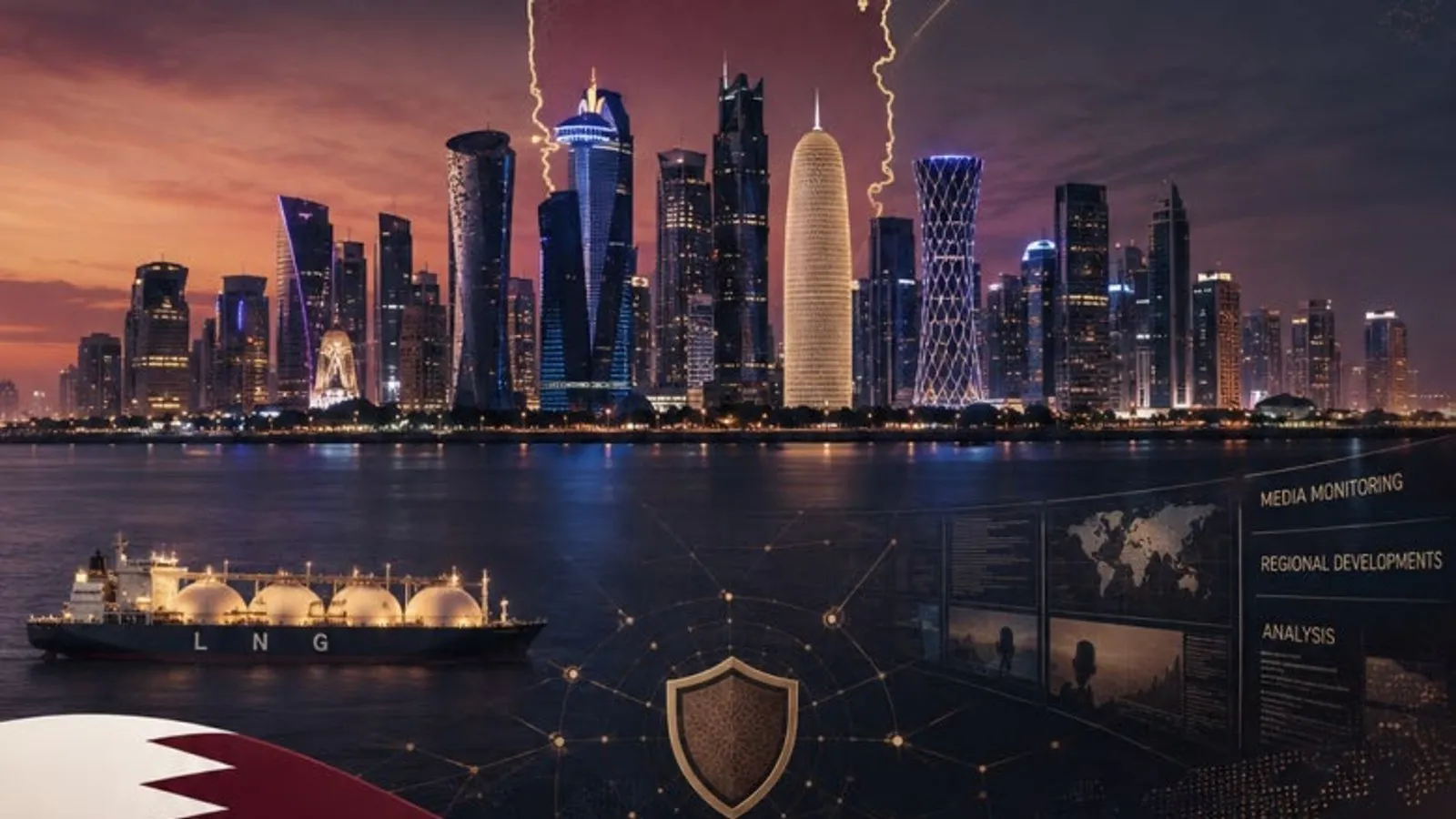
Beijing at the Center: The Prime Minister’s China Visit
The central official Qatari story of the morning is the prime minister’s trip to Beijing. The Qatar News Agency and the Foreign Ministry announced on September 6 that Sheikh Mohammed bin Abdulrahman will visit China on September 7 and 8 for talks on strategic relations, economic and investment cooperation, and regional developments. The announcement explicitly places de-escalation and the security and freedom of international navigation through the Strait of Hormuz on the agenda. The Peninsula carried the Foreign Ministry statement on the afternoon of September 6, and Qatar Tribune and Gulf Times led their September 7 editions with the trip. The report grades this as high-confidence official reporting, confirmed directly by the ministry and QNA and repeated across the English-language dailies.
The Qatari press supplied the framing. Al-Sharq’s 06:30 strategic feature argued that Qatar-China ties are moving beyond LNG into investment, infrastructure, technology, finance, and the digital economy, and that political coordination between the two governments is becoming more important as regional instability deepens. The feature was timed to the visit, and it presents Beijing as a strategic diversification and diplomatic partner rather than only an energy customer. That framing matters because of what China is to Qatar at this moment. Beijing is a major buyer of Qatari gas, a strategic economic partner, and a power with leverage in Tehran. The report’s assessment is that Qatar is placing its most important external relationships at the service of its immediate maritime-security problem, and that China is the obvious partner for a strategy that pairs diplomacy with pressure on Iran. The freedom-of-navigation condition Doha is carrying to Beijing is the one we traced on September 6 in The Mediator’s Condition, when the Foreign Ministry’s Lebanon readout and Al-Sharq’s editorial first converged on it.
Gulf Times’ morning front page shows how the pieces fit together. Its top stories combined the Amir’s call with Norway’s prime minister, which covered the Palestinian issue and international efforts for regional stability, the prime minister’s departure for China, and Qatar’s joint rejection of Gaza displacement. The report reads the juxtaposition as revealing. Qatar’s English-language morning agenda leads with mediation, strategic partnership, and Palestine, not with battlefield reporting, and Iran appears chiefly through Hormuz and the China mission. Al-Arab’s early-morning regional lead, an agency-led piece describing reciprocal attacks on tankers and military vessels in the strait, is the exception. It is not a Qatari editorial line, but its importance for Qatar is structural, because escalation in Hormuz feeds directly into LNG exports, shipping risk, insurance costs, and Doha’s diplomatic urgency.
The Legal File: Mediation Without Ambiguity About Responsibility
Qatar is hardening its legal posture toward Iran while preserving its political channels. Al-Araby Al-Jadeed’s politics desk reported, in what it presented as an exclusive, that Qatar has chosen international legal channels as the main vehicle for responding to Iranian attacks and is documenting incidents and losses to preserve the basis for future claims. The report refers to damage affecting the energy sector and to the broader economic cost of attacks on Qatari territory. Qatar Watch treats this as one of the most important Qatar-specific items in the window. It adds a legal and accountability layer to Doha’s diplomatic approach and suggests that Qatar is preparing for a post-conflict claims process rather than relying on political mediation alone. The item extends the trajectory we followed last week, from condemnation without legal attribution to the September 4 letters to the UN Secretary-General and the Security Council president, in which Doha reserved its right to full compensation. The formula is now sharper. Mediation continues, but it no longer requires ambiguity about who is responsible for attacks on Qatari territory.
The report’s assessment is that Qatar is refining a two-track Iran policy. Doha keeps the diplomatic channel open because it needs a negotiated maritime settlement. At the same time, it is building a legal case that protects its right to compensation and establishes that attacks on Qatar are not being politically normalized. China is the obvious external partner for this strategy because it has both economic stakes in Qatari gas and influence in Tehran. Al-Araby Al-Jadeed’s economy desk supplied the market context in two pieces. The first reported a gradual recovery in oil flows through Hormuz despite continued tension, with Qatar and Kuwait highlighted in the regional flow picture. The report’s reading is that the significance for Qatar lies less in crude volumes than in market confidence. Any normalization of passage reduces the immediate risk premium on Qatari exports, but the recovery remains fragile and does not remove the structural vulnerability of LNG shipments. The second piece argued that attacks on tankers and reciprocal maritime exchanges are pushing navigation and insurance into a critical risk zone, with consequences for Gulf fiscal balances, shipping costs, and energy revenues. Qatar is among the Gulf states most exposed because of the concentration of its LNG infrastructure and export routes, a point set out in The Broker’s Balance Sheet. External verification found that international and Qatar-based reporting converge on the same operational picture. Traffic has begun to recover in places, but tanker attacks and reciprocal strikes continue to make Hormuz a high-risk route. International wires are used only to corroborate those conditions, not to lead the report, and the naval exchange itself is covered in today’s Hormuz-axis daily.
Shared Destiny: The Turkish Ambassador’s Farewell Interview
The most substantive Qatar Watch item of the day is a valedictory interview. At 07:00 on September 7, Al-Sharq published a farewell conversation between Turkish Ambassador Mustafa Goksu and the paper’s editor-in-chief, Jaber Al-Harmi, together with Awatef Ben Ali, at the close of his six-year posting. The Foreign Ministry had held its formal farewell meetings on September 1 and 2. Goksu described a relationship spanning politics, defense, security, investment, trade, education, culture, tourism, and media, anchored in the Supreme Strategic Committee, which was set up in 2014 and meets annually. He said its 11 sessions have produced more than 125 agreements, 67 of them signed during his tenure. The military passage is the most substantive. In his account, defense ties have undergone a decisive strategic shift from training, military education, and joint exercises to a comprehensive and integrated defense partnership resting on joint capability development, technology exchange, and the upgrading of defense industries. Turkey contributes manufacturing depth in unmanned systems, electronic warfare, naval platforms, and command-and-control systems, and Qatar contributes investment capacity and vision. On Gaza, he described consultation without interruption at the highest level on restraining the aggression, securing relief flows, and backing mediation, guided by a single doctrine of ending the tragedy, imposing an immediate ceasefire, and reaching a just and comprehensive settlement. Asked what stayed with him from the leaders’ summits, he named not an agreement but the certainty that the two states are bound by a shared destiny that goes beyond passing interests and files.
The report notes that the valedictory format gives the ambassador license to summarize six years of policy on the record, and that a prominent editor-in-chief interview signals how Al-Sharq wants the relationship read. Israel is framed through Gaza and the need to restrain aggression. Qatar and Turkey are portrayed as complementary actors, with Ankara supplying defense-industrial capacity and Doha supplying capital and diplomatic reach. The tone matches Al-Sharq’s July 30 profile of the same relationship, which recorded President Erdogan’s condemnation of any violation of Qatari sovereignty during the Iranian attacks and the joint satellite agreement pairing Suheyl-3 with Turksat-Biruni. The institutional depth of the relationship is not new, and we described its committee structure and standing Turkish military presence in The Direct Channel. What is new is the vocabulary.
The report’s assessment is that the relationship should be understood as an institutionalized strategic network rather than a leader-to-leader affinity, and that its value to Qatar lies in redundancy. It offers political backing, defense depth, trade, a mediation partner, and access to a large regional media and educational ecosystem. Two points deserve weight. First, the defense description now uses the language of co-production and technology transfer, not procurement. If that is operationalized, Turkey becomes a structural part of Qatar’s post-attack rearmament and reduces Doha’s dependence on U.S. and European suppliers. Second, the interview lands while Ankara is also building out the Mecca Joint Defense Agreement with Saudi Arabia and Pakistan, so Qatar’s bilateral track sits inside a wider Turkish security architecture in the Gulf that Doha has been debating on its own terms. For Qatar Watch the operative point is that Turkey is presenting itself to a Qatari audience as a defense co-producer at the moment Doha is documenting Iranian damage and looking for external guarantors. The shared-destiny formulation is stronger than the usual language of partnership and deserves continued monitoring, as do the identity and early messaging of Goksu’s successor.
Gaza: The Anti-Displacement Coalition and the Al-Sharq Editorial
Gaza remains a formal Qatari diplomatic priority as well as a media theme. Qatar joined Saudi Arabia, Jordan, the UAE, Indonesia, Pakistan, Egypt, and Turkey in condemning Israeli proposals and statements concerning the displacement of Palestinians from Gaza. The joint foreign ministers’ statement rejects forced displacement, inside or outside the occupied Palestinian territory and under any pretext, reiterates Gaza’s integral status within that territory, and reaffirms a two-state settlement on the 1967 lines with East Jerusalem as its capital. Al-Watan carried the QNA-derived text as its lead political item, and Doha News added explanatory detail about the Israeli proposals while reproducing the official line. The report’s observation is about the shape of the coalition. It includes both Turkey and the UAE, which means Doha is operating through a broad anti-displacement alignment that crosses several regional political camps rather than acting alone.
Al-Sharq turned the joint statement into the paper’s own voice. Its 02:00 institutional editorial says that forced removal from Gaza is not a policy option but a violation of international and humanitarian law, and it presents Qatar’s political, diplomatic, and humanitarian activity as a consistent defense of Palestinian permanence, self-determination, and a state on the 1967 lines. The report treats this as stronger evidence of the domestic Qatari line than a QNA relay, because it is the newspaper’s institutional voice. Israel is framed as trying to impose a new demographic and geographic reality by force. The editorial does not center Hamas or the Muslim Brotherhood. It centers Palestinian national rights and international accountability. A signed column in the same edition supplies a useful domestic-attitude indicator on Iran. Writing explicitly as a Qatari, Mohammed Ibrahim Al-Hassan Al-Mohannadi contrasts earlier positive Qatari memories of Iran with the current war, which he says Tehran has imposed on Gulf societies with disregard for their security, their economic interests, and their role in supplying global energy. He portrays Qatar and the other Gulf states as builders of stability while Iranian conduct has crossed into direct, high-risk coercion. This is not an official statement. However, its tone is markedly more personal and accusatory toward Iran than Doha’s formal mediator language, and the report reads it as a sign that the social and elite narrative around Iran is hardening even as the government preserves diplomatic channels.
Qatar’s welfare instruments remain active in the background. Al-Sharq reported that Qatar Charity distributed more than 1,200 food baskets, totaling roughly 84.6 tons, to vulnerable families in Deir ez-Zor, Syria, in cooperation with the Molham Volunteering Team, with more than 6,000 people reported to benefit. The activity is modest relative to Qatar’s largest aid programs. The report’s assessment is that humanitarian institutions remain a persistent low-intensity influence instrument. They create networks, brand presence, and relationships with local implementers even when no major state-level aid package is announced, and they extend Qatari reach outside the most visible Gaza file. Taken together, the Gaza material shows a division of labor that has been visible for weeks. Formal diplomacy is coalition-based and anchored in international law, while Qatar-based Arabic media sustain a more ideological regional discourse. That gap is not evidence that every media argument is state policy, but it is part of the influence environment in which Qatar operates.
Al Jazeera Arabic: U.S. Power, Iran’s Three Maps, and Turkey as Peacemaker
The four Al Jazeera pieces reviewed share a strongly structural reading of the regional order. A September 7 opinion essay on the current Gulf war argues that the conflict does not fit classic models of decisive victory or negotiated settlement. In the author’s account, repeated U.S.-Israeli campaigns against Iran have been tactically intense but politically inconclusive, and the war is shifting toward intermittent blows, Hormuz, sanctions, and coercive bargaining. He questions whether Washington has a stable theory of victory and warns that war termination may remain elusive even where military superiority is clear. The recurring vocabulary is skeptical of U.S. strategic coherence. Israel is treated as a partner in the initial regime-change and nuclear logic but as less central in the current phase, and Iran is framed as a state able to absorb pressure and exploit geography. Qatar is not the authorial focus, but the analysis reinforces Doha’s own argument that only a political settlement can stabilize Hormuz.
A September 6 blog by Ali Juma al-Obeidi, the Libyan ambassador in Tehran, explains Iranian power through three overlapping geographic arenas. These are the Gulf and the Arab Mashreq, the Caucasus and Central Asia, and the Sea of Oman, the Indian Ocean, and Asia. Hormuz gives Iran leverage over global energy flows, but alternative corridors, Turkish connectivity, Russian interests, and China’s expansion all threaten to reduce the value of Iran’s location. The report finds the piece unusually useful for Qatar Watch because it treats Hormuz as both Iranian leverage and a source of systemic vulnerability, with Turkey cast as a competitor over corridors and China as an expanding economic actor. Two further blogs round out the set. Omar Fares’s open letter to defenders of Israel’s public diplomacy is explicitly polemical and defines its argument around Palestinian rights, occupation, displacement, the Nakba, and political responsibility for civilian suffering. Its vocabulary is substantially sharper than the English service’s standard news language, and the report grades it as author commentary that illustrates the ideological bandwidth permitted in the Arabic blog ecosystem rather than as network editorial policy. A blog on Kurdistan Region President Nechirvan Barzani portrays him as a pivotal intermediary in the Turkish-Kurdish peace track and argues that President Erdogan relies heavily on his political skill to keep the process moving. For Qatar Watch the significance is indirect. The piece reinforces a broader Qatar-based narrative in which Ankara is not only a military actor but a regional conflict manager and diplomatic pole.
The Arabic-English comparison holds the pattern of recent days. The Arabic service remains more willing to use structural and ideological language, including occupation, the Zionist project, and resistance-adjacent framing, and to host commentary questioning the strategic logic of U.S. and Israeli power. No equally prominent English-language opinion item inside the window matched the intensity of the three Arabic blogs and the September 7 Gulf-war essay. Hamas terminology was not central to the four pieces, so the report infers no new language shift on Hamas from them. The political-cartoon check found no qualifying new September 7 cartoon on the Al-Araby Al-Jadeed cartoon page before the 07:30 cut-off, and no older cartoon is substituted as new material.
The Diagram: Al-Muftah Names Qatar’s U.S. Critics Before the Section 117 Release
Qatar has moved from passive rebuttal to an active counter-campaign over U.S. university funding. Deputy Chief of Mission Hamad Al-Muftah publicly described the current scrutiny of Qatar Foundation as a “coordinated disinformation campaign” and published a diagram linking the Foundation for Defense of Democracies and Craig Singleton’s Wall Street Journal op-ed, the Brandeis Center and its lawyers, Jewish Insider, the September 4 Chicago Tribune commentary, and pressure from House Education Republicans. He claimed the network had placed people in key positions through shared donors and said more information would be sent to the authorities. The report is explicit that these are claims, not established facts. The trigger was new social-media circulation of the August 26-27 FARA amendment under which Qatar Foundation raised Venable LLP’s fixed monthly fee from 25,000 to 40,000 dollars and widened its target audience from Congress and the administration to state and local officials, a filing we covered on September 5. Eitan Fischberger, who highlighted the amendment, subsequently mocked Al-Muftah’s engagement and said the deputy ambassador had briefly unblocked him to comment before blocking him again. The report treats the personal exchange as secondary. The policy significance lies in the Qatari embassy’s increasingly public effort to discredit the institutional network scrutinizing Qatar Foundation.
The evidentiary layers must be kept separate. The Venable amendment and its fee and outreach changes are documentary FARA evidence. Al-Muftah’s description of a coordinated disinformation network is a Qatari diplomatic claim. The fact that FDD, Brandeis Center officials, Jewish Insider, the Wall Street Journal, and the Chicago Tribune all produced related material is observable, but coordination, common control, donor direction, or improper conduct is not established by that sequence alone. More significant than the accusation itself is the posture. A senior Qatari diplomat is naming U.S. critics, tracing relationships among them, and promising to transmit additional allegations to authorities, and the report reads this as an escalation in Qatar’s U.S.-facing reputational defense. Al-Muftah’s argument is not improvised. The embassy’s own FARA-filed informational materials from August 2025 make the same case, that Section 117 totals mostly reflect Education City operating costs and that former Director of National Intelligence Avril Haines testified there was no evidence of Qatari funding of antisemitic activity on U.S. campuses. What is new is the delivery, which repeats the pattern from May, when Al-Muftah answered MEMRI’s report on his X activity directly and by name. It also contrasts with the handling of Ambassador Huckabee’s campus-funding charge, which Doha answered at ambassador level and then let drop from its own press.
The regulatory clock explains the intensity on both sides. The Department of Education announced on July 6 that it would publish the names of foreign sources from prior Section 117 reporting cycles on July 15. It has since postponed the release to July 29, August 12, August 26, and now September 11. On August 26 the Brandeis Center asked Attorney General Todd Blanche and the Justice Department’s FARA Unit to investigate whether Northwestern University acts as a public-relations agent of Qatar, citing 737 million dollars in Qatar Foundation funding since 2007, annual operating support of 25 to 35 million dollars, management fees that partly support the Evanston journalism and communications schools, and a contractual undertaking to abide by Qatari law. The letter builds on a similar May request concerning Georgetown’s Bridge Initiative, and on August 31 the Center filed a FOIA request for the delayed report. The Department’s foreign-funding portal, launched in January, records Qatar as the largest foreign funder of U.S. higher education at roughly 6.6 billion dollars, led by Cornell at 2.3 billion, followed by Carnegie Mellon, Texas A&M, Georgetown, and Northwestern. An overnight Chicago Tribune opinion item also focused on Northwestern, Qatar, and antisemitism. The Tribune page could not be independently retrieved through the available web interface, so the report does not elevate unverified details from that commentary into a factual finding. Its presence is nevertheless consistent with the continuing U.S. public debate over Qatar-funded higher education.
Key Points
- China has moved to the center of Qatar’s Iran and Hormuz diplomacy. The prime minister’s September 7-8 visit places de-escalation and freedom of navigation explicitly on the agenda, and Beijing is the obvious partner for a strategy that pairs diplomacy with pressure on Tehran because it holds both economic stakes in Qatari gas and influence in Iran (high confidence on the official line, moderate on the assessment of Chinese leverage).
- Qatar is refining a two-track Iran policy. Mediation continues because Doha needs a negotiated maritime settlement, while a separate legal file documenting attacks and losses protects its right to compensation and establishes that attacks on Qatar are not being politically normalized (high confidence on the Al-Araby Al-Jadeed reporting and the UN letters, moderate on the assessment).
- The Qatar-Turkey relationship is best understood as an institutionalized strategic network whose value to Qatar is redundancy. The ambassador’s description of co-production and technology transfer, if operationalized, would make Turkey a structural part of Qatar’s post-attack rearmament and reduce its dependence on U.S. and European suppliers (high confidence on the interview content, moderate on the operational outcome).
- That bilateral track now sits inside a wider Turkish security architecture in the Gulf, given Ankara’s parallel work on the Mecca Joint Defense Agreement with Saudi Arabia and Pakistan (moderate confidence).
- Gaza remains a formal diplomatic priority pursued through coalition diplomacy. The eight-state anti-displacement statement crosses regional camps, and Al-Sharq’s institutional editorial shows the position is the domestic line, not only a QNA relay (high confidence).
- Qatar-based media continue to sustain a more ideological regional discourse than Doha’s formal language, and Al-Mohannadi’s column suggests the elite narrative on Iran is hardening even as the government preserves channels (high confidence on the content, moderate on the assessment).
- Al-Muftah’s diagram marks an escalation in Qatar’s U.S.-facing reputational defense. The publication sequence involving FDD, the Brandeis Center, Jewish Insider, the Wall Street Journal, and the Chicago Tribune is observable, but common direction, donor control, or improper coordination is not established by the material reviewed (high confidence on the existence and content of the counter-campaign, moderate on any broader claim of coordinated anti-Qatar activity).
- The Venable FARA amendment, the Section 117 postponement timeline, and the Brandeis Center referrals are documentary and carry high confidence. The September 11 release date is the next hard test of whether the Department publishes on time and how Qatar Foundation entities are named (high confidence).
What to Watch
- Whether Beijing publicly echoes Qatar’s language on freedom of navigation, and whether the talks produce a specific Iran or Hormuz initiative.
- Whether Qatari ministries, QatarEnergy, or legal advisers publish quantified damage estimates, claims procedures, or evidence packages related to Ras Laffan and other attacks.
- QatarEnergy notices on cargo schedules, force majeure, insurance, ship-to-ship loading, or alternative logistics.
- Any follow-on agreement or statement that operationalizes Qatar-Turkey defense-industrial cooperation, technology transfer, or joint Gaza diplomacy, and the identity and early messaging of Goksu’s successor.
- Whether Doha moves from the anti-displacement coalition statement to a new ceasefire or postwar governance initiative.
- Whether the Department of Education’s Section 117 release appears on September 11 after four postponements, and how Qatar Foundation entities are named in it.
- Whether Al-Muftah or the embassy publishes the additional information he says will be sent to authorities, whether House Education Republicans respond, and whether the Justice Department’s FARA Unit acts on the Brandeis Center’s Northwestern and Georgetown referrals.
- Whether the sharper structural language on Israel and U.S. power in Al Jazeera Arabic and Al-Araby Al-Jadeed is sustained or intensifies after the China visit and new Hormuz developments.
This post summarizes the Iran Dossier Qatar Watch report for September 7, 2026, covering the hard reporting window from 07:30 on September 6 to 10:30 on September 7. Primary collection emphasized QNA, the Qatari Foreign Ministry, and the local Qatari press, followed by Al Jazeera and Al-Araby Al-Jadeed, external critical research, and narrow international verification. Sources include the Foreign Ministry’s visit announcement, Al-Sharq, Al-Watan, Al-Arab, Gulf Times, The Peninsula, Qatar Tribune, Doha News, Al Jazeera Arabic, and Al-Araby Al-Jadeed, with external material from the FARA registration database, the Brandeis Center, Inside Higher Ed, and MEMRI. International wire reporting is used only to corroborate maritime conditions and does not lead the assessment. The report’s confidence grading is preserved here: high on the official Qatar-China and Hormuz line, the Turkish ambassador’s interview, the Gaza anti-displacement statement, the Qatar Charity activity, the existence and content of Al-Muftah’s counter-campaign, the Venable FARA amendment, the Section 117 timeline, and the Brandeis Center referrals; moderate on broader claims of coordinated anti-Qatar activity, where the publication sequence is observable but common direction is not established by the material reviewed.