The Broker's Balance Sheet: Qatar's $24 Billion Reason to Reopen Hormuz
The collapse in Qatar’s gas revenue is now the primary material driver of its foreign policy. Reuters calculations published this week put lost LNG sales at roughly $24 billion over the six months since the war began, with exports down as much as 96 percent, and Doha’s first-quarter fiscal data already show revenues falling by nearly a quarter. The report assesses that the intensity of Qatar’s Hormuz mediation follows the fiscal data as closely as it follows the diplomatic calendar, and that Doha’s objective has moved beyond de-escalation to shaping the settlement’s architecture: a formula that restores unconditional navigation rather than converting Iran’s ability to close the strait into a recognized right to manage it. The same window showed the Qatar-Turkey relationship shifting from diplomatic alignment toward operational integration. This post summarizes our Qatar Watch report for August 30.
The $24 Billion Engine
The war economy file moved into hard numbers this week, and they reframe everything else Doha is doing. Reuters calculations carried by OilPrice put Qatar’s lost LNG sales at some $24 billion over six months of war, with exports down as much as 96 percent: 18 cargoes shipped against 509 in the same period last year, on ICIS data. QatarEnergy expects the damage to Ras Laffan to cost about $20 billion a year in lost revenue, with repairs taking up to five years, and has declared force majeure of up to five years on some long-term contracts. In a reversal without precedent for the exporter, QatarEnergy has been buying US spot cargoes to serve its Asian term customers, while US LNG fills the European gap and Doha’s market share erodes with every month the strait stays shut.
The domestic transmission is already visible. The first quarter of 2026 closed with a deficit of QAR 10.3 billion (about $2.8 billion) as revenues fell 23.5 percent year on year, more than twenty times the prior-year shortfall, and a 3.7 percent cut in expenditure absorbed little of the shock. Jefferies projects the deficit widening to around 9 percent of GDP this year. Budgets of some government-funded entities have been cut, and the Qatar Investment Authority is expected to take a larger role in domestic stabilization at the expense of the surplus that would normally flow into the fund. Wednesday’s edition traced the early stages of this squeeze; the new data confirm its scale.
The report’s central judgment follows from these numbers. The revenue collapse is now the material engine of Qatari policy. It explains the intensity of the Hormuz mediation, gives Doha a direct stake in a settlement that restores unconditional navigation rather than a managed Iranian corridor, and squeezes the state budget without yet touching the influence instruments, which are equity positions and institutional holdings rather than recurring spend.
The Hormuz Order Debate
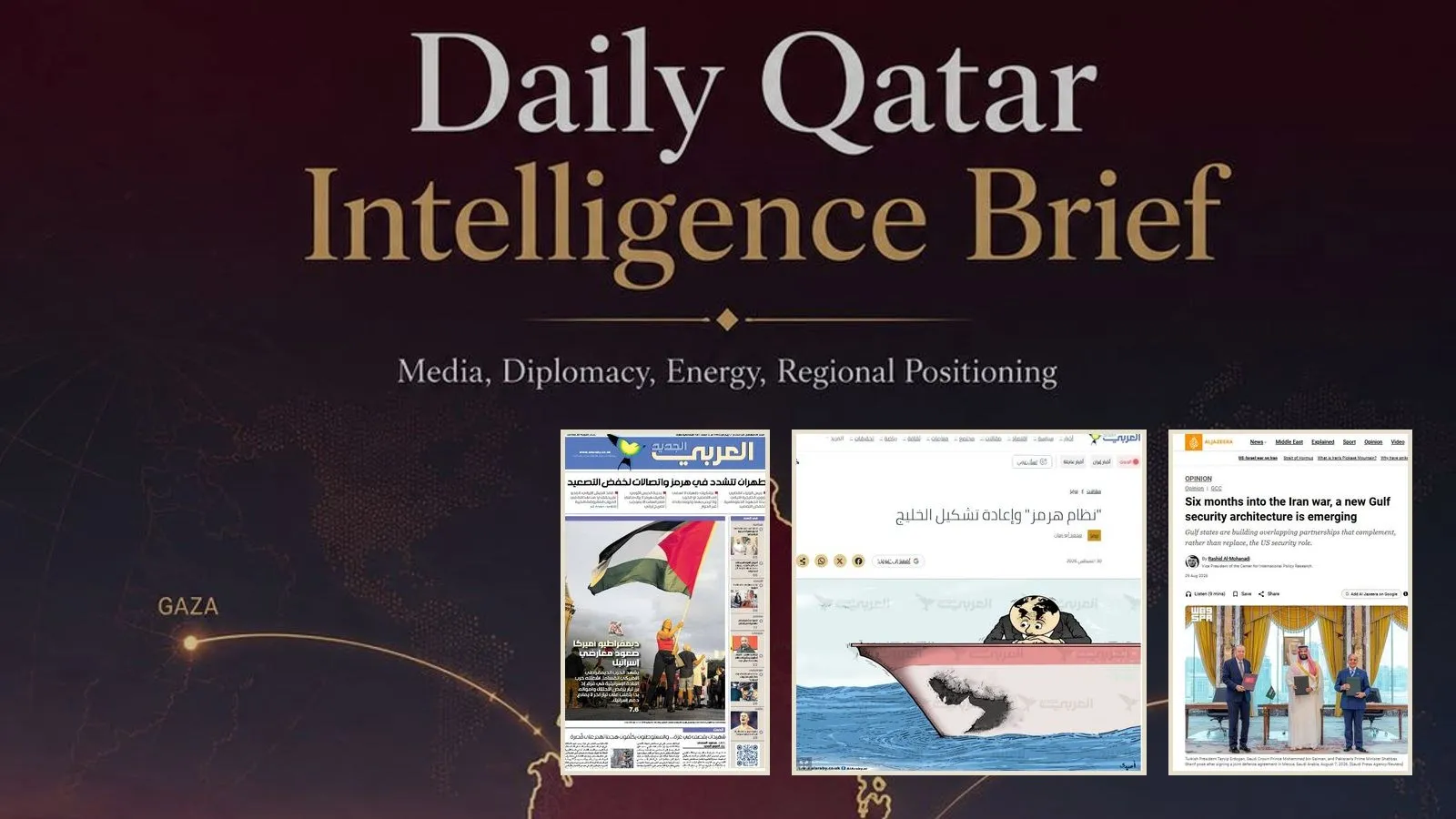
The most revealing analysis in the window came from inside the Qatari-funded media space. An essay in Al-Araby Al-Jadeed’s opinion section, published under the title “The ‘Hormuz Order’ and the Reshaping of the Gulf,” argues that the Iran-Oman understanding is no longer a conventional mediation product because Oman itself is becoming a direct negotiating party over shipping lanes, navigation arrangements, and possible revenues, while a substantial part of the political mediation has shifted to Qatar and Pakistan. In this reading, Doha’s task is no longer simply to bridge Washington and Tehran. It is to help produce a formula acceptable to the United States and the Gulf states without converting Iran’s ability to close Hormuz into a permanent political right to manage it.
The essay’s strongest point concerns narrative and sequencing. Washington does not want to lift pressure in a way that lets Tehran claim it forced concessions by closing the strait, and Tehran does not want to reopen it in a way that looks like capitulation under sanctions. Qatar and Pakistan therefore face the task of finding language and sequencing that allow both sides to claim they did not retreat. The warning is explicit: an agreement recognizing a special Iranian role in managing passage could convert a military disruption capability into a durable strategic gain.
Iranian messaging in the window illustrated the problem. Al Jazeera Arabic reported Deputy Foreign Minister Kazem Gharibabadi saying the strait remains closed and vessel passage requires Iranian coordination and permission, that an understanding has been reached with Oman, and that implementation requires Washington to fulfill its commitments. He named Qatar and Pakistan as participants in the diplomacy. Al-Araby Al-Jadeed’s Sunday front page carried the same contradiction in a single frame, leading with Tehran hardening on Hormuz while contacts continue to reduce escalation. Qatar calls for freedom of navigation; Tehran publicly frames passage as conditional and politically negotiated. The competing American and Iranian claims over the strait’s actual status are examined in today’s Hormuz-axis update.
Qatar and Turkey: From Alignment to Interoperability
The Qatar-Turkey relationship stood out on two levels. At the official level, Prime Minister and Foreign Minister Sheikh Mohammed bin Abdulrahman Al Thani spoke with Turkish Foreign Minister Hakan Fidan on 29 August about joint diplomatic efforts to reduce regional escalation, with Doha reiterating support for a solution that guarantees freedom of maritime navigation and opens the way to a comprehensive agreement. At the material level, Al-Sharq reported that Turkish contractors have carried out about 206 projects in Qatar worth roughly $21 billion, that some 1,116 Turkish companies operate in the Qatari market, and that around 250 Qatari companies hold investments of about $7.8 billion in Turkey across banking, finance, energy, logistics, media, and agriculture. The relationship is both strategic and materially embedded.
A new Al Jazeera English essay by Rashid Al-Mohanadi, vice president of the Center for International Policy Research, supplies the strategic frame. He argues that six months of war are producing a layered Gulf security architecture built from overlapping partnerships rather than a single NATO-style alliance, and he presents Qatar as an early operational example: the joint Typhoon framework with Britain and the combined military command structure with Turkey show how interoperability can be built below the level of a grand treaty. His emphasis is on shared information, embedded personnel, joint planning, air defense, and clear crisis authorities, and he argues explicitly that these arrangements should complement rather than replace the US security role. The report assesses that Qatar and Turkey enter the post-war security debate with an institutional head start over relationships that remain primarily political or commercial. This extends the dual-track pattern yesterday’s edition documented in the NATO partnership program.
The Volkswagen File: Leverage and Its Ceiling
The German workaround to Qatar’s shareholder objection took clearer shape. Bloomberg reported on 28 August that Volkswagen, the state of Lower Saxony, and Rafael Advanced Defense Systems are nearing a deal to produce Iron Dome support equipment at the Osnabrück plant, weeks after objections from the Qatar Investment Authority, Volkswagen’s third-largest shareholder with two supervisory board seats, stalled the original plan. Under the structure being discussed, Lower Saxony would take over parts of the site and form a joint venture with Rafael, with a state investment of roughly 200 million euros, leaving Volkswagen itself outside the defense production. German reporting describes the design as built specifically to accommodate the Qatari objection to direct cooperation between Volkswagen and Rafael. The supervisory board meets on 4 September, when a decision could come.
The report’s assessment is that the episode shows both the method and its ceiling in one frame. A shareholder objection that was never publicly announced imposed a four-month delay and forced the German side to redesign the transaction around Doha’s sensitivities, at no cost to Qatar. The limit of that leverage became visible only when a German state government agreed to carry the project itself. No contract has been signed, so the judgment remains provisional, and any public reaction from Doha or the QIA to the bypass structure would be a significant signal. The original intervention is analyzed in detail in our special report on the Volkswagen veto.
Gaza Framing and a Window to Eastern Libya
Gaza remained a persistent narrative priority, and the movement was rhetorical rather than governmental. QNA-derived reporting in Al-Watan and Al-Arab continued the standard vocabulary of Israeli aggression, occupation forces, and Palestinian martyrs. Al Jazeera English foregrounded civilian casualties and damage to medical infrastructure, and it explicitly noted that an Israeli military claim to have targeted a Hamas commander was unsupported by evidence in the report it covered. Al-Sharq’s opinion pages ranged further, from policy-oriented criticism of Netanyahu to a column using explicitly maximalist anti-Israel language and speaking of Israel’s eventual disappearance. These are media and author positions rather than new Qatari policy statements, and the report maintains the distinction: state restraint continues to coexist with a highly adversarial media environment. There was no new public Qatari initiative on Hamas disarmament or Gaza governance in the reviewed material.
Separately, Al-Araby Al-Jadeed reported that Minister of State Mohammed Al Khulaifi’s meetings in both Tripoli and Benghazi, including a 27 August meeting with Saddam Haftar, represent a meaningful widening of Qatar’s Libyan engagement after years of much stronger ties to western Libyan actors. The outlet reads the move as an effort to restore Doha’s ability to speak to both camps and potentially position itself as a mediator as the electoral track advances. The Libya file is secondary to Iran and Gaza, but it shows the same brokerage method applied elsewhere: maintain access across rival camps, reduce dependence on a single client relationship, and preserve a role for the moment negotiations mature.
Key Points
- The collapse in gas revenue is now the primary material driver of Qatari foreign policy, and the Hormuz mediation is fiscal self-preservation as much as regional brokerage. The intensity of prime-minister-level shuttle diplomacy tracks the fiscal data, not only the regional agenda (high confidence).
- Doha’s Hormuz objective has shifted from de-escalation to shaping the settlement’s architecture, specifically preventing Iran’s closure capability from converting into a recognized management right. The decisive negotiating detail remains private, so this is an inference from converging public signals (moderate confidence).
- The QIA objection at Volkswagen delayed but will not kill the Rafael project, and the Lower Saxony structure marks the practical ceiling of Qatari shareholder leverage. No contract is signed and the 4 September board meeting is pending, so the judgment is provisional by definition (moderate-to-high confidence).
- Fiscal strain will not reduce Qatar’s influence architecture in the near term, because the instruments are equity positions and institutional holdings rather than recurring spend. The first observable break would be QIA asset sales touching strategic stakes, which is an indicator, not a current fact (moderate-to-high confidence).
- Qatar-Turkey relations are moving from diplomatic alignment to operational integration, positioning both states for a networked post-war Gulf security order. Integration depth beyond the cited arrangements is not yet independently documented (high confidence).
What to Watch
- Whether Qatar, Turkey, or Pakistan announce a concrete implementation formula for Hormuz rather than continuing broad coordination language, and whether any emerging arrangement explicitly addresses Iranian authority over vessel approval, revenues, military ships, or lane management.
- Whether Qatar’s security discourse moves further toward the layered architecture Al-Mohanadi describes: more joint planning, embedded personnel, air defense coordination, or formal interoperability with Turkey, Britain, or GCC partners.
- Whether Volkswagen’s supervisory board approves the Lower Saxony-Rafael structure on 4 September, and whether Doha or the QIA reacts publicly to a design built to bypass its objection.
- Second-quarter fiscal figures, QatarEnergy statements on Ras Laffan repairs or force majeure, and any sign of QIA asset sales or an accelerated domestic drawdown as the gas revenue gap persists.
- Whether Doha resumes a visible Gaza role on Hamas disarmament, governance, or reconstruction, and how Qatari Arabic media frame any concessions required of Hamas.
- Whether the opening to eastern Libya produces follow-on contacts with the Haftar camp or a formal Qatari mediation role in the electoral and institutional track.
- New US congressional, Treasury, DOJ/FARA, or research-sector scrutiny of Qatari academic, media, lobbying, or influence networks.
This post summarizes the Iran Dossier Qatar Watch report for August 30, 2026, covering the reporting window from 07:30 on 29 August to 07:30 on 30 August, with a source cut-off of 09:00. Sources include the Qatari Arabic and English press (Al-Sharq, Al-Watan, Al-Arab, The Peninsula, Gulf Times), Al Jazeera Arabic and English news and opinion content, Al-Araby Al-Jadeed’s front page and opinion sections, official Qatar Ministry of Foreign Affairs statements, and external cross-checks from Reuters, Bloomberg, OilPrice/ICIS calculations, AGBI fiscal data, and German press reporting on the Volkswagen file. The report’s confidence grading is preserved here: high on the description of official Qatari messaging, the Qatar-Turkey relationship, and the cited media content; moderate on the inference that Qatar’s Hormuz role is expanding from facilitation toward management of a politically complex implementation formula, because the decisive negotiating details remain private and Iranian public statements may be tactical. Reported claims are kept distinct from confirmed facts throughout.