Hedging in Plain Sight: Doha Pairs Its Tehran Channel with NATO Integration
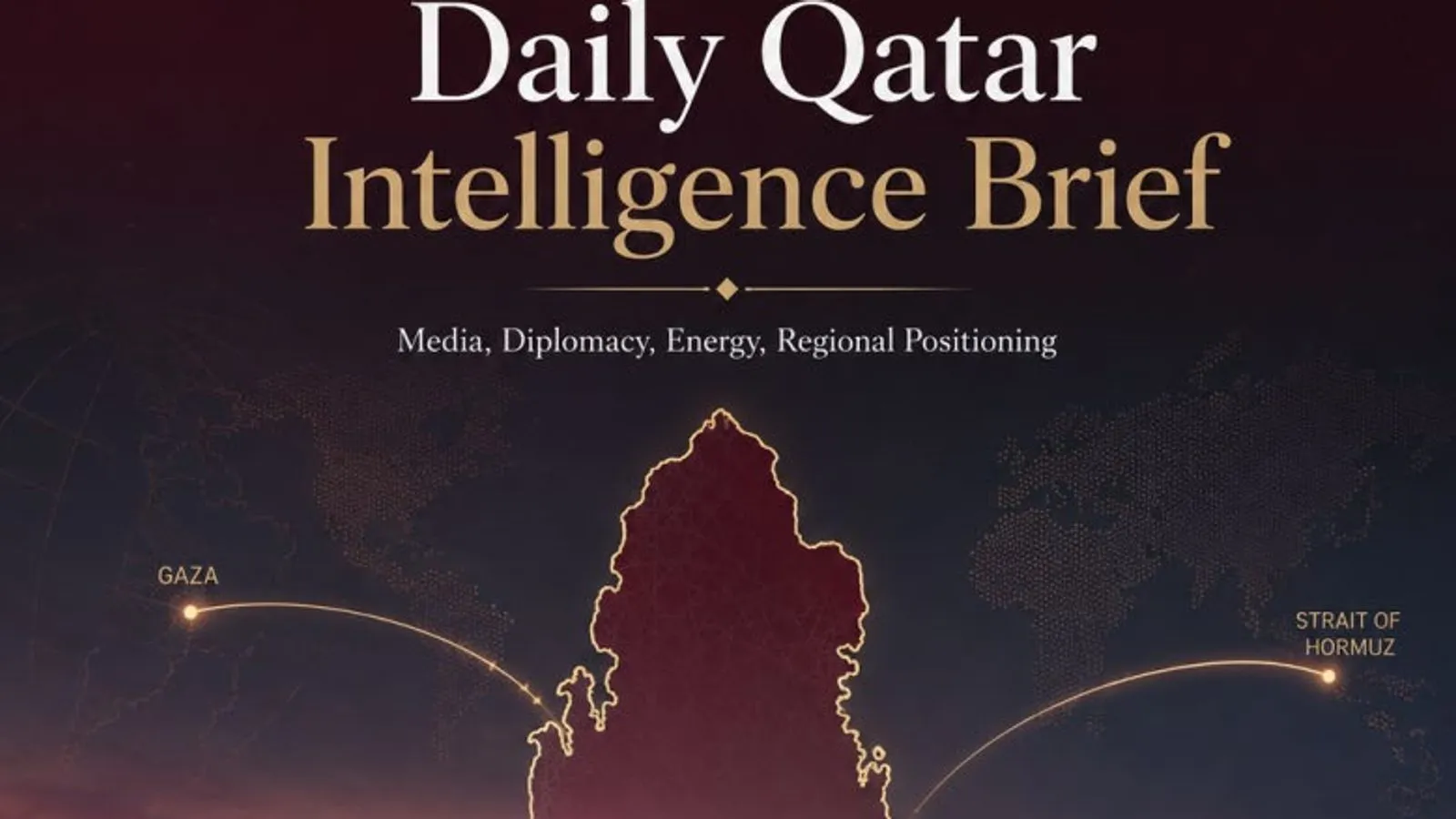
Qatar spent the window turning its Tehran diplomacy into a collective Gulf de-escalation track. Within roughly 36 hours of Prime Minister Sheikh Mohammed bin Abdulrahman Al Thani’s mission to Tehran, Doha briefed the foreign ministers of Oman and Kuwait, embedding the Iran channel in a regional framework rather than running it bilaterally. In parallel, Qatar brought an Individually Tailored Partnership Program with NATO into force, deepening formal defense cooperation with the Western alliance at the same moment it is trading messages with Tehran. The mediation may be producing its first procedural result: Reuters reported that Iran is preparing a written list of conditions for reopening the Strait of Hormuz after mediators asked Tehran to set them out. This post summarizes our Qatar Watch report for August 29.
From Bilateral Channel to Gulf Track
The most consequential Qatari behavior in the window was sequencing. After the Tehran mission that yesterday’s edition examined in detail, Sheikh Mohammed called Omani Foreign Minister Badr al-Busaidi and then, late on 28 August, Kuwaiti Foreign Minister Sheikh Jarrah Jaber Al-Ahmad Al-Sabah. Both calls, carried by QNA and reported in Al-Watan and The Peninsula, covered de-escalation and regional coordination, and in the Kuwait call Sheikh Mohammed reiterated Qatar’s support for a resolution that ensures freedom of maritime navigation and opens the way to a comprehensive agreement. Read in sequence, the contacts show Doha deliberately regionalizing the mediation rather than holding it as a bilateral asset. Oman matters most in this design, because it is the other Gulf state with durable access to both Tehran and Washington, and the two channels are better understood as parallel and sometimes complementary than as competing.
The Iranian side of the channel also moved. Al-Araby Al-Jadeed’s coverage late on 28 August reported President Masoud Pezeshkian saying Iran had reached an understanding with Oman over navigation in Hormuz, while still tying any reopening to American commitments including sanctions relief and the release of frozen assets. A Reuters report carried the same evening went further: Mohsen Rezaei, secretary of Iran’s Supreme National Security Council, said Iran was preparing a written list of conditions for reopening the strait after mediators asked Tehran to set them out, with an agreed central shipping channel through Omani and Iranian waters to follow once Washington met those conditions. If borne out, this is the first tangible procedural product attributable to the Doha channel, moving Tehran from open-ended rhetoric to enumerated terms that mediators can carry. Rezaei’s public messaging is analyzed separately in our review of his Al-Manar interview, and the Iranian domestic context is covered in today’s Hormuz-axis update.
The NATO Track
Qatar’s Defense Ministry announced on 27 August, just before this reporting window, that Qatar and NATO had brought an Individually Tailored Partnership Program into force. Qatari reporting describes the program as deepening political, defense, and security cooperation, strengthening operational interoperability, and providing a framework for joint action. On 26 August, Qatar’s Interior Ministry separately hosted Jeanine Pirro, the US Attorney for the District of Columbia, to review law-enforcement cooperation.
Read alongside the Tehran diplomacy, these steps define the strategy rather than contradict it. Doha is pursuing deeper institutional integration with Western security structures while preserving the political access to Iran that underpins its mediator role. Six months into a regional war that has disrupted Hormuz and battered Qatar’s LNG trade, the two tracks are complementary components of a hedging strategy, and the report assesses that Qatar wants each side to see the other track: Washington should value Doha’s access to Tehran, and Tehran should understand that Doha’s Western anchoring is not negotiable.
Whose Strait Is Open?
The factual status of Hormuz itself became a contested narrative in the window. Al Jazeera English’s 29 August live coverage opened with the IRGC claiming firm control over the strait and accusing US leaders of spreading false statements to move energy prices. The White House, responding directly to Al Jazeera, said the US naval blockade remains fully active and that the strait is open and cleared of mines. CENTCOM commander Admiral Brad Cooper said US forces have assisted roughly 1,500 commercial vessels carrying close to 750 million barrels of crude through the strait in recent months. Meanwhile, Gulf Times carried the International Maritime Organization’s call for practical solutions, citing at least 70 attacks on international shipping since the conflict began, 19 seafarer deaths, and roughly 400 vessels with about 6,000 seafarers unable to leave safely.
Two implications follow for Doha. First, when the basic condition of the waterway is itself disputed, any Qatari-brokered corridor will require an agreed monitoring baseline that neither side currently accepts, which makes a verification mechanism a likely precondition for a durable arrangement. Second, the White House chose Al Jazeera as the platform for its rebuttal of the IRGC. That choice implicitly acknowledges the network’s reach in the regional information space, and Qatar’s centrality to the diplomacy, at the same moment US advocacy circles are intensifying criticism of Qatari influence.
The Opinion Barometer: The Case for a Costly Compromise
Al Jazeera’s opinion pages gave an unusually clear window into the Qatar-based debate, and the arguments converged on a conclusion favorable to Doha’s diplomacy. The most striking piece ran in Arabic under the title “It Is Time to Eat the Frog!” by Alan Eyre, a former US diplomat who served on the core US nuclear negotiating team with Iran. Eyre argues that Washington has replaced a failed military strategy with an equally flawed economic one. In his reading, impoverishing ordinary Iranians will not compel a leadership that treats the confrontation as existential, and the sanctions campaign lacks the time, the Chinese cooperation, and the US diplomatic machinery it would need to succeed. His prescription is stark: the administration should accept a politically costly compromise, claim victory, and make restoring maritime traffic through Hormuz the immediate objective, even if Iran retains substantial control over the strait.
A second Arabic essay, by Saudi political scientist Suleiman Al-Oqaily, argues that six months of war have destroyed two assumptions on which Gulf strategy rested: that energy would flow safely, and that security could be imported ready-made from Washington. He describes a third path in which Gulf capitals keep the United States as a core partner while adding layers of deterrence and regional relationships, and he explicitly locates Doha’s mediator model inside that transformation. In English, Mahjoob Zweiri writes that Iran can still claim survival but that the claim is eroding as the war shifts to economic siege, with civilian leaders warning of collapse while the security establishment resists concessions. Al-Araby Al-Jadeed’s economic commentary added the backdrop, citing 66 percent inflation in July and 128 percent food inflation, while stopping short of predicting capitulation. Across both languages the shared frame is that Iran is weakened but not defeated, which creates intellectual space for negotiated de-escalation rather than Iranian surrender. These are author views rather than editorial positions, but their prominence is itself a media barometer, and the report treats them as such.
Gaza: Disarmament Returns as the Test
Gulf Times’ 29 August edition reported Nickolay Mladenov’s statement to the UN Security Council that Hamas had not fulfilled commitments including disarmament, despite the group’s late-July promise to do so. The same reporting emphasized continued Israeli strikes that make the ceasefire difficult for Gazans to experience as real. This produces a two-sided implementation frame in Qatar-linked media: Hamas is presented as behind on disarmament while Israel is presented as eroding the political process through force. The Qatari press did not offer a new enforcement or sequencing formula in the window. Where the issue appeared, the emphasis remained on implementing the broader roadmap and pairing Hamas’s obligations with Israeli withdrawal and reciprocal commitments, the same posture documented when Mladenov first raised the weapons standard. Doha’s mediator position is becoming more uncomfortable as the disarmament benchmark hardens, because its media environment continues to foreground Israeli conduct while external actors measure the roadmap by Hamas’s compliance.
The Influence File Thickens
Two Qatar-specific signals deserve emphasis, and both come from named, senior figures rather than anonymous accounts. Jaber Al-Harmi, editor-in-chief of the Qatari daily Al-Sharq, published a religiously framed post over footage from Gaza containing a prayer asking God to punish the Jews, describing them as having spread corruption on earth, and asking that they be scattered, divided, and removed from the land. The post is openly polemical, and its significance lies in the author’s position at the top of a major Qatari newspaper. It should not be read as state policy, but it is a direct indicator of the rhetorical register available in an influential Qatar-based media environment.
Separately, MEMRI documented a speech by Ali Al-Qaradaghi, secretary-general of the Doha-based International Union of Muslim Scholars, an organization MEMRI characterizes as affiliated with the Muslim Brotherhood. Al-Qaradaghi presented electoral gains by Muslim candidates in the United States as consequences of October 7, calling such effects “the blessings of the Al-Aqsa Flood.” The claim proves no causal relationship and establishes no coordination with any US campaign. Its importance is the ideological statement itself: a senior Doha-based cleric publicly celebrating the October 7 attack, under Hamas’s own name for it, as a transnational political accelerant. MEMRI’s Qatar Threat Monitor No. 81 packaged these threads with older material, including Khalid Sheikh Mohammed’s 1990s employment in Qatar and an advocacy group’s call for scrutiny of Northwestern University’s Qatar relationship. The report grades these items individually, because their evidentiary weight varies from historical US records to advocacy requests, but together they show the recurring structure of external criticism: Qatar is treated simultaneously as a major US security partner and as a state whose Islamist-linked networks warrant scrutiny.
Key Points
- Doha is deliberately regionalizing its Iran mediation, briefing Muscat and Kuwait City within roughly 36 hours of the Tehran mission to embed the channel in a collective Gulf framework rather than hold it bilaterally (high confidence).
- Qatar is running a dual-track strategy in plain sight: institutional integration with Western security structures through the NATO partnership program alongside preserved political access to Tehran, with each track reinforcing the value of the other (high confidence).
- Tehran’s reported move toward a written list of conditions for reopening Hormuz would be the first tangible procedural product of the mediation channel; the report treats it as reported rather than confirmed pending delivery of the list (moderate confidence).
- The factual status of the strait has become a contested narrative with direct energy-price implications, which makes an agreed verification baseline a likely precondition for any durable corridor arrangement (high confidence).
- The Al-Harmi and Al-Qaradaghi statements materially strengthen the Qatar influence file as indicators of the Doha-based media and religious ecosystem, without evidence of Qatari government direction or endorsement (moderate-high confidence on the statements themselves, which rest on primary sources).
What to Watch
- Any Qatari announcement of a follow-on mechanism with Iran or Oman on a Hormuz shipping corridor, de-mining, or guarantees for commercial passage.
- Whether Tehran’s promised list of conditions is delivered through the Qatari or Omani channel, and whether Doha’s role in soliciting it is publicly acknowledged.
- Whether the IRGC-White House dispute over the strait’s status hardens into a sustained narrative battle on Al Jazeera platforms, and which baseline Qatari outlets adopt.
- Whether Doha publicly links Gaza reconstruction, governance, or Israeli withdrawal to a timetable or verification mechanism for Hamas disarmament, and any new Hamas statement clarifying what disarmament means in practice.
- Further Qatar-Turkiye coordination on Gaza or Iran that moves beyond general diplomatic consultation.
- New US congressional, DOJ/FARA, Treasury, or university-related scrutiny of Qatari funding and influence, and any defined law-enforcement workstream following the Pirro visit.
- Whether Al Jazeera Arabic continues to normalize the argument that Gulf states need parallel security arrangements because US protection is no longer sufficient.
This post summarizes the Iran Dossier Qatar Watch report for August 29, 2026, covering the reporting window from 07:30 on 28 August to 07:30 on 29 August. Sources include the Qatari Arabic and English press (Gulf Times, Al-Arab, Al-Watan, The Peninsula), Al-Araby Al-Jadeed’s news and opinion pages, Al Jazeera Arabic and English opinion and live coverage, official QNA, Defense Ministry, and Interior Ministry statements, MEMRI’s Qatar Threat Monitor, and external cross-checks from Reuters and CENTCOM statements. The report’s confidence grading is preserved here: high on the Qatar-linked media framing of Iran, Hormuz, and Gaza, based on direct review of the material; moderate on the broader assessment of Gulf security diversification, which is an analytical inference rather than declared Qatari policy. External critical claims are weighted by source strength and are not adopted as established fact without corroboration.