Handover, Not Storage: Mladenov Raises the Standard, and Doha's Access Goes on Trial
The central new development is a sharper Gaza disarmament claim. In his Security Council briefing, Nikolay Mladenov said Hamas and the armed factions had agreed, for the first time, to hand over their weapons and transfer full governing authority, civilian and security, to a transitional administration recognized by the United Nations. He simultaneously warned that Hamas has not yet fully met its commitment to cease military activity. This creates a much clearer implementation test than the earlier language of collecting, limiting, or storing weapons: Qatar can claim a genuine diplomatic breakthrough only if custody, decommissioning, and security authority move irreversibly away from Hamas. The second track is Tehran, where the prime minister’s August 27 mission is the principal Qatari diplomatic event, because reopening Hormuz is a direct national-economic requirement, not merely a mediation objective. This post summarizes our Qatar Watch report for August 27.
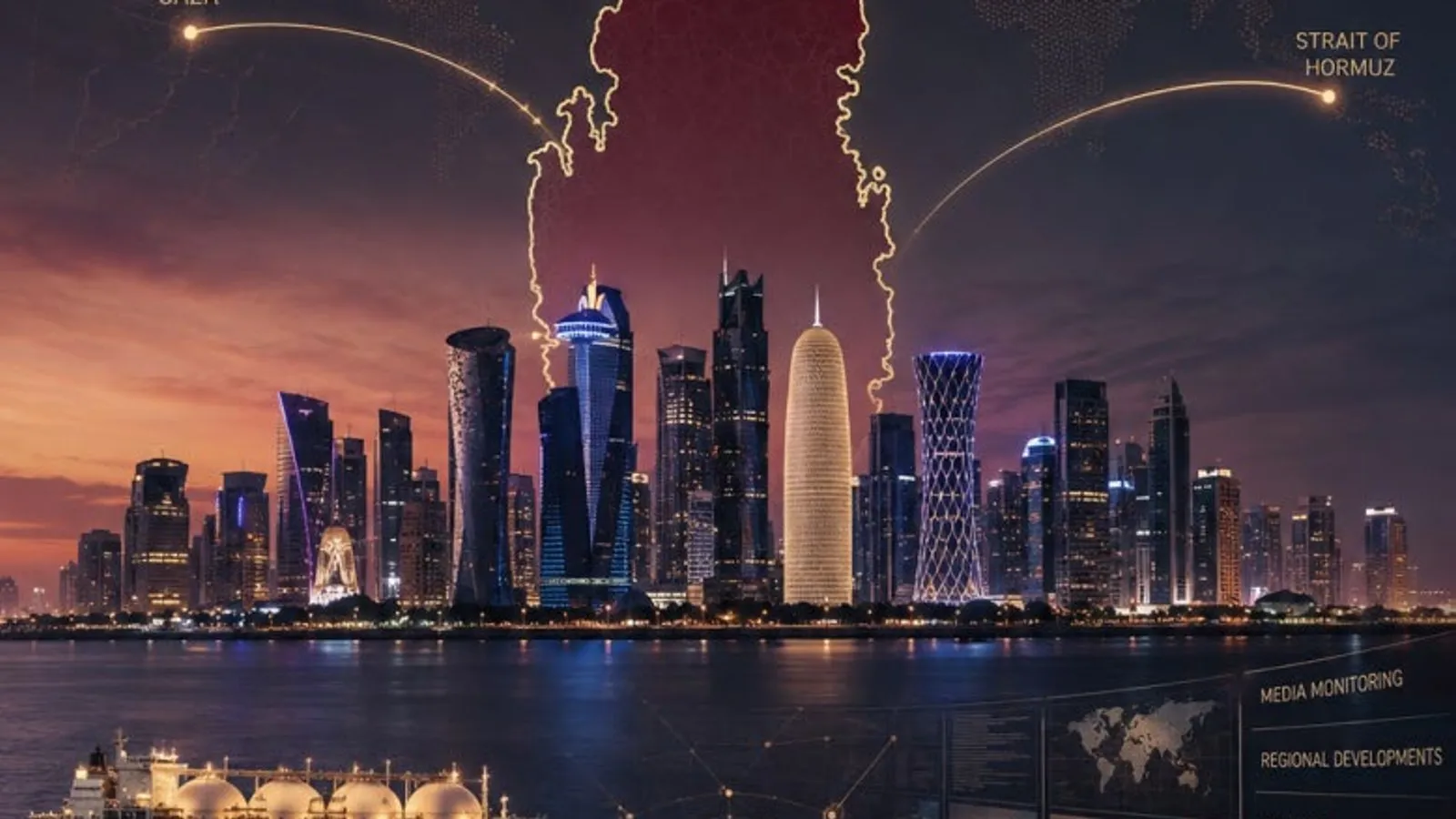
Mladenov Raises the Standard
The Board of Peace framework now describes weapons handover, not weapons storage. Per Mladenov’s briefing, the weapons would go to a new Palestinian governing body, with decommissioning supervised by the International Stabilization Force, and the emerging National Committee for the Administration of Gaza would consist of independent Palestinian technocrats responsible for civil administration and humanitarian relief. The most useful short formulation is his: the factions agreed to transfer full governing authority, both civilian and security. The significance sits in the security clause, since a technocratic civilian administration without a monopoly over coercive power would not satisfy the mechanism he described. His warning was equally important: continued weapons carrying, tunnel activity, and obstruction of convoys would set the process back, and the Arabic service emphasized his caution that ceasefire failure would become a point of no return. Demilitarization is a continuing behavior test, not a single declaration.
The report’s assessment is precise about what changed and what would prove it. This is materially stronger than formulas that leave weapons under Palestinian factional custody, and the critical distinction is not the verb in a communique but post-transfer capability: a credible mechanism requires verified inventories, a recipient body independent of Hamas, supervised decommissioning or destruction, restrictions on tunnels and military production, and an authority capable of preventing replenishment. If the weapons simply move into warehouses Hamas can later recover, the political language will have changed more than the balance of power. Qatar’s relevance is direct: Doha has argued that its relationship with Hamas provides leverage unavailable to other US partners, and an actual handover would be evidence for that claim. Conversely, continued military activity after a public acceptance would place Qatar under pressure to show that its access produces compliance, not merely dialogue. The domestic tracking detail matters too: Gulf Times carried the stronger disarmament formulation prominently and tied it to ISF supervision, while QNA’s Gaza item concentrated on ceasefire fragility and humanitarian conditions, showing the domestic press can carry a harder implementation claim even when the state wire stresses the political frame. Al Jazeera Arabic paired the mechanism with the warning that Israel’s rejection of the framework and continued attacks could also destroy the process, a two-sided enforcement frame: Hamas must demilitarize, but Israeli actions are presented as equally capable of making implementation impossible.
The Prime Minister Goes to Tehran
The August 27 Qatari press is dominated by the Tehran visit, and the placements are the message. Al-Sharq leads its print edition with the visit under the theme of freedom of navigation, presenting it not as a generic Iran call but as a direct Qatari intervention into the maritime problem on which the country’s export economy depends. Gulf Times and Qatar Tribune do the same in English, framing Doha as an active mediator whose immediate objective is practical: de-escalation and restoration of navigation, rather than alignment with Washington’s sanctions campaign or Tehran’s demand for a permanent role over transit. The Peninsula’s editorial turns the visit into policy doctrine: dialogue over military escalation, freedom of navigation, direct contact with Iran, rejection of threats to Gulf sovereignty, and continued GCC coordination, a deliberately balanced posture that refuses to normalize Iranian coercion while also refusing to define the crisis through US secondary sanctions.
Al-Araby Al-Jadeed moved the file further during the day, quoting the prime minister’s argument that a direct Washington-Tehran hotline is necessary to prevent disruption of the reopening process. The mechanism is the point: Doha is not merely urging both sides back to formal negotiations; it is advocating a continuous crisis-management channel capable of preventing military or political incidents from shutting the strait again while broader talks remain unresolved. And Al-Araby’s own print front page supplies the sharpened context: its banner reports Washington temporarily renewing military action against Iran, so the editorial effect is crisis diplomacy conducted while military pressure resumes, not diplomacy during a pause. The report’s key judgment on the trip is blunt: it reflects vulnerability as much as diplomatic relevance, since Qatar has fewer physical alternatives to Hormuz than several neighboring exporters, and a durable navigation arrangement affects revenue, fiscal space, sovereign investment, and influence spending simultaneously.
The Barometer: Coercion as Self-Defeating
The August 26 Al Jazeera opinion and blog package is unusually dense, and the report reads its cumulative message in one proposition: American coercive power remains formidable but is increasingly transactional, inflationary, and strategically self-defeating; Israeli territorial and political power is increasingly contested; and Iran retains geographic and asymmetric leverage despite military damage. The anchor essay, co-authored by Jeffrey Sachs, presents the secondary-sanctions campaign as an attempt to sever Iran from finance, shipping, technology, energy, and third-country commerce, argues that sanctions can devastate living standards without reliably producing capitulation, and warns that punishing major Chinese institutions could invite retaliation through critical-mineral controls; its strategic conclusion runs beyond Iran, urging states to reduce dependence on the dollar and question the reliability of American security guarantees. A companion essay describes modern coercion as control over finance, insurance, logistics, and settlement systems, contrasting US financial reach with Iran’s geographic leverage over Hormuz, money and geography as competing strategic infrastructures. Rantawi’s scenarios piece argues Washington increasingly talks to actors who actually control decisions on war and peace even when formally designated, Hamas his clearest example, a line that connects directly to the Gaza file, since Hamas can be required to disarm while remaining indispensable to implementation. Al-Jaber’s essay on Israeli influence in American politics distinguishes organizational strength from eroding social consent, and the report notes the cross-platform echo: Al-Araby carries reporting on Democratic primary voters trending toward a candidate prepared to stop military aid, the two Qatari-linked outlets reinforcing the same forecast of a widening elite-public gap. Around them: the West Bank framed as structural territorial absorption, cancer patients as an implementation metric that keeps Gaza anchored in civilian harm, and essays on American religious politics and transactional alliance management in East Asia that translate the same confidence problem to other theaters.
Al-Araby’s own edition shifts decisively toward current-war effects: European gas inventories draining ahead of winter, the global inflationary bill for isolating Iran, sanctions spillover into Iraq, and Ibrahim Saif’s argument that the 2026 war redefines Gulf diversification around resilience, logistics redundancy, food and energy security, fiscal shock absorption, and the ability to operate when maritime routes are disrupted, rather than headline non-oil growth. Its lead feature escalates the UNRWA file through the Qalandia Institute seizure, framed as a two-front project of obstructing Gaza implementation while dismantling international institutional presence in Jerusalem and the West Bank. And its weekly columnist Dalal El-Bizri runs a line harder than Al Jazeera’s typical framing, describing the Gaza and south Lebanon ceasefires as the same bargain and, unusually for the platform, identifying Hezbollah as Iranian in birth, patronage, and decision, with its second round against Israel declared as revenge for the assassination of Ali Khamenei. The report flags the signal: even sympathetic Arab commentary now treats Hezbollah’s disarmament debate as inseparable from Iranian, not Lebanese, decision-making.
The Access Question: The Atlantic and CSIS
Two external items put Doha’s model itself on trial, and the report treats them as the window’s most consequential scrutiny. Shane Harris’s investigation in The Atlantic assembles the Boeing 747 gift, lobbying and public-relations spending it puts at nearly 250 million dollars across at least 88 US firms since Trump’s first election, Al Udeid, and the Hamas, Iran, and Muslim Brotherhood-linked relationships into a single critique of Qatar’s hedging strategy: buy access in Washington, host the base, maintain ties across mutually hostile camps, and make Qatar useful enough that no major actor wants to dispense with it, while acknowledging that successive US administrations themselves used Qatar as a channel and benefited from its mediation. The article’s central challenge is not that Qatar failed to gain influence; it is that influence failed to deliver strategic insurance: the war damaged the LNG system and left the export model exposed behind a constrained Hormuz. The most damaging conceptual point is the distinction between access and protection: Doha can secure meetings and broker transactions, but none of that necessarily prevents a larger power from pursuing a war whose externalities fall directly on Qatar.
The CSIS paper by Leslie Palti-Guzman independently corroborates the day’s reporting and supplies the missing quantitative baseline: the June memorandum’s collapse in July, sustained targeted US strikes since, Hormuz crossings down roughly 70 percent against the truce period, two Ras Laffan trains struck with repairs estimated at three to five years and 17 percent of export capacity lost, 64 million tonnes per year undamaged, roughly 40 cargoes moved in the June window, and market discussion of a force majeure lift as early as October. Three analytical claims the report marks for tracking: Iran is running a deliberate divide-the-Gulf strategy through differentiated attack patterns, with Qatar absorbing about 737 missile and drone attacks, roughly 11 percent of the Gulf total, against far heavier UAE targeting, a pattern designed to push each state toward bilateral accommodation with Tehran; the plausible end-state short of settlement is two competing shipping systems inside Hormuz, an Iran-approved lane and the US-protected Omani corridor; and the paper’s observation that QatarEnergy’s merchant share from the new Golden Pass project approximately equals the volume lost at Ras Laffan, raising the question of a quiet understanding about targeting, which the report is careful to carry as an allegation, not a finding, while noting that its appearance in a mainstream Washington think-tank product extends the Atlantic’s access-versus-protection critique into the energy domain. The war-economy distinction that frames both: market optimism is not physical normalization. Oil can fall on expectations of a Hormuz arrangement while cargo reliability, insurance, vessel availability, and actual transit volumes remain impaired; Qatar’s diplomacy is trying to convert political expectation into operational access.
Key Points
- The decisive Gaza question is no longer semantic (high confidence on the briefing record): if the handover claim is real, the requirement is to verify who receives the weapons, whether they are destroyed or merely stored, who controls the custody chain, and whether Hamas retains the ability to reconstitute independent armed capability.
- Mladenov’s formulation gives Qatar an opportunity and a risk: successful implementation would validate Doha’s access to Hamas; failure would expose the gap between mediator assurances and enforceable outcomes.
- The Tehran trip reflects vulnerability as much as diplomatic relevance: Qatar has fewer physical alternatives to Hormuz than several neighboring exporters, so a durable navigation arrangement affects revenue, fiscal space, sovereign investment, and influence spending simultaneously.
- The media environment remains more permissive than official state language: Al Jazeera Arabic and Al-Araby Al-Jadeed question US strategic competence, sanctions effectiveness, and Israeli political durability more sharply than QNA or the domestic English press.
- External scrutiny converged on the same conclusion by independent routes (the report’s reading of The Atlantic and CSIS): Qatar’s financial depth does not offset physical route concentration, and its long-term LNG recovery depends on normalized transit and the Doha-Tehran relationship; access is not protection.
What to Watch
- Whether QNA, the Foreign Ministry, or the prime minister publicly adopts Mladenov’s explicit weapons-handover formulation rather than reverting to collection, limitation, or storage language.
- The recipient of Hamas and factional weapons, the inventory and verification mechanism, whether weapons are destroyed or stored, and who controls access to any storage sites, plus whether the ISF receives a practical mandate, personnel, and enforcement authority sufficient to supervise decommissioning.
- Evidence that Hamas has actually ceased tunnel work, military activity, weapons production, and convoy interference, the specific behaviors Mladenov identified as implementation risks.
- The substance of the Tehran talks: whether Iran accepts a temporary navigation mechanism without securing a permanent political veto or revenue claim over commercial passage, and whether a US-Iran hotline or equivalent continuous crisis channel is formally created, with Qatar or Oman hosting or brokering it.
- Actual QatarEnergy LNG loadings, ship transits, insurance conditions, and charter availability after any reopening announcement, and whether force majeure lifts by the October date circulating in the market.
- Early evidence of corridor bifurcation inside Hormuz: differentiated insurance terms, Iranian authorization practices, or escort arrangements distinguishing an Iran-approved lane from the US-protected Omani corridor, and which lane Qatari cargoes actually use.
- Whether the Al-Araby economic-resilience framing begins to appear in Qatari domestic policy language, whether Al Jazeera English begins carrying the Arabic service’s stronger themes, and any new congressional, Treasury, DOJ/FARA, university-funding, or lobbying evidence that gives the Atlantic critique a regulatory or legislative follow-on.
- Whether Qatari domestic media acknowledge the renewed US military action against Iran reported on Al-Araby’s front page while the prime minister is in Tehran, or continue framing the mission exclusively as de-escalation.
This post summarizes the Iran Dossier Qatar Watch report for August 27, 2026, covering the hard reporting window of August 26, 13:00 to August 27, 13:00: QNA and the August 27 Qatari print and online press, the Mladenov Security Council briefing as carried by Al Jazeera Arabic and English, the Al Jazeera opinion package, the Al-Araby Al-Jadeed print edition and online cycle, and external scrutiny from The Atlantic and CSIS. The report’s evidentiary flags are preserved here: the CSIS quiet-understanding observation is an allegation rather than a finding, and the handover claim is a publicly stated framework position whose test is verified post-transfer capability.