From Mediator to Mechanism: Doha Bids for an Operational Role at Hormuz
Qatar’s most consequential action was Prime Minister Sheikh Mohammed bin Abdulrahman Al Thani’s mission to Tehran. Doha used its access to senior Iranian leaders to press a practical interim framework for the Strait of Hormuz, a temporary joint shipping corridor plus a joint mine-clearance project, serving its own strategic interest in predictable navigation while positioning itself as the intermediary that can move between Tehran, Washington, and the Gulf states. The messaging paired engagement with limits: the Foreign Ministry stressed neighboring states’ sovereignty and freedom of navigation even as Iranian Foreign Minister Araghchi publicly thanked Qatar for its mediation. On Gaza, Doha worked the UN track to reinforce the political roadmap rather than unveil a new formula on Hamas’s weapons. This post summarizes our Qatar Watch report for August 28.
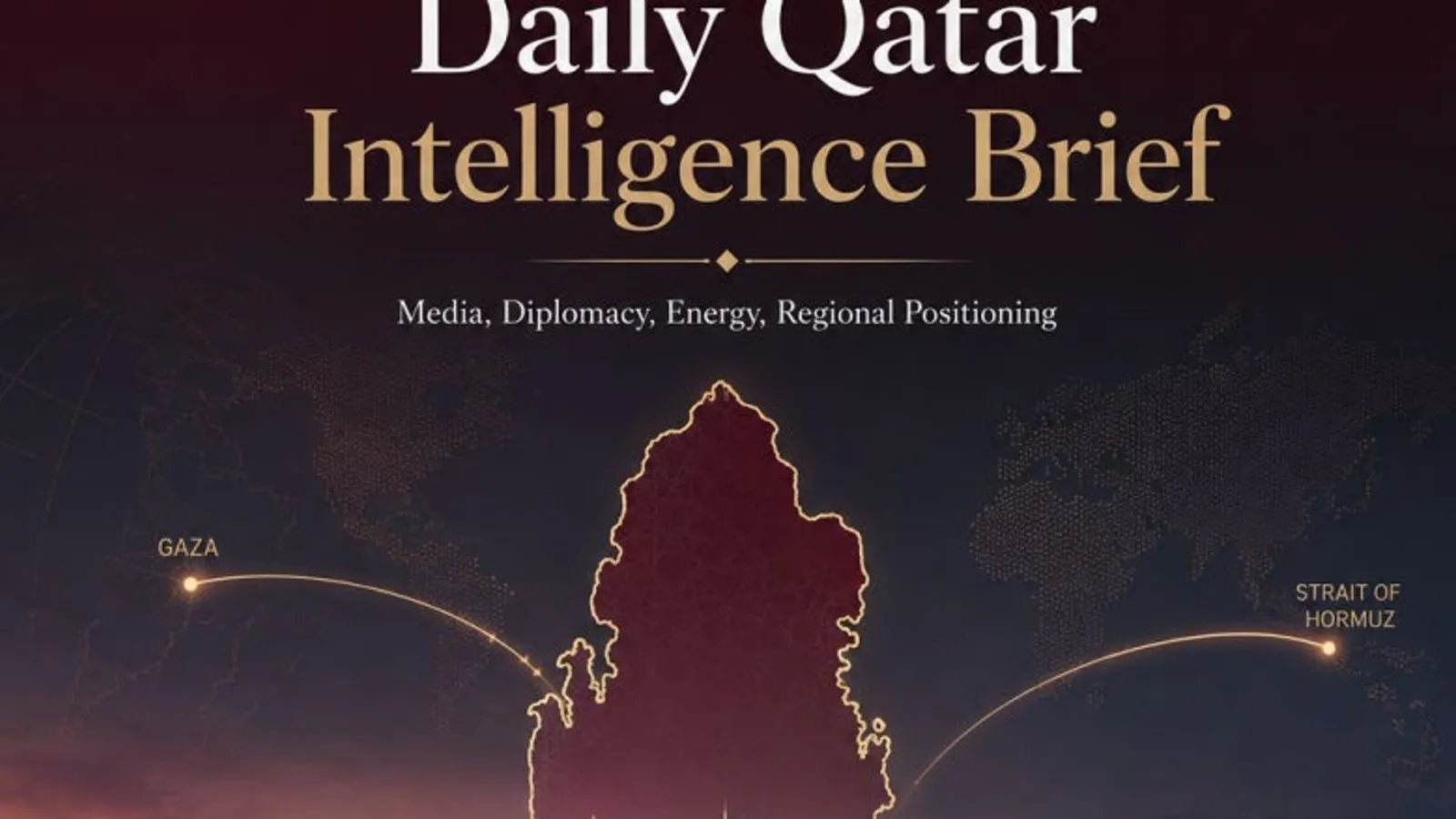
The Tehran Mission: A Corridor, Not a Communique
The Tehran visit advanced Qatar’s preferred model of statecraft: use access to all sides to build a practical mechanism that also protects a direct national interest. The proposed corridor and mine-clearance project would reduce the risk that the Hormuz dispute hardens into a permanent coercive regime over Gulf shipping, and for Qatar, whose energy exports are exceptionally exposed to the strait, the issue is both diplomatic and economic. The formula Doha struck lets it preserve access to Tehran without endorsing Iranian control of Hormuz: engagement, but bounded by sovereignty and freedom of navigation under international law.
The initiative also carries a prize beyond the immediate crisis. If the corridor moves from concept to practice, Qatar could become part of the mechanism linking Iran, Oman, Gulf exporters, and potentially the United States, an implementation role that would extend Doha’s leverage well past this war. That is the report’s central reading: Doha is seeking an operational role in a Hormuz arrangement, not merely a diplomatic profile. How Tehran received the mission, and the conditions it is preparing in response, is covered from the Iranian side in today’s Hormuz-axis update.
The Press Carries the Objective
The 28 August press cycle gave the mission top billing in both languages, and the placements are the message. Al-Araby Al-Jadeed’s print front page directed readers to Qatari efforts to prepare conditions for dialogue between America and Iran, describing intensified activity to return the crisis to diplomacy and secure a Hormuz settlement through a temporary corridor. Gulf Times ran the clearest English rendering of the immediate objective, “Qatar calls upon Iran to reopen Hormuz,” a headline more direct than the official formulation, framing Doha as pressing Tehran for a practical outcome. Qatar Tribune foregrounded the joint mine-clearance project and the senior meetings, hewing closely to the official line, and The Peninsula amplified the official account of the corridor framework.
In the Arabic opinion pages, Al-Arab presented the mission as wartime problem-solving, an actor building an exit from conflict rather than aligning with either belligerent camp, while Al-Watan carried a sharply critical piece on Israeli settlement expansion, arguing that E1 construction is designed to impose de facto annexation and destroy the territorial basis of a Palestinian state.
The Barometer: Two Languages, Two Arguments
The Al Jazeera split that this series tracks each edition was unusually clean this window. Arabic opinion remained more ideologically adversarial toward Israeli and U.S. power: an essay arguing Israel’s strike on Abu al-Duhur airport lacked security justification and was driven by Netanyahu’s political calculations, a blog on Trump’s pressure pushing Europe toward strategic autonomy, and another presenting rising Muslim political participation and declining AIPAC influence as a structural shift in U.S. politics. The most notable item for the influence file was François Burgat’s essay recasting 25 years of the post-9/11 war on terror as a broader campaign against Muslims and Islamist opposition. The report flags the author’s standing as part of the data point: a French court conviction for publicly glorifying terrorism over posts relaying a Hamas statement became final in May, and Al Jazeera Arabic’s decision to platform his war-on-terror essay days later is itself evidence for how the network’s Arabic service curates this argument.
English opinion, by contrast, ran competing verdicts on the Iran war side by side. Mahjoob Zweiri argued Iran has survived militarily but that renewed economic pressure is testing its weakest points and sharpening internal divisions, reporting that President Pezeshkian himself has broken with wartime resolve rhetoric. Adolfo Franco argued the opposite case, that sustained U.S. pressure is strengthening Washington’s hand, describing the strait as “a chokepoint being pried loose finger by finger.” Publishing both creates a more pluralistic English debate than the Arabic selection, where criticism of Western and Israeli power runs more consistently. On Qatar itself, both language services converge on the same core frame: Doha as an active mediator seeking a practical Hormuz arrangement and renewed dialogue.
Gaza: Sequencing, Not a New Formula
Qatar used the UN track to reinforce the political roadmap rather than unveil a new public formula on Hamas’s weapons. Its representative, speaking for the Arab Group, condemned Israel’s rejection of the roadmap for implementing President Trump’s Gaza plan and emphasized Israeli withdrawal, reconstruction, and Palestinian statehood. Al-Araby Al-Jadeed’s same edition prominently reported Israel’s position that reconstruction will not begin before Hamas is disarmed and Gaza fully demilitarized, keeping the disarmament dispute visible in Qatar-linked media even as Doha’s own emphasis stayed on implementation of the broader roadmap.
The resulting information environment matters. Doha does not deny that the roadmap contains security obligations, but its public emphasis is on reciprocal implementation and Israeli obligations rather than isolating Hamas disarmament as the first or sole condition. That framing helps Qatar preserve its mediator relationship with Palestinian actors while resisting an Israeli sequencing formula that would separate disarmament from withdrawal and reconstruction. The weapons standard itself, and the handover language Mladenov put on the record at the Security Council, was the subject of yesterday’s edition; this window brought no new Qatari formulation against that standard.
Libya and the Influence Toolkit
Qatar’s regional activism extended beyond Iran and Gaza. Al-Araby Al-Jadeed reported a Qatari diplomatic push in Libya spanning both Tripoli and Benghazi: Minister of State Mohammed Al Khulaifi discussed support for unifying the military institution, Qatari participation in reconstruction and development, and a four-country migration mechanism linking Libya, Qatar, Turkiye, and Italy. The breadth of contacts across rival camps illustrates the standing model: mediation, elite access, and economic engagement used as mutually reinforcing influence instruments rather than alignment with a single faction.
External scrutiny stayed comparatively mild this window. FDD’s overnight brief highlighted the Tehran mission among its Middle East must-reads, presenting it as an effort to relaunch diplomacy as Washington intensifies economic pressure. The item alleges no new Qatari misconduct, but it is useful external evidence that a critical U.S. national-security institution treats Doha’s mediation as a material part of the Iran file rather than ceremonial diplomacy; the report rates it high for the fact and relevance of the visit, limited for broader influence claims because it relies on open reporting.
Key Points
- Doha is seeking an operational role in a Hormuz arrangement, not merely a diplomatic profile (high confidence): a temporary corridor and mine-clearance mechanism would protect a core economic vulnerability while increasing Qatar’s relevance to both Washington and Tehran.
- Qatar is maintaining a dual message toward Iran: preserve dialogue and mediation, but reject restrictions on Gulf sovereignty and freedom of navigation (high confidence).
- On Gaza, Qatar continues to frame implementation around the comprehensive roadmap, Israeli withdrawal, and reconstruction; the weapons issue remains central to the wider dispute, but Doha did not publicly foreground a new disarmament formula in the period covered (moderate confidence, reflecting fluid negotiations).
- Al Jazeera Arabic opinion continues to provide a markedly more critical frame of Israel, U.S. power, and post-9/11 counterterrorism discourse than the network’s English pages, which are more pluralistic on the Iran war (moderate-high confidence).
- Qatar’s Libya activity shows the mediation model remains geographically broad and is increasingly paired with security-sector, migration, and economic engagement.
What to Watch
- Formal Iranian acceptance, modification, or rejection of the temporary Hormuz corridor and joint mine-clearance mechanism.
- Any Qatari role in technical implementation of a Hormuz arrangement, including coordination with Oman, other GCC states, or the United States.
- Changes in Qatari language on the sequencing of Hamas disarmament, Israeli withdrawal, reconstruction, and international verification, and any direct Hamas statements on weapons collection or transfer following mediator contacts.
- Further Qatar-Turkiye coordination in Gaza, Syria, or the Libya migration mechanism.
- New U.S. congressional, Treasury, DOJ/FARA, or think-tank material concerning Qatari influence, Hamas, the Muslim Brotherhood, universities, or media.
- Whether Al Jazeera Arabic continues to amplify arguments recasting counterterrorism policy as anti-Islamist or anti-Muslim political repression, and whether that framing migrates into English output.
This post summarizes the Iran Dossier Qatar Watch report for August 28, 2026: the 28 August Qatari Arabic and English press (Al-Watan, Al-Arab, Al-Araby Al-Jadeed’s print edition, Gulf Times, Qatar Tribune, The Peninsula), the Al Jazeera Arabic opinion and blog output and Al Jazeera English news and opinion pages, official Qatari Foreign Ministry statements on the Tehran meetings and the Arab Group’s UN intervention, and external material from FDD. The report’s confidence grading is preserved here: high on Qatar’s Tehran diplomacy and the proposed Hormuz mechanism, supported by official statements and convergent Qatar-based reporting; moderate-high on the media-framing assessment; moderate on Gaza sequencing, because negotiations remain fluid and public statements reveal only part of the mediator discussions.