From Hedge to Architecture: Türkiye's Mecca Pact and the Map Ankara Is Drawing
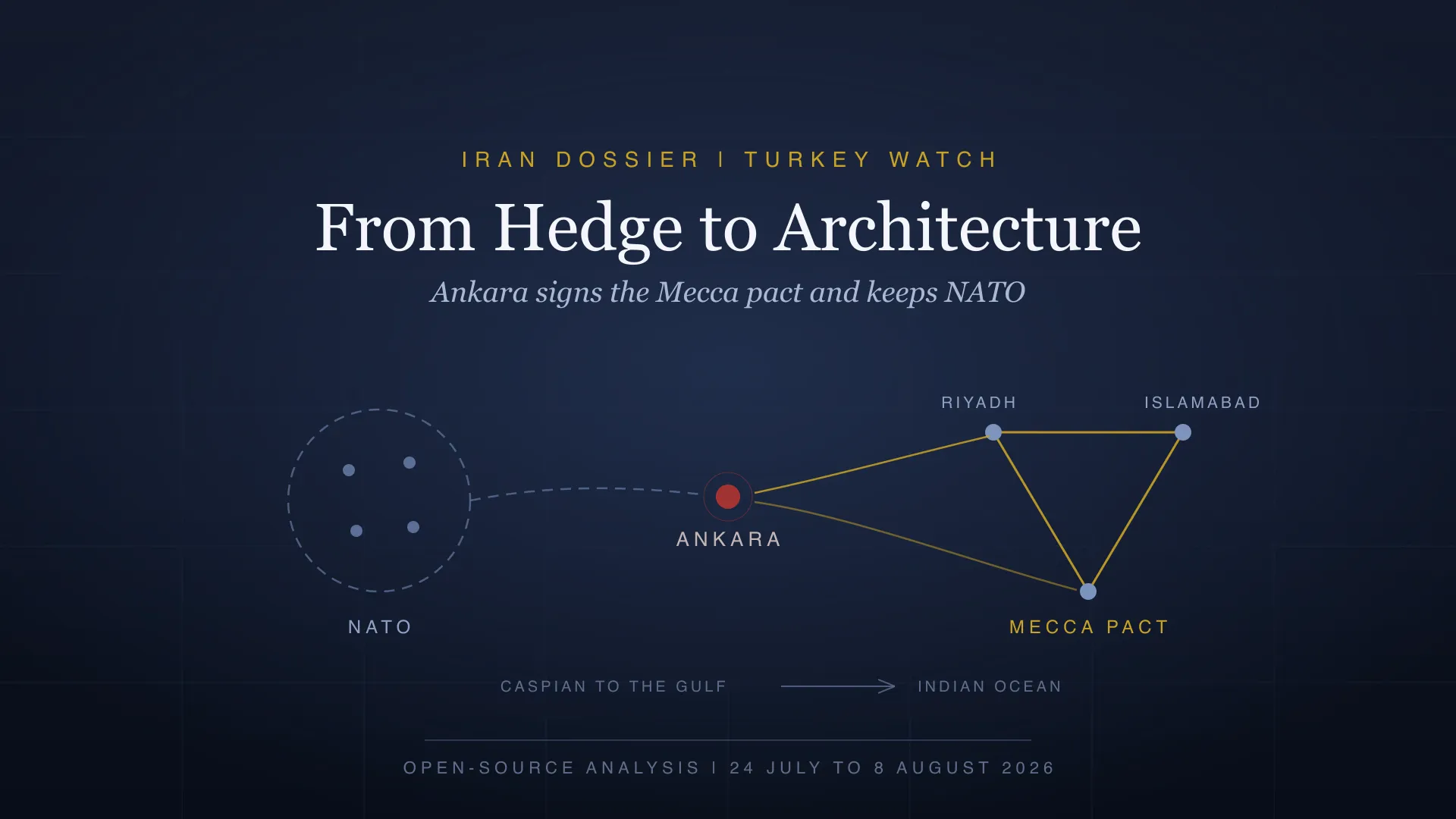
Ankara used the fortnight of 24 July to 8 August to turn a year of hedging into a signed instrument. On August 7, at the Al-Safa Palace in Mecca, President Erdoğan joined Crown Prince Mohammed bin Salman and Prime Minister Shehbaz Sharif in signing the Mecca Joint Defence Agreement, a trilateral pact that treats an armed attack on any one signatory as an attack on all three. On the same day, the Presidency’s disinformation centre stated that Türkiye remains bound to its NATO commitments. Those two facts, side by side in a single news cycle, are the whole method: build parallel structures that reduce dependence on Western guarantees while keeping the Western relationship formally intact. This post summarizes our Turkey Watch report for the fortnight; the full report, with Turkish-language primary sourcing throughout, is available as a PDF.
The Signing at Al-Safa
Turkish primary reporting sets the scene tightly: Erdoğan flew to Jeddah on the morning of August 7, travelled on to Mecca, and met Mohammed bin Salman at the Al-Safa Palace before the trilateral text was signed with Shehbaz Sharif. The pact extends to Türkiye the mutual-defence commitment Riyadh and Islamabad concluded in September 2025. Erdoğan presented it in the register of the UN Charter, invoking the Article 51 right of self-defence, stressing that the agreement targets no country and remains open to other allies, and framing it as advancing defence cooperation, joint defence-industrial projects and counterterrorism. A terminology note from the report worth preserving: the Turkish name, Mekke Ortak Savunma Anlasmasi, is unambiguously the Mecca Joint Defence Agreement; renderings such as “Deterrence Agreement” are looser.
None of this was improvised. Talks on Turkish accession were reported at an advanced stage in January, after Israel’s 2025 strikes inside Qatar drew only a muted Western response, and Chatham House read the trajectory at the time as classic hedging: a separate defence agreement that makes Türkiye more secure if NATO proves unreliable, and that yields leverage inside NATO in the meantime. What materialized on August 7 is precisely that instrument.
What the Pact Does, and What It Does Not
On the value side, the Atlantic Council’s Rich Outzen argues the agreement broadens an umbrella Türkiye has already opened to Qatar, Syria and Libya, adds an economic giant and a nuclear-armed state to Ankara’s side, sharpens deterrence against an Israel whose leaders increasingly speak of Türkiye as an adversary, and should benefit Turkish defence industries commercially while reinforcing Türkiye’s place in the trade and energy networks running between India and Europe.
The limits are equally clear, and two analysts mark them. The Middle East Institute’s Gonul Tol cautions against the “Muslim NATO” label: the identical collective-defence clause in the 2025 Saudi-Pakistan pact produced no automatic Pakistani military response when Saudi Arabia was struck. The Atlantic Council’s Allison Minor adds that Pakistani officials have maintained the 2025 agreement carried no nuclear umbrella, and that neither that pact nor the older Gulf Cooperation Council commitment has ever produced an Article 5-style response in practice. The report’s first key judgment follows: the Mecca pact reads as architecture rather than an operational alliance; its near-term product is deterrent signalling, not a binding trigger.
The direction of travel, though, is expansion. Al Jazeera’s reporting describes the pact as the possible core of a wider alignment sitting between Israel and Iran and wary of both, with the door left open to Egypt, Qatar, Syria and the UAE. The overlap with the August 6 eight-state Gaza statement is worth noting: four of that document’s eight signatories, Egypt, Qatar, the UAE and Jordan, are among the states most often named as accession candidates. If even one or two accede, the trilateral hedge becomes the institutional spine of the Sunni entente Ankara’s doctrine has been signalling toward for over a year, the same architecture whose pull on Doha we examined in The Shrinking Fence.
The Pressure Campaign Against Israel
The declaratory track ran in parallel, on two fronts. On Syria, Foreign Minister Fidan hosted his Syrian counterpart in Ankara on August 6 and delivered the cycle’s sharpest language, calling Israeli strikes on Syrian sovereignty and territorial integrity among the gravest threats to the country’s stability, urging a stronger international response, and pressing for observance of the 1974 Disengagement of Forces Agreement. Israeli Foreign Minister Sa’ar answered on the asymmetry of footprints, claiming Türkiye occupies roughly five percent of Syrian territory against an Israeli presence of about one tenth of one percent; the report logs those figures as a public claim, contested and unverified.
Two further threads from the same press conference deserve attention. Fidan folded the Iran file into his remarks, calling for an immediate ceasefire and the reopening of the Strait of Hormuz, the first time this cycle a senior Turkish official has spoken directly into the maritime-coercion file, aligning Ankara’s stated position with Gulf shipping concerns and with the ceasefire diplomacy it is trying to broker. And on Gaza he argued that Israel seeks to uproot Palestinians from their land and that continued strikes obstruct the Board of Peace plan. The concrete multilateral step was the eight-state foreign ministers’ statement of August 6, which binds the Mecca trio to five further states in a single text. Erdoğan’s own messaging kept to the register of a strong response and sanctions against Israel, though the specific sanctions wording circulating from his account could not be matched to a Turkish-language primary and is logged as attributed pending confirmation. The pattern holds across the fortnight: declaratory action continues to outrun policy, and binding economic measures against Israel have not followed.
A Deliberately Quiet Washington Week
No fresh Erdoğan-Trump exchange surfaced, and the silence reads as convenient. Ankara has an interest in letting the pact’s non-targeted, defensive framing settle in Washington before any friction narrative can attach to it, and the clearest signal of that management was the same-day NATO reaffirmation, the compartmentalisation thesis stated in Ankara’s own voice. The backdrop from the prior cycle still frames the file: Trump praised Erdoğan in early July for keeping Türkiye out of the Israel-Iran war, and Netanyahu was reported to have pressed Trump by phone to rein in Erdoğan’s rhetoric and limit arms sales that would further modernise the Turkish air force. Read against that backdrop, the Mecca pact functions as insurance against exactly the outcome Netanyahu is seeking: reduced US arms and diplomatic cover for Ankara, offset by political weight and defence-industrial cooperation that does not run through Washington.
The Ideological Layer
Pro-government commentary supplies the register in which Ankara’s base is invited to read all this, and the report treats it as diagnostic rather than predictive. In two Yeni Safak columns from just ahead of the window, Ibrahim Karagul cast Israel as an internal threat to the United States itself, argued that Washington will ultimately have to choose between sacrificing itself and sacrificing Israel, and grounded Israel’s fear of Türkiye in a coming regional order that, on his account, leaves no place for an Israeli state, closing on the warning that “whoever lies down with Israel will wake in hell.” The analytic value of the columns is that they show the civilizational and eschatological vocabulary through which a flagship pro-government voice converts a security hedge into a project of regional reordering, the substrate that makes the Mecca pact and the eight-state statement legible to Ankara’s base as something larger than transactional deterrence.
Three structural notes complete the layer. The pact sits comfortably inside the Blue Homeland doctrine that has governed Turkish naval posture since 2006. The Qatar dimension is structurally relevant even without new headlines: Türkiye’s tolerance for, and periodic sponsorship of, Muslim Brotherhood-linked networks, most visibly the shared hosting of Hamas figures with Doha, is part of what makes a Sunni entente legible to Ankara’s domestic base, and it connects this file to the congressional scrutiny now building in Washington. And commentary carried by Anadolu framed the agreement as strengthening the southern corridor of the Organisation of Turkic States, running from the Caspian to the Gulf and on to the Indian Ocean, and reinforcing the Middle Corridor between China and Europe: the corridor language describes the map Ankara is drawing for itself.
Rhetoric Versus Reality
The report closes the gap between claims and record in four lines. The pact “targets no country,” yet analysts tie its timing to regional anxiety over Israeli power projection, and Ankara-side readings present it as sharpening deterrence against Israel. “An attack on one is an attack on all,” yet the identical 2025 clause produced no automatic response and carried no nuclear umbrella. “Israel destabilizes Syria” is Fidan’s central charge, met by Sa’ar’s contested footprint arithmetic. And “a strong response and sanctions against Israel” has so far produced a declaratory eight-state statement, no binding Turkish economic measure, trade suspension or diplomatic downgrade. This is the continuity line: displacement rather than exit, with every question about American reliability an opening Ankara is now structured to fill.
Key Points
- The Mecca pact reads as architecture rather than an operational alliance: its collective-defence clause mirrors the 2025 Saudi-Pakistan text, which produced no automatic response in practice, so the near-term product is deterrent signalling, not a binding trigger.
- For Ankara the value compounds: the pact adds an economic heavyweight and a nuclear-armed state to a Turkish-led security network already reaching Qatar, Syria and Libya, sharpening deterrence against Israel without a formal breach with the West.
- The hedge is additive: Türkiye reaffirmed NATO obligations on signing day, and the arrangement is designed to raise Ankara’s leverage inside Western structures, not to exit them, which is why the compartmentalised Washington channel matters more than the pact’s headline language.
- The eight-nation Gaza statement of August 6 is the concrete multilateral step the rhetoric had been pointing toward; binding economic measures against Israel have still not followed, so declaratory action continues to outrun policy.
- Fidan’s call to reopen the Strait of Hormuz places Türkiye, for the first time this cycle, inside the Iranian maritime-coercion file, aligning Ankara’s stated position with Gulf shipping concerns and the ceasefire diplomacy it is trying to broker.
Indicators to Track
- Accession signals from Egypt, Qatar, the UAE, Jordan or Indonesia, the single most important indicator of whether this becomes a bloc or stays a trilateral gesture.
- Whether the eight-nation Gaza statement converts into any binding measure, sanction or downgrade rather than remaining declaratory.
- Any published military annex to the Mecca agreement clarifying actual force-commitment obligations.
- Any Erdoğan-Trump contact addressing the F-35 and S-400 file, now potentially complicated by the pact.
- Further Fidan-Sa’ar exchanges as the primary live escalation channel on Syria, and any Turkish move on the 1974 Disengagement line.
- Whether the Karagul register migrates from opinion columns into official or semi-official framing of the pact.
This post summarizes the Iran Dossier Turkey Watch report for 24 July to 8 August 2026, built on Turkish-language primary sourcing (Anadolu Agency, the Presidency, Yeni Safak, Hurriyet, TRT Haber, Sabah, NTV and others) with strategic assessment drawn from Chatham House, the Atlantic Council and the Middle East Institute. The full report, including source links for every claim and the indicative Karagul column appendix, is available here: Turkey Watch, 24 July to 8 August 2026 (PDF).