Eight Flags Over Gaza: Doha Widens the Coalition as Tehran Warns the Gulf
The 24 hours to midday August 7 showed Qatar running two campaigns at different temperatures. On Gaza, Doha escalated: it joined seven Arab and Islamic states in a statement that ties ongoing Israeli strikes to the collapse of President Trump’s plan and calls for practical international measures to compel Israeli compliance. On Iran, it absorbed a threat: Tehran warned Gulf governments, through contacts that included Qatar, that their oil, electricity, water and transport infrastructure could be targeted if they fail to pressure Washington. One track is coordinated advocacy; the other is crisis management under duress. Running quietly beneath both, Al Jazeera’s opinion pages spent the day publishing what amounts to a manual for the influence architecture the US Senate began mapping two days earlier.
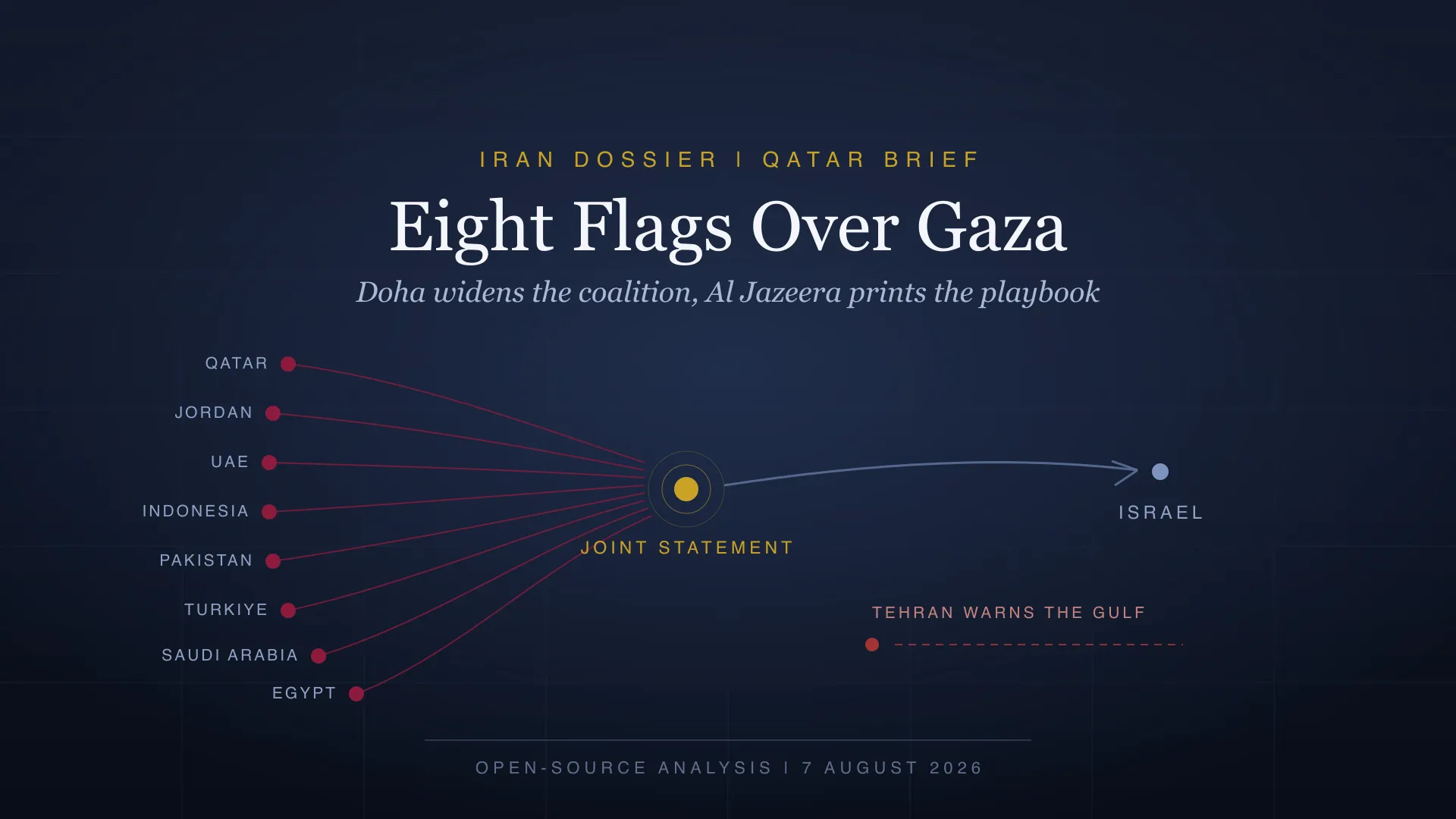
Eight Flags, One Indictment
On August 6, Qatar joined Jordan, the UAE, Indonesia, Pakistan, Türkiye, Saudi Arabia and Egypt in the strongest coordinated statement of the period. The ministers condemned attacks on healthcare and civilian infrastructure, declared that ongoing Israeli actions breach both international law and the Comprehensive Plan to End the Gaza Conflict, and explicitly linked the problem to President Trump’s announcement that the Palestinian factions had accepted the roadmap, including its weapons-confinement provisions. The statement extends the indictment beyond Gaza, to settlement expansion, settler attacks and Jerusalem, and calls on the UN Security Council to take practical measures to compel Israeli compliance and hold violators accountable.
This is materially sharper than routine ceasefire language, and the coalition arithmetic is the point. The mediator troika of three days ago has become eight states spanning the Gulf, the Levant, North Africa and South and Southeast Asia, including two nuclear-adjacent militaries and the world’s largest Muslim-majority state. The sequencing narrative is unchanged: the factions accepted the roadmap, so the burden of implementation now sits with Israel.
Israel rejected the statement as a distortion. Reuters reported the Israeli counter-claim that Hamas continues to rearm, recruit and construct tunnels, in breach of the first condition of the US-backed plan for a demilitarized Gaza. That is the verification gap in one sentence: the regional statement treats Palestinian acceptance of the roadmap as sufficient to transfer responsibility to Israel; Israel argues acceptance is not equivalent to verified demilitarization. Neither reading is falsifiable without a joint verification mechanism, which still does not exist.
Tehran’s Message to the Gulf
The Iran file turned more threatening for Qatar during the window. Reuters reported that Tehran warned Gulf states to persuade President Trump to desist from further attacks or face strikes on vital infrastructure, including oil fields, electricity, water and transport systems. The warning was conveyed through high-level contacts involving Foreign Minister Abbas Araqchi and counterparts including Qatar, alongside public language about Iran’s full readiness to respond to any aggression or to the participation and cooperation of regional states in it.
This changes the mediator equation. Qatar seeks to preserve a working channel with both Washington and Tehran, but Iran is now openly using the vulnerability of Gulf infrastructure as coercive leverage against the same states it needs as intermediaries. Doha therefore has a direct interest in rapid de-escalation even while resisting any arrangement that legitimizes unilateral Iranian control over Hormuz.
The proposed Iran-Oman Hormuz arrangement, meanwhile, looks less workable the closer it gets. Reuters reported that shipping-industry sources consider a fee-based system unviable because of sanctions, insurance clauses and international maritime norms; Iran is seeking service-related charges and an oversight role, while the United States rejects tolls or Iranian approval requirements. All of this supports Qatar’s public insistence on freedom of navigation, international law and regional consensus, and The Peninsula’s editorial line captured the balance Doha is trying to hold: validate Iran as a necessary party to negotiations, reject the use of Hormuz as a political-pressure tool, and place management of the waterway under international law rather than national discretion.
The Playbook in Print
The day’s most revealing material was not diplomatic but editorial. The August 6 opinion and blog sample across both Al Jazeera services is directionally consistent, and one piece stands out. On Al Jazeera English, George Zeidan argued that the erosion of bipartisan American support for Israel creates an opening for disciplined Palestinian advocacy, and recommended, explicitly, using Gulf influence in Washington and binding Arab normalization to Palestinian statehood. That is not observation; it is advice. When a Qatari-funded network publishes a working manual for the influence architecture Doha itself operates, the line between commentary and state messaging grows thin.
The Arabic service carried the heavier ideological load, and the selection tells its own story. An opinion piece read a Michigan primary win and the rise of progressive politicians as evidence that criticism of Israel is becoming electorally viable, framing Arab and Muslim American voters as a bloc that can move foreign policy. A second offered a British employment case as legal proof that anti-Zionism is a protected belief. A third carried the delegitimization argument into Latin American elections and even World Cup stands, repeating along the way an unverified claim about a US strike killing schoolgirls in southern Iran and insinuating Israeli tampering with vote-counting in Colombia and Peru, neither supported by evidence. Two more items treated Türkiye with notable warmth: Ankara as the constructive healer of Lebanon and Syria, obstructed by Iran, France, the United States and Israel, and an openly admiring account of the AKP’s 25 years in power as a model of durable Islamist-rooted governance. The most mobilizing item, a Gaza negotiations blog, described talks conducted under bombardment and used the language of siege, starvation and genocide.
These are author-driven pieces, not formal network editorials, and that caveat belongs in any honest reading. But editorial selection is itself a message. Taken together, the day’s sample normalizes the erosion of US bipartisan support for Israel and casts Arab and Muslim American political ascent as its engine, upgrades anti-Zionism from opinion to protected principle, rehabilitates Türkiye and the AKP as benign regional leadership, and keeps the emotional charge over Gaza high through resilience portraits and genocide vocabulary. The English service files the same themes in cooler, more exportable prose.
The Brotherhood File Stays Open
The timing is the signal. In the same news cycle in which a Senate subcommittee mapped Doha-linked bodies such as the International Union of Muslim Scholars as influence infrastructure, Al Jazeera English published an argument for deploying Gulf influence in Washington, and Al Jazeera Arabic ran an admiring study of the Turkish Islamist governance model. Doha will call the first journalism and the second analysis; the hearing reframes those same relationships as an ecosystem that lends religious and academic cover to Brotherhood-aligned actors. Both readings rest on the same set of facts, which is exactly why this file will keep generating pressure on Qatar in Washington. Assertions that Qatar materially finances the US Brotherhood network remain unestablished by any formal Senate finding; the exposure, for now, is architectural rather than financial.
Key Points
- The eight-state statement is a genuine escalation in form: it widens the anti-Israel diplomatic coalition well beyond the mediator troika, invokes the Security Council, and extends the indictment to the West Bank and Jerusalem, while remaining diplomatic and narrative rather than material.
- The core dispute is unchanged and unresolved: the regional bloc treats Palestinian acceptance of the roadmap as shifting the burden to Israel, while Israel cites continuing Hamas rearmament and tunnel construction; without a verification mechanism, both narratives remain self-sealing.
- Iran’s infrastructure threat, delivered through channels that include Qatar, converts Doha’s mediation from a prestige asset into a security necessity: Qatar is now managing a file in which it is also a potential target.
- The Hormuz fee proposal is stalling on technical and legal reality: shipping-industry skepticism, sanctions exposure and US rejection of tolls support Qatar’s freedom-of-navigation position without Doha having to confront Tehran directly.
- The August 6 Al Jazeera opinion sample, especially the Zeidan essay, blurs the line between commentary and strategy: it articulates in public the same Gulf-influence-in-Washington approach that the Senate hearing framed as an influence operation, and it does so on a Qatari-funded platform.
- Türkiye’s consistently sympathetic treatment in the Arabic sample, as regional healer and as governance model, is the soft face of the Brotherhood-aligned axis now under Senate scrutiny, and it binds Doha’s media posture to Ankara’s regional project.
What to Watch
- Whether Qatar, Egypt and Türkiye begin conditioning further Gaza implementation on verified Hamas weapons confinement, or continue placing the burden almost exclusively on Israel.
- Any Qatari response to Iran’s threat against Gulf infrastructure, especially language on sovereignty, self-defence or Al Udeid.
- Whether a Hormuz arrangement includes Iranian fees, permits or formal control mechanisms, the details that will determine whether Doha can accept it without undercutting its freedom-of-navigation position.
- Whether Al Jazeera English begins adopting the Arabic service’s explicit “resistance” terminology for Hamas or Palestinian armed groups.
- Any formal Qatari, QNA or Al Jazeera response to the August 5 Senate hearing and its references to Doha-based IUMS networks.
This analysis is based on an open-source review of the August 6-7 reporting window: the QNA text of the eight-state joint statement, Reuters reporting on the Israeli response, the Iranian warning to Gulf states and Hormuz passage feasibility, editorials and front pages of The Peninsula, Gulf Times and Qatar Tribune, and the August 6 opinion and blog output of Al Jazeera Arabic and English.