Doha's Mediation Moment: The Podium, the Blog and the Think Tank Speak as One
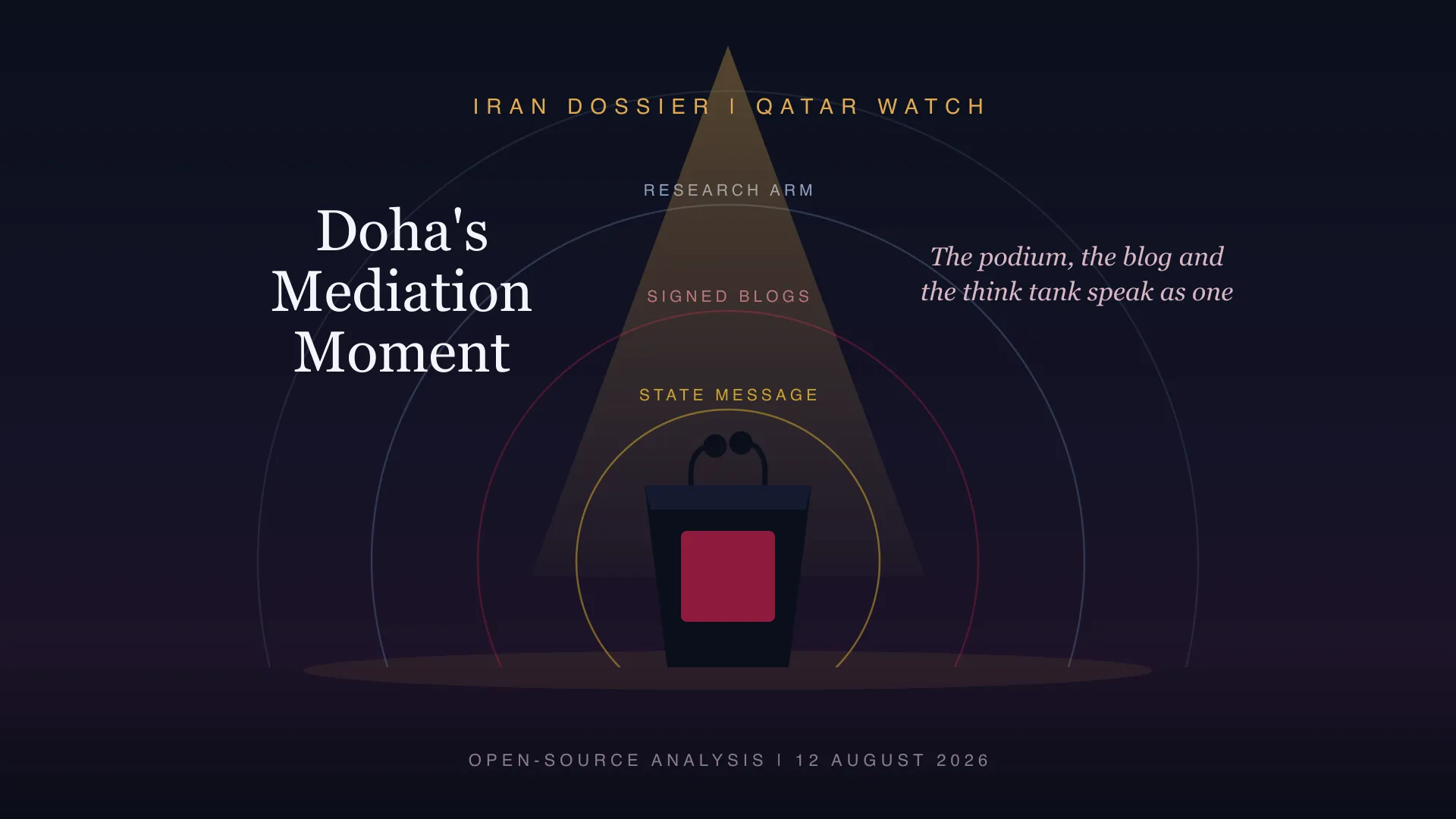
Qatar spent the August 11-12 window positioning itself at the meeting point of the region’s two live diplomatic tracks, Gaza and the US-Iran file over the Strait of Hormuz. Foreign Ministry spokesman Majed al-Ansari supplied the sharpest signal: he called the US-Iran phase a watershed, said Doha was watching the Oman-Iran channel closely, and set the restoration of free navigation through Hormuz as the minimum immediate requirement. The framing does real work, converting a geographic liability, Qatar’s LNG dependence on Hormuz, into a claim on diplomatic centrality. But the most useful development of the window was not a headline. It was the alignment between the official line and Al Jazeera’s research output, the machine working end to end. This post summarizes our Qatar Watch report for August 12.
Diplomacy at the Center
At the weekly Foreign Ministry briefing, al-Ansari said Israel’s rejection of the Gaza plan amounted to continued foot-dragging on steps already agreed toward a ceasefire, expressed hope that international pressure would force the second phase, and argued that a recent Hamas declaration had helped produce a breakthrough, presenting Doha’s mediation as a joint effort with the United States, Egypt and Türkiye. The report’s assessment: Qatar stays tied to the US framework but assigns blame in one direction, which protects its standing with Hamas and Arab publics while keeping the mediation anchored to Washington. For Israel, the signal is that Qatar will run diplomatic and media pressure in parallel with quiet mediation rather than act as a neutral conveyor of positions. The move is not improvised: Qatar congratulated Khalil al-Hayya on his election as head of Hamas’s political bureau, the relationship that keeps Doha inside the channel through which Hamas positions reach the table.
On Hormuz, al-Ansari’s concrete marker was that the immediate minimum is restoration of free navigation consistent with international law. This is national-security business, not mediation of convenience: the LNG model is structurally exposed to any disruption, so Doha has a stronger incentive than most to back a maritime deal even if it leaves the wider US-Iran disputes open. Expect an incremental formula: shipping first, strategic questions later. Two smaller items complete the official picture: asked about the Mecca pact, al-Ansari welcomed regional cooperation that strengthens security without endorsing a bloc aimed at any state, acceptance of a denser Sunni security network while staying out of an explicit anti-Iran front; and Qatar condemned Colombia’s recognition of Israeli sovereignty over the Golan, an easy alignment with the Arab consensus on a territorial principle.
The domestic press converged on the two-part message with little visible challenge: Gulf Times led with Israel stalling on the Gaza accord and made Hormuz the sub-head; The Peninsula transmitted the official formulation with minimal editorial distance; Qatar Tribune carried the strategically sensitive item, Iran’s intention to charge commercial vessels for Hormuz passage, which bears directly on the free-navigation principle the ministry stressed; and Al-Arab ran an analytical piece arguing the region is entering a model of sustained attrition, the environment in which Qatar’s mediation both thrives and becomes politically costly.
Three Registers, One Machine
Al Jazeera’s output separated cleanly into three registers, and the separation is the analytically useful part. The newsrooms carried Hormuz and Gaza as straight news, with the familiar split: Arabic amplified Doha’s diplomatic centrality between Washington, Tehran and Muscat, while English translated the crisis into energy security for a global audience. A signed blog advanced the thesis the network would not state editorially: the Moroccan blogger Aws al-Ghazawi asked whether the Mecca pact seeds a new Islamic military alliance and answered yes in spirit, reading it as proof Washington can no longer guarantee Gulf security alone, telling Iran to treat the alliance as an opportunity rather than a threat, and arguing that Israel’s deeper fear should be economic. The report calls this the outrider channel: a post-American, multipolar reading and an Iran-friendly overture that the Foreign Ministry, which welcomed the pact only as generic stability, would not put its name to.
The most consequential layer is the research arm. The Al Jazeera Centre for Studies published a study by Mohanad Mustafa arguing that Hamas has reached the furthest point of the war on the weapons file, a fifteen-point framework to regulate, store and hand over arms to a Palestinian technocratic committee in parallel with an Israeli withdrawal, and that Israel still refuses. Its central claim: the real dispute is no longer Hamas’s weapons but Israel’s determination to remain in Gaza. It reconstructs the sequence, Netanyahu’s rejection and a set of Israeli edits, destroy rather than store the weapons, no withdrawal before full disarmament, and no Turkish or Qatari role on the verification committee, reviews Israel’s four declared war aims as met or attainable, and concludes that disarmament has shifted in Israel’s position from objective to justification. The report’s assessment deserves quoting in full spirit: this is the research-register twin of al-Ansari’s podium line. The ministry says Israel is foot-dragging; the Centre supplies the architecture, chronology and thesis that shift the burden fully onto Israel. Read together they show the machine working end to end: state message, research validation, then Arabic and English amplification. The study is analytically serious and one-sided by design.
A second Centre study, by Saleh al-Naami, maps settler violence in the West Bank as organized terrorism: incidents rising from 221 in 2016 to more than 1,800 in 2025, 16 Palestinians killed in the first half of 2026 against two in all of 2016, settlement farms covering roughly two million dunams, and the absorption of thousands of settlers into official reserve units after October 7, which it says erased the line between armed settler and soldier. Several claims draw on Israeli investigative and Shin Bet material; the value is the editorial function. Two coordinated studies inside one 48-hour window, running the same direction, is itself the signal: the research arm is running a coordinated Gaza and West Bank argument, not isolated papers.
The Counter-Frame
The external monitoring layer tightened this window. MEMRI recorded the Qatari Prime Minister’s congratulations to al-Hayya and read it as continuation of Doha’s unreserved support for Hamas rather than the conduct of a neutral broker; whatever the reading, an official Qatari endorsement of the negotiator now leading Hamas complicates any claim that Doha sits above the parties it mediates between. The standing context files remain: FDD’s June mapping of what it describes as Qatar’s roughly 400 billion dollar footprint in the United States; the Justice Department’s National Security Division determination that AJ+ met the foreign-agent standard, which the outlet did not comply with; and ISGAP’s estimate of roughly 100 billion dollars in undocumented Qatari money in US higher education. These are context rather than window events, but they define the terrain on which Qatar’s mediation and media operate, and they connect to the congressional file this series has tracked since August 5.
The Hostility Is the Point
The report’s implications section is its sharpest, and it belongs in summary form. Israel should read Qatar’s posture as instrumental, not benign, and above all should not read the mediation as proof that hostility has receded: Doha has built a model in which enmity toward Israel pays. Brokering makes Qatar indispensable to Washington; spending across Western institutions buys influence; Al Jazeera keeps the pressure on Israel constant, cheap and deniable; and the mediation is what makes the rest respectable. The stake runs deeper than brokerage: Hamas is the Palestinian branch of the Muslim Brotherhood, the movement Qatar has sponsored for two decades, alongside Türkiye, as its preferred vehicle of regional influence, so Doha holds an ideological interest, not only a diplomatic one, in Hamas surviving the war with its political and military power intact. That is why public pressure on Israel does not contradict Qatar’s wish to stay inside the negotiating room; it is the reason Qatar wants to be there. The operational lesson for monitoring: when the ministry’s message, a signed blog and two research papers converge inside 48 hours on the same conclusion, the effect is a coordinated information posture, and Al Jazeera’s research output should be treated as a leading indicator of Qatari diplomatic positioning, not as separate analysis.
On the regional balance, the report adds three structural notes: Hormuz is potentially the more consequential file, because Qatar’s exposure can pull Doha toward formulas Israel may judge insufficiently coercive toward Tehran; Türkiye is the bridge across several parts of Qatar’s strategy, and if the Mecca arrangement deepens, Doha will have to manage a harder triangle of security affinity with Ankara and Riyadh, economic vulnerability to Iran and dependence on the United States; and the Sunni-Shia divide is not disappearing but being overlaid by pragmatic security arrangements, with Qatar’s preferred position between the camps and its central risk that a future crisis eliminates the middle ground.
Key Points
- Qatar converted its Hormuz exposure into a claim of diplomatic centrality: the watershed framing and the free-navigation minimum position Doha as the indispensable node between Washington, Tehran and Muscat, with an incremental shipping-first formula the likely push.
- On Gaza, blame is assigned in one direction by design: anchoring to the US plan while naming Israel the principal obstacle keeps Doha indispensable to Washington without softening its posture toward Israel or Hamas.
- The window’s defining finding is the coordinated information posture: podium line, signed blog and two Centre for Studies papers converging inside 48 hours, each layer reinforcing Doha’s framing while preserving deniability.
- The al-Ghazawi blog is the outrider: an Islamic-NATO, post-American reading with an Iran-friendly overture that official Qatar would not sign, floated on the network’s platform.
- The counter-frame hardened: MEMRI’s reading of the al-Hayya congratulations, the FDD footprint baseline, the AJ+ FARA determination and the university-funding estimates define the terrain of US scrutiny even without new window events.
- The report’s bottom line: Qatar is turning the region’s fragmentation into leverage, and hostility to Israel is one of the strategy’s engines, made profitable and deniable by the mediation, the money and the media. The next test is Hormuz.
What to Watch
- A concrete maritime formula for Hormuz from Oman or Qatar: transit guarantees, fees, inspections or sequencing.
- Qatari language separating a Hormuz arrangement from the broader US-Iran strategic file.
- Practical steps, beyond declaration, from the signatories of the joint statement on Israeli actions in Gaza.
- New Centre for Studies output on Gaza, the West Bank or the Mecca pact, treated as a leading indicator of Doha’s next diplomatic move.
- Whether Al Jazeera Arabic sharpens Israeli responsibility for diplomatic failure while the English service shifts toward US pressure on Israel.
- Further Qatari state contact with the al-Hayya leadership, and any signal Doha is shaping rather than merely carrying Hamas positions.
- Institutional mechanisms growing out of the Saudi-Turkish-Pakistani agreement that Qatar may join, support or coordinate with.
- New Qatar Charity or QRCS activity in politically sensitive theatres, and movement on US scrutiny of Qatari influence networks, university funding, FARA compliance or Hamas-related mediation.
This post summarizes the Iran Dossier Qatar Watch report for August 12, 2026, covering the August 11-12 reporting window, built on Qatar MFA and QNA output, the Qatari Arabic and English press, the Al Jazeera newsroom, blog and Centre for Studies layers, and external monitoring by MEMRI, FDD, ISGAP and US Senate FARA correspondence.