Controlled Experimentation: Doha Tests Hormuz One Cargo at a Time and Puts Syrian Sovereignty at the Front of Its Israel File
Qatar’s strongest official statement on September 10 concerned Syria, and its most important economic signal was a single LNG cargo. The Foreign Ministry condemned Benjamin Netanyahu’s entry into Syrian territory as illegal, a violation of Syrian sovereignty and international law, and a serious threat to regional security, and it demanded urgent international action and compliance with the 1974 Disengagement Agreement. The same channels welcomed the IAEA Board decision closing Syria’s non-compliance file. Read together, the two texts cast Doha as the advocate of the Syrian state’s rehabilitation and Israeli action beyond recognized borders as the disruption. In the war economy, Kpler data reported by Reuters show seven vessel transits of the Strait of Hormuz on September 10, against a ten-day average of 15 and roughly 125 large commercial vessels a day before the war. Al Marrouna completed the first known Qatar-linked LNG delivery to Pakistan since July, and Al Ghashamiya and Al Daayen were observed inside the strait in ballast. The report’s judgment is that Qatar is engaged in controlled experimentation, and that repetition and insurability remain the test of anything more. Brent settled at $107.63 after the largest wave of shipping attacks since the war began. Around those two files, the Qatari press converged on legal and economic accountability for Israel, used the 25th anniversary of 9/11 to frame the Hormuz war as a product of post-2001 militarization, and argued that economic resilience is now a national-security requirement. This post summarizes the Qatar Watch daily intelligence review for September 11.
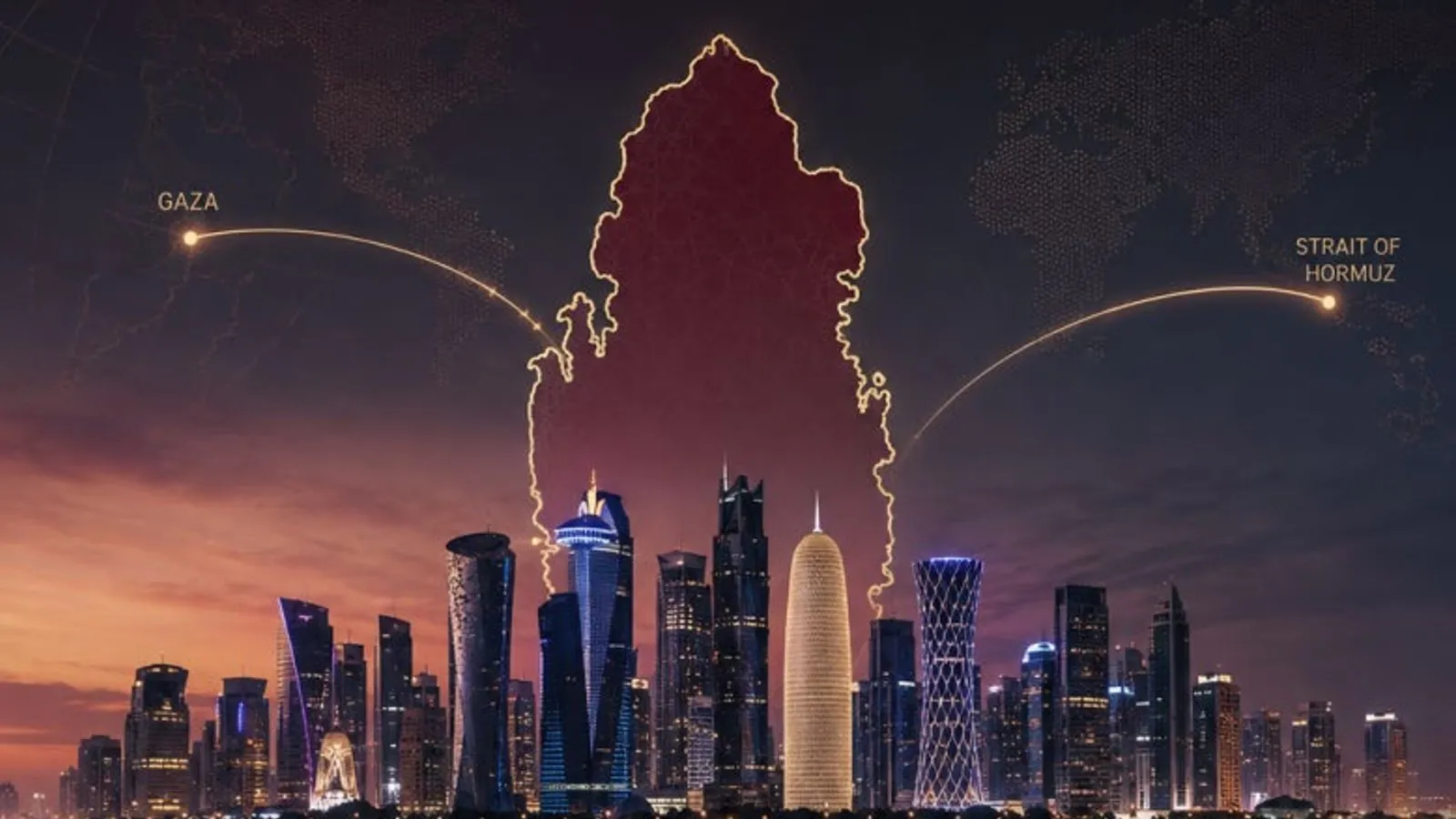
Syrian Sovereignty as the Official Line of the Day
The Foreign Ministry statement of September 10 is the strongest official political text in the window. Carried by the Qatar News Agency in English and Arabic and confirmed by The Peninsula, it describes Netanyahu’s entry into Syrian territory as an illegal border crossing, a violation of Syrian sovereignty and international law, and a serious threat to regional security. It calls for urgent international action and for compliance with the 1974 Disengagement Agreement. The language is legal and sovereigntist throughout. Hamas and Iran do not appear. The report reads the statement alongside Qatar’s welcome for the IAEA Board decision closing Syria’s non-compliance file, which Doha presented as a step toward restoring Syria’s normal standing, returning it to peaceful nuclear applications, and moving toward reconstruction. Together the two items place Qatar on the side of Syrian state sovereignty and institutional rehabilitation, with Israel named as the party breaching both.
Official diplomacy on the Gulf file was more careful. A Qatari-Saudi exchange on September 10 emphasized de-escalation, regional security, and freedom of navigation, and a meeting between Minister of State Mohammed Al Khulaifi and an Austrian envoy stressed a diplomatic solution that guarantees navigation through Hormuz. The report notes the wording. Qatar supports predictable navigation and avoids endorsing any Iranian control over commercial transit. That is consistent with the September 9 weekly briefing line, covered in Conditioned Mediation, that the immediate and unconditional reopening of Hormuz is Qatar’s top priority. The Financial Times reports a GCC-Iran meeting track in Salalah aimed at a temporary shipping arrangement, which the report treats as reinforcing Doha’s preference for a repeatable regional mechanism over a one-off passage exception. No new window-relevant post on Iran, Hormuz, Syria, or Israel was retrieved from the prime minister’s or the spokesman’s accounts.
Accountability for Israel, With a Corrective From Inside the Ecosystem
Qatari commentary moved beyond official condemnation and argued that Western tolerance for occupation and settlements is narrowing. The official anchor is the ministry’s September 8 statement welcoming Britain’s ban on settlement goods, which cited Security Council Resolution 2334 and Article 8 of the Rome Statute. On September 11, Al-Sharq’s opinion page carried Adel al-Hamdi’s argument that the British measures matter more as a symbol than as commerce, because they mark a shift from managing occupation through diplomatic concern to imposing political and economic cost. The Arab Center for Research and Policy Studies, writing in Al-Araby Al-Jadeed, made the same case in more structured terms. Its causal argument is domestic: Gaza altered British electoral politics and raised the cost of an ambiguous Israel policy. A blog on Al Jazeera Arabic by Omar Fares presented Netanyahu’s angry response as evidence that pressure is beginning to impose a cost. The report assesses, with moderate-to-high confidence, that this convergence is a measurable narrative trend. It is commentary and does not amount to a new Qatari policy.
The corrective came from the same platforms. Bassem Ezbidi, a Palestinian political scientist at Birzeit University, argued in Al-Araby’s September 11 print edition that the South African precedent worked because of three things Palestinians do not yet have. The first is pressure from below that forces legislatures to act. The second is a message reduced to a single moral principle. The third is serious preparation for the day after. He named three obstacles that make the task harder, including the loss of legitimacy that armed action carries in Western opinion after 9/11, the absence of a single representative voice, and Washington’s role as what he called the last wall, illustrated by its warning to Britain of economic consequences for punishing Israel. His conclusion is that the sanctions announced by twelve states are “the first stone in a wall not yet built.” For the report, the item matters in two ways. A Qatar-funded platform is carrying a Palestinian self-critique that treats armed action and divided representation as the main obstacles to Western pressure on Israel. It also records the U.S. warning to Britain as the operative constraint on the accountability trend the rest of the Qatari press is celebrating. In a related column, Dalal al-Bizri argued in Al-Araby that Lebanon’s documentation of Israeli violations is no substitute for accountability, and she noted that Hezbollah has its own reasons to be cautious about international judicial mechanisms.
Seven Transits and One Delivery
The controlling indicator is the Reuters count. Kpler data show seven vessel transits of Hormuz on September 10, against a ten-day average of 15 and about 125 large commercial vessels a day before the war. Reuters cautions that vessels running with their transponders off may be missed. Against that background, Al Marrouna completed the first known Qatar-linked LNG delivery to Pakistan since July, the voyage described in One Passage Is Not a Lane and confirmed at Port Qasim in the September 10 review. Two further QatarEnergy-linked carriers, Al Ghashamiya and Al Daayen, were observed inside the strait in ballast, which the report reads as possible staging for further controlled tests. Its judgment is that this is controlled experimentation, with high confidence on the traffic data and moderate confidence on the interpretation. The corridor remains severely impaired, and one delivery is an operational success and not a regular service.
The report is explicit that Qatar faces a dual constraint. Roughly 17 percent of LNG export capacity remains offline after damage to two Ras Laffan trains, and QatarEnergy has extended force majeure on some contracted supplies into early November. A sustained reopening of the strait would not restore the two damaged trains, and undamaged production cannot be fully monetized while safe carrier transit is intermittent. European gas has priced the constraint. Dutch TTF reached EUR 78.72 per megawatt-hour on September 9, and the Wall Street Journal reports that the market increasingly treats Qatar as a structural supply risk. Marine risk is the third element. A September 10 marine-insurance assessment rates the Hormuz environment as severe or critical depending on area and period, and the report argues that the strategic issue for Qatar is the willingness of owners, charterers, and reinsurers to accept repeat exposure. The key indicator is therefore repetition. LNG carriers are specialized, high-value assets, and Qatar needs a corridor that is commercially predictable and insurable, which a single physically possible crossing does not establish.
Oil prices carried the war-risk premium. Brent settled at $107.63 a barrel on September 10, up 6.34 percent, and WTI at $102.48, up 6.69 percent, the highest since May 19 and the steepest single-day rise in nearly two months after the largest wave of shipping attacks since the war began. Brent traded near $106 early on September 11. The Qatar index fell 0.3 percent on September 10 and QNB lost 1.4 percent, which the report reads as regional security risk becoming visible in the local market after the stability reading of the previous day. The same day’s Hormuz picture from Tehran’s side, including the Houthi advance toward the Red Sea coast, is covered in the daily intelligence update, and the Iranian economic press is summarized in the Economic Press Review.
Resilience as a National-Security Requirement
The local press built a resilience narrative in parallel with the traffic data. In Al-Sharq on September 11, Ali Mohammed al-Mohannadi cited Hormuz and maritime shipping as reasons to accelerate diversification, advanced industry, innovation, small and medium enterprises, and policy flexibility. The report calls this the clearest morning-press statement of the economic lesson Doha wants drawn from the war, which is that resilience has become a national-security requirement. Al-Arab’s editorial promoted the unified GCC tourist visa as an integration project with joint packages, longer stays, and a single-Gulf-destination marketing model, and the report notes that the piece also carries a resilience function by stressing cross-Gulf interdependence and non-energy growth. Lusail led its business cycle with QatarEnergy’s Angola expansion, Qatar Airways’ recovery, and the equity market, in a frame the report describes as pragmatic: geopolitical pressure is real, and diversification and state investment are the stabilizers.
The assessment keeps the two halves separate. Qatar Airways reports passenger traffic at about 90 to 95 percent of the pre-crisis level and plans 138 aircraft over five years, and the report judges that connectivity is recovering far faster than LNG logistics. The Angola agreement, the aviation recovery, and the GCC visa reduce the risk that the war economy becomes a single-sector story. They do not offset the fiscal weight of LNG disruption while two Ras Laffan trains remain offline. The report’s confidence is high on the messaging and low on any fiscal offset. The policy implication follows directly. The longer Hormuz remains unreliable, the greater the incentive to accelerate non-LNG revenue, overseas asset diversification, and regional service-sector integration. The half-year deficit that gives those incentives their weight was reported in The Cost Enters the Budget.
A second maritime risk is entering the Qatari frame. In Al-Araby, economics columnist Mustafa Abdel Salam treated Houthi advances toward the Red Sea coast as an international trade and energy problem, with cumulative chokepoint risk raising shipping, insurance, and inflation pressures on Suez-linked trade. On Al Jazeera English, the Saudi analyst Khaled M. Batarfi argued that Saudi Arabia must restore deterrence against the Houthis without returning to an open-ended Yemen war. The report assesses that the widening Houthi threat is increasingly relevant to Qatar even when Doha is not targeted, because simultaneous eastern and western maritime stress reduces the value of partial relief at only one chokepoint.
The 9/11 Frame and the Language Differential
The 25th anniversary of 9/11 ran through Al-Sharq, Al Jazeera Arabic, and Al-Araby Al-Jadeed as one argument. Ahmed al-Qadidi’s Al-Sharq column moved from post-9/11 securitization of Islam and Muslims to the 2026 U.S.-Iran war and Hormuz, arguing that military power alone cannot produce durable stability. On Al Jazeera Arabic, the Moroccan academic Hassan Aourid opened with a first-person account of Washington on the day of the attacks and then argued that the aftermath fused Muslim identity with a security problem. Al-Araby’s page-8 news feature, a Washington-datelined report and not an opinion column, argued that the response reshaped the world more than the attack did, compared the condition of Arabs and Muslims after 9/11 to the McCarthy era, and tracked Islamophobia in current U.S. politics through the case of New York Mayor Zohran Mamdani. Emad Hajjaj’s cartoon drew the world’s continents as smoke rising from the two towers. The report assesses, with moderate confidence, that the frame casts Muslims as durable victims of the War on Terror and Hormuz as its consequence. It treats the finding as a barometer signal about how Qatar-funded media narrate the current war, with no policy significance.
The Al Jazeera opinion set showed a pronounced language differential. Arabic opinion and blogs concentrated on Israel, Lebanon, Arab institutional weakness, and the post-9/11 Muslim experience, and used occupation, accountability, and impunity as routine vocabulary. English opinion was more conventional in its state-security framing, centered on Saudi-Houthi deterrence and on Dimitar Bechev’s Carnegie Europe argument about the far right and Russia. Hamas was not central in either set. Where Hezbollah appeared in Arabic, in Oraib al-Rantawi’s column on the Ali al-Taher ridge, it was described as an armed strategic actor with tunnels, weapons, and Iranian backing. The report is careful about what this establishes. All of the items are author opinions or guest blogs, and no formal network position can be inferred from them.
How Doha Describes Its Own Power, and the Pressure From Outside
The most consequential influence signal of the day is domestic self-description. Al-Sharq’s formal editorial on the UN General Assembly memorial for Sheikh Hamad bin Khalifa Al Thani stated that Qatar’s influence is measured by mediation, diplomacy, education, energy, media, and humanitarian action as much as by economic achievement. The report calls this unusually explicit as a statement of the Qatari influence model, and it notes that the formulation closely matches Qatar’s actual portfolio of instruments. The Peninsula’s editorial on Education Above All supplied the operating logic, which is agenda setting first and then implementation partnerships and measurable results, and it set an unusually concrete internal test of predictable financing and accountability. Qatar Charity’s inaugural Rofaqa Quran competition for sponsored orphans, with 389 sponsored children and 278 contestants from 20 countries, belongs to the same welfare-based toolkit. On Turkey, Doha News kept attention on strategic trust, and the report records continuity with no new bilateral instrument.
External pressure sharpened on two files. A bipartisan U.S. congressional letter seeks Entity List action against Sunkissed Organic Farms, formerly Appin Technology, BellTroX, and CyberRoot. Lawmakers say there is evidence these hack-for-hire groups operated at the behest of the Qatari government, targeting opponents of Qatar’s World Cup bid and the family of former House Intelligence Committee Chairman Mike Rogers, which TechCrunch and CyberScoop link to Reuters’ 2023 reporting on his wife. Qatar did not respond to requests for comment. The report assesses with high confidence that the allegation and the blacklist request exist, and with low-to-moderate confidence that the public record establishes Qatari state direction. The missing element is the evidentiary bridge between known hack-for-hire actors and government tasking, and the report asks future reporting to distinguish a Qatari client, a Qatar-based intermediary, and an order from the Qatari government. On academic influence, the Wall Street Journal exchange between Ted Mitchell of the American Council on Education and Neetu Arnold of the Manhattan Institute narrows the dispute to what should be public and under what authority. The live event is the Department of Education’s publication of prior-cycle foreign-source names under Section 117, delayed twice and scheduled for September 11. The evidentiary priority is mechanism, which means Qatar-specific donor or contracting entities, agreement clauses, governance leverage, and curriculum or research conditions. The Cornell-Qatar Foundation branch campus remains the clearest institutional mechanism on record, and it is not by itself proof of improper influence.
Key Points
- Syrian sovereignty is the strongest official Qatari line of the day. The September 10 Foreign Ministry statement on Netanyahu’s entry into Syrian territory, paired with the welcome for the IAEA Board decision, presents Doha as the advocate of Syrian state rehabilitation and Israel as the disruptor. Hamas and Iran are absent from both texts (high confidence).
- Qatar-linked LNG movement through Hormuz is controlled experimentation. Seven transits on September 10 against a ten-day average of 15 and about 125 a day before the war, one completed delivery to Pakistan, and two carriers inside the strait in ballast do not add up to normalization. Repetition and insurability remain the test (high confidence on the traffic data, moderate confidence on the interpretation).
- Qatar’s war economy is bound by a dual constraint. About 17 percent of export capacity remains offline at Ras Laffan, force majeure runs into early November, and a reopened strait would not restore the damaged trains. Marine-insurance conditions rated severe or critical add a third limit on fleet availability (high confidence).
- Qatar-based media are converging on legal and economic accountability for Israel. Al-Sharq, the Arab Center analysis, and the Al Jazeera Arabic blog present British settlement measures as the end of impunity, while Ezbidi’s op-ed records the U.S. warning to Britain as the operative constraint. This is commentary, and the indicator is a new Qatari official or multilateral step (moderate-to-high confidence as a narrative trend).
- Economic resilience is now argued as a national-security requirement. Al-Sharq ties diversification directly to Hormuz, Al-Arab promotes the GCC visa, and aviation has recovered to 90 to 95 percent of pre-crisis traffic. None of this offsets the fiscal weight of LNG disruption (high confidence on the messaging, low confidence on any fiscal offset).
- The 9/11 anniversary is being used to frame the Gulf war as a product of post-2001 militarization across Al-Sharq, Al Jazeera Arabic, and Al-Araby. The finding has barometer significance only (moderate confidence).
- The hack-for-hire allegation now sits inside a formal U.S. blacklist request. The tasking and payment chain remains unpublished (high confidence that the request exists, low-to-moderate confidence on proven state direction).
- The Section 117 release scheduled for September 11 is the live academic-influence indicator. Qatar-specific donor entities, agreement clauses, and governance terms would move the file from aggregate money to mechanism (high confidence on the timeline).
What to Watch
- Whether Al Ghashamiya, Al Daayen, or other QatarEnergy-controlled carriers load at Ras Laffan and exit Hormuz openly with their transponders on, and whether completed deliveries to Asian or European customers become repeatable.
- Any public change to QatarEnergy’s force-majeure guidance, customer nominations, Ras Laffan output estimates, or repair timelines.
- Whether war-risk premiums, exclusions, or reinsurance availability ease enough to support scheduled LNG movements.
- Whether the Salalah process produces a written or operational shipping arrangement, and whether Qatar publicly defines freedom of navigation in terms that reject an Iranian permission model.
- Whether the accountability convergence across Al-Sharq, Al-Araby, and Al Jazeera moves into new Qatari official diplomacy or coordinated multilateral action, and whether the reported U.S. warning to Britain slows replication by other states.
- Whether Doha follows the Syria sovereignty statement with a multilateral initiative on the 1974 Disengagement Agreement or on Syrian reconstruction financing.
- Any new Qatar-Turkey joint mediation initiative or practical mechanism on Gaza, Syria, or Hormuz beyond existing strategic-partnership language.
- Commerce Department action, Justice Department or FBI material, congressional hearings, litigation discovery, or a Qatari response that clarifies the alleged hack-for-hire tasking chain.
- The September 11 Section 117 release, and any Qatar-specific donor names, contract clauses, or governance mechanisms it contains.
- Expansion of Education Above All, Qatar Charity, or the Qatar Fund for Development into new conflict theaters, and whether aid is paired with diplomatic access or narrative campaigns.
This post summarizes the Qatar Watch daily intelligence review for September 11, 2026, covering the window from September 10 to September 11. Primary sourcing is Qatari: the Qatar News Agency and the Ministry of Foreign Affairs for the Syria statement, the IAEA welcome, the Qatari-Saudi exchange, and the humanitarian items; Al-Sharq, Al-Arab, Lusail, The Peninsula, Qatar Tribune, and Doha News for the domestic press; Al Jazeera Arabic and English for the media barometer; and Al-Araby Al-Jadeed’s September 10 and 11 opinion, analysis, and print pages for the accountability and anniversary material. External verification rests on Reuters and Kpler for the Hormuz transit count and the oil settlement, Trading Economics for the September 11 price, the Wall Street Journal for European gas and the Section 117 correspondence, the Financial Times for the Salalah track, Gulf Times for the aviation figures, a September 10 marine-insurance assessment for war-risk conditions, TechCrunch and CyberScoop for the congressional letter, and the Department of Education for the Section 117 schedule. The report’s evidentiary flags are preserved here. The reading of Qatar-linked LNG movement as controlled experimentation carries moderate confidence. The hack-for-hire allegation is recorded as a formal request whose evidentiary bridge to state direction remains unpublished. Al Jazeera and Al-Araby opinion items are the work of guest or regular contributors and do not represent a network position. The report states high confidence on official Qatari statements, published press framing, and the visible Hormuz traffic figures, and lower confidence on inferred strategic intent.