One Passage Is Not a Lane: Doha Clears Hormuz Once and Hardens Its Terms for the Waterway
Qatar has proved that a laden cargo can still leave the Gulf, and it has not yet proved that it can do so repeatedly. The carrier Al Marrouna, loaded in Qatar in early August, crossed the Strait of Hormuz and was tracked in the Gulf of Oman early Tuesday, signaling Port Qasim in Pakistan with arrival expected on September 10. Bloomberg’s ship-tracking reporting describes it as the first visible Qatari LNG exit through the waterway since July. Pakistani energy reporting adds the detail that matters most: the transponder stayed on throughout, which suggests QatarEnergy and Nakilat judged the corridor safe enough to be seen using it. Several mostly empty Qatari carriers have begun returning toward the Gulf, consistent with positioning for further loadings. None of this is a restart. Force majeure remains in place into October for Pakistani and Bangladeshi buyers and into November for Italy’s Edison, roughly 93 percent of Qatari LNG normally depends on Hormuz, and the Dolphin pipeline cannot substitute for seaborne cargoes. The report sets out a seven-step recovery ladder and places Al Marrouna firmly at step one. On the political side, Doha hardened its terms. Foreign Ministry spokesman Majed Al-Ansari told the Hili Forum that Gulf security is a shared responsibility, that Gulf states should help design future regional arrangements, and that treating the weaponization of critical waterways as a normal instrument of pressure cannot be accepted. In Beijing, the readout of Prime Minister Sheikh Mohammed bin Abdulrahman Al Thani’s meeting with Wang Yi became the first official Qatari text of the visit to name freedom of navigation in Hormuz. Doha also condemned the Houthi strikes on southern Saudi Arabia that wounded 73 people, naming the Houthis and leaving Iran unnamed. This post summarizes the Qatar Watch daily intelligence review for September 8.
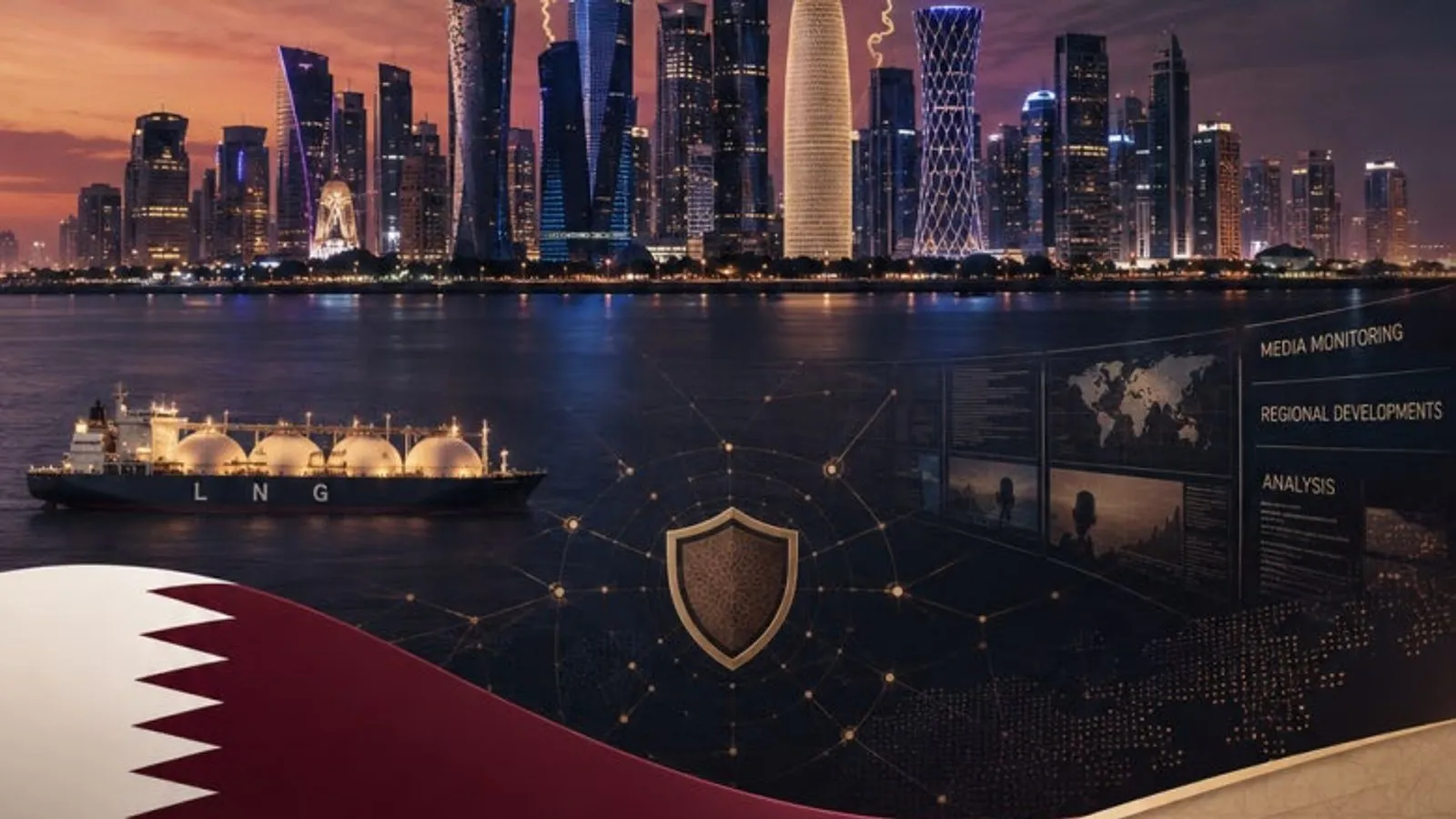
The Crossing, and What It Does Not Prove
The LNG file is the center of gravity, and the overnight evidence upgrades exactly one judgment. Al Marrouna, loaded in Qatar in early August, completed an outbound Hormuz transit before the morning cut-off and was visible in the Gulf of Oman with Port Qasim as its declared destination, making about 15.5 knots against an arrival time of 01:00 on September 10. Al-Araby Al-Jadeed had flagged the voyage the previous evening as a possible first step toward resumed exports, and Bloomberg’s tracking reporting confirmed the transit before the cut-off.
The transponder detail carries the analytic weight. A dark transit would have signaled that the operator considered the route survivable only if unobserved. A public crossing signals that QatarEnergy and Nakilat judged the corridor acceptable enough to use openly, which is a commercial judgment as much as a security one. Several mostly empty Qatari carriers have also begun heading back toward the Gulf. That is consistent with repositioning for future loadings, but it is equally consistent with storage management at a plant running near minimum, and it does not by itself demonstrate a sustained export program.
The analytical mistake to avoid is treating passage as equivalent to normalization. The report proposes a seven-step ladder for judging Qatar’s recovery. A loaded tanker can pass. Additional tankers can pass repeatedly. Underwriters and crews treat the route as insurable and operationally acceptable. Ras Laffan loads at reliable rates rather than at minimum storage-management levels. Customers restore schedules instead of relying on replacement cargoes. Force-majeure notices are shortened or withdrawn. Revenue capture approaches pre-crisis conditions. Al Marrouna establishes the first step, and the empty-carrier pattern suggests preparation for the second. The remaining five are not demonstrated. Our own account of the attempt, written before the crossing was confirmed, ran as Testing the Waters.
Two categories of claim deserve separation. Vessel-tracking accounts circulating overnight said that two Qatari tankers had been turned back by the Revolutionary Guard, that a third crossed with its transponder off, and that a transit fee may have been paid to Iran. None of that is independently established, and the fee question matters mainly as an indicator of Iranian efforts to institutionalize control rather than as a settled fact. Separately, an overnight post by Dr. Mohammed Al-Hashimi is worth treating as elite messaging rather than as an operational notice. It acknowledged market attention to Qatari tanker destinations, Ras Laffan, and the timing of export resumption, and presented Doha as quietly restoring the energy value chain. Its interest lies in how directly it names the questions Doha knows its customers are asking.
Revenue will lag physical recovery in any case. Replacement purchases have already been arranged, insurance and chartering costs are elevated, customers have hedged, and force-majeure schedules do not dissolve when one tanker clears the strait. The crossing matters most for Pakistan and other price-sensitive South Asian buyers, because it proves a physical Qatari cargo can again escape the Gulf, and marginally for China, because it lowers the probability that a temporary disruption hardens into long-term diversification away from Qatar.
Mediation With Harder Boundaries
Qatar’s Iran policy is becoming more explicit without becoming anti-Iranian. Al-Ansari used the Hili Forum to argue that the current crisis extends into energy, trade, navigation, and global supply chains, that Gulf security is a shared responsibility, and that Gulf states should be central partners in designing future regional security arrangements. He warned specifically against normalizing the recent pattern of coercion. Gulf Times gave the intervention its morning lead, foregrounding the point that weaponizing Hormuz threatens the world rather than only the region, and carrying the formulation that Qatar will seek greater strategic autonomy and Gulf security cooperation while strengthening rather than weakening its partnership with the United States. Qatar Tribune followed the same line on its front page, which confirms that this was a principal official message rather than a marginal speech.
The doctrine now combines three elements: collective Gulf security, a continuing strategic partnership with Washington, and continuing dialogue with Tehran. In practice Doha is saying that engagement with Iran cannot mean accepting Iranian unilateral authority over the rules of commerce. Doha still needs the Tehran channel, because the physical LNG problem cannot be solved by military access alone.
That makes the Iran-Oman corridor the decisive text rather than a side negotiation. Iranian Foreign Ministry spokesman Esmail Baqaei said the understanding on managing Hormuz shipping is in its final stages and days away, that it will define a temporary safe route, and that it will be documented with the International Maritime Organization. What remains contested is the reopening mechanism, maritime service fees, security arrangements, and Iran’s insistence that it and Oman jointly manage the strait within their territorial waters. Deputy Foreign Minister Kazem Gharibabadi has said the strait will not fully reopen until Washington meets its lapsed June commitments. For Qatar the test is precise. A corridor lodged with the IMO and free of fees is compatible with Doha’s proposal for a Malacca-style fund. A fee-bearing, inspection-based corridor is exactly the outcome Al-Ansari warned against at Hili. Tehran’s own account of the same corridor, and of the zone it sits inside, runs in today’s daily intelligence update.
Beijing, and the Sentence That Names the Waterway
The prime minister’s China visit ran across two days and two readouts, and the difference between them is the finding. The meeting with Premier Li Qiang produced a text covering strategic ties and expansion in economy, investment, trade, energy, and technology, with no specific LNG guarantee or shipping mechanism announced. The meeting with Foreign Minister Wang Yi produced the operative sentence: the readout states the necessity of ensuring the security and freedom of international navigation in the Strait of Hormuz, and the prime minister reaffirmed full Qatari support for diplomatic efforts that guarantee freedom of maritime navigation.
Iran is not named in that text, the United States is absent, and Gaza does not appear. The message to Beijing is that Doha wants Chinese weight behind a navigation guarantee, not only behind long-term offtake. Al-Sharq’s editorial board read the visit as evidence that the relationship has become a strategic pillar, deliberately broadening it beyond energy into investment, technology, and political dialogue. The Peninsula reproduced the official agenda without claiming an LNG restart or a China-specific shipping guarantee, which is the correct distinction: the visit is strategic reassurance while physical export normalization is being tested separately at the strait. A separate meeting with Chinese company founders and executives was reported in minimal terms and named no firms. Doha’s use of Beijing as a lever on the waterway is the continuation of the pattern we described in Mediation Plus Accountability.
Condemning the Houthis, Not Naming Iran
Houthi missile and drone strikes early Tuesday hit civilian and energy sites in Abha, Khamis Mushait, Jizan, and Najran. Saudi authorities reported 73 wounded, fires at several energy facilities, and a temporary halt to some operations, and coalition spokesman Turki al-Malki called the attacks a dangerous escalation. Qatar condemned the targeting of civilian and economic sites through the state news agency, and extended the condemnation to continued attacks on commercial ships in the Red Sea as a threat to the security and freedom of international navigation.
The vocabulary is the point. It mirrors Doha’s Hormuz language exactly, which allows Qatar to condemn an Iranian ally on maritime grounds without breaking its Tehran channel. The Houthis are named as the aggressor and Iran is not named. Qatar issued that condemnation on the same day its first cargo in weeks ran a corridor that Iran tolerates, which is mediation with harder boundaries in practice.
There is a second implication for the emerging security architecture. The Mecca Joint Defence Agreement treats an armed attack on Saudi Arabia, Turkey, or Pakistan as an attack on all, and the first Jizan strike came two days after the signing. A multi-city salvo is a materially larger test of that clause. Turkish and Pakistani reactions therefore become a Qatar-Turkey indicator, because Doha sits outside the pact but inside the Turkish security orbit. Kemal Ozturk’s Al Jazeera Arabic article used the attack on Qatar as an argument for why the Saudi-Turkey-Pakistan alliance should mature and expand, which frames Qatar’s own experience as a proof case for collective defense. The correct judgment remains limited. Qatar-Turkey affinity is visible and Qatar-based media is receptive to arguments for regional security autonomy, but nothing in this window shows Qatar joining the pact or changing its formal alliance structure.
A third consequence is economic. A sustained Houthi campaign against Saudi west-coast export infrastructure removes the one bypass Qatar never had, and strengthens the collective-security case Al-Ansari made at Hili for every Gulf producer. Oil moved in both directions inside 24 hours, trading near $96 after Monday’s Iran-Oman signal and rising about a dollar to $98 after the Saudi damage. A corridor deal lowers the Hormuz premium. A campaign against Saudi energy infrastructure raises the Red Sea premium. Qatar has no pipeline alternative and is exposed to the first rather than the second, which is why Doha’s interest lies in an early, low-fee corridor even at the price of Iranian participation in its management.
Gaza, Network Power, and the Humanitarian Instruments
Official Doha kept Gaza inside the same regional-security picture rather than treating it as a separate file. In the Amir’s call with British Prime Minister Andy Burnham, the Palestinian issue, a two-state peace, and the Hormuz escalation were discussed together. The Arab League ministerial council praised Qatari and Egyptian mediation and called for completing all stages of the Gaza ceasefire framework, and Qatar joined seven Arab and Islamic states, including both Turkey and the UAE, in condemning Israeli ministers’ statements on expelling Palestinians from Gaza.
The local press is sharper than the official diplomacy. Sahar Nasser’s column in Al-Arab argues that Hamas is only part of Israel’s problem with Qatar, and that the real objective is to convert Doha’s Hamas channel from reciprocal mediation into a one-way instrument for transmitting and enforcing Israeli demands. She describes Qatar’s ability to speak simultaneously with Hamas, Tehran, Washington, and Beijing across Gaza, Iran, Hormuz, and energy as a form of network power, and argues that preserving it is the correct response to Israeli pressure. This is signed opinion rather than government policy, but it is one of the clearest domestic articulations of how anti-Qatar pressure is being read in Doha. The practical test remains operational: whether Qatari access produces verifiable implementation in Gaza while preserving enough neutrality to keep the channel usable. No new Qatari mechanism for weapons verification, custody, or enforcement was announced in the window.
Qatar’s welfare institutions expanded on the Syria file in the same 24 hours. Qatar Charity distributed more than 1,200 food baskets in Deir ez-Zor, roughly 84.6 tonnes reaching more than 6,000 indirect beneficiaries, which is classic relief. Qatar Red Crescent went further, signing a strategic cooperation agreement with the Syrian Arab Red Crescent in Damascus and opening an official representation office in Syria, with an agenda covering early recovery, infrastructure rehabilitation, household economic empowerment, and health. Minister of State for International Cooperation Maryam Al-Misnad argued separately that humanitarian access should be built into negotiations rather than treated as a post-agreement addition. The significance is not that aid projects are political. It is that sustained service delivery creates local partners, legitimacy, and institutional access that purely diplomatic actors do not have.
External Scrutiny and Counter-Messaging
No qualifying new U.S. congressional measure, Treasury action, Justice Department or foreign-agent filing, Foundation for Defense of Democracies report, or MEMRI Qatar Threat Monitor publication was identified inside the reporting window. The most recent Qatar Threat Monitor issue located remains number 81, dated August 28, and the relevant think-tank studies on Qatari university funding predate this window. Those materials are baseline and are not recycled here as new findings.
The one new development is Qatari counter-messaging. Hamad AlMuftah alleged that a network of American research, advocacy, and media actors is conducting a coordinated disinformation campaign against Qatar Foundation and manipulating how foreign-funding disclosures are presented. The distinction the report draws is worth preserving. Foreign-funding disclosures, contracts, and foreign-agent registrations can be established document by document. A claim that multiple critics act under common direction requires a separate evidentiary chain, and it should remain attributed to the person making it. The strategic aim of the response is visible enough: to move the public argument from the scale of the funding to the motives and methods of the critics.
Key Points
- Al Marrouna’s completed transit is the most important Qatar-specific event of the window. It changes the LNG picture from an attempted restart to a first successful visible outbound crossing since July (high confidence, on Bloomberg ship-tracking reporting).
- The transponder-on crossing indicates that QatarEnergy and Nakilat judged the corridor acceptable enough to use openly. That is a commercial judgment as much as a security one (moderate confidence on the inference, high confidence on the fact of the public transit).
- The system remains abnormal. Force majeure, tanker availability, insurance risk, Iranian routing authority, and limited Ras Laffan operations continue to separate one passage from commercial normalization (high confidence).
- Repeatability is the open question. No second laden Qatari carrier has been reported crossing outbound, and the returning empty carriers may serve storage management rather than immediate customer delivery (high confidence that the test is unresolved).
- Doha is coupling LNG recovery with a doctrine of collective Gulf security and protected waterways, without abandoning either the U.S. partnership or engagement with Iran (high confidence).
- The Wang Yi readout is the first official Qatari text of the Beijing visit to name Hormuz navigation. Doha wants Chinese weight behind a navigation guarantee, not only behind long-term offtake (high confidence).
- The fee and inspection terms of any Iran-Oman corridor text will decide whether Qatari recovery is commercial or politically permitted. An IMO-lodged corridor without fees fits Doha’s position, and a fee-bearing, inspection-based one does not (high confidence on the framing, low confidence on the outcome).
- Qatar’s condemnation of the Houthi strikes names the Houthis and not Iran, using maritime-navigation language that mirrors its Hormuz position. This lets Doha stand publicly with Riyadh without closing the Tehran channel (high confidence).
- The Houthi salvo is a materially larger test of the Mecca Joint Defence Agreement than the first Jizan strike. Turkish and Pakistani reactions are the indicator, and nothing in this window shows Qatar joining the pact (high confidence on the test, low confidence on any Qatari accession).
- Qatar’s humanitarian institutions are moving from emergency delivery to institutional presence in Syria, which converts wartime access into potential post-conflict influence (moderate confidence).
- Claims that Qatari tankers were turned back by the Revolutionary Guard, that one crossed dark, or that a transit fee was paid remain tracker-level and are not independently established (low confidence).
- The coordination allegation against Qatar Foundation’s critics is not established and should be separated from the independently verifiable record of funding disclosures and registrations (low confidence in the coordination claim).
What to Watch
- Whether additional laden Qatari LNG carriers follow Al Marrouna through Hormuz within the next 24 to 72 hours. Repeatability is the next decisive test.
- Whether the returning empty carriers actually reach Qatar and convert into new Ras Laffan loadings rather than remaining positioning or storage movements.
- Any QatarEnergy notice shortening, confirming, or withdrawing force majeure for Pakistani, Bangladeshi, European, or other buyers.
- Ras Laffan loading cadence and plant utilization, and whether the system moves above minimum storage-management operations toward scheduled customer cargoes.
- War-risk insurance, chartering, and crew acceptance, and whether voyages become commercially routine rather than individually negotiated, escorted, or politically permitted.
- Publication of the Iran-Oman text: the presence or absence of service fees, inspection rights, and IMO lodging, and any Qatari or GCC endorsement or reservation.
- Al Marrouna berthing at Port Qasim on or about September 10, and any Pakistani statement on resuming the government-to-government LNG channel.
- Whether Qatar converts the Beijing visit into a specific supply-assurance, shipping, financing, or diplomatic mechanism beyond broad partnership language.
- Whether the collective Gulf security language produces concrete GCC military, maritime, or critical-infrastructure arrangements while the U.S. partnership is simultaneously reinforced.
- Whether the Houthi campaign extends to Yanbu or Red Sea tankers, and whether Turkey and Pakistan respond in collective-defense language under the Mecca agreement.
- Any Qatari statement that names Iran, rather than only the Houthis, in connection with the Saudi strikes.
- Any new U.S. congressional, Department of Education, Treasury, foreign-agent, or think-tank evidence on Qatar Foundation, university funding, or influence activity.
This post summarizes the Qatar Watch daily intelligence review for September 8, 2026, covering the hard window from 07:30 on September 7 to 12:00 on September 8. Primary sourcing is Qatari: the Foreign Ministry and Qatar News Agency for the Hili Forum intervention, the Beijing readouts, the Arab League item, and the condemnation of the Houthi strikes; the Amiri Diwan for the call with the British prime minister; Al-Sharq, Al-Arab, and Al-Watan for the Arabic press; Gulf Times, Qatar Tribune, The Peninsula, and Doha News for the English press; and Al-Araby Al-Jadeed for the pre-crossing energy report. External verification of the Al Marrouna transit rests on Bloomberg ship-tracking reporting syndicated before the cut-off, with Pakistani energy reporting and vessel-tracking data for the transponder status and arrival time. Iranian statements on the Oman corridor are from the Iranian Foreign Ministry as carried by Bloomberg and Rigzone. Force-majeure and dependence baselines are drawn from earlier reporting and are marked as baseline rather than as new findings. The report’s evidentiary flags are preserved here: single-passage evidence does not establish repeatability; tracker claims about turned-back tankers, dark transits, and transit fees are preliminary; the coordination allegation regarding Qatar Foundation’s critics is unestablished; and no qualifying new external investigation was dated inside the window.