Conditioned Mediation: Doha Hardens Its Line on Iran, Closes the Strike File With Israel, and Lands One Cargo in Karachi
Qatar’s language on Iran crossed a threshold on September 9, and its strategic objective did not move with it. The Cabinet condemned Iranian attacks on Kuwait and on the Saudi tanker SIDR, declared that freedom of navigation through the Strait of Hormuz is non-negotiable, and described the security of the Gulf Cooperation Council as indivisible. A separate Foreign Ministry statement held Iran legally responsible for renewed attacks on Jordan. Doha continues to argue that negotiation is the only sustainable exit, so the accurate description of its posture is conditioned mediation, with navigation and the security of neighboring states now stated as conditions. On the Israel file, a week of official silence ended. Foreign Ministry spokesman Majed Al-Ansari told Al-Araby Al-Jadeed that Qatar considers the September 2025 strike on Doha closed after Netanyahu’s public apology and pledge of non-repetition, and the ministry’s weekly briefing dismissed the hostile-state remark as a smear campaign. Qatar also joined seven Arab and Islamic states in welcoming Britain’s ban on settlement goods. The strongest economic signal was operational. The LNG carrier Al Marrouna berthed at Port Qasim in Pakistan on the morning of September 10 with 142,217 cubic meters of gas under a government-to-government contract, on a day when Reuters counted seven commodity transits of Hormuz and no LNG exits. The report reads the cargo as a selective safe-passage test that does not by itself restore the corridor. Qatar Airways, by contrast, says passenger traffic is back to 90 to 95 percent of pre-crisis levels. This post summarizes the Qatar Watch daily intelligence review for September 10.
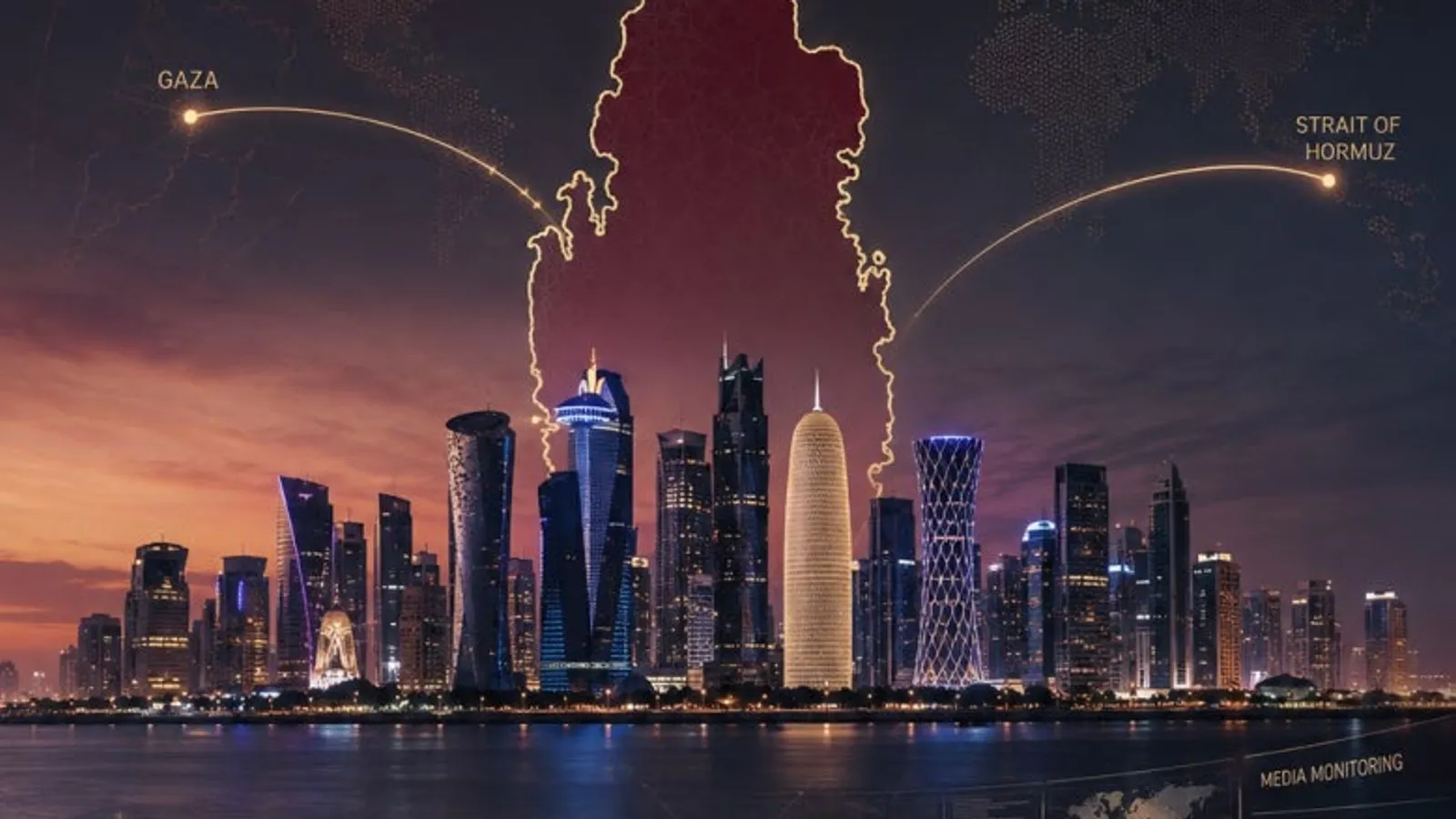
A Threshold on Iran, With the Objective Unchanged
The September 9 Cabinet statement is the hardest official Qatari text on Iran of this war. It condemned Houthi attacks on Saudi civilian and economic targets, attacks on Red Sea shipping, the Iranian strike on the Saudi tanker SIDR, and renewed Iranian attacks on Kuwait. Its two operative formulations were that freedom of navigation through Hormuz is non-negotiable and that GCC security is indivisible. The second phrase matters because it places the crisis inside a collective Gulf frame and takes it out of the register of a bilateral dispute between Doha and Tehran. A separate Foreign Ministry statement the same day called the renewed Iranian attacks on Jordan a flagrant violation of sovereignty and international law, held Iran legally responsible for their consequences, and backed Jordan’s right to defend its territory.
Both statements then pivot to the same destination. Each closes with a call for an immediate halt to military operations and a return to negotiations. The report assesses that this pairing is the point. Qatar now attributes unlawful attacks to Tehran by name, invokes legal responsibility, and rejects the use of Hormuz as a political-pressure instrument. It has not joined an anti-Iran coalition, and it retains a direct economic reason to keep a channel open to Tehran. The more accurate description is conditioned mediation. Dialogue remains the preferred instrument, but freedom of navigation, sovereign non-attack, and the protection of GCC states are now articulated as conditions and no longer as aspirations. Doha’s tolerance for Iranian coercive ambiguity has narrowed, even as its balancing policy survives.
The Foreign Ministry’s weekly briefing on September 8 supplied the doctrine. Ibrahim bin Sultan Al Hashmi, who directs the ministry’s media department, said Qatar rejects the normalization of a no-war-no-peace condition, that the immediate and unconditional reopening of Hormuz is the top priority for Qatar and the region, and that coordination with China runs in parallel with the prime minister’s visit to Beijing. That visit, covered in The Cost Enters the Budget, produced a Chinese description of the relationship as entering a golden decade and, in the South China Morning Post’s reading, a Qatari pledge to prioritize China’s energy supply through the strait. The report’s judgment is that Doha is enlisting the one major power with leverage in Tehran and a direct stake in Qatari cargoes, so that its harder line arrives with Chinese weight behind it. Tehran’s own account of the same day’s naval exchanges appears in the daily intelligence update.
Closing the Strike File, Opening a Narrative Contest
Doha’s silence on Netanyahu’s hostile-state remark, noted in the September 9 review, ended in two steps. At the September 8 weekly briefing, Al Hashmi rejected the description as a smear campaign, invoked Israeli conduct in the Palestinian territories, and said Qatar would not be deterred from its humanitarian and mediation role. Al Jazeera English carried the rebuttal and Al-Watan amplified it. On September 9, the first anniversary of the Israeli strike on Doha, Al-Ansari gave Al-Araby Al-Jadeed an interview in which he said Qatar considers the 2025 attack file closed after an explicit public apology and a pledge of non-repetition, while stressing that sovereignty is a red line and that mediation continues. Because the speaker is the Foreign Ministry spokesman, the content is an attributable official position delivered through a Qatar-funded platform.
The report’s reading is that Doha is now fighting Israeli criticism as a narrative contest and no longer treating it as background noise. Three institutional voices converged in the window. Al Jazeera Arabic’s anniversary package, including a network-produced report by staff writer Mahmoud Lafi, framed Netanyahu’s criticism as a sustained effort to undermine a mediator that Israel and the United States have repeatedly needed. In Al-Arab, Khalid Al-Jaber of the Middle East Council on Global Affairs argued that accusations about Qatari financing, universities, and media influence are being used to explain away Israeli policy failures. Al-Araby’s September 10 print edition placed Israel’s retaliation against Britain and the closure of Israeli candidate lists in a single electoral frame. The report is careful about what this does and does not establish. The counter-narrative does not disprove criticism of Qatar’s Hamas ties or funding relationships. It shows that the response has shifted from denial toward a counter-accusation that Israel is scapegoating the mediator.
The Israel file also moved beyond rhetoric. Qatar joined Turkey, Egypt, Indonesia, Jordan, Pakistan, Saudi Arabia, and the United Arab Emirates in an eight-state statement welcoming Britain’s ban on imports from Israeli settlements. Al-Araby’s economy page counted twelve states that have now announced such bans, put settlement exports at roughly $200 million to $300 million a year, and presented the British step, the E1 project, and the European Commission’s trade-preference proposal as a single tightening front. Separately, Al-Watan reported that an Arab Jerusalem committee welcomed a Qatari initiative for an institutional media platform to document Israeli violations in the city. The report assesses, with moderate-to-high confidence, that the coalition and the platform are instruments of policy, and that they become measurable when a funding line, a working platform, or replication by another state appears.
One Cargo in Karachi, and the Count That Frames It
Reuters’ tracking for September 9 is the controlling indicator. Seven commodity vessels crossed Hormuz that day, down from twelve the day before and below the ten-day average of fourteen. Four exited and three entered, and no LNG tanker left the Gulf. Reuters cautions that vessels running dark are not captured. Against that background, Al Marrouna’s openly tracked laden transit on September 7, described in One Passage Is Not a Lane, reached its destination. Port Qasim Authority officials told Business Recorder that the carrier berthed at the Engro Elengy terminal at about 11:38 local time on September 10 with 142,217 cubic meters of LNG, or about 81,936 tonnes.
The commercial terms explain the destination. Pakistani reporting places the cargo under Pakistan’s government-to-government contract with Qatar at a price slope of 13.37 percent of Brent, and notes that Pakistan LNG Limited had rejected spot offers near $26.70 per million British thermal units. Bloomberg’s report of a second Qatari cargo for Pakistan in the coming days is repeated in the Pakistani press but has not been confirmed by ship-tracking. Riviera Maritime, citing ICIS, and Splash247 both describe the voyage as the first openly visible Qatari-controlled laden crossing since late July, and Splash247 suggests it tested a selective safe-passage arrangement. The report judges that explanation plausible, given Pakistan’s mediation role and the parallel Iran-Oman discussions, and notes that QatarEnergy has not confirmed any formal corridor.
The interpretation stays narrow. One state-linked laden transit proves that passage can be arranged. A sequence of laden outbound QatarEnergy vessels would indicate a functioning corridor. Until that occurs, the binding constraint on Qatari LNG is maritime access, since Qatar’s willingness to sell is not in question. The Pakistan destination reinforces the political reading, since the first openly tracked cargo went to the state mediating between Washington and Tehran, under a contract, which is consistent with a negotiated exception. The constraint side is unchanged. Edison’s August 28 notice still covers 29 cargoes and about 3.8 billion cubic meters of gas from early April into early November, with no new extension announced. European benchmark gas remains in the high 70s of euros per megawatt-hour with storage roughly two-thirds full, and Brent traded near $101 a barrel, its highest since May, with WTI near $96. Reuters adds that marine-fuel supply has adapted, but Singapore bunker prices remain more than 60 percent above pre-war levels and Fujairah activity is about 40 percent of its pre-war level.
Aviation Recovers While the Corridor Does Not
Outside LNG, Qatar is projecting resilience, and the report treats Qatar Airways as the strongest counterexample to the Hormuz bottleneck. Group chief executive Hamad Ali Al-Khater told Gulf Times that passenger levels have returned to roughly 90 to 95 percent of last year, that the network has been rebuilt from about 60 destinations to 160, and that Hamad International Airport is handling more than 140,000 passengers a day. The carrier plans 138 new aircraft over five years, including A350-1000s and 777-9s, with 50 A321LR aircraft expected by year-end. A Qatar News Agency account of the February airspace closure gave the scale of the earlier shock. About 16,400 stranded passengers were accommodated, roughly 8,000 in Doha and 8,400 abroad, using 15,600 hotel rooms across 61 hotels. The report reads this as deliberate reputational messaging about crisis-management capacity.
Two further indicators point the same way. The Qatar Stock Exchange closed at 9,851.49 on September 9, down 0.06 percent on turnover of QAR 391.5 million, which the report uses as a stability reading. Despite war-risk pricing in energy and shipping, the domestic equity market showed no sign of acute stress. QatarEnergy signed heads of terms with Angola’s national agency, Shell, and Sonangol for Blocks 8 and 22 in the Kwanza Basin on September 9, covering exploration through production. That does not replace lost LNG throughput, but it shows the company still executing a long-horizon international strategy while the Gulf corridor is impaired.
The war-economy assessment that follows is more textured than the fiscal figures reported on September 9 would suggest on their own. Qatar is not experiencing economy-wide paralysis. Aviation has largely recovered, the equity market is orderly, and the national energy company is still signing upstream deals abroad. The vulnerability is concentrated but strategic. LNG export reliability remains hostage to Hormuz access, insurance conditions, and negotiated passage, and that concentration gives Doha a strong incentive to seek a durable maritime arrangement while avoiding any posture that would foreclose contact with Iran.
Turkey as Strategic Reserve
The Turkish ambassador’s farewell interview with Al-Sharq, published on September 7 and re-amplified in the current Qatari social stream, is unusually substantive on defense. Ambassador Mustafa Goksu described the relationship as a comprehensive strategic partnership across politics, defense, security, investment, energy, and technology, and said eleven rounds of the joint committee had produced more than 125 agreements. He described defense cooperation as having moved from training, exercises, and procurement into research, technology transfer, localization, and joint production, and he identified Barzan Holdings as part of the industrial network. The report calls this the strongest current articulation of the partnership as strategic infrastructure.
The assessment is that Turkey gives Doha strategic redundancy. It does not replace the United States in Qatar’s security calculus. The Gulf war raises the value of a partner that combines military presence, defense-industrial capacity, political alignment on Palestine, and access to regional mediation channels. The indicator that would change the reading is operational. New deployments, air-defense integration, or accelerated co-production would matter; further declaratory agreements would not. The theme has a media echo. Al Jazeera Arabic blogs in the window treated the Saudi-Turkish-Pakistani defense framework signed in Mecca as the nucleus of a region-led security order that China could support without leading, a discourse that normalizes an enlarged Turkish role and dovetails with Doha’s own search for diversified partnerships.
Two network items are recorded with their evidentiary limits intact. The International Union of Muslim Scholars reported that its Qatar branch met at the union’s Doha headquarters on September 5 under Ali al-Qaradaghi to review programs and projects. The report confirms an active organizational footprint and draws no inference of new state financing or direction, and it notes that no U.S. designation of a transnational Brotherhood body has been announced. On the humanitarian side, Minister of State Maryam Al Misnad met ICRC director-general Pierre Krahenbuhl in Doha on Gaza, Sudan, and aid-worker protection, and Education Above All launched a visual campaign in Paris and Geneva on the International Day to Protect Education from Attack.
Volkswagen and Section 117, With the Burden of Proof Clarified
The Volkswagen file now has a structure the report can assess. Volkswagen announced on September 7 that it had agreed key terms with Lower Saxony and Aurelius Capital for the possible sale of its Osnabrueck plant, which is to become a defense and security center with an initial air-defense project involving Rafael Advanced Defense Systems. Final agreements and approvals are still required. The National reports that structuring the transaction without a direct Volkswagen-Rafael partnership may have helped overcome resistance from the Qatar Investment Authority, which holds roughly 17 percent of Volkswagen’s voting rights and two supervisory-board seats. Volkswagen’s own release does not attribute the structure to QIA, so the report treats the causal claim as credible reporting that the company has not confirmed. Its judgment, at moderate-to-high confidence, is that this is a bounded influence case. Shareholder leverage may have shaped the legal and corporate architecture, but it did not prevent Lower Saxony, Aurelius, and Rafael from moving ahead.
The Section 117 exchange in the Wall Street Journal on September 7 is useful for a different reason. It separates the transparency dispute from the influence question that is usually collapsed into it. Ted Mitchell of the American Council on Education argues that Congress did not require universal public release of individual foreign donor names, and that public naming can endanger donors or the relatives of political dissidents. Neetu Arnold of the Manhattan Institute counters that disclosure already occurs in New York, Pennsylvania, Utah, and New Jersey, that she obtained donor names for twelve Association of American Universities institutions through public-records requests, and that transparency has not ended foreign giving. Her Qatar-specific point is Cornell’s 2001 partnership with Qatar Foundation to operate a branch campus in Doha.
The report’s conclusion is that little changes on the influence question but the burden of proof becomes clearer. The Department of Education reported Qatar as the largest foreign source of reportable gifts and contracts in 2025, at more than $1.1 billion, with much of the total tied to branch-campus contracts. Scale and source categories are established. Governance rights, governing-law clauses, curriculum or hiring authority, and traceable narrative effects are the evidence that would establish influence, and neither letter supplies it. The live indicator is procedural. The Department’s delayed publication of prior-cycle foreign-source identities is due on September 11, and any Qatar-specific disclosure or litigation over it belongs in the next report.
Key Points
- Qatar’s official line on Iran has crossed a rhetorical threshold. The September 9 Cabinet statement and the Foreign Ministry statement on Jordan pair legal responsibility, a non-negotiable Hormuz, and indivisible GCC security with the standing call for negotiations. This is conditioned mediation. Qatar has not realigned against Iran (high confidence).
- Al Marrouna’s berthing at Port Qasim is a completed test, not a restored corridor. The cargo moved under Pakistan’s government-to-government contract on a day when Reuters recorded seven Hormuz transits and no LNG exits (high confidence on the arrival, moderate confidence on the interpretation).
- Repetition is the normalization test. Whether the reported second Qatari cargo exits openly, and whether any laden carrier moves to a destination other than Pakistan, will decide whether passage is commercial or negotiated (high confidence on the framing, low confidence on the outcome).
- Doha is now answering Israeli criticism directly and at official level. Al-Ansari’s closing of the 2025 strike file and the weekly briefing’s rejection of the hostile-state remark as a smear campaign end a week of silence, and Al Jazeera, Al-Araby, and Al-Arab converge on the targeted-mediator frame (high confidence on the statements, lower confidence on inferred intent).
- The eight-state settlement-goods statement and the Jerusalem documentation platform are instruments of coordinated pressure. They become measurable when a platform, a funding line, or replication by another state appears (moderate-to-high confidence).
- Aviation and corporate reach have recovered while the LNG corridor remains the strategic vulnerability. Qatar Airways reports 90 to 95 percent of pre-crisis traffic, the equity market is orderly, and QatarEnergy signed Angolan heads of terms, while force majeure to Edison runs to early November and Brent sits near $101 (high confidence).
- The Qatar-Turkey defense relationship is now described by Ankara’s ambassador as integrated production and technology transfer. The indicator to watch is deployments, air-defense integration, or co-production. Further agreements alone would not change the reading (moderate confidence).
- QIA influence on the Volkswagen Osnabrueck sale appears bounded. It may have shaped the transaction’s form but did not stop the Rafael project. The attribution rests on The National’s reporting, which Volkswagen’s own release does not support (moderate-to-high confidence).
- The Section 117 exchange narrows the dispute to what must be public and under what authority. Scale and source are established, and mechanism evidence is still absent. The Department of Education’s release of prior-cycle donor identities on September 11 is the live indicator (high confidence on the timeline).
- The IUMS Qatar-branch meeting confirms network continuity in Doha and nothing more. No U.S. designation of a transnational Brotherhood body has been announced, so the principal warning indicator has not triggered (high confidence).
What to Watch
- Whether the second Qatari LNG cargo reported for Pakistan exits Hormuz openly with its transponder on, and whether any laden carrier moves to a destination other than Pakistan.
- Any formal Iran-Oman-Pakistan or International Maritime Organization safe-passage mechanism covering Qatari LNG, and whether insurers recognize it.
- Whether Doha moves from legal responsibility and GCC solidarity toward operational security coordination against Iranian attacks.
- Whether Beijing follows its golden-decade language with a public position on Hormuz that names Iranian conduct, or confines itself to freedom-of-navigation generalities.
- Whether the Jerusalem documentation initiative or the Qatar-Turkey defense relationship gains a concrete platform, funding line, deployment, exercise, or co-production project.
- Final Volkswagen Osnabrueck documents, or a QIA or Volkswagen statement clarifying whether Qatari objections shaped the deal.
- The Department of Education’s planned September 11 release of prior-cycle foreign-source identities, related litigation, and any Qatar-specific Section 117 disclosure.
- New IUMS or Doha-based Brotherhood activity, especially any U.S. move toward a transnational Brotherhood designation.
- Whether Qatar Airways sustains its 90 to 95 percent traffic recovery and its winter network through renewed regional disruption.
- Whether QatarEnergy reduces its force-majeure exposure before early November or extends cancellations further into the European winter.
This post summarizes the Qatar Watch daily intelligence review for September 10, 2026, covering the window from September 9 to September 10. Primary sourcing is Qatari: the Qatar News Agency and the Ministry of Foreign Affairs for the Cabinet statement, the statement on Jordan, the eight-state settlement-goods statement, and the September 8 weekly briefing; Al-Araby Al-Jadeed for the Al-Ansari interview and the September 10 print edition; Al-Arab, Al-Watan, Al-Sharq, Lusail, Gulf Times, and Qatar Tribune for the domestic press; and Al Jazeera Arabic and English for the media barometer. External verification rests on Reuters for the Hormuz transit count and marine-fuel conditions, Business Recorder and Geo for the Al Marrouna berthing and contract terms, Riviera Maritime and Splash247 for the transit, Edison’s August 28 notice for force-majeure totals, Trading Economics and Investing.com for crude prices, Volkswagen’s own release and The National for the Osnabrueck structure, and the Wall Street Journal, the American Council on Education, the Manhattan Institute, and the U.S. Department of Education for the Section 117 material. The report’s evidentiary flags are preserved here. The attribution of the Volkswagen structure to QIA resistance remains unconfirmed. The reading of Al Marrouna as a negotiated safe-passage test carries moderate confidence. The second Pakistani cargo has been reported but not yet tracked. The IUMS meeting is recorded as evidence of network continuity only. Al Jazeera opinion and blog items are the work of hosted guest contributors whose views are not the network’s editorial position. The report states high confidence on Qatar’s harder official line, the Qatar Airways figures, the Volkswagen transaction structure, current Section 117 rules, and the Al Marrouna arrival, and moderate confidence on the pace of LNG recovery and on inferred strategic intent.