A Structure Waiting for a Trigger: The Mecca Alliance Becomes an Institution as Israel Arms Greece
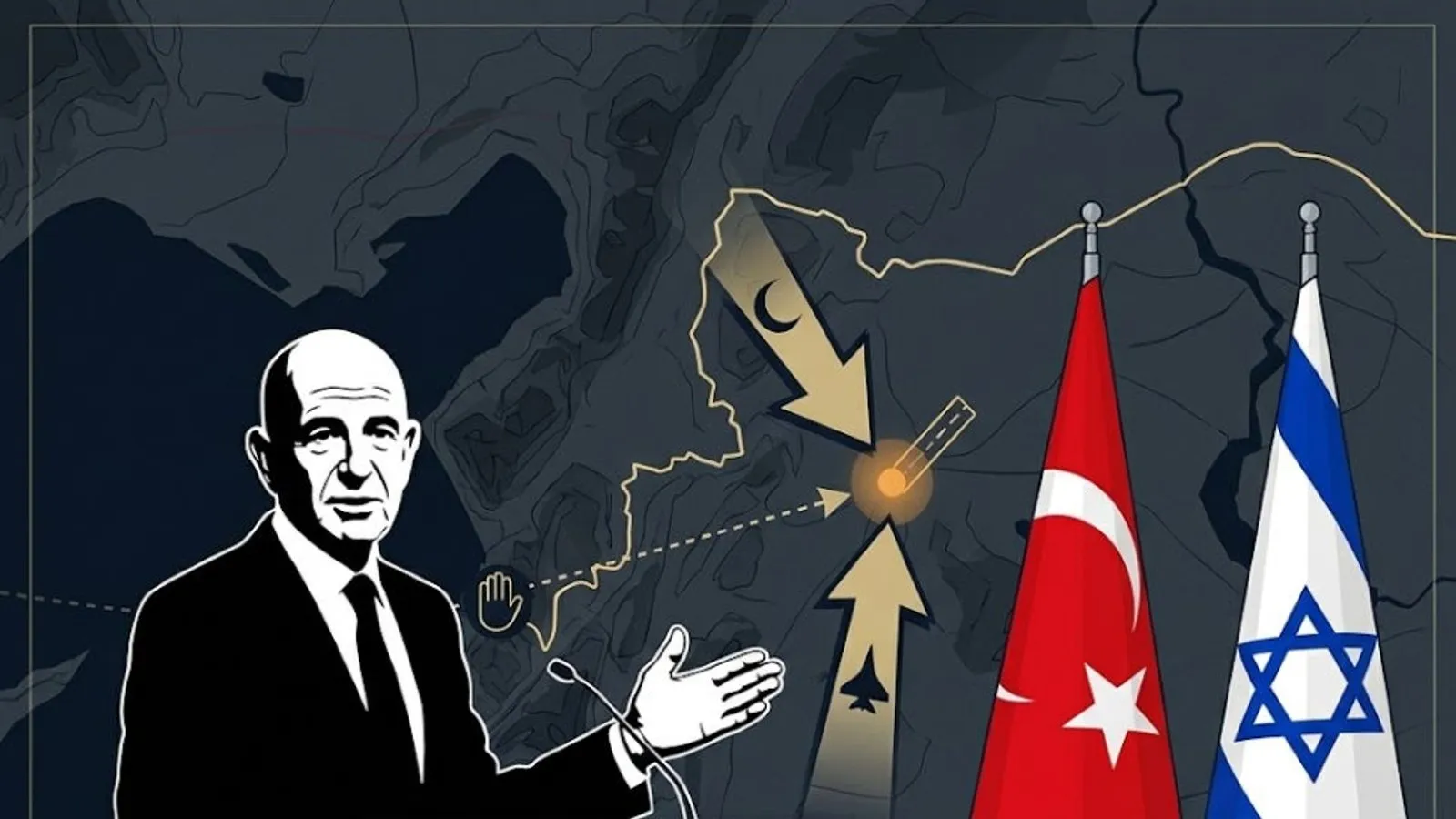
Turkey’s regional project moved from signature to structure in the two weeks after the Abu al-Duhur strike, and Israel built the first structure explicitly designed against it. On August 31 the foreign ministers, defense ministers, and chiefs of staff of Turkey, Saudi Arabia, and Pakistan gave their mutual-defense pact a name, a committee, a secretariat, and a membership roadmap. The same day Israel and Greece signed Achilles Shield, an integrated air-defense agreement worth roughly $3.5 billion that Athens will deploy first on the eastern Aegean islands facing Turkey. We assess that these are not competing tracks but one strategy run at several tables at once. The Mecca alliance institutionalizes the Sunni security network, the Shanghai Cooperation Organisation and the F-35 request keep East and West both in play, the NATO-compatibility formula supplies cover, and Israel serves as the organizing enemy. A direct Israeli-Turkish clash remains unlikely in the coming weeks. The theater to watch has shifted west, to Cyprus and the Aegean, where Ankara’s own press has already written the script for the next incident. This post updates our August 23 summary with the full August 17 to September 2 record.
Two Tables on One Day
On Monday, August 31, Israeli and Greek defense officials signed Achilles Shield in Tel Aviv. Reported values range from $3.4 billion to $3.6 billion, and the report treats them as a range. The package bundles David’s Sling and Spyder from Rafael, Barak MX and multi-mission radars from Israel Aerospace Industries, a Rafael-led command-and-control system designed to fuse Greek and Israeli sensor networks into a single air picture, and a separate Drone Dome contract. Full operational readiness is targeted within 35 months. Greece’s defense council approved the program on July 23, more than a month before signature, so the political decision in Athens predates any single Turkish provocation of the intervening weeks. Greece plans to deploy the system first in its northeast and on the eastern Aegean islands facing the Turkish coast. That detail is the one Ankara has fixed on.
The same day, in Istanbul, the first meeting of the Mecca Defense Alliance’s Strategic Political and Defense Committee closed with Foreign Minister Hakan Fidan’s sharpest personal language yet against Netanyahu, delivered without any mention of the Greek deal. That weekend President Erdogan was in Bishkek for the Shanghai Cooperation Organisation summit. Turkish commentators drew the connection at once. Nedret Ersanel, a staff columnist at the pro-government daily Yeni Safak, set out the three tables of Istanbul, Tel Aviv, and Bishkek and asked whether Achilles Shield was also an answer to the Mecca alliance. He found it hard to say no. The report reads the sequence in the opposite order from the Turkish press. The Turkish project came first, the Israeli-Greek response second, and the Turkish victimhood narrative third. Israeli commentary has been explicit that the Greek layer is built against a Turkey that has just given itself a mutual-defense clause, and Fidan himself described the Greek-Cypriot-Israeli architecture in January as a pattern intended to contain Turkey.
The Mecca Alliance Acquires Machinery
The pact signed in Mecca on August 7, summarized in our August 9 post, declared that an armed attack on any of the three states would be treated as an attack on all. On August 31 it acquired a bureaucracy. The committee met at the level of foreign ministers, defense ministers, and chiefs of staff, which on the Turkish side meant Fidan, Defense Minister Yasar Guler, and Chief of the General Staff Selcuk Bayraktaroglu. Fidan announced that the official name is the Mecca Defense Alliance, that the secretariat will be established in Riyadh, that the first secretary-general will be Pakistani, and that a roadmap for new members is being drafted. He also said the alliance is not directed against any state and that it complements Turkey’s NATO obligations rather than replacing them. Erdogan described the committee’s work product on his flight home. It covers a secretariat to be made operational, defense-industrial cooperation, and, under military cooperation, joint training, standardization, and the sharing of threat assessments and capabilities.
Membership is moving more slowly than Turkish leaders suggest. Egypt has neither joined nor declined, and its state-linked press has said plainly that Cairo did not sign. Ersanel reported that a flexible participation formula is being worked on that would let Egypt sit inside the alliance without the full mutual-defense commitment, and that Washington’s support for the pact has limits, namely Egypt and Israel. Bangladesh has emerged as the most credible new candidate, though Dhaka says the matter is not under discussion. Syria says it is reviewing options. Iran’s position stayed contradictory, with a parliamentary-linked figure speaking of an invitation under consideration while the Foreign Ministry denied any formal invitation. No signatory describes the pact as directed against Iran. The report also warns against the phrase now circulating in Israeli circles that calls Turkey the new Iran. Iran was a proxy power with a degraded conventional base. Turkey is NATO’s second army with an 80 percent domestic defense-industrial base. The analogy understates the problem.
The report’s negative finding on the mutual-defense clause is unchanged in substance, but its character has changed. No signatory has invoked or formally referenced the mutual-defense clause since August 7, including during the Abu al-Duhur episode. However, an alliance with a secretariat, a chief-of-staff committee, and a standardization program is no longer a signal. It is a structure waiting for a trigger. The activation threshold still sits well above a strike on an empty runway, but the machinery below that threshold has grown.
Ankara Answers Israel Through Athens
Turkey’s official response to Achilles Shield took two days to arrive and did not name Israel when it did. The de facto reaction came first through the press, where Yeni Safak described a dirty alliance in the Eastern Mediterranean against Turkey and Milliyet covered the deal more neutrally. On September 2, Milliyet reported that Ankara had delivered a formal note to Athens stating it would not allow any action that changes the status quo in the Aegean. The note was framed as a response to three Greek spatial-planning programs that Turkey’s Foreign Ministry had protested through August, covering tourism, renewable energy, and industry. The same day, asked on his return flight how Turkey would respond if Greece kept arming the islands, Erdogan gave his first words on the file. He said Turkey covets no one’s territory but does not let anyone trample its rights, and he warned that anyone who reads Turkish calm as weakness is making a grave mistake. Greece, he added, must stop arming islands whose status is demilitarized. He placed the warning geographically at Kas, the Turkish town facing Kastellorizo, on the island chain where the Israeli systems will be deployed.
The routing is itself a finding. By answering an Israeli-Greek deal through the Aegean treaty file, Ankara can escalate with Greece under the language of the Lausanne and Paris treaties while the Israel dimension is carried by the press. The Aegean file was already active. Turkey’s marine national parks decree of August 16, covering roughly 23,000 square kilometers, drew a Greek charge of illegality and a Turkish Defense Ministry declaration of readiness to physically block disputed activity, and on August 27 the ministry warned against a reported Greek drone base on Rhodes. The report assesses that an Aegean incident in the coming weeks would be a Greek-Turkish incident in form and an Israeli-Turkish incident in Turkish narrative.
Bishkek and the 360-Degree Vision
Erdogan attended the Shanghai Cooperation Organisation’s anniversary summit in Bishkek as a dialogue partner and guest of honor, alongside Xi Jinping, Vladimir Putin, Narendra Modi, and Iran’s Masoud Pezeshkian. He called the organization a rising star and an indispensable component of the multipolar order, and he asked that Turkey’s Middle Corridor be harmonized with China’s Belt and Road. He praised the Mecca alliance’s collective deterrence and then pivoted to Gaza, citing 74,000 killed in Gaza and Lebanon. Putin called Turkey Russia’s privileged partner. Asked on the flight home whether Turkey might pursue full membership, Erdogan said closer ties are possible and that a membership perspective “never means a break from one bloc or turning our back on the West.” The goal, he said, is to increase Turkey’s own weight with a 360-degree vision.
The report reads that sentence as the doctrine of strategic autonomy in operational form. Turkey now holds NATO membership, a Saudi-Pakistani mutual-defense pact, a live request to rejoin the F-35 program, and a membership perspective in a Chinese- and Russian-led security organization, and it denies that any of these constrains the others. The same logic governs the F-35 file. Asked directly whether a transfer of the S-400 to a third country had been raised with Putin, Erdogan did not answer. He said the talks on re-entry continue, that Turkey will not give up its KAAN fighter or its own air-defense programs, and that Turkey is increasing its options. The legal position is unchanged. Under the FY2020 National Defense Authorization Act the president must certify that Turkey no longer possesses the S-400 before the transfer ban can be waived, and no certification or waiver has occurred. Six Turkish-purchased F-35s remain in US storage, and the $1.4 billion Turkey paid remains held. In the meantime Turkey kept up uninterrupted NATO participation, with F-16s on Latvian air policing and F-16s, AWACS, and tankers in Romanian air-defense activity, while BAE Systems began producing Turkish Eurofighters and Congress cleared roughly $700 million in General Electric engines for KAAN.
Fidan, Netanyahu, and the Court Press
Fidan’s August 31 statement is the sharpest from a senior Turkish official in this window. He described Netanyahu as the common enemy of humanity, a murderer and genocidaire who must be stopped, and said the international system must fight the Netanyahu threat. He dated the escalation to Israeli domestic politics, saying the Netanyahu government’s rhetoric had targeted Turkey and its president since Israel’s election process began. The report notes that the election frame is convenient for Ankara. It presents a structural rivalry as a passing Israeli phase and keeps the door to a post-Netanyahu reset open while the alliance-building continues. Netanyahu supplied the counterpart. On August 29 his office called Erdogan an antisemitic dictator in response to Turkey’s Interpol red-notice request. On August 30 he said Israel must prevent the emergence of new rivals such as Turkey. Read together, the two statements move Israeli rhetoric from personal insult to explicit strategic-rivalry language, and Ankara used the second within a day as a quotable admission that Turkey is the target.
The doctrinal ceiling was set, as usual, by Ibrahim Karagul, the former editor-in-chief of Yeni Safak, whom the series treats as a leading indicator because his framings have repeatedly surfaced in official language after a lag. His August 25 column argued that Israel lacks the courage or strength for direct war with Turkey, would push Greece and Cyprus to the front line, and is in any case only a detail beside Turkey’s larger project. His September 1 column, the most important of the window, declared this the century of the return of empires, said Turkey will fill the vacuum the United States leaves, described Turkey encircling Israel step by step from Syria to Sinai and from Lebanon to the Red Sea, forecast a provocation in Cyprus or the Aegean in the coming days with Israel behind it, and closed with a call to return to Jerusalem. He built that doctrine on an official text. Erdogan’s August 30 Victory Day message gave the armed forces a 2,235-year past, reaching back to the Hunnic steppe, where the state had previously spoken of a thousand years. Yeni Safak operated as a coordinated platform in the window, with one columnist for doctrine, one for geopolitics, one for government access, and one for religious-political mobilization.
Official language stayed on its established formulas. None of the government texts uses encirclement, empire, or Jerusalem. The report assesses the gap as sequencing rather than disagreement, since three earlier Karagul framings have already crossed into official speech. Those are Israel as a threat to Turkey itself, Syria and Lebanon as a Turkish security perimeter, and the Israeli election as the driver of Israeli conduct toward Turkey.
Syria, Gaza, and Lebanon: The Pattern Held
On Syria, the pattern documented in our August 19 post and the August 23 update held. Erdogan broke his silence on August 25 in Ahlat, warning that the blood merchants would lose, and on August 28 called Zionism a radical, occupying, genocidal ideology. He did not name Abu al-Duhur, did not confirm or deny a Turkish presence, and did not threaten a response. Fidan, Bayraktaroglu, and Guler made no personal statement on the strike through September 2, yet all three sat at the alliance table on August 31. The report reads the silence as a communications choice rather than absence from the file. US envoy Tom Barrack repeated that the strike may have been intended to provoke Ankara and praised Turkish restraint. Syria ended the window stronger for Turkey than it began. Erdogan welcomed the announced dissolution of the YPG-PYD, said Washington had come around to one flag and one army, and restated Turkey’s guarantor role at the SCO. The Interpol request against Netanyahu, filed August 21, has produced no procedural action. It has produced what Ankara wanted from it, a fresh Israeli attack on Erdogan and a fresh Turkish claim to act where the international system fails.
On Gaza, Turkey remains guarantor and co-mediator with Qatar and Egypt. It backs the second phase of the Trump-brokered plan on paper, blames Israel for the stall, has never opposed Hamas disarmament as a concept, and conditions it on sequencing, with a Palestinian administration and vetted police in place first. Hamas’s political bureau keeps its Ankara and Istanbul channel. On August 26 Hamas and other factions agreed for the first time to surrender weapons in stages, and the report could locate no dated Turkish statement responding by name. The Turkish Red Crescent said only about 100 of a promised 600 daily aid trucks were entering Gaza, a figure Ankara cites as evidence of Israeli non-compliance. Lebanon remains a declared perimeter without an operational entry point. The offer to take part in security arrangements after the UN interim force’s mandate ends still stands, no deployment exists, and no official has linked Abu al-Duhur to Lebanon. Qatar appeared inside every Turkish move of the window, as co-signatory, first call, co-mediator, and platform. On the Iran war, Ankara condemned the Israeli strike in Syria and said nothing about US strikes on IRGC targets around Hormuz on August 30 and September 2, the same asymmetry it showed in the war’s first phase.
Outlook: Which Province Is Next
The report’s assessment is that the architecture of the double game did not move, and four things did. The Mecca alliance became an institution. Israel built the first structure explicitly designed against the Turkish project, and Ankara answered it in the Aegean register. The western theater entered Turkish threat forecasting with its interpretive frame already published. And the imperial time horizon widened in a presidential text, which the court press converted into doctrine within two days. Netanyahu’s new-rivals sentence and Karagul’s return-of-empires column describe the same fact from opposite ends.
In the short term a direct military clash remains highly unlikely. No Turkish official has threatened force, the Mecca clause has not been referenced in any Israel dispute, and the US deconfliction channel, though unproven since its first failure, remains in place. Restraint continues to function as method. Every week the file stays in the legal arena, Turkey converts Israeli action into international pressure while its build-up continues. Over one to six months the risk of renewed friction is moderate to high and now runs on two tracks. In Syria the sequence of Turkish site interest, survey visit, and Israeli strike remains intact, and the YPG-PYD dissolution removes the last constraint on Turkish freedom of action in the north. In the Eastern Mediterranean, Achilles Shield deployment on the eastern Aegean islands will be tested by Turkish reconnaissance, exercises, and marine-park enforcement, and the first Turkish naval or air response to an Israeli-supplied Greek system would be the first direct Israeli-Turkish operational contact outside Syria. Beyond six months a full war stays outside the base case at any horizon, because the Turkish endgame does not require one. It requires what this window delivered: an institutionalized Sunni alliance, a Syrian province with the Kurdish constraint removed, a legal front against Israel’s leadership, an Aegean file that lets Turkey escalate under treaty language, and an ideological layer that has already written the justification. The correct question for Israeli planning, the report concludes, is which province is next, and this window’s answer is the Eastern Mediterranean.
Key Points
- Achilles Shield is read in Ankara as Israeli-Greek containment and answered with the victimhood frame Turkey has used since 2017. The record runs the other way. The deal follows a decade of Turkish coercion in the Aegean and Cyprus, was approved in Athens in July, and landed the day the Mecca alliance institutionalized (high confidence).
- The Mecca Defense Alliance moved from signature to institution on August 31, with a name, a committee at minister and chief-of-staff level, a secretariat in Riyadh, a Pakistani first secretary-general, and a membership roadmap. The mutual-defense clause has still never been invoked, but the machinery beneath it now exists (high confidence).
- Erdogan’s Bishkek formula, closer SCO ties without turning away from the West, states the doctrine in one sentence. Turkey seeks the benefits of every system and rejects the premise that membership in one constrains participation in another. The F-35 request, the retained S-400, and KAAN are held on the same terms (high confidence).
- Fidan’s August 31 language is the sharpest from a senior Turkish official in the window and was delivered from the alliance podium without linking the two. Netanyahu’s August 30 statement naming Turkey a rival to be prevented gave Ankara a quotable Israeli admission that it used within a day (high confidence).
- Karagul’s columns of August 25 and September 1 supply the doctrinal ceiling: Israel as a detail, the return of empires, encirclement from Syria to the Red Sea, a forecast Aegean provocation attributed to Israel in advance, and a return to Jerusalem. Official language has not matched this, and on the series’ record the lag is timing (high confidence on content, moderate-to-high on the leading-indicator read).
- On Syria, Gaza, and Lebanon the pattern held. Ankara applied legal and diplomatic pressure, kept its senior military silent, continued its entrenchment, held its guarantor and mediator posture on Gaza, and kept Lebanon a declared perimeter without an entry point (high confidence on Syria and Gaza, moderate on Lebanon).
- Direct military confrontation with Israel stays unlikely in the coming weeks. The medium-term risk is structural and now has two theaters, another strike on a Turkish-linked Syrian site and an incident in the Aegean or around Cyprus that Turkish commentary has already attributed to Israel in advance (moderate-to-high confidence on the structural read).
What to Watch
- Turkish operational activity around the eastern Aegean islands and Cyprus as Achilles Shield deployment begins, and any Turkish statement naming Israel in an Aegean incident.
- Follow-up to the September 2 note to Athens, and any Greek response that Ankara treats as a change in the status quo.
- Establishment of the Mecca alliance secretariat in Riyadh, appointment of the Pakistani secretary-general, and the first joint exercise or standardization decision.
- The first official Turkish reference to the Mecca alliance in a dispute with Israel, and any Saudi or Pakistani statement of support in such a dispute.
- Accession movement by Egypt, including a flexible formula, by Bangladesh, or by any other candidate.
- The first appearance of encirclement, imperial-return, or Jerusalem language in any official Turkish statement, and whether Bayraktaroglu or Guler break their public silence on Israel by name.
- Turkish basing decisions in northern Syria after the YPG-PYD dissolution, and any Israeli strike on a site tied to them.
- The UNIFIL mandate transition and any Lebanese response to the Turkish participation offer.
- Israeli domestic developments ahead of the October 27 election and their effect on the intensity of anti-Turkey rhetoric.
The series now tracks seven trajectory-change indicators, the five from the Abu al-Duhur reports plus an Aegean or Cyprus incident in which Ankara names Israel and the first official use of encirclement language. None was met officially in this window.
This post summarizes the Iran Dossier Turkey Watch regional press and policy monitor for August 17 to September 2, 2026, compiled on September 2. The report draws on Turkish primary sources, including Presidency and ministry transcripts, state and pro-government media, and opposition press, cross-referenced against Greek, Israeli, Arab, and international reporting and independent think-tank analysis. Every quotation in the report is checked against its original publication, and opinion items are identified by author and by the writer’s relationship to the outlet. Where an expected voice did not comment, that silence is reported as a finding. The report reads the window against the July 2026 baseline assessment, Turkey’s Strategic Double Game.