Baiting the Turks: The Abu al-Duhur File, Updated Through August 23
The updated special report reads Abu al-Duhur against the strategic baseline this series has built: Ankara is pursuing regional primacy through strategic autonomy, with post-Assad Syria as its most advanced province, and since Erdogan’s June 10 perimeter speech it has named Israeli operations in these theaters as a threat to Turkey itself. Against that baseline, the strike registers as a friction point on a longer trajectory, not a self-contained event. Turkey’s endgame does not require a war with Israel, and Ankara’s conduct this week, restraint in official channels, escalation through deniable voices, and conversion of the incident into legal and diplomatic capital, fits a strategy of creeping entrenchment better than a march toward confrontation. This post updates our August 19 summary with the full August 17-23 record.
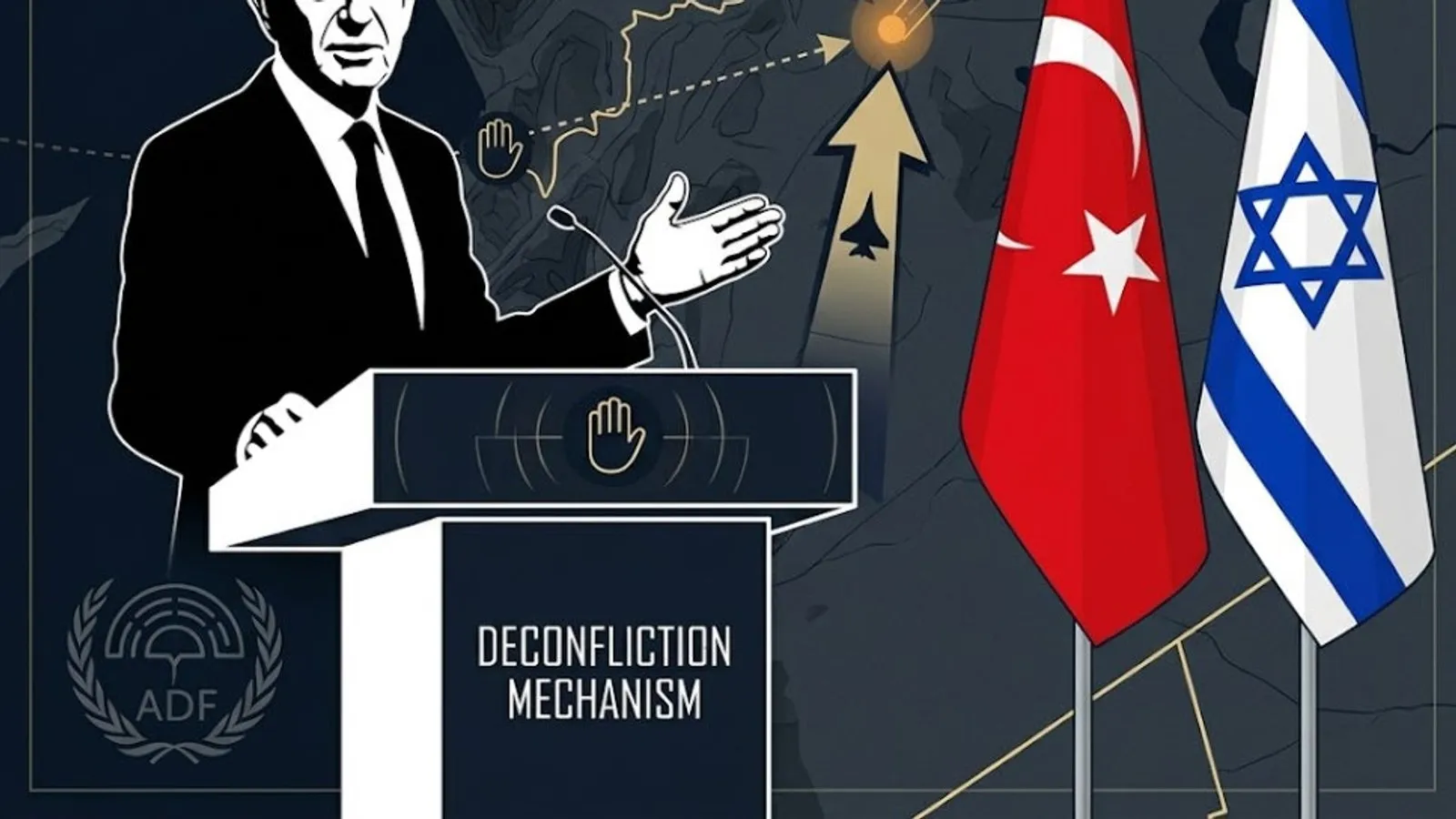
The Voices Rise, the Chain of Command Stays Silent
Turkey’s formal channel on the strike stayed exactly where week one left it: a single Foreign Ministry statement, No. 160, condemning the strike as a violation of Syrian sovereignty without naming Israel’s leadership. Through August 23, President Erdogan, Foreign Minister Fidan personally, Chief of the General Staff Bayraktaroglu, and Defense Minister Guler still had not addressed the strike on the record, a gap the report notes widened rather than closed as the days passed. Bayraktaroglu was diplomatically active around it, five calls in roughly seven hours on August 19 with the chiefs of staff of Saudi Arabia, the United States, Qatar, Oman, and Niger, but ministry readouts describe them only generically. Forty-four written opposition questions to the Defense Ministry remained unanswered.
Around that official silence, everything escalated. The Ministry of National Defense put the denial on the record on August 20: no Turkish military delegation was present at the base before or during the strike. Communications Director Duran moved from condemning irresponsible aggression on August 18 to calling Netanyahu “genocidal” on August 20 and dismissing the Israeli Prime Minister’s Office’s renewed criticism as unhinged ravings on August 21. Turkey joined ten other states, Qatar, Saudi Arabia, Pakistan, Indonesia, Malaysia, Algeria, Lebanon, Mauritania, Somalia, and Palestine among them, in a joint condemnation on August 21, its first multilateral step of the episode. And on August 22 Ankara opened a second, legal front: the Justice Ministry requested an Interpol Red Notice against Netanyahu, tied to the Turkish criminal case over the May interception of the Gaza-bound Sumud flotilla. The report is careful about the linkage: formally a separate track, but Israeli and Turkish officials answered each other as if the two were one dispute, so the tracks are reinforcing each other.
The sharpest language of all came from outside government. Ibrahim Karagul, silent on the strike on the day, wrote on August 20 that Turkey and Israel are already at war across the entire geography, framing the strike as a deliberate provocation designed to drag Turkey into premature confrontation and threatening merciless revenge. The report logs it as the single most escalatory piece of rhetoric found anywhere in Turkish commentary this window, published in Turkey’s largest pro-government daily, and matched by no official.
Barrack’s Account: Five Days, a Backchannel, and a Failed Fusion Cell
The most consequential new material in the update is US envoy Tom Barrack’s expanding account of the run-up, given across PBS, a YouTube interview, and print outlets on August 21-22 and corroborated by Hurriyet Daily News, the Washington Times, the Washington Post, and Daily Sabah. The sequence he describes: Israel raised its concern about Turkish movement at Abu al-Duhur five to six days before the strike; Washington checked with its intelligence agencies and got a clear answer that nothing was happening; Syrian officials told Mossad chief David Barnea, in a two-hour backchannel conversation with Foreign Minister al-Shaibani, that no Turkish troops, convoy, or weapons were at the facility; a US-backed fusion cell stood ready to keep the dialogue going; and Israeli jets then struck anyway, without notifying Washington or Ankara, within about 80 kilometers of the Turkish border. Barrack’s own summary: this was not a miscommunication.
He offered competing explanations, a communications breakdown inside the Israeli system between Mossad, the military, and the Prime Minister’s Office, or something more deliberate, and voiced the harder one himself: “The Israelis were baiting the Turks,” drawing an explicit parallel to Turkey’s 2015 downing of a Russian jet and calling unnotified warplane deployments at the border a very dangerous game. He also disclosed that Israel had earlier warned Turkey away from T4 and Palmyra under threat of strikes, a warning Ankara heeded, and praised the Turkish military’s restraint. Israel publicly disputed parts of his account on August 23. Two American voices bracket the risk: Ambassador Mike Huckabee said a de-escalation process was in place and the sides were not close to direct confrontation, and former Mossad counterterrorism chief Oded Eilam put the probability of a military clash at close to zero, on the grounds that a clash would cut against what he called Erdogan’s creeping-annexation strategy, a characterization the report notes is consistent with this series’ own baseline. The report’s structural finding stands: the fusion cell, which dates to a January agreement, has now failed its first live test, and no Turkish statement engages Barrack’s account; Ankara keeps arguing presence, not process.
What the Institutions Added
The think-tank record thickened in week two. ACLED’s early read holds: the strikes almost certainly aimed to prevent Turkey from anchoring its influence at the base, in a direct line from the 2025 T4 pattern of Turkish site interest, survey visit, Israeli strike. Alma ruled out any Iranian or Hezbollah dimension. Quincy’s Responsible Statecraft kept the sharpest institutional critique, and the Foundation for Defense of Democracies became the most active publisher, three pieces in three days placing the strike inside the eighteen-month Israel-Syria trajectory, documenting Turkish military surveys of T4, Palmyra, and Hama in March 2025, disputing Ankara’s standing to invoke Syrian sovereignty, and convening a discussion titled around whether Erdogan’s Turkey is the Middle East’s next great threat. Carnegie’s Khaddour, ECFR’s Aydintasbas, and the Arab Center’s Saban held their week-one positions. Damascus added a factual claim of its own late in the window: it had told Israel in advance that no Turkish presence was planned, deepening the dispute over why the strike happened at all. Notably, a long list of major institutions with standing Turkey-Israel-Syria programs had still published nothing dedicated by August 23, and no analyst linked the strike causally to the Mecca pact; the closest remains Steven Cook’s pre-strike note that Saudi and Pakistani forces would presumably back Turkey in a fight.
Outlook: Checkmate by Restraint
The report’s assessment section is the sharpest statement yet of the series’ endgame thesis. In the short term, a direct clash remains highly unlikely: no Turkish official has threatened retaliation, the Red Notice is legal escalation rather than force, and Ankara’s restraint functions as method: every day the incident stays in the diplomatic and legal arena, Turkey converts an Israeli military action into pressure on Israel’s international position while its entrenchment in Syria continues undisturbed, a reading Turkish commentary itself advanced by describing the episode as a diplomatic checkmate. The rhetorical ceiling nonetheless keeps rising, and Barrack’s account of the run-up shows how easily a strike of this kind could have gone differently.
Over one to six months, the risk of renewed friction is moderate-to-high and structural: Turkey’s push to convert its Syrian position into permanent basing, training, and air-defense infrastructure collides with Israel’s demonstrated doctrine of striking that infrastructure before it becomes fact, the sequence now played out at T4, Hama, and Abu al-Duhur. The most likely next incident is another strike on a site tied to Turkish basing plans, with the fusion mechanism’s unproven repair determining whether it stays contained. Beyond six months, a full war remains unlikely, lopsided costs, NATO membership, and active US mediation all hold the risk down, but the report flags the limit of Ankara’s patience: if Israeli strikes keep cutting into its basing plans, Turkey is unlikely to hesitate over calibrated military moves short of confrontation, combat air patrols over northern Syria, radar locks on Israeli aircraft, or placing a small Turkish detachment at a contested site so that any further strike would put Turkish personnel in the impact zone. The two developments that would genuinely change the picture: an Ankara decision to invoke the Mecca pact’s mutual-defense clause in a Syria dispute, and extension of the declared perimeter doctrine from Syria to Lebanon in practice.
Key Points
- Ankara’s frame held all week: the strike is treated as a violation of Syrian sovereignty, with Turkey as Syria’s advocate rather than the aggrieved party, and the August 19 rebuttal attacks the motive behind Israel’s claim, an election-driven pretext, while the presence question was answered on the record only by the Defense Ministry spokesperson on August 20 (high confidence).
- The chain of command stayed silent through August 23 while the speaking voices escalated sharply: Duran to “genocidal,” Karagul to “already at war” and merciless revenge, rhetoric no official has matched but that ran in Turkey’s largest pro-government daily (high confidence).
- The episode now runs on three Turkish tracks at once: entrenchment in Syria, a legal front against Israel’s leadership built on the flotilla case and the Red Notice request, and regional alignment held in reserve; the Mecca pact stayed out of the dispute, and no Turkish source invoked it (high confidence).
- Barrack’s corroborated account, five to six days of advance warning, a Mossad-Damascus channel that reported no Turkish presence, a fusion cell that failed its first live test, and his own baiting-the-Turks theory, makes Washington’s rebuke the episode’s most consequential outcome and leaves the deconfliction mechanism’s ability to prevent a repeat unproven (high confidence on the account’s content; Israel disputes parts of it).
- Expert convergence on a near-zero probability of direct confrontation coexists with a deepening factual dispute over why the strike happened, and the report’s outlook is continued low-level friction that pays Ankara a political dividend, with calibrated Turkish military steps possible if strikes keep cutting into basing plans (moderate-to-high confidence).
What Would Signal a Change in Trajectory
- A Turkish official above the Communications Directorate, Erdogan, Fidan, or the Defense Ministry leadership, addressing the strike directly.
- Any Turkish reference to the Mecca pact in the context of a dispute with Israel.
- Movement of Turkish air-defense components toward Syrian bases despite the strike.
- Collapse or formal suspension of the US fusion mechanism.
- Turkish rhetoric or deployments linking the Syrian file to Lebanon.
None of the five appeared in the August 17-23 window.
This post summarizes the Iran Dossier Turkey Watch special report on the Abu al-Duhur strike, updated through 21:00 on August 23, 2026. Section A draws exclusively on Turkish primary sources with every quotation verified in the original Turkish; Section B on international wires, Israeli media, Ambassador Barrack’s interviews as corroborated across PBS NewsHour, Hurriyet Daily News, the Washington Times, the Washington Post, Daily Sabah, and the Jerusalem Post, and the research institutions that published inside the window. Where an expected voice did not comment, that silence is reported explicitly as a finding.