Watch the Definitions: Hormuz Leverage and the Contest over Phase II
The August 14 cycle reinforces a pattern that has become more important than any single Qatari announcement. Doha is simultaneously positioning itself around the region’s urgent maritime-security problem, the reopening and management of the Strait of Hormuz, while its information environment continues to shape the terms under which Phase II of President Trump’s Gaza initiative is debated. These are distinct files, and there is no evidence of a formal quid pro quo between them. Strategically, however, they are converging in Washington: the more indispensable Qatar becomes on Hormuz, the more weight its interpretation of Gaza implementation can carry with an American administration that needs progress on both fronts. This post summarizes our Qatar Watch report for August 14, covering the August 13-14 window.
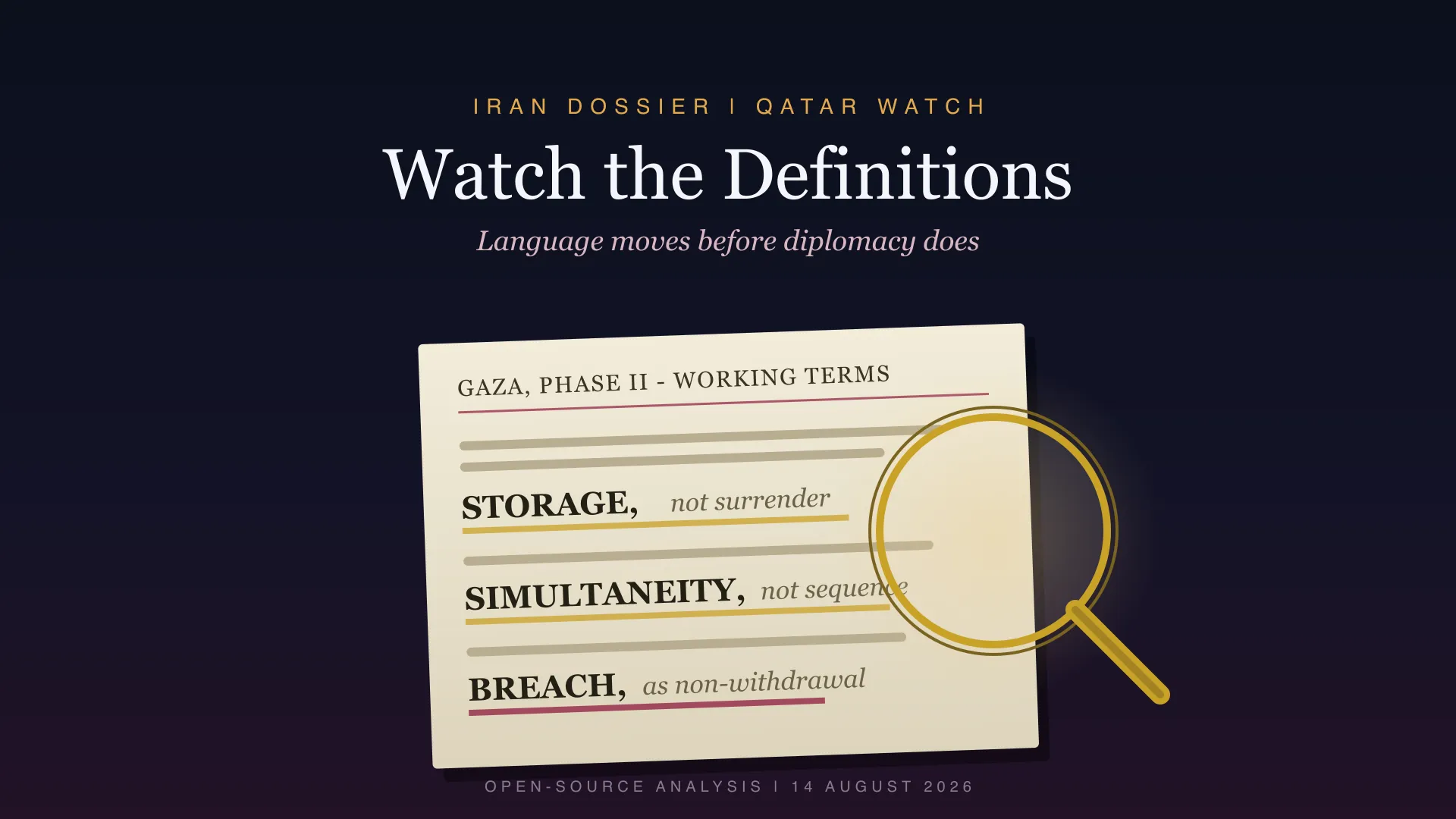
The Definition Contest
For Gaza, the contest is no longer over whether the Trump framework exists; Qatar is not seeking to overturn it. The contest is over what the framework means in practice, and the previous report’s three definitions kept migrating through the Qatar-based information environment: disarmament reframed as weapons storage under Palestinian supervision, sequencing presented as reciprocal simultaneity rather than disarmament first, and breach increasingly attached to Israeli non-withdrawal. The report repeats its central warning deliberately, because it remains operationally relevant: if those definitions harden into the working interpretation of Phase II, Israel’s insistence on full disarmament first stops being a negotiating position and becomes alleged non-compliance. That inversion is the strategic risk, and it is happening in language before it happens in diplomacy.
The Board of Peace’s August 3 statement remains the most important American textual anchor, because it places withdrawal after completion of disarmament. The Qatari challenge is not to repudiate that text publicly; it is to establish an alternative account of the original bargain in which the Cairo understandings required parallel movement. If Washington begins using the same vocabulary, the interpretive contest is effectively decided even without a new formal agreement. The report’s integrated assessment sharpens the point for decision-makers: watch the definitions. If US officials begin using storage as an adequate interim equivalent to disarmament, or if withdrawal becomes formally linked to partial milestones rather than completion, the policy environment has moved. The operational test is verifiability: a storage arrangement with defined custody, inspection and enforcement provisions would be a different proposition from the undefined formula now circulating; it is the vague version that converts ambiguity into negotiating advantage for Hamas.
Hormuz: Exposure and Indispensability
QNA’s August 14 cycle carried two closely related reports: two ADNOC vessels attacked while transiting the strait, and a relay of the UAE’s condemnation that explicitly described the incident as a hostile Iranian attack. The editorial fact matters more than the incident: official Qatari media carried direct attribution to Iran rather than a sanitized formulation. The context had hardened by the window’s close. This was the second attack on ADNOC shipping in under a week; the company has reported some fifteen vessels attacked since the war began on February 28, with one crew member killed and twenty injured; the UAE Foreign Ministry characterized the IRGC’s conduct against commercial shipping as acts of piracy and a tool of economic pressure and blackmail; and Tehran had offered no comment by close. Qatar’s own Foreign Ministry, which condemned the August 8 strike as a blatant violation, had not issued a comparable stand-alone statement on the new incident within the window; the QNA relay of the UAE condemnation carried the attribution instead.
Doha is attempting to preserve two positions that become harder to reconcile with every incident: Iran cannot be permitted to normalize coercion over commercial shipping, but Qatar does not want a regional security architecture defined solely as an anti-Iran coalition. Its exposure is structural and unusual: unlike the UAE and Saudi Arabia, Qatar lacks a mature alternative corridor capable of replacing the maritime route, so the strait is not an abstract diplomatic file but a direct vulnerability to the LNG model. And the connection to Gaza is indirect but strategically important: Washington needs capable interlocutors with both Tehran and Hamas, and Qatar is one of the few states that can claim both channels. That does not mean Doha can exchange concessions across the files; it means successful facilitation on Hormuz increases Doha’s overall credibility and access at precisely the moment the definition of Phase II remains contested.
The Opinion Barometer
The most consequential new opinion item is Pascal Boniface’s August 14 Arabic essay, which opens by stating that Netanyahu categorically and explicitly rejected the peace plan proposed by President Trump, presents Phase II as including Israeli withdrawal and gradual Hamas disarmament, and argues Hamas accepted the plan while Netanyahu rejected it. The essay widens into a harsher indictment, describing a gradual strangulation of Gaza’s population and an objective of pushing Gazans toward leaving, and its register runs to describing Israeli cabinet ministers in explicitly fascist terms. The key signal for the report is not the anti-Israel rhetoric but the structure: Boniface places Netanyahu in direct tension with Trump, reframing a Gaza implementation dispute as Israeli obstruction of an American president’s own initiative. That framing can support Qatari mediation pressure while letting Doha present itself as defending Trump’s plan rather than defending Hamas.
Two Arabic pieces fill in the longer-term layer. An essay asking why a Muslim president in the West is no longer unimaginable uses Abdul El-Sayed’s political rise as a springboard, notes the US Constitution places no religious bar, and describes the White House door as theoretically ajar. The report is careful with it: this is a forecast, not evidence of a Qatari operational project, and its relevance is narrower, Al Jazeera chose to publish an essay treating expanding Muslim political representation in Western institutions as a historical trend and possible future source of power. The second is an unapologetically celebratory essay by the AK Party’s secretary-general on the party’s 25 years, rooted in a thousand-year civilizational conception, crediting Erdoğan with restoring the nation to the state, casting Türkiye as the greatest hope for the Palestinian cause, and declaring that Türkiye now redefines the rules of the international order. The value is the platform and timing: a senior official of Türkiye’s ruling party presenting Ankara as a Muslim civilizational power and principal defender of Gaza, on Qatar’s network, reinforcing Türkiye’s role as the bridge between Doha’s Gaza posture and a less US-exclusive regional order. The English service ran a different register, criticism of Washington’s use of the terrorist label and an argument that Iran is a pragmatic state capable of accommodation; the two services speak to different audiences while overlapping in skepticism of US power.
The Long Game in America
The report treats the week’s US material as an indicator pair to be measured, not assumed. The education-funding item that recirculated on August 14 revived a long-running dataset rather than revealing a new transfer: the US Department of Education’s February 2026 disclosure release reported more than 5.2 billion dollars in foreign gifts and contracts to American universities for 2025, with Qatar the largest foreign source at more than 1.1 billion, and widely cited cumulative analyses placing Qatar’s total since 1986 at roughly 6.3 billion. Two cautions are essential and the report states them plainly: the data can include long-term arrangements tied to US branch campuses in Doha, and the federal figures establish financial scale and transparency obligations, not ideological control; the leap from funding to political outcomes must remain an assessment question, not a stated fact. The other half of the pair is the August 5 Senate hearing on the Muslim Brotherhood network, which has still drawn no significant in-window QNA, Qatari daily or Al Jazeera response; the juxtaposition, Washington debating the Brotherhood as an influence network while Al Jazeera Arabic treats Muslim political ascent as increasingly normal, is analytically striking but not evidentiary proof of coordination. The rigorous watch question the report sets: not “did Qatar buy campus protests” but where financial dependence, curricular partnerships, research relationships and elite-network formation create measurable policy or narrative effects.
Qatar Charity’s footprint kept accumulating in the background, cash assistance to 1,530 displaced families in Mogadishu following water and sanitation projects in Senegal benefiting more than 70,000 people, with the standing indicator unchanged: whether humanitarian platforms become operationally connected to postwar Gaza reconstruction and governance, where access could become political leverage.
Key Points
- Qatar is working inside the Trump framework, not against it: the contest is over the operational definitions of disarmament, sequencing and breach, and it is being won in language before it is contested in diplomacy.
- Hormuz and Gaza are distinct files with no evidence of a formal quid pro quo, but they converge in Washington: indispensability on the strait adds weight to Doha’s interpretation of Gaza implementation.
- QNA’s direct attribution of the ADNOC attacks to Iran, via the UAE’s condemnation, shows official Qatari media not sanitizing Iranian responsibility even as Doha avoids an anti-Iran architecture; each new incident narrows the space between mediation with Iran and deterrence of Iran.
- Boniface’s essay marks the useful evolution in the media layer: Netanyahu recast as the party that rejected Trump’s plan, converting an Israel-Hamas dispute into an Israel-versus-American-plan narrative that Doha can champion as defence of the plan itself.
- The AK Party anniversary essay articulates, in a ruling-party voice, the model Al Jazeera is willing to platform: Muslim democratic legitimacy, defence-industrial autonomy and a claim to speak for Gaza, compatible with the post-American signal and with Qatar’s strategy of keeping the American guarantee while widening Türkiye’s space.
- The report’s bottom line: Qatar’s power on August 14 is cumulative rather than spectacular, military partner of the United States, intermediary with Iran and Hamas, central actor on Hormuz, media power, humanitarian donor and the largest reported foreign funder of US higher education, instruments that should not be collapsed into a single directed plan, but whose interaction forms an influence ecosystem in which Doha shapes agendas, definitions and access across several arenas at once.
What to Watch
- Whether the US administration or Board of Peace restates in writing that withdrawal follows completed disarmament, or adopts a milestone-based parallel formula.
- Whether Qatar’s Foreign Ministry itself begins using the explicit storage terminology so far carried by the media and analytical layer.
- Whether any storage proposal acquires defined custody, inspection and enforcement parameters, which would materially change its strategic meaning.
- Whether Al Jazeera English converges with Arabic on the sequencing argument or keeps its more cautious international register.
- Whether renewed Iranian attacks on shipping force Qatar to harden its public attribution and deterrence language.
- Whether Doha moves from welcoming the Saudi-Turkish-Pakistani framework to any practical association with it.
- Whether congressional scrutiny of Brotherhood networks expands to Qatar, Al Jazeera, university funding or lobbying, and whether Qatari official or media outlets ever respond directly to the August 5 hearing.
- Whether Qatar Charity, QFFD or QRCS acquire formal roles in Phase II reconstruction, governance or aid verification.
This post summarizes the Iran Dossier Qatar Watch report for August 14, 2026, covering a hard reporting window of August 13, 10:00 to August 14, 11:30 Israel time: QNA and the Qatari dailies, the Al Jazeera Arabic and English opinion packages reviewed in full, Qatar Charity’s own reporting, the US Department of Education disclosure data and the Senate hearing record, with MEMRI’s Qatar Threat Monitor used as an out-of-window external baseline. Confidence is high on the supplied opinion pieces, the QNA Hormuz reporting and the federal funding data, moderate-high on the preference-shaped-mediation assessment, and moderate on the broader influence-ecosystem judgment, which integrates separate instruments without claiming documentary proof of central direction.