The Podium and the Newsroom: Doha Carries Its Hormuz Case to UNGA as the Security Council Stalls and the FCC Hands QIA a Stake in CBS and CNN
Qatar’s morning messaging on September 20 runs on two parallel tracks, and the Qatar Watch review for the day reads them together. The first is diplomatic. Al-Sharq gives unusual prominence to an interview with Sheikha Alya Al-Thani, who presents the Amir’s UN General Assembly address as the statement of Qatar’s policy priorities, built on an international position against Iranian attacks and a documented legal record over Hormuz. The second is economic. Gulf Times reports that Qatar’s food and container imports have kept moving through Saudi overland corridors and Red Sea and Omani ports, while stating plainly that LNG exports cannot be rerouted around Hormuz. Doha can diversify its imports far more easily than the route by which it sells its gas. Brent settled at $103.87 on September 18 after a week in which the market priced in the September 10 attack on Saudi Arabia’s East-West pipeline. The Security Council enters high-level week blocked after the Russian and Chinese veto of the US draft on the Iran sanctions panel, so Qatar’s leverage shifts to the General Assembly podium, the September 22 meeting between President Trump and Gulf leaders, and the Qatar-Pakistan mediation channel that Tehran says remains open. In Washington, the Justice Department’s September 16 notice on unregistered foreign agents widens enforcement exposure for foreign-funded advocacy without naming a target, and the FCC’s approval of 49.5 percent foreign ownership in a merged Paramount-Warner Bros. Discovery gives the Qatar Investment Authority an indirect, non-voting stake in CBS and CNN. The report judges that the Qatar-in-America file is moving from campuses and lobbying toward network news ownership, a setting where neither FARA nor Section 117 applies. This post summarizes the Qatar Watch daily intelligence review for September 20.
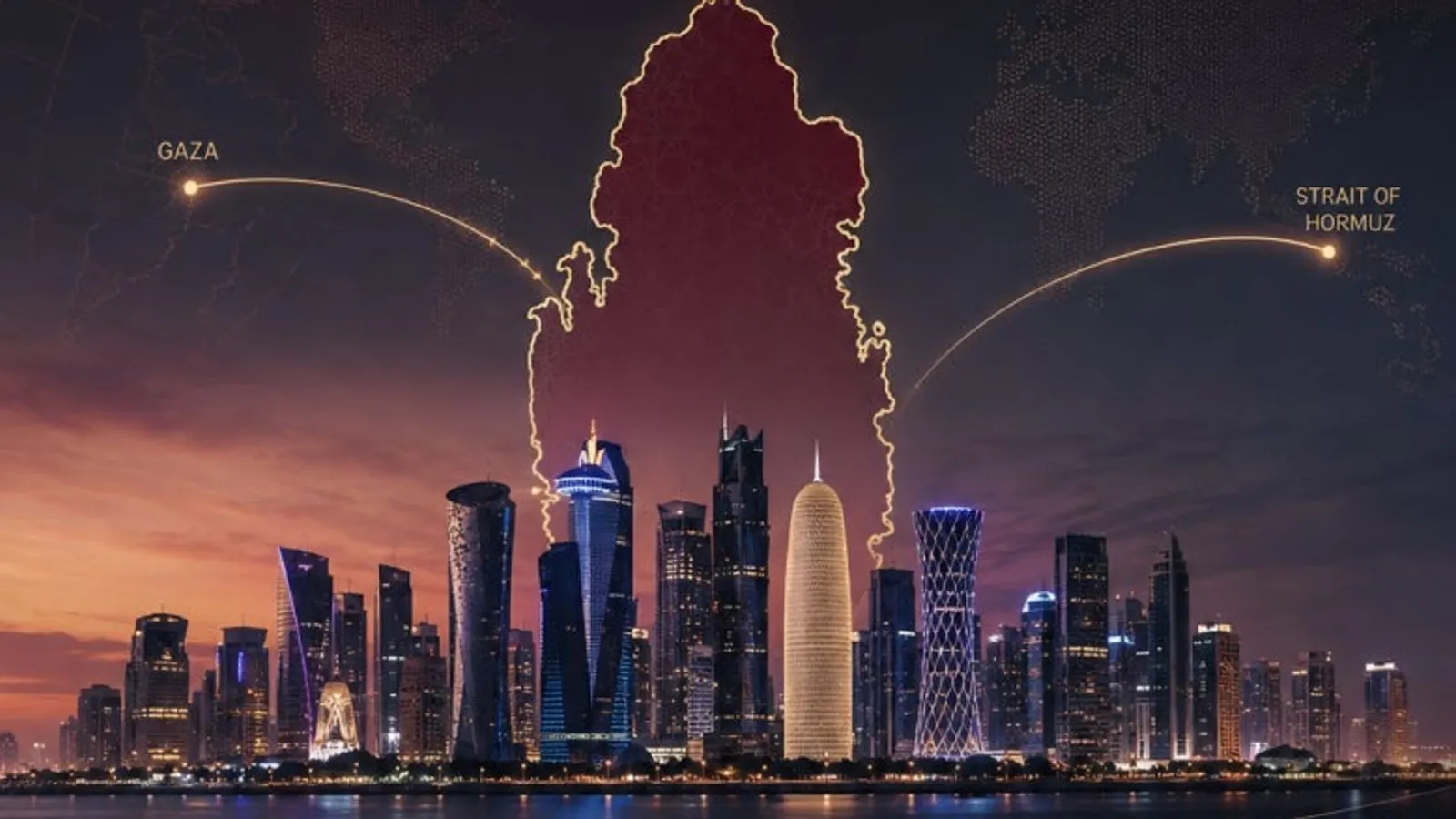
The Amir’s Speech as a Policy Text
The Qatar News Agency’s morning stream continued to stress Qatar’s partnership with the United Nations and its self-presentation as a trusted mediator and multilateral actor. The principal package emphasizes mediation, humanitarian diplomacy, development assistance, and the maintenance of channels with parties to complex crises. The Arabic and English services carry the same institutional line, and the review found no material divergence in framing. The package is being republished across the local press on September 20, which gives it a second-day amplification effect. The relevant point for Qatar Watch is less the generic UN language than the effort to place mediation, humanitarian aid, and multilateralism at the center of Qatar’s international brand in the days before the General Assembly.
Al-Sharq supplied the day’s strongest item. Its interview with Sheikha Alya Al-Thani, published at 06:30, says the Amir’s UN address will define Qatar’s regional and international priorities. She describes Doha’s effort to build a clear international position against Iranian attacks and says Qatar has assembled what she calls a “documented legal record” at the UN rebutting Iranian claims. The interview also foregrounds Qatar’s position on the Hormuz dispute. The report treats this as the clearest public statement yet of how Doha intends to use the podium in New York.
The rest of the domestic press followed the same two themes. Al-Watan fronted the Qatar-UN partnership language and separately covered a Hormuz seminar convened by the Qatar Press Center, which stressed the strait’s importance to energy security, shipping, and supply chains. Al-Watan also reported that Fitch has kept QatarEnergy at AA and removed it from negative watch, with annual spending cited at QAR 36 billion. Lusail concentrated on diversification. It reported manufacturing investment of QAR 248.44 billion in the first half of 2026, 28 new factories entering production with QAR 253 million in investment, and private-sector exports of QAR 900 million, and it presented the GCC rail project and the Qatar Financial Centre as instruments of resilience. Al-Arab’s visible morning stream was dominated by domestic, cultural, and sports coverage, with the Qatar Foundation’s BilAraby forum prominent, and no separate foreign-policy lead changed the picture.
In the English-language press, Gulf Times carried the item the report considers most important for the war-economy file, examined below. The Qatar Tribune reported the Gaza Education Ministry’s appeal as schools reopen, with roughly half a million students resuming classes after a three-year interruption, many in temporary learning spaces. The Peninsula’s strongest strategic items remained the UN package published late on September 19, and no new item in the morning sweep superseded the Al-Sharq and Gulf Times leads.
Al Jazeera Arabic: The Costs of a Long War
Al Jazeera Arabic’s opinion page continued to frame the Iran war through its costs to US strategy, regional stability, and institutions. The most Qatar-relevant piece is by Khaled Al-Jaber, executive director of the Middle East Council on Global Affairs in Doha, writing as a guest contributor. He argues that President Trump’s America First presidency is being pulled back into a dense Middle East conflict system. In his account, Iran has not been decisively defeated, Hormuz remains central to energy security, Israel remains a major US commitment, and the Yemen, Red Sea, Lebanon, Syria, Iraq, and Palestine files feed domestic American concerns over fuel prices, inflation, military spending, and the midterm elections.
Three other signed pieces round out the set. Emad El-Din Hussein, editor-in-chief of Egypt’s Al-Shorouk, presents the Egypt-US relationship as transactional and resilient despite recurring friction. He argues that Egypt’s geopolitical weight, from the Suez Canal to Palestinian mediation, limits Washington’s ability to use aid as leverage, and his reading of US-Israel policy is critical. Turki Al-Qablan develops an analytical model of ethnic pressure in Iran, in which peripheral geography becomes strategically relevant when it overlaps with uneven development, representation deficits, discrimination, security pressure, and cross-border ethnic ties. He avoids treating diversity itself as a cause of fragmentation and presents peripheral pressure as a variable that drains resources under war and sanctions. Jason H. Campbell of the Middle East Institute delivers a sharply critical assessment of Pete Hegseth’s leadership of the Pentagon during the war, linking personnel decisions, a proposed annual testosterone-testing requirement, the dissolution of a drone-attack battalion, senior-officer dismissals, and pressure on Stars and Stripes to a broader claim of institutional distraction.
The report’s barometer assessment is measured. The selected output is not a single editorial line, but it clusters around a consistent concern, which is that prolonged US military engagement is generating strategic, economic, and institutional costs while regional actors retain leverage. Qatar is present indirectly, through Doha-based authors and institutions and through the network’s choice of themes. None of the four pieces argues Qatari state policy explicitly, and all four are signed opinion.
Al-Araby Al-Jadeed: Greenland, Islamabad’s Channel, and the Saudi Artery
Al-Araby Al-Jadeed’s September 20 print issue gives the Greenland story the dominant visual treatment, with a large photograph of tourists facing the Ilulissat Icefjord under the headline that Greenland is in Trump’s grip. The paper says the president has shifted away from an overt strategy of taking the island by force and has instead achieved a practical expansion of US control through an agreement with Copenhagen and Nuuk to strengthen the American military presence. The framing is skeptical. Formal annexation has receded, in the paper’s reading, but basing and security arrangements have brought Washington closer to its strategic objective while limiting potential Russian or Chinese access to the Arctic.
Page 4 covers the Pakistani effort to revive the Iran-US diplomatic track. Foreign Ministers Abbas Araghchi and Ishaq Dar discussed regional developments, and Dar stressed uninterrupted energy supplies and safe shipping because of the impact on developing states. The two agreed to meet in New York on the margins of the General Assembly. A Pakistani delegation is reportedly being prepared for a near-term visit to Tehran, and Iranian reporting suggests that Interior Minister Mohsin Naqvi could travel within days. Iranian officials say mediation remains active and is aimed at returning Washington and Tehran to the June memorandum framework. The article also notes Omani-German discussion of restoring freedom of navigation in Hormuz and the Red Sea, and it records Trump’s statement that the war will end soon and fuel prices will fall afterward. The report’s assessment is that Pakistan is presented as a mediator with interests of its own, and that this matters for Qatar because Doha and Islamabad have operated as parallel and interlocking channels in the wider US-Iran file. The seven conditions that Tehran routed through Qatar, described in the same day’s Hormuz-axis daily, sit inside that channel.
Page 10 examines the disruption to Saudi Aramco’s East-West oil artery and the resulting pressure on European supply. The paper’s central argument is that Saudi Arabia’s ability to bypass Hormuz has itself become vulnerable, which forces changes in export routing and tightens the market for alternative barrels. The disruption follows the September 10 drone attack, launched from Iraq, on the pipeline. Satellite imagery and industry sources indicate that three pumping stations were damaged, Aramco has told at least two European refiners that they will receive no crude next month, and Riyadh says the line could restart within days. Oil finished the week flat as the market judged the outage smaller than first feared. For Qatar Watch the significance is comparative. Qatar’s LNG export vulnerability remains concentrated at Hormuz, and Saudi Arabia’s principal bypass route has now also been targeted, which reduces the Gulf’s collective redundancy.
Two further pages belong to the Gaza file. A page 15 commentary argues that the documentary NAZA, built around testimony from Israeli intelligence and military personnel on targeting practices in Gaza, should be understood as part of a wider shift in Western cultural engagement with the war, in which artistic neutrality is treated as complicity. The report again separates this from the question of Qatar’s cultural presence in Venice. There is evidence of a permanent Qatari pavilion and extensive institutional cooperation, but the material reviewed does not establish that Qatar financed the film, selected the jury, or caused the award, a distinction first drawn in the Qatar Watch weekly. Page 17 describes Gaza’s new school year under exceptional conditions, with field schools, temporary learning points, and online options for a student population the paper estimates at roughly 620,000. Electricity cuts, scarce devices, unreliable internet, and life in tents mean that the restart, in the paper’s framing, is an attempt to restore routine under badly degraded conditions.
The War Economy: Imports Reroute, LNG Cannot
Gulf Times’ report on Qatar’s supply chain is the day’s central war-economy item. A logistics expert at Carnegie Mellon University in Qatar says the country shifted containerized imports rapidly to overland Saudi routes and to Red Sea and Omani ports after the February closure of Hormuz, supported by reserves, the expansion of Hamad Port, and food-security investment made after the 2017 blockade. The caveat is explicit. These workarounds cannot replace Hormuz for LNG exports. Hormuz therefore remains the single most important structural vulnerability in Qatar’s external sector, and the domestic resilience story does not change that.
Reuters reporting republished by Gulf Times says Hormuz traffic slowed again after tanker attacks, which reinforces the distinction the series has drawn between intermittent vessel movement and normalization. The small, irregular LNG departures recorded in the September 19 daily remain the relevant baseline. On the balance sheet, Al-Watan’s report that Fitch kept QatarEnergy at AA and removed it from negative watch, while retaining a negative outlook, points to low production costs, liquidity, and reserves as credit strengths. Lusail’s first-half manufacturing data and its coverage of the Qatar Financial Centre and GCC rail fit the domestic resilience narrative. None of these projects substitutes for an open LNG export corridor. Brent crude settled at $103.87 on September 18, with WTI at $100.30.
The Information Environment: A Narrow Qatar Nexus
Motaz Azaiza has described a Hamas-linked WhatsApp group called Smart and pressure on Gaza journalists who deviated from preferred messaging. A post by Eitan Fischberger then listed Reuters, AP, The New York Times, CNN, The Washington Post, PBS, NPR, the BBC, The Guardian, Al Jazeera, and Drop Site News as outlets that use Gaza-based journalists. The report attributes that list to Fischberger and states that the available evidence does not establish that personnel from every named outlet belonged to the specific group.
The Qatar nexus is narrow. Azaiza now lives in Qatar, and Al Jazeera is a central Qatar-based employer of Gaza journalists. Earlier reporting from 2021 established that Gaza journalists, including Al Jazeera personnel, joined Hamas-related WhatsApp channels for newsgathering. The report concludes that the new testimony merits monitoring as evidence about the environment in which Gaza reporting is produced, without implying that Doha or Al Jazeera management directed Hamas messaging.
Qatar in the United States: A FARA Notice, CAIR, and a Stake in Network News
On September 16 the Department of Justice issued a standalone public notice reminding citizens and noncitizens that anyone acting in the United States at the direction or control of a foreign government or foreign principal must register under the Foreign Agents Registration Act or notify the Attorney General under 18 U.S.C. § 951, with civil and criminal liability of up to five years in prison for failure to do so. The notice names public demonstrations that further a foreign power’s propaganda or other goals as covered activity, and it invites members of the public with information about undisclosed foreign direction to contact the FBI or their local US Attorney’s Office.
Covington & Burling’s election and political law group reads the release as unusual in form and deliberate in timing. It arrived one month after Todd Blanche was confirmed as Attorney General and shortly after the department signaled that it will finish revising the FARA regulations, and it departs from Pam Bondi’s early 2025 position that criminal FARA enforcement should be limited to conduct resembling traditional espionage. The emphasis on public advocacy and demonstrations tracks National Security Presidential Memorandum 7 of September 25, 2025. In Covington’s reading the audience is nonprofits, advocacy groups, think tanks, and grassroots organizations with foreign funding or ties, and the tip line is designed to widen the pipeline of future cases.
The notice names no country and no organization. For Qatar’s US footprint, the report identifies three tracks of exposure that are already on file. The registered lobbying and public-relations network is compliant on paper. The university referrals, including the Brandeis Center’s referrals on Georgetown and Northwestern, have drawn no public move from the department. The third track is CAIR. The organization’s stated position is that it receives no funding from foreign organizations or governments. Against that stands the Middle East Forum’s July 20 investigation, which reported that the Islamic Development Bank, whose largest shareholders include Qatar, Iran, Turkey, and Saudi Arabia, has disbursed $7.7 million toward the $30 million CAIR Plaza project in Washington. Two caveats apply, and the report states both. A financing arrangement does not by itself create a FARA obligation, and the Forum is an interested party in the CAIR debate. CAIR’s public output this week, including its 32nd gala and national policy conference on September 12 and 13, stayed on civil-rights and Islamophobia themes, and no CAIR response to the DOJ notice had been identified by September 20. The report’s assessment is that the notice changes incentives and not facts. It lowers the threshold for referrals and puts foreign-funded advocacy on notice that street activity counts. Whether that reaches any Qatar-linked entity depends on choices the department has not yet made.
The second development is regulatory. On September 17 the Federal Communications Commission granted Paramount Skydance’s petition to let foreign investors hold 49.5 percent of the equity in a merged Paramount-Warner Bros. Discovery, above the 25 percent benchmark that triggers review because Paramount owns 28 CBS stations. Of that share, 38.5 percent sits with three Gulf sovereign funds, the Qatar Investment Authority, Saudi Arabia’s Public Investment Fund, and Abu Dhabi’s Investment Authority through L’imad Holding, which together supply roughly $24 billion of the financing. The stakes are non-voting. The Ellison family and RedBird Capital hold all of the voting stock, and the FCC accepted Paramount’s argument that the funds cannot influence licensee decisions. Any aggregate foreign voting interest above 25 percent, or any change to the approved investors, requires fresh approval, and Paramount has already asked for room to raise the foreign share later because the merged company will need more capital.
The ruling was issued at staff level without a full Commission vote. Commissioner Anna Gomez, the sole Democrat, objected that a stake of this size buys influence over what gets said and made. Seven Democratic senators led by Cory Booker had asked in March for a full review of the Gulf funds and Tencent, and Free Press argued for spinning CBS and CNN into a wholly American-owned subsidiary. The merger itself remains on hold pending an antitrust suit by California, eleven other states, and the Writers Guild, with trial set for March 2027 and closing deferred to the verdict or June 1, 2027, whichever comes first.
The report’s reading is that QIA gains an indirect financial position in CBS News and CNN, the two US network news operations that Doha has most often been accused of courting by other means. The non-voting structure limits formal control, and no editorial influence is established. The channel to watch is capital dependence, since Paramount has told the SEC that it expects strategic and commercial opportunities with the funds. In the report’s judgment, the Qatar-in-America file moves with this ruling from campuses and lobbying to network news ownership, a setting in which the FARA and Section 117 arguments do not apply and the only formal safeguard is the FCC’s voting-interest condition. CNN’s own footprint in Doha is already growing. The network opened an operation in Qatar in 2025 with Media City Qatar, and on October 29 it holds its Global Perspectives summit at the Rosewood Doha, its first in the Gulf, with Media City Qatar as host partner and QIA chief executive Mohammed Saif Al-Sowaidi among the first announced speakers. A prospective indirect owner of the network will therefore share its stage in Doha within six weeks of the FCC ruling and well before the deal closes.
A Blocked Council and the Week Ahead in New York
On September 17 Russia and China vetoed the US draft that would have extended the Panel of Experts supporting the 1737 Iran Sanctions Committee to September 2027. Eleven members voted in favor, with Pakistan and Somalia abstaining. Russia told the chamber that the Council had concluded its consideration of the Iranian nuclear file and that the non-proliferation item had been removed from the list of matters of which the Council is seized, on the argument that Resolution 2231 expired on October 18, 2025 and that the snapback was never validly triggered. The Panel’s mandate lapses on September 26, in the middle of high-level week. The same afternoon Bahrain convened an Arria-formula meeting on freedom of navigation, chaired by Foreign Minister Abdullatif bin Rashid Al-Zayani, which keeps the Hormuz file alive outside the formal agenda. France holds the presidency and has no Middle East product scheduled for the week beyond the monthly Palestinian-question meeting and an informal dialogue with the League of Arab States. The Council’s Iran and Hormuz track therefore enters the General Assembly session procedurally blocked, and the split among the permanent members now extends to whether the item exists at all.
Qatar’s legal record is the counterpart to that blockage. Resolution 2817 of March 11, which condemned Iran’s strikes on Gulf states and demanded that they stop, remains the anchor of Doha’s position. Qatar has built a documentary file around it. Identical letters of March 1 recorded Iranian missiles over civilian and residential areas with 16 injured, a further letter covered the Ras Laffan attack, a July letter recorded three more injuries, and letters in early September rejected Iran’s Article 51 self-defense claim, its demand for compensation, and its assertion of a right to control the strait. This is the record Sheikha Alya Al-Thani describes in her Al-Sharq interview.
The diplomatic calendar for September 21 to 28 has four fixed points. On September 22 President Trump meets GCC leaders or foreign ministers in New York on US ideas for a postwar strategy on Iran. The State Department sent invitations on September 16, the group may widen to other Arab and Muslim leaders, and Trump said on September 17 that he faces a big decision on whether to resume large-scale strikes. The meeting was first reported in the September 18 daily as an Axios account carried by Al-Araby, and it is now confirmed in primary reporting. The State Department will admit a core Iranian delegation to the high-level session even though talks remain stalled, and Iranian security chief Mohsen Rezaei told Al Jazeera on September 19 that consultations continue with the mediators Qatar and Pakistan and that Tehran awaits Trump’s response. Araghchi and Dar plan to meet on the UNGA margins, and a Pakistani delegation is being prepared for Tehran. The high-level segment runs from September 18 to 28, and the Amir’s address is the reference point for Qatar’s public line.
The report draws four conclusions. First, no new Security Council product on Iran or Hormuz is likely before the Amir speaks. The double veto was procedural as much as substantive, and Bahrain’s Arria format is the only venue the Gulf states can open on their own. Second, Qatar’s leverage during the week runs through the General Assembly podium and the September 22 meeting, where Doha will press two lines, Resolution 2817 as the legal baseline against Iran and mediation as its brand. Third, Doha wants a Council that stays seized of the matter without authorizing force. It co-sponsored the GCC texts in March and May, but its mediator role depends on Tehran not treating it as a belligerent, which is why its language stays on international law and navigation. Fourth, the September 22 meeting is the risk point. If Washington asks Gulf states to endorse a postwar containment architecture or a renewed strike campaign, Qatar will be pressed to choose between its US alignment and its channel to Tehran in the same week it presents itself at the UN as the honest broker.
Key Points
- Doha is using the General Assembly to consolidate a rules-based narrative around sovereignty, mediation, and maritime security. The Al-Sharq interview with Sheikha Alya Al-Thani and the QNA UN package republished across the local press on September 20 are the evidence (high confidence).
- Domestic supply resilience is real but asymmetric. Import security through Saudi, Red Sea, and Omani routes is stronger than LNG export-route security, which stays tied to Hormuz. Gulf Times’ analysis and Fitch’s affirmation of QatarEnergy at AA with a negative outlook support the judgment (high confidence).
- Al Jazeera Arabic opinion clusters around the costs of prolonged US military engagement and an Israel-centered regional strategy. The basis is four signed pieces from September 19 and 20, which are signed opinion pieces and do not amount to a formal editorial line (moderate confidence).
- Al-Araby Al-Jadeed’s September 20 issue binds US power, energy chokepoints, Israel and Gaza, and diplomacy into a single conflict system, from Greenland on the front page to the Aramco artery, the Pakistani channel, NAZA, and Gaza’s schools (high confidence).
- The Justice Department’s September 16 FARA notice raises enforcement risk for foreign-funded advocacy in the United States without naming targets. There has been no public action on the Qatar-linked university referrals or on CAIR, and the CAIR financing report comes from an interested party (moderate confidence).
- The Security Council is blocked on Iran entering high-level week after the 11-2-2 double veto. Qatar’s leverage moves to the UNGA podium, the September 22 Trump-GCC meeting, and the Qatar-Pakistan channel that Rezaei says remains open (high confidence).
- The FCC’s staff-level approval gives QIA an indirect, non-voting stake in CBS and CNN, and the exposure question in the United States moves from campuses to network news. The merger still faces a March 2027 antitrust trial and objections from Free Press and Senate Democrats, so the position is prospective (moderate confidence).
What to Watch
- Any QNA or Foreign Ministry increment before or during the Amir’s UNGA engagements, especially on Iran, Hormuz, Gaza, and mediation, and whether her documented-legal-record language appears in the Amir’s address.
- Whether the Qatari Arabic papers further amplify Sheikha Alya Al-Thani’s language on Iranian attacks and Qatar’s UN legal record.
- Fresh LNG tanker passages, QatarEnergy cargo workarounds, force-majeure language, war-risk premiums, and any new Ras Laffan operating data.
- Whether Reuters, AP, the BBC, CNN, The New York Times, The Washington Post, The Guardian, or Al Jazeera respond to the Azaiza and Smart WhatsApp allegations.
- Any Doha- or Pakistan-linked movement to revive the US-Iran diplomatic channel around UNGA, including the Araghchi-Dar meeting and the reported Pakistani delegation to Tehran.
- Whether NAZA develops into a wider Qatar-linked cultural-influence debate or remains primarily an Israel and Gaza cultural controversy.
- Any public DOJ step on the Brandeis Center referrals, any inquiry to CAIR, or a first FARA case built on the September 16 notice, and the disclosures filed at the September 25 Section 117 deadline.
- Whether the FCC’s staff-level ruling is taken to a full Commission vote or challenged by Senate Democrats, and any move by Paramount to raise the Gulf funds’ share.
- Any Qatari letter to the Security Council or request for a meeting over new Iranian strikes during high-level week.
- The readout of the September 22 Trump-GCC meeting, whether Qatar endorses a US postwar framework, and how Al Jazeera and the Qatari papers frame it the next morning.
- The speaker list and sponsorship of CNN’s Global Perspectives summit in Doha on October 29, and whether Paramount or Ellison-side figures appear alongside QIA.
This post summarizes the Qatar Watch daily intelligence review for September 20, 2026. Primary sourcing is Qatari: the Qatar News Agency’s Arabic and English feeds for the UN package; Al-Sharq for the Sheikha Alya Al-Thani interview; Al-Watan for the Hormuz seminar and the Fitch rating; Lusail for the manufacturing data; Al-Arab for the BilAraby forum; Gulf Times for the supply-chain analysis and the republished Reuters shipping report; the Qatar Tribune for the Gaza schools appeal; The Peninsula for the UN package and, with the Qatar Tribune, for Qatar’s September letters to the Security Council; and Al Jazeera Arabic together with Al-Araby Al-Jadeed’s September 20 print edition for the opinion barometer, the Greenland, Pakistan, Aramco, NAZA, and Gaza pages. External sourcing rests on CNBC and Trading Economics for oil prices and the Aramco outage, on Eitan Fischberger’s post for the Azaiza allegations, on the Department of Justice release and Covington & Burling’s client alert for the FARA notice, on the Middle East Forum and CAIR’s own releases for the CAIR material, on Variety, Deadline, the Hollywood Reporter, the Los Angeles Times, TheWrap, and Senator Booker’s letter for the FCC ruling, on CNN’s press room for the Doha summit, and on Anadolu and Security Council Report for the Council record, together with Axios, The Hill, and RFE/RL for the diplomatic calendar. The report’s evidentiary flags are preserved here. Confidence is high on the directly sourced Qatari press, the Al Jazeera articles, the Al-Araby issue, the Security Council record, and the FCC ruling, all documented in primary sources. It is moderate on the information-environment implications of the Azaiza testimony, because the membership and control of the WhatsApp group remain incompletely documented and the outlet list is attributed to Fischberger, and moderate on the US enforcement outlook, since the DOJ notice signals intent and no Qatar-linked action has been announced. The CAIR financing figure is the Middle East Forum’s and the Forum is an interested party. Any causal link between Qatar and NAZA’s Venice award is unsupported by the material reviewed.