Doha Between Tehran and Riyadh: Qatar Leans Toward the Saudis as Its Soft Power Spreads to Cairo and Damascus
Qatar’s position between Tehran and Riyadh grew harder to hold over the past 48 hours. Doha keeps its channels to Iran and its place in the Hormuz talks, while Houthi forces aligned with Iran strike Saudi territory and have closed Riyadh’s King Khalid International Airport through October 17. On October 13, Qatar Airways suspended flights to Riyadh and Dammam, two days after Qatar and Saudi Arabia signed a broad energy memorandum. In practice, Qatar is moving closer to Riyadh on aviation and energy, while its value as a mediator still depends on access to Tehran. Away from the Gulf, Qatari soft power is expanding. Qatar Charity reopened a restored mosque outside Damascus and opened an office in Cairo, and the prime minister is expected in Beirut on October 15. At home, the war continues to drain Qatar’s main source of income, with September LNG loadings at about a quarter of prewar volumes.
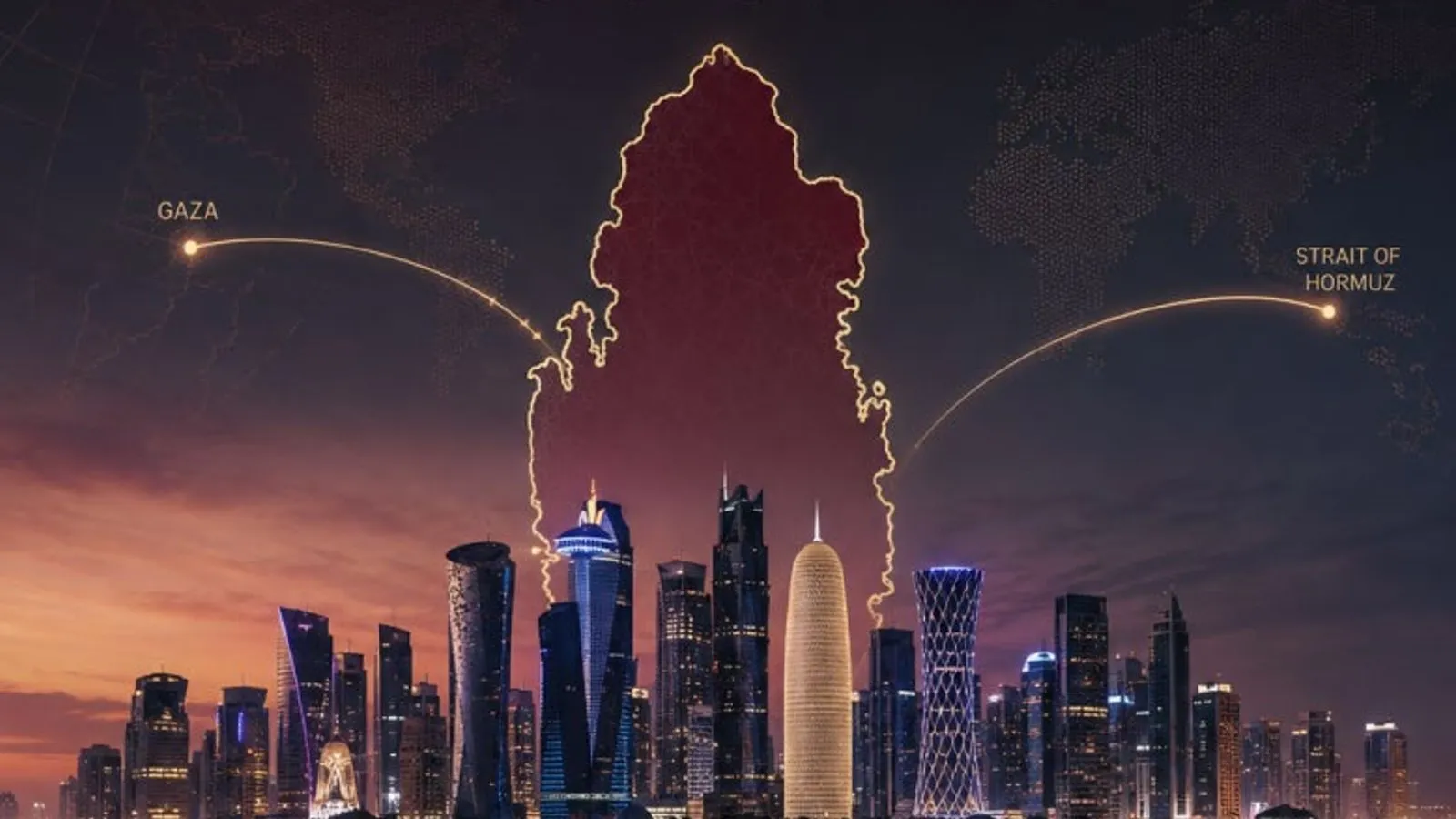
A Harder Balance Between Tehran and Riyadh
The October 13 front page of Al-Araby Al-Jadeed led with the Houthi attacks that have disrupted King Khalid International Airport. The paper reported that the closure will last until October 17 and described continued fighting near Taiz and Bab el-Mandeb. It also reported that Iranian Foreign Minister Abbas Araghchi, in a call with Saudi Foreign Minister Prince Faisal bin Farhan, offered to help facilitate talks between Riyadh and the Houthis. The reporting shows no sign that Saudi Arabia has accepted a mediating role for Tehran. Battlefield figures released by the Saudi-led coalition remain claims until they are independently verified.
The asymmetry at the center of Qatar’s position is plain. Qatar has access to Tehran and, together with Pakistan, has helped move the Hormuz negotiations forward. Saudi Arabia, meanwhile, is under attack by a force aligned with Iran. Public Qatari support for Saudi security does not rule out mediation. However, mediation becomes politically more costly as civilian casualties and aviation disruption mount. Our previous brief covered Doha’s declaration that Saudi security is integral to its own.
Within three days, the pressure built on several fronts. Between October 11 and 13, Doha signed an energy framework with Riyadh, saw its national carrier withdraw from two Saudi cities, and watched Tehran present itself as a channel to the Houthis. The same edition of Al-Araby Al-Jadeed reported an Iranian escalation against shipping in the Strait of Hormuz and described Houthi strikes aimed at the core of the Saudi economy. Qatar’s public line still emphasizes de-escalation and dialogue. The report judges that a clear Qatari statement assigning responsibility for the attacks on Saudi airports would mark the point at which this balance breaks.
Qatar Airways cited the security situation and passenger safety when it suspended its Riyadh and Dammam services. The suspension imposes direct costs on Qatar’s hub network, on rebooking and business travel, and on cargo logistics. It does not mean that Qatar has joined the military campaign against the Houthis. The report found no independent evidence that Doha is financing Turkish or Pakistani military operations on Saudi Arabia’s behalf.
The energy memorandum was signed in Riyadh on October 11 by Minister of State for Energy Affairs Saad bin Sherida Al Kaabi and Saudi Energy Minister Prince Abdulaziz bin Salman, on the sidelines of the International Energy Forum ministerial meeting. It sets out a framework for cooperation in oil, gas, refining, petrochemicals, electricity, clean hydrogen, renewables, efficiency, storage, and carbon capture. It creates no new export route and no joint production facility, and it takes effect only after both countries complete their legal procedures.
Syria, Egypt, and Lebanon: A Wider Regional Footprint
On October 12, Prime Minister and Foreign Minister Sheikh Mohammed bin Abdulrahman Al Thani received Syrian Foreign Minister Asaad al-Shaibani in Doha. According to Qatar’s Foreign Ministry, the two reviewed bilateral cooperation and developments in Syria, and Qatar reaffirmed its support for Syrian unity, sovereignty, state institutions, and reconstruction.
On the same weekend, Qatar Charity reopened the al-Omari Mosque in Harasta, in the Damascus countryside, after a full restoration of severe war damage. The project was funded by donors in Qatar and carried out with the Wifaq Humanitarian Foundation. The mosque, one of the oldest in the district, can hold up to 6,000 worshippers and now runs on solar power with battery storage. It is the first of five war-damaged mosques around Damascus that the program plans to restore. The project has a clear humanitarian and religious purpose and a plausible soft-power effect. Any claim that it serves political recruitment would require evidence that the report does not contain.
Qatar Charity also opened an office in Cairo on October 12, its 35th field office worldwide. Egyptian Minister of Social Solidarity Maya Morsy attended the ceremony alongside the charity’s chairman and Qatar’s ambassador to Egypt, and the governors of Cairo and Matrouh were also present. Qatari press put the first-phase budget at about QAR 36 million (roughly $10 million), spread across health, community development, food security, and social care. Both sides tied the office to their joint Gaza relief work, which runs through Egypt’s national aid mechanism. The opening follows the August meeting of the Qatar-Egypt Joint Higher Committee, which scheduled the first round of talks on an economic partnership agreement for October.
The significance lies in the history. In June 2017, Egypt joined Saudi Arabia, the UAE, and Bahrain in listing Qatar Charity among the entities they designated during the boycott of Doha. Nine years later, the same organization has a permanent platform in the most populous Arab state, opened with an Egyptian minister at the ribbon-cutting. The episode shows how far relations have moved since the 2021 AlUla reconciliation.
Lebanon may be next. Citing its own information, Al-Araby Al-Jadeed reports that the prime minister will arrive in Beirut on the evening of October 15 and meet senior political and military officials the following day. Lebanese officials reportedly hope that Qatar, which helped secure the earlier ceasefire, will help consolidate calm and press for Israel’s withdrawal from Lebanese territory. The visit has not been officially announced, and the report treats it as single-sourced until it is confirmed.
Taken together, diplomacy, reconstruction, religious infrastructure, and media coverage give Qatar several visible instruments of influence in post-Assad Syria and beyond. Their coexistence does not prove that Qatari state institutions, Qatar Charity, and independent media are acting in coordination. The report’s test is whether Doha moves from symbolic support toward financed infrastructure, formal administrative partnerships, or documented commitments on security-sector reconstruction.
Gaza a Year On, and the Nobel Debate
The October 2025 ceasefire, mediated by Qatar, Egypt, Turkey, and the United States, ended major hostilities and secured exchanges of hostages and prisoners. Its second phase remains stalled. A year later, Israel’s withdrawal, Hamas disarmament, the international stabilization force, a working governance structure, and large-scale reconstruction are all incomplete. A Reuters anniversary review states that Israel still controls roughly two-thirds of Gaza. Qatar’s role in brokering the agreement is therefore distinct from any power to enforce it.
Qatari-linked commentary marked the anniversary by scoring the war on Israel’s lost standing. In Al-Watan, the veteran Palestinian writer Munir Shafiq, a former director of the PLO Planning Center, argued that critics who called the war an Israeli victory overlooked the endurance of Gaza’s population, the resistance’s surviving military capacity, and a shift in world opinion. Netanyahu, he wrote, failed to occupy Gaza or destroy the resistance. Shafiq concluded that the damage to Israel’s reputation alone justifies calling the outcome a victory for the Palestinian cause. These are the columnist’s judgments and carry no Qatari government endorsement. The report notes that Al-Watan chose to run a column that says nothing about the mediators’ diplomatic achievement, which illustrates the distance between official Qatari diplomacy and political commentary in Qatar’s press.
The Nobel Peace Prize gave the same theme an international anchor. On October 9, the Norwegian Nobel Committee awarded the 2026 prize to Navi Pillay, the South African jurist who chaired the UN commission of inquiry that concluded in September 2025 that Israel had committed genocidal acts in Gaza. President Trump called the decision “disgraceful and embarrassing,” and Washington announced new sanctions on the International Criminal Court within hours. On Al-Araby Al-Jadeed’s October 13 opinion page, the Syrian writer Abdulbaset Sida linked the U.S. reaction to Trump’s own campaign for the prize and to anger at Pillay’s Gaza findings. He added that Gulf states have concluded that relying on Washington alone for their security has failed. The report found no official Qatari comment on the award. It assesses that the prize strengthens the genocide framing in Qatari-funded outlets at a time when Doha still depends on Washington to press Israel on the ceasefire’s second phase.
A Wide Range of Views in Qatar-Linked Media
Al Jazeera Arabic’s opinion pages carried two notable guest essays. Saudi analyst Suleiman al-Uqaily argued on October 12 that the airport attacks are a regional security challenge driven mainly by Iranian strategy, and that Tehran should bear higher costs for attacks by its partners. On October 13, Russian commentator Alexander Kuznetsov asked whether Moscow could mediate between Washington and Tehran and argued for a broader regional security settlement. No Russian mediation mechanism has been agreed. Both essays are the authors’ own positions and do not represent Al Jazeera’s editorial line or the Qatari government. Their publication shows that the network’s opinion space admits both a Saudi security argument and a diplomatic route outside a U.S.-led model.
Al-Araby Al-Jadeed offered a more direct example of soft-power praise. Former Lebanese minister Ghazi al-Aridi, writing as a guest contributor, thanked Qatar and Azmi Bishara for building the Arab Center for Research and Policy Studies into one of the region’s leading research institutions. He framed the column as a reply to Israeli attacks on Bishara, including National Security Minister Itamar Ben-Gvir’s accusation that Bishara directs missiles at Israel. The column is attributed opinion and offers no evidence of specific policy outcomes.
The War Economy Hits Qatar’s Core Export
Lost LNG volumes, not oil prices, set Qatar’s near-term economic outlook. Reuters reports that Qatar’s September LNG loadings barely reached a quarter of prewar levels, with a further drop possible in October. That shortfall is separate from the structural loss caused by Iran’s earlier strike on Ras Laffan, which knocked out about 17 percent of export capacity. The report cautions against combining the two figures. Damaged trains lower potential output, while conditions in Hormuz, operating limits, and tanker availability depress actual exports far below installed capacity. The IMF projects that Qatar’s real GDP will contract by 8.6 percent in 2026.
A recovery channel exists but has not yet opened. Reuters reported on October 7 that the first train of QatarEnergy’s North Field East expansion is ready to start operations in November, with commercial production possible in the first quarter of 2027. These are expected milestones, and market access, feed gas, vessel availability, and insurance remain conditions for meeting them.
Transport costs are a further drag. An OPEC and non-OPEC ministerial statement issued in Riyadh on October 12 said combined shipping and insurance costs for some energy flows now exceed one-third of the value of the cargo. Brent traded at $105.47 a barrel and WTI at $92.57 in intraday trading on October 13, and European TTF gas stood near a wartime high of €86.50 per megawatt-hour. Higher world prices bring Qatar little benefit on cargoes that cannot sail. Prices eased slightly on the day as markets weighed Washington’s decision to lift sanctions on Russian diesel exports, which Trump said would deliver more than 300,000 tonnes immediately. For Qatar, the deal adds political noise to a product market already short of Gulf refinery output.
Financial buffers are holding. Qatar Central Bank reserves and foreign-currency liquidity stood at QAR 262.3 billion at the end of September, up 0.46 percent from a year earlier. The Qatar Stock Exchange index closed October 12 at 8,976.64, up 1.15 percent after a two-day decline. The report cautions that one day’s rebound does not show durable stabilization, and that the reserves cushion volatility without replacing lost export earnings.
London Courts Qatari Capital
Dame Susan Langley, Lady Mayor of the City of London, used her first visit to Doha to court Qatari investors. In an interview carried by Qatar Tribune on October 13, she described the partnership as strong and long-term and named green finance, FinTech, and Islamic finance as areas with room to grow. She said London could help Doha widen the sukuk market. She also said the GCC-UK free trade agreement has been concluded and, once in force, will ease services and digital trade. She promoted two British tools aimed at Gulf capital, the InvestConnect project platform and the Office for Investment’s financial services desk. Britain wants Qatari capital for its own growth agenda. For Doha, the channel supports diversification and keeps access to Western markets open as energy revenue falls.
Section 117 and U.S. Institutional Influence
In the United States, a federal temporary restraining order issued on October 1 still restricts publication of previously undisclosed foreign donor identities reported by universities that belong to the Association of American Universities. The order runs through October 29 unless extended, and it does not remove the underlying reporting duties. October 13 was the scheduled date for the government’s opposition filing, but no new filing could be confirmed. Our Section 117 special report explains the order. The June JINSA study, civil discovery involving Carnegie Mellon, and the Brandeis Center’s request for a FARA inquiry into Northwestern remain analysis, litigation, or requests. None establishes an investigation or a violation. The report found no new verified U.S. enforcement action on Qatari influence in education between October 11 and 13.
Key Points
- Qatar’s two-track position between Tehran and Riyadh is becoming more costly as Houthi attacks hit Saudi aviation and energy. The Riyadh airport is closed until October 17, Qatar Airways has suspended Saudi flights, and Riyadh has not accepted Iran’s offer to facilitate talks with the Houthis (high confidence).
- Qatar-Saudi energy cooperation is widening on paper, but the security of energy transport remains the binding constraint. The memorandum takes effect only after legal procedures in both states (moderate confidence).
- Qatari soft power is expanding through charity, religious infrastructure, and diplomacy in Syria and Egypt. There is no evidence of a single coordinated program (high confidence).
- Doha is extending its Levant role toward Lebanon. The prime minister’s expected October 15 visit to Beirut is single-sourced and not yet officially announced (moderate confidence).
- London is courting Qatari capital in finance and technology, and the GCC-UK free trade agreement is concluded and awaiting entry into force (high confidence).
- Gaza implementation remains deadlocked a year after the ceasefire, and Qatari-linked commentary judges the war by Israel’s lost legitimacy (high confidence).
- Lost LNG exports matter far more for Qatar’s near-term revenue than gains in oil prices (high confidence).
- There is no new verified U.S. enforcement action on Qatari influence in education (moderate confidence).
What to Watch
- Any shift in Qatar’s official language from general appeals for de-escalation to explicit attribution of responsibility for the attacks on Saudi airports and energy sites.
- Contacts between Doha, Tehran, and Riyadh, and whether reported proposals turn into an agreed negotiating format.
- Follow-up to the Shaibani visit, financing for Qatar Charity’s remaining Syrian projects, and any reconstruction tenders.
- The first projects from Qatar Charity’s Cairo office, the first round of Qatar-Egypt partnership talks, and any political pushback in Egypt.
- Official confirmation of the prime minister’s Beirut visit and the meetings expected on October 16.
- Progress on Israeli withdrawal, Hamas disarmament, governance, and reconstruction financing in Gaza.
- Daily LNG loadings at Ras Laffan, Hormuz transit notices, and the commissioning of North Field East.
- Any official Qatari reaction to the Pillay award and the scope of the new U.S. sanctions on the International Criminal Court.
- Steps toward entry into force of the GCC-UK free trade agreement and Qatari investment moves in London.
- Section 117 docket filings before the restraining order expires on October 29.
This post summarizes the Qatar Watch daily intelligence report for October 13, 2026, with information current to 09:00 UTC. The report draws on QNA, the Qatar Foreign Ministry, Qatar Tribune, Al-Raya, Al-Arab, and Al-Watan; the October 13 print edition of Al-Araby Al-Jadeed; Al Jazeera Arabic and English; Reuters, the Financial Times, Ahram Online, and Masrawy; the IMF, OPEC, Qatar Central Bank, and Qatar’s National Planning Council; and U.S. court records. The prime minister’s Beirut visit rests on a single press report. Coalition battlefield figures are unverified claims, and economic indicators are intraday observations or the latest published official figures. Signed opinion pieces are attributed commentary and do not set Qatari state policy. Our Hormuz-axis update for October 13 covers the day’s Iranian side of the picture, and earlier posts in the series are collected on the Qatar Watch hub.