Stranded Inside the Gulf: Qatar's LNG Revenue Collapses as the Tanker War Nears Ras Laffan
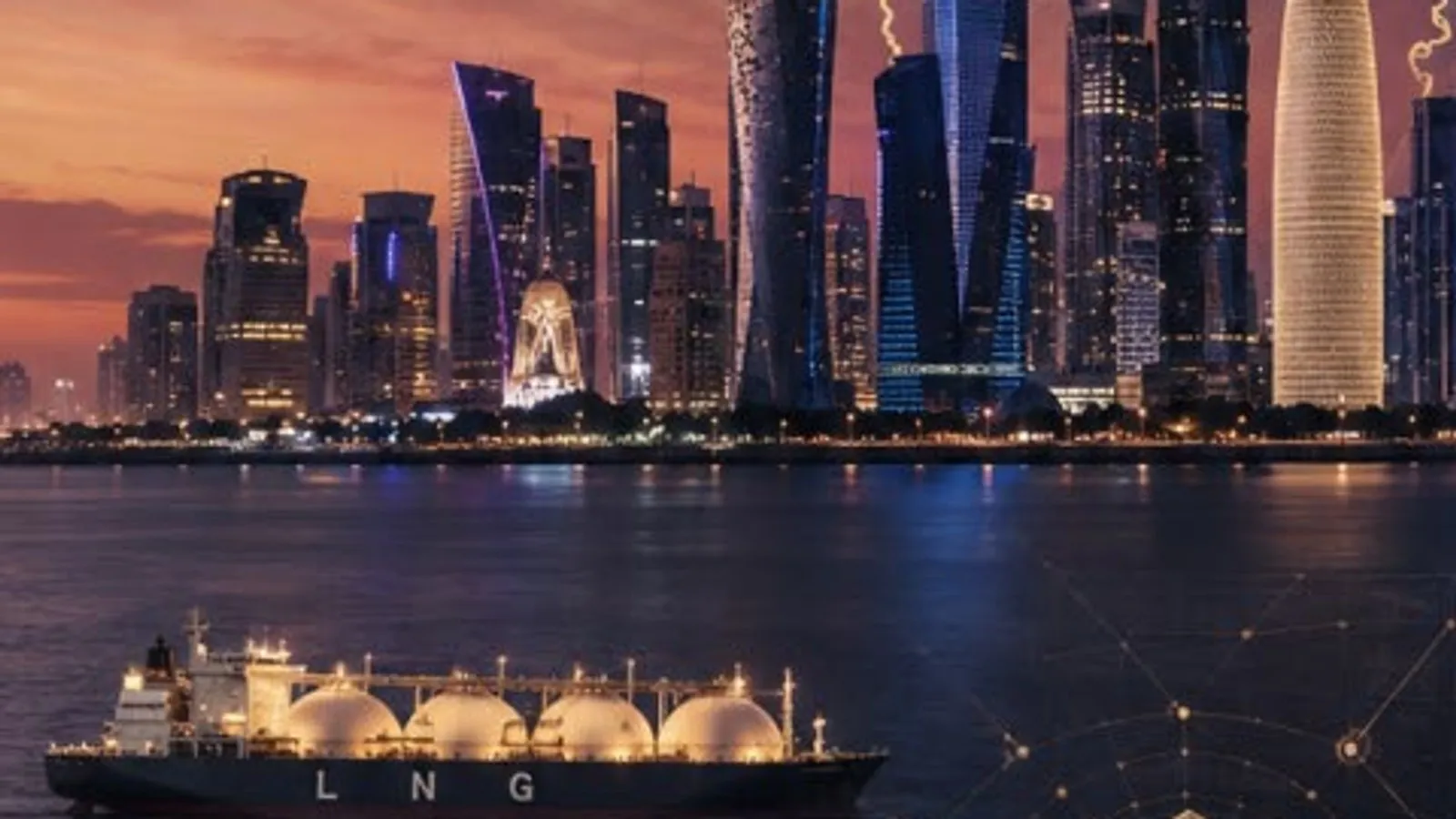
The war at sea is now hitting Qatar’s main source of income. Iran’s tanker campaign has moved deeper into the Gulf, with a tanker struck about 50 nautical miles north of Qatar’s northern tip on October 7. Kpler expects Qatar’s LNG exports to fall to about 0.6 million tonnes in October, down from 1.6 million in September. The report estimates that the drop removes $0.7 billion to $0.8 billion from monthly gross export value. On the diplomatic front, Doha condemned the Houthi strikes on Riyadh’s King Khalid International Airport, declared Saudi security part of its own, and announced no military role. Its Gaza mediation is running on existing commitments one year after the ceasefire. Meanwhile, Al-Araby Al-Jadeed published three cartoons in three days ridiculing President Trump, one of them by a Qatari artist. The report assesses that Qatar, whose LNG cannot bypass Hormuz, has the strongest motive of any Gulf state to keep U.S.-Iran message traffic alive.
Gulf Solidarity Without a Military Role
On October 10, Qatar’s Ministry of Foreign Affairs called the Houthi attacks on King Khalid International Airport a grave breach of Saudi sovereignty and a direct threat to civilians, civilian infrastructure, and air navigation. It expressed full solidarity with Saudi Arabia and backed all legitimate measures to protect the kingdom. The key line was that Saudi security is integral to Qatar’s own security and to the Gulf Cooperation Council (GCC) system. That goes further than a routine condemnation and commits Doha, at least rhetorically, to the idea of indivisible Gulf security. The statement announced no Qatari military contribution.
The Saudi civil aviation authority reported 12 killed and 309 injured in the October 10 attack, including a U.S. citizen. The airport was hit again on October 11, when a projectile struck Passenger Terminal 4 and caused a fire, and the authority said Dammam’s King Fahd International Airport was also struck that evening. The Houthis now describe Saudi airports, except those of Mecca and Medina, as a theater of operations under an “airport for airport” formula. They also claim strikes on Aramco’s Shedgum gas plant and Tanajib oil facility. Neither Riyadh nor the coalition has confirmed damage at those sites, and Saudi crude exports were not reported disrupted.
The costs for aviation are already visible. Lufthansa Group, Air India, Kuwait Airways, flydubai, and Etihad have suspended or cut Saudi services, and the EU aviation safety agency widened its advice to avoid Saudi airspace. Hamad International depends on open regional airspace, and the reviewed reporting does not show whether Qatar Airways has curtailed Saudi routes since the October 11 disruptions noted in our previous brief. A sustained Houthi campaign against Saudi civil aviation would raise insurance and routing costs for every Gulf carrier.
Saudi Arabia, Egypt, Turkey, and Pakistan issued a joint statement condemning the attacks, and Turkey and Pakistan pledged to make defensive capabilities quickly available under their August defense arrangement with Riyadh. However, Turkish Foreign Minister Hakan Fidan ruled out troop deployments and offensive operations, and the Turkish parliament has not ratified the pact. Doha welcomed the arrangement on August 11. The report finds no verified evidence that Qatar is financing the Turkish or Pakistani effort, and it treats such claims as unsubstantiated until financial records or official statements support them.
In Washington, President Trump said the United States “may” join Saudi strikes on the Houthis but announced no decision. Iran’s foreign minister offered his Saudi counterpart help in facilitating a Saudi-Houthi dialogue, and President Masoud Pezeshkian praised Oman’s mediation in a call with Sultan Haitham bin Tarik. Diplomacy and military warnings are running in parallel, and nothing yet amounts to a verified de-escalation agreement.
The Tanker War Reaches Qatar’s Waters
Attacks on shipping have spread well beyond the strait. On October 7, the Antigua-flagged tanker Acers was hit by multiple projectiles about 50 nautical miles north of Madinat ash Shamal, a short distance from the Ras Laffan LNG complex. The crew put out a fire and the vessel continued to Kuwait. No one claimed the attack. On October 9, the fully laden supertanker GEM NO.2 was struck off the UAE. Over the weekend, UKMTO reported a drone strike on a tanker near Oman’s Sohar anchorage and a second tanker damaged in Hormuz, and the U.S. military said it disabled a cargo ship that tried to run its blockade of Iran. Our October 8 brief covered the first reports of the Acers strike.
The numbers point to a deliberate campaign. Reuters counted at least 12 attacks on oil, LNG, and LPG tankers around the strait between September 28 and October 5, the most in any week since the war began on February 28. Kpler counted only 7 transits on October 6 and 10 on October 7, against about 125 large commercial transits a day before the war. Crude flows through the strait fell 27 percent in a week, while exports routed through the Gulf of Oman and the Red Sea doubled.
Tehran’s rhetoric hardened in step. Mohsen Rezaei, secretary of the Supreme National Security Council, warned that a new war would bring “a wider and more comprehensive plan” and threatened regional cables, data centers, and AI facilities. Lawmaker Hassan Qashqavi said the strait would not reopen before Iran’s conditions are met. The data-center threat has a Qatari dimension. Doha hosts hyperscale cloud regions and markets itself as a digital hub, and Al Udeid Air Base gives Iran a standing reason to treat Qatari territory as part of the American footprint. Our Hormuz-axis update for October 12 covers Iran’s seven conditions in detail.
Qatar’s LNG Revenue in October
LNG is recovering far more slowly than oil. Kpler estimates Qatar’s October exports at about 0.6 million tonnes, down from about 1.6 million tonnes in September. September was the best month since the war began, yet it still came in below a quarter of the prewar average, and about a third of its cargoes went to Kuwait inside the Gulf. By comparison, Middle East oil flows through Hormuz reached about 80 percent of prewar levels in September. LNG carriers are scarcer and more expensive than crude tankers, and their owners refuse transits when the risk of attack or blockade is high. QatarEnergy has extended force majeure notices to customers in Asia and Europe. Iranian missile strikes reportedly disabled about 17 percent of export capacity at Ras Laffan, and limited storage and condensate handling cap output even when ships can sail.
The report’s own estimate puts the revenue effect in plain terms. A tonne of LNG carries about 52 million British thermal units, and oil-indexed term contracts at current Brent levels price cargoes at roughly $13 to $15 per million Btu. On that basis, the drop of one million tonnes removes about $0.7 billion to $0.8 billion in monthly gross export value. October volumes would earn well under $0.5 billion, compared with roughly $4.5 billion to $5 billion in a normal prewar month. High spot prices offer no relief, because Qatar cannot ship enough volume to capture them. The expansion target of 142 million tonnes a year by 2030 depends on safe navigation that does not exist today.
Qatar’s stock index fell about 1.5 percent on October 11 as investors reacted to the Riyadh attack. That move is a market reading and says nothing about physical export capacity. Brent traded near $104 a barrel on Monday morning after touching $105.48 late Sunday, and WTI stood at $92.44. Saudi Aramco cut its November price for Arab Light to Asia to $5 below the Oman/Dubai average, the steepest discount in six years, in what one economist quoted by Al-Araby reads as a fight for long-term Asian market share.
Energy Diplomacy With Riyadh
On October 11, Minister of State for Energy Affairs Saad al-Kaabi and Saudi Energy Minister Prince Abdulaziz bin Salman signed a memorandum of understanding covering oil, gas, refining, petrochemicals, electricity, hydrogen, renewables, efficiency, storage, and carbon capture. It enters into force only after legal procedures in both states. As a result, it signals strategic alignment but creates no new supply flows.
At the International Energy Forum ministerial in Riyadh, al-Kaabi urged governments to keep energy above politics. He said the war has constrained about 20 percent of global hydrocarbon supply and caused tens of billions of dollars in damage to energy assets. These are the minister’s figures and have not been independently measured. The report judges that his message is aimed as much at Tehran and Washington as at the forum itself.
Gaza One Year After the Ceasefire
The ceasefire took effect on October 10, 2025. Gaza’s health ministry says Israeli fire has killed 1,488 Palestinians and wounded 5,281 since then, and it puts the cumulative toll since October 2023 at 74,377 killed. These figures come from Gaza authorities and are unaudited. More than 100 humanitarian and rights organizations, including Amnesty International, Oxfam, and the Norwegian Refugee Council, said on October 9 that the ceasefire exists only on paper. On the night of October 10, Israeli forces moved the markers of the “yellow line” westward in Shujaiya, the first such advance in at least a month. OCHA puts access-restricted areas at about 64.9 percent of the Strip.
The second phase of the U.S. plan has not moved. Israel insists on full Hamas disarmament first, while Hamas and the Trump administration want simultaneous steps. The International Stabilization Force has not deployed, and Indonesia, which pledged the largest contingent, put its plans on hold in the spring. Almost nothing has been rebuilt. On October 10, President Mahmoud Abbas postponed Palestinian presidential and legislative elections from November 28, 2026, to September 11, 2027.
Qatar remains a mediator alongside Egypt, Turkey, and the United States. Its most recent statements date from August, and no new Qatari statement on Gaza was found for October 10 to 12. With the Foreign Ministry focused on Riyadh, Hormuz, and U.S.-Iran message traffic, the Gaza track is running on existing commitments. The Israeli election on October 27 is the next point at which the mediators can test whether the second phase can restart.
Qatar-Linked Media: Sharp Critique and a Wide Range of Views
Al Jazeera English led its airport coverage with Saudi casualties and international condemnation, and it carried both Qatar’s statement and Secretary of State Marco Rubio’s. On Al Jazeera Arabic’s opinion pages, Adel al-Hawatmeh, an assistant professor at Lusail University, argued that the United States has failed to secure Hormuz despite overwhelming naval power and went to war with Iran without an exit strategy. The essay is signed commentary and does not represent a Qatari government position.
Al-Araby Al-Jadeed offered a contrasting view. On its October 12 opinion page, Istanbul-based Palestinian writer Majed Azzam defended the Saudi-Turkish-Pakistani defense arrangement as legitimate collective defense and blamed Iran and its allied armed groups directly. Read together with the Al Jazeera essay, it shows how wide the range of opinion in Qatar-linked media is. The Azzam essay is not evidence that Qatar has joined the pact or agreed to fund it. Other opinion pieces covered the Syrian Muslim Brotherhood’s insistence on organizational independence and Azmi Bishara’s call for enforceable regulation of privately owned digital platforms. The report finds no evidence of Qatari material support for the Brotherhood in this material.
The sharpest signal came in the paper’s cartoons. Over three days, Al-Araby published three drawings that ridicule Trump. Al-Rih Ambaddi drew him waist-deep in Gaza’s rubble demanding the Nobel Peace Prize, and the paper moved the cartoon from its website to the printed opinion page on October 12. Qatari cartoonist Saad Al-Muhannadi showed Trump holding a bloodied bomb on a medal ribbon while Navi Pillay, the 2026 laureate, raises the real Nobel medal. Emad Hajjaj pinned Trump and a Revolutionary Guard officer to opposite ends of a rolling oil barrel, mocking both as prisoners of an oil war neither controls. The satire goes much further than anything Doha says officially about Washington. Because Al-Muhannadi is a Qatari national, the report treats his drawing as a more pointed signal than work by a foreign contributor.
Soft Power and the Section 117 Watch
Qatar Foundation’s October 11 account of its Showtime! arts program fits the foundation’s long-standing investment in educational prestige, and it shows no sign of activity in U.S. schools. In the U.S. debate over foreign funding of universities, a temporary federal order of October 1 still restricts disclosure of previously unpublished donor identities. No later order and no Qatari funding transaction dated October 11 or 12 was verified. The reviewed material contains no new U.S. government action against Qatar, no new Qatar Investment Authority acquisition in the United States, and no university payment linked to misconduct. Our Section 117 special report explains the court order in force.
Key Points
- Doha’s official line on the Riyadh attacks is full solidarity and indivisible Gulf security, with no announced Qatari military role (high confidence).
- Iran’s tanker campaign now reaches waters close to Qatar, and October is shaping up as the weakest LNG month since the summer (high confidence).
- Houthi strikes on Saudi airports, together with claimed hits on Aramco plants, extend Gulf energy risk from sea lanes to onshore infrastructure. The Aramco damage rests on Houthi claims and is unconfirmed (moderate confidence).
- Washington has not decided to join combat against the Houthis, and Turkey has ruled out troops and offensive action (moderate confidence).
- The Gaza ceasefire survives on paper while Qatar’s mediation is on hold (moderate confidence).
- Qatar-linked media voices diverge widely, and Al-Araby’s satire of Trump sharpened over the weekend (high confidence).
- No verified evidence shows Qatar financing Turkish or Pakistani military aid to Saudi Arabia. Diplomatic support and energy coordination do not imply payment (moderate confidence).
What to Watch
- Whether Washington moves from discussing strikes on the Houthis to taking part in them.
- Whether Saudi, Turkish, and Pakistani assistance expands beyond its publicly described defensive role.
- Further tanker attacks inside the Gulf near Qatari waters, and above all any strike on an LNG carrier.
- Kpler and ship-tracking data on Qatari LNG loadings in the second half of October, and any new QatarEnergy force majeure notices.
- Independent confirmation or denial of damage at Aramco’s Shedgum and Tanajib sites.
- Movement of Gaza’s yellow line, the mediators’ response, and any contacts on the second phase after Israel’s October 27 election.
- Whether the Qatar-Saudi energy memorandum produces specific commercial contracts.
- New U.S. filings or court decisions that change public visibility into foreign funding of universities.
This post summarizes the Qatar Watch daily intelligence report for October 12, 2026, covering October 10 to 12. The report draws on QNA and the Qatar Foreign Ministry; the October 12 print edition and online cartoon section of Al-Araby Al-Jadeed; Al Jazeera English and Arabic news, opinion, and blog pages; Reuters, Gulf News, Alhurra, Arab News, Asharq Al-Awsat, and TASS; Kpler data as reported by UA.News; and U.S. court records. The LNG revenue figures are the report’s own estimates. Houthi claims of damage to Aramco facilities are unconfirmed, and Gaza casualty and damage figures come from Gaza authorities and are unaudited. Signed opinion pieces and cartoons are attributed commentary and do not set Qatari state policy. Earlier posts in the series are collected on the Qatar Watch hub.