Hedging in Two Registers: Doha Stands With Washington While the Media It Funds Turns on Trump
Doha is running two messages at once, and the gap between them widened this week. Official Qatar condemned the Houthi attack on Riyadh’s King Khalid International Airport, called Saudi security part of its own, and kept the United States as its security partner. Qatar Airways flights to Riyadh were disrupted on October 11, so the war now touches Qatar’s commercial aviation directly. Nothing in the material reviewed shows a Qatari military role or Qatari money behind Turkish or Pakistani support for the Saudi campaign. Meanwhile, the media groups Qatar funds portrayed President Trump as vain, transactional, and willing to bend international law. The report judges with high confidence that Doha keeps state policy separate from this media space, and that the arrangement earns Qatar credibility with Arab audiences at little cost in Washington, at least until U.S. strikes on Iran resume.
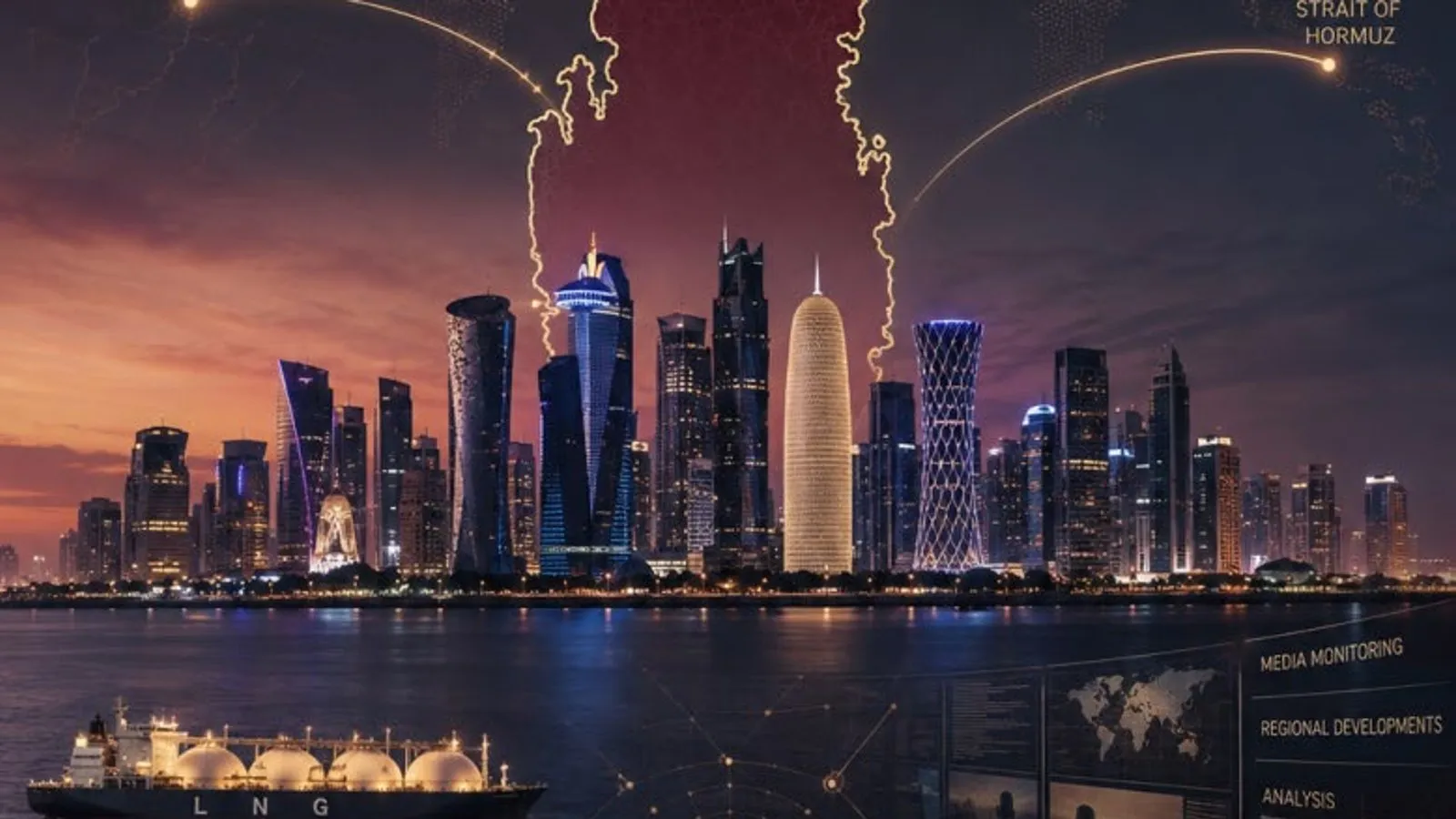
Doha’s Official Line: Gulf Solidarity and a Quiet Partnership
On October 10, Qatar’s Ministry of Foreign Affairs condemned the Houthi attacks on King Khalid International Airport in the strongest terms. It called them a violation of Saudi sovereignty and a threat to civilians, aviation, and regional security, and it backed the measures Riyadh takes to protect itself. The ministry said Saudi security is part of the security of Qatar and of the Gulf Cooperation Council (GCC). The statement announced no Qatari deployment and no contribution to offensive operations in Yemen. The reported Saudi toll stood at 12 killed and 309 injured, subject to confirmation.
The Qatar News Agency (QNA) grouped condemnations of the airport attack from Secretary of State Marco Rubio, the UN secretary-general, the UN envoy for Yemen, and the GCC secretary-general. Rubio’s statement was addressed to the region as a whole and carried no message aimed at Doha. On October 9, QNA also ran a straight report on the new U.S. sanctions against the International Criminal Court (ICC). It noted the Treasury’s six-month wind-down period and that the measures came hours after Navi Pillay, a former ICC judge, won the Nobel Peace Prize. The agency printed no reaction from the court, its member states, or Doha.
For a state that presents itself as a champion of international accountability, the silence looks deliberate. The report assesses that Qatar does not want a dispute with Washington over the court while the Gulf is at war. Our October 10 brief traced how Doha has moved closer to Riyadh while keeping its channel to Tehran open.
How Qatar-Linked Media Portray Trump
Between October 8 and 11, the two main Qatar-linked media groups presented Trump as a president driven by vanity and deal-making, ready to bend international law and to time wars for electoral gain. The United States as a country fared better. Coverage described a superpower whose courts, Congress, and press still push back against the president. None of the items reviewed questioned Qatar’s own alliance with Washington, the U.S. presence at Al Udeid Air Base, or Doha’s role as a mediator.
Al-Araby Al-Jadeed, a London-based outlet within the wider Qatar-linked media ecosystem, was the most openly polemical. Its October 11 print edition devoted the opinion page to three columns on Trump. Bahraini columnist Hassan Madan mocked the president’s habit of putting his name on buildings, coins, and passports, including his suggestion on Truth Social that Hormuz be renamed the “Strait of Trump.” Lebanese writer Gerard Dib argued that Trump’s wish for the Nobel Peace Prize cannot be squared with his support for Israel and his coercive foreign policy. Jordanian writer Samer Khair Ahmad criticized Washington’s refusal to slow the race in artificial intelligence. A full-page feature traced U.S. hostility to the ICC from the 1998 Rome conference to the October 9 sanctions, and gave equal space to the court’s reply and to eight allied foreign ministers who backed it. The news pages covered Trump’s demand that Iran “give us everything we want” and the Trump-Putin diesel deal, largely through Ukrainian and European objections.
Al Jazeera English took a different approach. Its news pages rely on agency copy and measured vocabulary, and the skepticism lies in story selection and sourcing. An October 9 analysis presented Trump’s pledge not to strike Iran before the November 3 midterms as a way to shield Republican candidates from an unpopular war. An October 10 explainer on the Board of Peace drew its verdict from critics who called the board a failure. On October 11 the channel reported the Justice Department’s antitrust probe into five U.S. television networks that had suspended coverage of the president. For a network that has faced U.S. calls to register under the Foreign Agents Registration Act (FARA), press-freedom stories about Washington also serve its institutional interest.
Al Jazeera’s Arabic site read U.S. politics as a story of decline and eroding norms. It profiled the writer Curtis Yarvin as an influence on Trump and Vice President JD Vance, and it published an Arabic digest of a Fareed Zakaria column arguing that the United States is fighting a costly war to restore the prewar status quo. An October 8 guest column by Saleh bin Mohammed Al-Khuthlan, a former member of the Saudi Shura Council, urged Gulf states to prepare for renewed U.S. operations against Iran after the midterms and to build a security framework less dependent on Washington.
The report judges with moderate confidence that this division of labor is widening. Al Jazeera delivers its critique through framing and source choice, which protects its news brand, while Al-Araby delivers it as open polemic. No evidence of central editorial instruction was found.
Gaza, One Year On
Al-Watan marked the anniversary of the October 2025 Gaza agreement with a full-width photograph of Trump holding the signed document, under the headline “One Year Since the Faltering ‘Gaza Agreement.’” The page counts 1,445 Palestinians killed and 5,072 wounded since the agreement took effect, with about 2.15 million of Gaza’s 2.4 million people displaced. These figures come from Gaza sources and are unaudited. The analysts it quoted, speaking to Anadolu Agency, expect stalemate until Israel forms a government after its October 27 election, or a conditional opening once the U.S. midterms have passed. One blamed Washington for misleading the Palestinians and Israel for deliberate obstruction. The page treats Trump as the only actor able to force Israel’s hand but doubts he will use that power before his own election.
A cartoon on Al-Watan’s opinion page showed a tank labeled “U.S. midterm elections” flying an Israeli flag and carrying surveillance equipment. It is an editorial accusation of Israeli influence over American politics, with no evidence behind it. Its interest for this brief is that allegations of foreign influence run in both directions in the Qatar-linked media space.
On Al Jazeera English’s opinion page, Lorenzo Kamel, a historian at the University of Turin, argued that Hamas’s fate will not decide Gaza’s future. He called the movement a symptom of occupation and blamed Israel’s demand for full Hamas disarmament for the deadlocked talks. The column does not mention the United States or the mediators, Qatar included. For Doha, which has hosted Hamas’s political leadership and guarantees the 2025 agreement, the argument is convenient because it places responsibility for the stalled second phase on Israel. Other Al Jazeera Arabic essays argued for sovereign control of trade-corridor data and challenged Western frameworks for explaining Islam. The report finds nothing in these essays to show that the Qatari state has adopted a policy of distance from Washington.
Pillay’s Nobel and the Contest Over AI Answers
The Nobel committee’s citation for Navi Pillay covered her whole legal and human-rights career. She also chaired the UN commission of inquiry that concluded Israel had committed genocide in Gaza, a finding Israel rejects and on which the International Court of Justice has issued no final ruling. Al-Araby set the U.S. sanctions on the ICC beside Trump’s attack on the Nobel committee at a rally. QNA reported the sanctions without linking them to the prize. No congratulatory statement from the emir or the Foreign Ministry was found, so the enthusiasm documented here is media coverage and not an official position.
Al-Araby’s media page reported, citing earlier investigations by +972 Magazine, The Guardian, Axios, and others, on alleged Israeli government-backed efforts to seed online content that AI assistants retrieve when answering questions about Israel and Palestine. One cited investigation found that roughly 85 percent of about 900 pages in one network appeared in Common Crawl. The article itself concedes that a cited page does not show that readers were persuaded or that AI systems shifted lastingly in Israel’s favor. The topic is relevant because similar allegations are made about Qatar-linked networks. Shared methods do not by themselves prove equivalent sponsorship.
Nebraska and Section 117: Documented Lobbying, Unproven Effect
A September 17 FARA amendment filed by Cornerstone Government Affairs discloses work for Qatar’s embassy through the Nebraska firm Jensen Rogert Associates. The target was LB1262, a bill that would have barred Nebraska colleges and their foundations from accepting gifts or contracts from designated foreign adversaries. Its list named Qatar alongside China, Russia, Iran, and North Korea, and it extended to Al Jazeera and the Muslim Brotherhood. Jensen Rogert’s state filings record that it opposed the bill and report $30,300 in receipts. The amendment, which the firm attributes to a processing error, discloses 19 previously unreported contacts with 13 officials between February 13 and March 18, including the bill’s sponsor and the governor’s policy research director. The bill was indefinitely postponed on April 17.
The record supports three conclusions. Doha ran a targeted lobbying effort, it reached officials while the bill was live, and the contacts were disclosed only in September. It does not explain why the bill stalled, and it shows no improper inducement or wrongdoing by legislators. The report judges with high confidence that Nebraska is a documented lobbying case and that nothing shows a purchased legislative outcome. The bill’s explicit listing of Al Jazeera shows that, in parts of the United States, the network’s coverage is already treated as a security question.
The federal Section 117 case, which concerns publication of foreign donors to U.S. universities, is a separate matter. No new ruling has emerged, and the next federal filing falls on October 13. Our Section 117 special report explains the court order now in force. The standing watch on hack-for-hire firms and Qatar-aligned digital networks produced no new Commerce, Justice Department, or FBI action. A congressional request is not an enforcement finding, and the claim that Qatar pressed for the deletion of a post by Health Secretary Robert F. Kennedy Jr. remains unsubstantiated.
Yemen, Energy, and Qatar’s Balance Sheet
Al-Araby’s coverage of the Yemen escalation reported Saudi-led strikes on Sanaa airport and Houthi attacks that disrupted King Khalid International Airport. It cited reports that Qatar Airways and Etihad canceled several Riyadh flights, some into Monday. Saudi-backed Yemeni forces claim gains around Dhubab and the approaches to Bab al-Mandab, while the Houthis say they still hold Perim (Mayyun) Island. Casualty figures from both sides are attributed and unaudited. The Saudi-Turkish-Pakistani defense arrangement appears to be a defensive framework and does not show Turkish or Pakistani ground combat in Yemen. Al Jazeera English reported that Trump was weighing whether to join strikes on the Houthis, but no U.S. deployment has been announced.
The war economy is creeping toward Qatar’s own waters. Citing Lloyd’s List, Al-Araby reports at least 13 attacks on oil and gas tankers since September 28, including incidents off Qatar and near Fujairah. The report treats this with moderate confidence because it rests on a single secondary source, and LNG loadings at Ras Laffan are the real test. The paper also cites a World Bank forecast that GCC economies will contract 4.3 percent in 2026. No new QatarEnergy shutdown or Qatar-specific cargo disruption has been confirmed. Brent settled at $104.72 a barrel and WTI at $91.85 on October 9, supported by a hurricane that halted about 1.3 million barrels a day of U.S. Gulf of Mexico output. Asian spot LNG traded near $26.50 per million British thermal units, a regional marker that does not reflect QatarEnergy’s long-term contract prices. Our Hormuz-axis update for October 11 covers the shipping picture in detail.
Qatar’s largest lender reported a strong nine months. QNB Group posted net profit of QAR 13.3 billion (about $3.65 billion) for January to September, up 4 percent. Excluding the accounting effect of Turkish hyperinflation, profit reached QAR 16.4 billion, up 8 percent. The bank reports a capital adequacy ratio of 19.7 percent and nonperforming loans at 2.7 percent. These bank-reported figures show balance-sheet strength, but they predate the October escalation and are no substitute for a stress test of a prolonged Gulf shipping closure.
Al-Araby’s economy pages also reported that remittances out of the GCC reached a record $161 billion in 2025, driven in part by residence fees that push foreign workers to send their families home. The report names no Qatari fee change. Amnesty International and Human Rights Watch continue to document wage abuse and limits on labor mobility and expression in Qatar. That record matters when Qatari media present Doha as a firm advocate of international legal accountability, and it carries more weight in a week when Doha said nothing about the ICC sanctions.
Key Points
- The Saudi-Houthi escalation now hits Gulf aviation directly. Qatar’s exposure is commercial and diplomatic, with no sign of a military role (high confidence).
- Qatar-linked media portray Trump as self-serving, transactional, and hostile to international law, while official channels stay neutral or supportive. Doha keeps state policy separate from the media space it funds (high confidence).
- Al Jazeera delivers its critique through framing and source choice, and Al-Araby delivers it as open polemic. The division of labor is widening while Al Jazeera’s news brand stays intact (moderate confidence).
- The U.S. sanctions on the ICC widen the gap between Qatar’s accountability messaging and its U.S. partnership. Doha’s silence protects the partnership but leaves the argument to Al-Araby (moderate confidence).
- Al-Araby documents efforts to seed content that AI systems retrieve, but concedes there is no proof of a lasting shift in AI answers (moderate confidence).
- Maritime risk is creeping toward Qatari waters. The evidence rests on a single secondary source, and LNG loadings are the test (moderate confidence).
- QNB’s results show balance-sheet strength, though Turkish inflation and regional shipping risk still weigh on them (high confidence).
- Nebraska is a documented lobbying case, and nothing shows a purchased legislative outcome. Section 117 has no new ruling (high confidence).
- The watch on hack-for-hire firms and influence networks stays open, with no new U.S. enforcement decision (moderate confidence).
What to Watch
- Further statements from the Foreign Ministry or the emir on Saudi retaliation, possible U.S. strikes on the Houthis, the ICC sanctions, and Pillay’s Nobel award.
- Restoration of Qatar Airways service to Riyadh.
- QatarEnergy LNG notices, physical cargo disruptions, changes in war-risk premiums, new Hormuz transit rules, and confirmation of the reported tanker incidents off Qatar.
- Trump’s decision on Iran after the November 3 midterms, and whether Al Jazeera and Al-Araby frame the result as a verdict on his wars.
- Any U.S. move against Al Jazeera, including renewed FARA pressure or state bills modeled on LB1262.
- The October 13 federal filing in the Section 117 case, and follow-up on Nebraska’s late FARA disclosures.
- New Commerce, Justice Department, or FBI action on hack-for-hire networks, and primary evidence that separates registered advocacy from covert activity.
- Further Al Jazeera and Al-Araby coverage of U.S.-Israel relations, AI narrative campaigns, and Qatari institutional soft power.
This post summarizes the Qatar Watch daily intelligence report for October 11, 2026, covering October 8 to 11. The report draws on QNA and the Qatar Foreign Ministry; the October 11 print editions of Al-Araby Al-Jadeed and Al-Watan; Al Jazeera English and Arabic news and opinion pages; the Qatar Tribune’s business and energy pages; the September 17 FARA amendment, Nebraska lobbyist filings, and the LB1262 legislative record; and Amnesty International and Human Rights Watch. Gaza casualty figures come from Gaza sources and are unaudited. Yemeni battlefield and casualty claims come from the belligerents and remain unconfirmed. The tanker-attack count and the World Bank forecast reach the report through Al-Araby’s citations. Claims of Qatari financing for Turkish or Pakistani deployments remain unsupported. Signed opinion pieces are attributed commentary and do not set Qatari state policy. Earlier posts in the series are collected on the Qatar Watch hub.