Sovereignty Under the Bases: Doha Rejects Iran's Targeting Logic as the IUMS File Reaches North America
Qatar has moved its public line on Iran from mediator neutrality to direct legal attribution. The Foreign Ministry’s statement of September 3 condemned the renewed Iranian attacks on Kuwait as violations of sovereignty and international law and said Iran bears full legal responsibility for the attacks and their consequences. Doha still calls for dialogue, but it no longer avoids naming Iran as the responsible party when Gulf territory is hit. The Peninsula’s editorial of September 4 took the argument one step beyond the official text. It argued that U.S. military facilities in Gulf states do not reduce host sovereignty and do not make those states legitimate Iranian targets. Qatar hosts a major U.S. military presence, so this is the doctrine Doha most needs the region to accept. The window’s main external development came from the Muslim Brotherhood file. On September 3, Jewish Onliner published an investigation naming North American members of the Doha-based International Union of Muslim Scholars, days after the union’s president described the electoral gains of Zohran Mamdani and Abdul El-Sayed as blessings of the October 7 attack. The report treats the piece as a lead for the congressional track rather than adjudicated fact, but it lands in a Washington already primed by Senate testimony on the union and by House passage of a bill on university boycotts of Israel. On the economy, benchmark prices are high and physical exports are not. Only four commodity vessels transited Hormuz on September 3, and QatarEnergy’s force majeure to Italy’s Edison now runs into November. This post summarizes our Qatar Watch report for September 4.
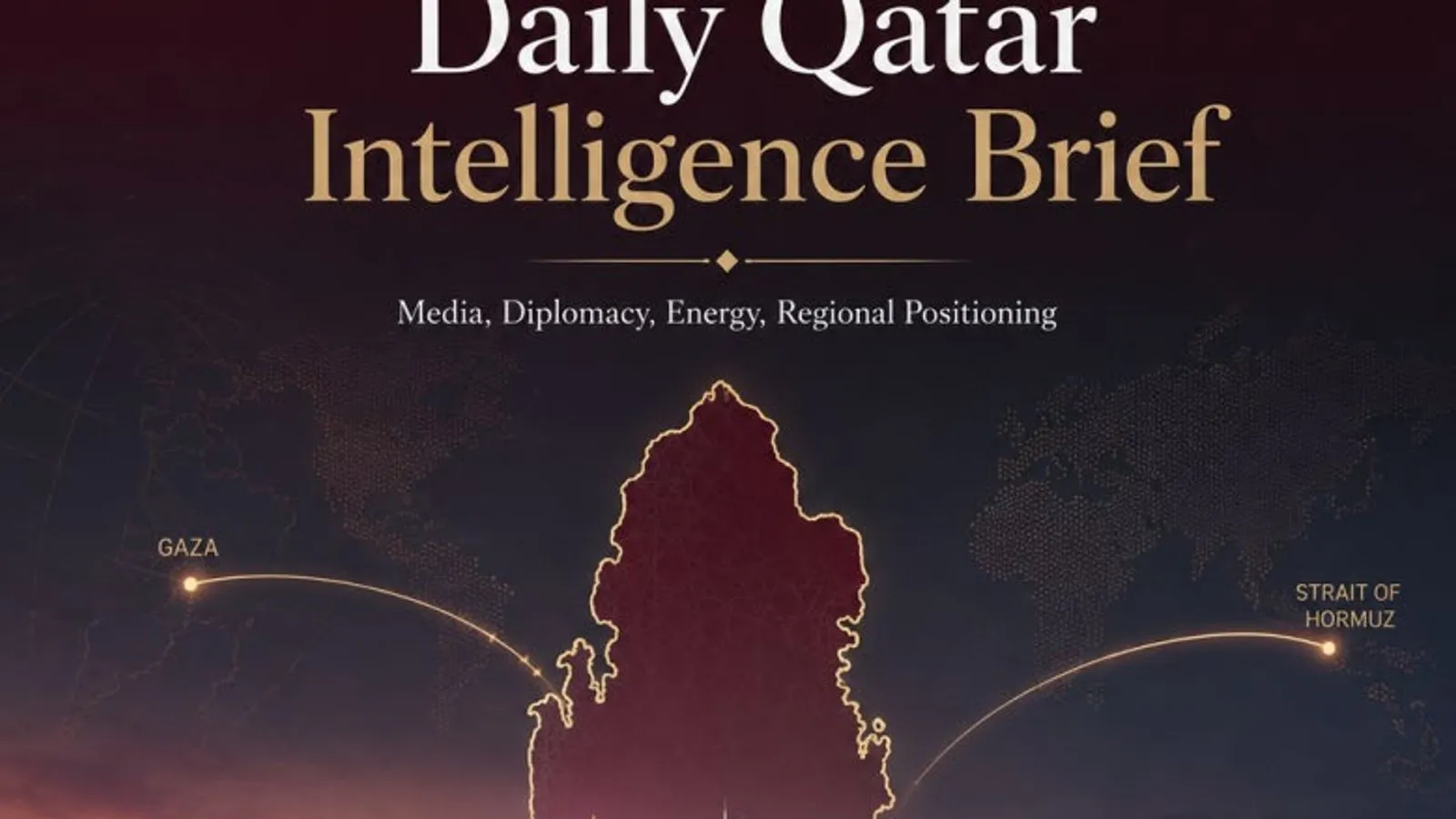
Legal Responsibility and the Basing Doctrine
The Qatar News Agency and Foreign Ministry statement of September 3 condemned the renewed Iranian attacks on Kuwait in the strongest terms, described them as a violation of Kuwaiti sovereignty and of international law, and stated that Iran bears full legal responsibility for the attacks and their consequences. The statement still calls for dialogue and de-escalation. What has changed is that Doha no longer avoids naming Iran as the responsible party when Gulf territory is hit. The domestic press carried the language without hedging. Al-Sharq and Al-Arab ran the statement within hours and preserved the direct attribution, Qatar Tribune reproduced it in its front section, and Gulf Times placed it on the September 4 front page below a lead on the Amir’s engagement with Uzbekistan. None of these items presented the U.S. military presence as a mitigating factor or blamed Washington for Kuwait’s exposure. Al-Watan’s regional section treated the attacks as a widening Gulf-security problem in agency-style coverage, carrying Iranian claims about control of Hormuz alongside reports of strikes on bases used by the United States.
The Peninsula’s formal editorial of September 4, which declares full solidarity with Kuwait, is the most important English-language Qatari editorial of the cycle because it goes one step beyond the official text. It supports the condemnation, calls the U.S.-Iran confrontation dangerous, and rejects the proposition that U.S. military facilities in Gulf states make those states legitimate Iranian targets. In its reading the United States is a treaty and security presence, and hosting it does not void the sovereignty of the host. The report judges that this is the doctrine Doha most needs the region to accept. Qatar hosts a major U.S. military presence, and that presence is central to its security architecture. A regional narrative in which U.S.-linked infrastructure turns Gulf states into lawful battlefields would erode Qatar’s deterrence model directly. The objective is therefore dual. Doha wants to keep the U.S. security relationship and to stop Tehran from normalizing a targeting doctrine that would make Qatar’s own territory a lawful target. That is why the same week can hold a condemnation of Iranian attacks, a defense of host-state sovereignty, and a renewed call for negotiations without contradiction.
The step from yesterday is incremental but real. In the September 3 edition Doha assigned Iran legal responsibility for attacks on Jordan, Bahrain, and Kuwait and for the strike on the Saudi tanker SIDR. Today the attribution is repeated for the renewed Kuwait wave and, through The Peninsula, extended to the legal status of the bases themselves. The balance Doha struck on September 1, when it condemned Iranian attacks without assigning legal responsibility, now looks like the starting point of a trajectory rather than a settled position. The military sequence behind the Kuwait statement, including Iran’s claimed strikes on Ahmad al-Jaber Air Base and the Kuwaiti interceptions, is covered in today’s Hormuz-axis daily.
Gaza Through Hospitals and Headlines
Qatari activity on Gaza ran through humanitarian infrastructure and media rather than through new mediation. Al-Sharq reported on the morning of September 4 that a UN humanitarian delegation had visited the Hamad Hospital in Gaza, which the Qatar Fund for Development supports, to assess shortages in prosthetic materials, cochlear implants and hearing devices, medical equipment, generators, spare parts, and fuel-related supplies. Gaza appears in the item through deprivation and crossing restrictions, and Qatar appears as an embedded service provider with institutional continuity. No comparably significant new Qatari mediation step was identified in the window. The report’s assessment is that welfare assets of this kind sustain Qatari relevance between diplomatic rounds. Medical infrastructure creates durable relationships with patients, local administrators, UN officials, and future reconstruction mechanisms, and it keeps Qatar in the room when the mediation channel is quiet. The two Al-Sharq guest columns of the day worked the same ground from different directions. Jassim Al-Malki, a former deputy chairman of the Central Municipal Council, turned Gaza hunger into a personal moral obligation and called for donations through trusted relief bodies. Ahmad Qadidi, a Tunisian former diplomat and regular columnist, celebrated Qatar’s identity as a mediator that keeps pursuing de-escalation after setbacks. Some of the episodes he cites predate the window, so the column is baseline narrative rather than news.
The Israel file was worked hardest in the Qatar-funded media layer. Al-Araby Al-Jadeed, the London paper funded through Fadaat Media and led by Azmi Bishara, gave the politics section of its September 4 print edition to a two-page treatment of National Security Minister Itamar Ben-Gvir’s plan to move about 1.86 million Palestinians out of Gaza. The report by Ahmad Abu Qamar in Gaza and Nayef Zeidani in Haifa presented the plan as staged, with roughly 250,000 people in the first year, 1.31 million within three years, and 1.86 million within seven, and it traced the idea to President Trump’s January 2025 proposal involving Egypt and Jordan and to earlier Israeli advocacy of voluntary emigration. The paper framed displacement as state ideology dating to 1948 with Ben-Gvir as its current electoral vehicle, placed the Gaza Health Ministry’s cumulative toll of 73,470 killed in a stat box at the top of the page, and anchored the spread with a photograph of a displaced family. Hamas does not appear as an actor in the legible text. The facing page carried a West Bank report on settler attacks on Burqa and al-Mughayyir and a piece on the dispute over diaspora representation in the Palestinian National Council ahead of elections called for November, a field in which Qatar-linked and Brotherhood-linked bodies compete with Fatah structures. Al Jazeera English ran the same Ben-Gvir plan as formal news on September 3, alongside reported deaths in Gaza, under a genocidal-war frame and with the word ceasefire in quotation marks. The convergence is the finding. The two Qatar-funded outlets treated the plan as policy rather than campaign noise on the same day, and Israel’s election campaign is being presented to Arab audiences as a displacement referendum.
The digital opinion cycle was more varied than the print lead. Nasser al-Sahli argued that Western democracies reward extreme Israeli rhetoric while demanding Palestinian moderation. Editor-in-chief Ma’an al-Bayari attacked Tony Blair’s role in a Trump-led postwar governance model as colonial engineering of Palestinian identity, and Wael Qandil warned that a Trump-led Board of Peace model could migrate from Gaza to Lebanon if UN mechanisms there are weakened. Ahmad al-Jundi used Netanyahu’s super-Sparta imagery to argue that Israel is moving toward permanent militarization. The most notable item was internal. Osama Abu Irshaid, executive director of American Muslims for Palestine, argued that Palestinian politics faces systemic collapse and criticized Hamas, the Palestinian Authority, and the other factions for failing to adjust, describing Hamas as a damaged actor whose denial is part of the crisis. The outlet’s morning mix therefore included criticism of Hamas as well as of Israel. The report’s assessment is that the state is holding its Gaza position in reserve while the Iran file is hot and the media ecosystem carries the argument, the pattern we described yesterday. No new Qatari state initiative against Israel beyond diplomacy, media amplification, and humanitarian presence was identified in the window.
The IUMS Map: A Doha-Based Body Gets North American Names
The window’s main external development is the Jewish Onliner investigation published on September 3, which names individuals in the United States and Canada identified as members of the International Union of Muslim Scholars. The union is headquartered in Doha, was founded by Yusuf al-Qaradawi, and was described in written testimony at the Senate Judiciary subcommittee hearing of August 5 as the Muslim Brotherhood’s transnational scholarly authority. Its president, Ali al-Qaradaghi, told Al-Sharq in February 2025 that Qatar and Turkey are the union’s biggest supporters and funders. The named individuals include Yasir Qadhi of Plano, Texas, who chairs the Fiqh Council of North America; Suhaib Webb in Washington; Zaid Barzinji of the Maqasid Institute in Nashville; Ibrahim Kamel of the Islamic Center of Southern California; Jamal Badawi of Halifax, a co-founder of the Islamic Society of North America who is listed as a union trustee; Mohamed Rida Beshir and Wael Shehab in Canada; and Jasser Auda, a founding board member now listed as residing in Malaysia. The identifications rest on self-identification, institutional biographies, and union-linked publications, several of them archived. The piece also connects several of the named individuals to institutions listed in the Brotherhood’s 1991 explanatory memorandum, records that Badawi was named an unindicted co-conspirator in the Holy Land Foundation case, and notes that Saudi Arabia, the UAE, Bahrain, and Egypt listed the union as a terrorist organization in 2017.
The investigation ties the named individuals to the union’s rulings on Israel. It cites the August 2020 Palestine fatwa that declared normalization forbidden and jihad for liberation a consensus obligation, which listed Badawi and Auda as trustees, the October 2023 ruling declaring military intervention in Gaza an obligation for Muslim governments, and the March 2025 fatwa calling for jihad against Israel and for the supply of weapons, intelligence, and money to fighters. The timing is not accidental. On August 29 in Istanbul, at the opening of the Turkish office of the Al-Quds International Institution, al-Qaradaghi said that Mamdani and El-Sayed would not have reached where they did without the October 7 attack, and he counted their outcomes “among the blessings of the Al-Aqsa Flood.” The U.S. Treasury lists the Al-Quds International Foundation as Hamas-controlled and called it a sham charity in 2024, and it designated the Egyptian Brotherhood in January 2026 for material support to Hamas.
The report is careful about evidentiary weight. Jewish Onliner is an advocacy outlet, and its membership claims should be treated as leads for verification rather than adjudicated fact. Confidence is moderate to high that the named individuals have been publicly described as union members in the cited sources, and lower on current membership status, because the union publishes no roster. The policy significance does not depend on that distinction. The piece converts a Doha-based institution into a named North American network at a moment when the Senate has already taken testimony on the union, the House has passed H.R. 4795 on university boycotts of Israel, and Treasury has designated Brotherhood branches. Two earlier Jewish Onliner investigations were cited in written testimony at the August 5 hearing chaired by Senator Ted Cruz, so the outlet has an established channel into the congressional record. The report expects the next moves to be congressional letters seeking Foreign Agents Registration Act and Section 117 reviews of institutions associated with the named individuals, and pressure on Qatar to distance itself from the union. H.R. 4795 is not a Qatar measure. It targets institutional boycotts of Israel by universities in federal programs. Its relevance is the environment it creates, in which Qatar’s academic relationships and foreign-funding disclosures are already contested and a congressional shift toward conditioning federal support on Israel-related campus conduct raises the political cost of any perceived link between foreign money and anti-Israel activism. The House committee presents the bill as anti-discrimination, and Al Jazeera and Al-Araby present it as an attack on free speech. Qatari media had not responded to the investigation by the cut-off. Al-Sharq’s continued platforming of al-Qaradaghi is the domestic indicator to watch. We traced the Senate stage of this file in Hidden in Plain Sight and the campus-money exchange with Ambassador Huckabee in yesterday’s edition.
The Al Jazeera Barometer and the Turkey File
No new Qatar-Turkey bilateral step was identified after the cut-off of September 3, but the relationship stayed prominent in Qatar-based analysis. Al Jazeera Arabic’s staff analysis of September 4, drawing on an Al Jazeera Centre for Studies position paper, asked why Israeli concern about Turkey is increasing. It answered that Israel is worried by Turkey’s expanding security role in Syria and its wider regional ties, reads Israeli action in Syria partly as signaling against Turkish entrenchment, and sets emerging Turkey-Pakistan-Saudi alignments against Israel’s partnerships with India, Greece, and Cyprus. This is research and media analysis rather than Qatari policy, but the report treats it as narrative reinforcement. A Qatar-based media ecosystem increasingly reads Israel’s posture through competition with Turkey and not only through the Iran-Israel axis, and al-Qaradaghi’s Istanbul speech adds a Brotherhood-network layer to the Doha-Ankara link. The Israeli side of that competition, including the Greek air-defense deal, is covered in this week’s Turkey Watch.
The rest of the Arabic output was more ideologically expansive than the English. Pascal Boniface, the French political scientist, argued in a guest opinion that Trump’s economic war on Iran and reliance on secondary sanctions collide with Chinese energy and strategic interests, making Chinese submission unlikely and accelerating relative U.S. decline. Ahmad al-Hila argued that Netanyahu may face a challenge from his own right as the electoral field fragments. Boundary items carrying the September 3 date included a Kuwaiti commentator’s argument that sanctions weaken Tehran only when paired with sustained pressure on oil revenue, foreign exchange, and maritime activity, a blog on Gulf investment in artificial intelligence as the next generation of influence spending, and blogs on settler accountability and on free speech for pro-Palestinian activism in the Trump era. Al Jazeera English was more institutional and policy-economic. Its most Qatar-relevant signed piece, by Sultan Barakat of Hamad Bin Khalifa University, argued that prolonged Gulf insecurity structurally benefits U.S. LNG exporters while weakening Gulf suppliers, and that each unavailable Qatari cargo can create a durable opening for U.S. supply. Its formal news still used the genocidal-war frame for Gaza, and Ali Harb’s report on H.R. 4795 foregrounded critics who say the bill suppresses expression while carrying the sponsors’ anti-discrimination rationale. All of the opinion items are signed guest contributions, so they show what the network chooses to host rather than its formal editorial position.
High Prices, Stranded Cargoes: The Wartime Economy
The binding constraint on Qatar’s revenue is physical, not price. Reuters counted four commodity vessels through Hormuz on September 3 against a ten-day average of 15 and a far higher prewar baseline. Brent traded at 96.20 dollars on September 3 and WTI at 91.86 after the Iranian missile fire on Kuwait, and Brent eased toward 95 by the close, with prices up more than 7 percent on the week. Asian spot LNG reached a five-month high this week and European benchmark gas a three-and-a-half-year high. None of this reaches Qatar’s cash receipts while cargoes cannot lift, because a cargo that cannot leave does not earn the scarcity premium. The baselines from outside the window quantify the damage. Reuters estimated on August 26 that Qatari LNG exports had fallen 96 percent, with 18 cargoes against 509 in the comparison period and about 24 billion dollars in foregone gas-sales revenue, the arithmetic we set out in The Broker’s Balance Sheet. QatarEnergy has extended force majeure to Italy’s Edison, canceling five more cargoes through early November and bringing canceled deliveries to 29, or about 3.8 billion cubic meters. Cancellations to Pakistan run into October and to Bangladesh beyond September. Rare ship-to-ship transfers of Qatari and Emirati LNG outside the strait show exporters testing costly workarounds.
The macro picture is mixed. The Qatar Stock Exchange gained about 0.1 percent on September 3 with no sign of panic, while first-quarter GDP fell 7 percent year on year on lower energy output. Markets can stay liquid while the hydrocarbon income shock accumulates underneath. The report’s reading of the policy implications is unchanged from earlier editions. Qatar’s fiscal and sovereign-wealth buffers mean a temporary shock does not stop it from funding foreign policy or influence tools. The cost is cumulative, however. Every month of lost or delayed LNG sales raises the pressure to prioritize core obligations, export reliability, and customer relationships. Humanitarian programs, global investment, education partnerships, media spending, and diplomatic activism stay financeable but grow more expensive relative to foregone income. The second-order risk is market share. Buyers replacing Qatari cargoes with U.S. LNG may keep those relationships after the disruption ends, which is the point of Barakat’s Al Jazeera English essay. Confidence is high on the direction of the revenue loss and moderate on its magnitude, since QatarEnergy publishes no realized cargo prices and most of its LNG is sold under long-term contracts.
Key Points
- Qatar now assigns Iran full legal responsibility for attacks on Gulf states while still advocating dialogue. The September 3 statement marks a harder sovereignty doctrine alongside continued mediation (high confidence on the position, moderate to high on the assessment that the hardening will hold).
- The Qatari English-language editorial line rejects the argument that U.S. bases make host states legitimate Iranian targets. It is an editorial rather than a communique, but it aligns with the state’s interest in protecting the U.S. basing model (high confidence).
- Qatar’s Gaza presence in the window ran through Qatar Fund for Development medical infrastructure and Qatar-funded media rather than mediation. No new state initiative was identified (high confidence).
- Al-Araby Al-Jadeed and Al Jazeera English converged on the Ben-Gvir displacement plan as policy, and Israel’s election campaign is being presented to Arab audiences as a displacement referendum (high confidence on the content, moderate on the assessment).
- The Jewish Onliner investigation ties a Doha-based body to named U.S. and Canadian institutions at a moment when Congress and Treasury are already engaged. The identifications are documented but rest on an advocacy source, and current membership status is unverified (moderate to high confidence on the documentary basis, lower on current status).
- Qatar’s LNG revenue loss is driven by physical export constraint rather than by price, and the cost is cumulative (high confidence on direction, moderate on magnitude).
- No new Qatar-Turkey bilateral initiative was identified. Media signaling continues to cast Ankara as a regional counterweight to Israel (high confidence).
What to Watch
- Whether Qatar keeps using explicit legal-responsibility language toward Iran, or returns to neutral mediator vocabulary once attacks on Gulf states subside.
- Whether Doha or the Gulf Cooperation Council formalizes the doctrine that U.S. facilities do not make Gulf hosts legitimate targets.
- Whether any Qatari official, Al-Sharq, or Al Jazeera responds to the Jewish Onliner map of IUMS members, and whether al-Qaradaghi is again given a Qatari platform.
- Whether members of Congress request FARA, Section 117, or IRS reviews tied to institutions associated with the named individuals, and whether Qatar is named in those requests.
- Whether Al-Araby Al-Jadeed and Al Jazeera sustain the Ben-Gvir displacement plan as a running frame for the Israeli election campaign.
- Whether the Qatar Fund for Development, the Qatari Committee for the Reconstruction of Gaza, or Qatari charities announce new Gaza packages after the Hamad Hospital visit.
- Whether a fresh Qatar-Turkey diplomatic or security initiative follows the media focus on Israeli-Turkish competition.
- Whether QatarEnergy extends or lifts force-majeure notices, and whether Qatari cargoes exiting Hormuz begin to recover.
- Whether ship-to-ship LNG transfers become scalable or stay an emergency workaround, and whether Asian and European buyers lock in U.S. supply.
- Whether H.R. 4795 advances, and whether Qatar-funded or Qatar-partnered U.S. universities become specific targets of congressional or antisemitism-related scrutiny.
This post summarizes the Iran Dossier Qatar Watch report for September 4, 2026, covering the hard reporting window from 10:30 on September 3 to 10:30 on September 4 Doha time. Sources include the Qatar News Agency and Foreign Ministry statement, Al-Sharq, Al-Arab, Al-Watan, The Peninsula, Gulf Times, Qatar Tribune, Al-Araby Al-Jadeed in print and online, and Al Jazeera Arabic and English, with external material from Reuters, CNBC, Trading Economics, Euronews, OilPrice, Jewish Onliner, the Senate Judiciary Committee’s written testimony, MEMRI, the U.S. Treasury, the House Committee on Education and the Workforce, and the George Washington University Program on Extremism. The report’s confidence grading is preserved here: high on official Qatari positions, Qatari press publication and framing, the Hamad Hospital report, the Al-Araby print content as legible on the page, the current Hormuz shipping signal, and the House action; moderate to high on the assessment that Qatar is hardening its sovereignty language while preserving mediation; moderate to high on the documentary basis of the IUMS membership identifications and lower on current membership status, since the union publishes no roster and the investigating outlet is an advocacy publication; and moderate on near-term fiscal loss, because QatarEnergy does not publish realized cargo prices and most of its LNG is sold under long-term contracts. Timing confidence is lower for the Al Jazeera items that carry only a September 3 date.