Power Plants and Tanker Shuttles: Doha Pairs Economic Statecraft With a Firmer Gulf Alignment
Doha is pairing economic statecraft with a firmer alignment with its Gulf neighbors. In Beirut on October 16, Qatar offered to finance, build, and operate a rebuilt Lebanese power sector while pressing for an Israeli withdrawal from the south. At the UN Security Council the same day, it condemned Iranian attacks on Qatar and declared Saudi security part of its own. Both moves raise Qatar’s value to Washington and Riyadh. They also narrow its room for maneuver with Tehran, although the mediation channel between the United States and Iran remains open for now.
Lebanon: From Political Support to a Financed Stake
Prime Minister and Foreign Minister Sheikh Mohammed bin Abdulrahman Al Thani closed his Beirut visit with two sessions with Prime Minister Nawaf Salam at the Grand Serail. At the joint press conference, Salam said Qatar will finance, build, and operate a project to rehabilitate Lebanon’s power generation under a build-operate-transfer (BOT) model, at no upfront cost to the Lebanese treasury. According to Al-Araby Al-Jadeed, he described an integrated scheme covering several generation sources and the supporting grid. QatarEnergy and TotalEnergies agreed to develop a solar plant as a first step, and Lebanon’s National News Agency reported that the talks also covered gas supplies. Sheikh Mohammed said the project would benefit both the Lebanese economy and the participating Qatari entities.
The offer builds on the $434.25 million package Qatar announced in January through the Qatar Fund for Development, which included up to $400 million for the energy sector. Our previous brief noted that the visit’s opening meetings produced no figures. That remains largely true. Capacity, tariffs, the length of the concession, any sovereign guarantee, and a signing date have not been announced.
The report assesses that the reference to participating Qatari entities signals a commercial structure with expected returns. That model suits a Lebanese state with no money to contribute, and it would give Doha a long-term presence in the ministries, the regulator, and the grid. The project should be tracked by signed agreements and construction milestones.
On security, Sheikh Mohammed called for implementation of Resolution 1701 by all parties, a full Israeli withdrawal, and handover of the south to the Lebanese army. He said Qatar will work with the United States to rebuild the south so that displaced residents can return. At the Security Council, Qatar rejected Israeli statements about annexing parts of southern Lebanon, urged compliance with the 1974 Israel-Syria disengagement agreement, and welcomed Washington’s removal of Syria from the state-sponsors-of-terrorism list. The report judges that Doha is running one policy on both northern fronts. It backs recognized state authority in Beirut and Damascus, opposes Israeli-held ground, and brings Gulf capital in behind stabilization. Because southern reconstruction is tied to coordination with Washington, Qatari money will follow whatever security arrangements the U.S.-mediated Lebanon-Israel track produces.
Gaza: Backing the Trump Plan’s Second Phase
At the Security Council’s quarterly open debate, Permanent Representative Sheikha Alya Ahmed bin Saif Al Thani said Qatar continues to work with the United States, Egypt, and Turkey on the ceasefire. She called for full implementation of President Trump’s plan, as endorsed by Resolution 2803, including its second-phase roadmap. She also rejected any forced displacement of Palestinians, condemned settler incursions into Al-Aqsa, denounced the E1 settlement plan, and restated support for a Palestinian state on the 1967 lines.
The second phase ties a gradual Israeli withdrawal to an inventory of heavy weapons under the Palestinian National Committee. Hamas links disarmament to withdrawal, while Israel insists on disarmament first. Qatar’s fuel grant of 1.3 million liters was confirmed delivered on October 6, and Doha has announced no further shipment or new initiative on the crossings since. The report judges that Qatar needs the Trump process to survive because it guarantees Doha’s access to the White House. Qatar uses that access to press for humanitarian entry and reconstruction while keeping its criticism of Israeli settlement policy.
Iran: A Mediator Moving Toward the Gulf Camp
Qatar’s UN statement condemned Iranian attacks on Qatar and its neighbors and called for full compliance with Resolution 2817. It rejected the use of the Strait of Hormuz as political leverage and demanded that the strait reopen without conditions. In the same statement, Doha confirmed that it continues to mediate between Washington and Tehran and supports Pakistan’s parallel effort. The statement applied the line the emir set in his October 13 address to the Shura Council, which our October 14 brief covered.
Public positions are hardening on both sides. President Trump told Newsmax on October 15 that Washington is weighing a strike on the underground site Iran is reportedly building at Pickaxe Mountain. He ruled out U.S. ground troops and predicted the war would end soon. Al-Araby Al-Jadeed’s Tehran correspondent paired those remarks with Iranian threats to force U.S. naval units out of the Gulf. Iran’s side of the same day is covered in our Hormuz-axis update.
The report assesses that Doha now stands openly closer to the Gulf camp. This position helps Qatar with Riyadh and with the Gulf capitals most exposed to the disruption. However, it also gives Tehran grounds to question Qatar’s neutrality and to lean harder on Pakistan or Oman as channels. Iran still needs a Gulf interlocutor with access to the White House, so the Qatari channel survives for now. A Qatari statement naming Iran as responsible for the Houthi strikes on Saudi airports would signal that the channel has broken.
Yemen and Saudi Security
A Security Council presidential statement condemned Houthi attacks on civilians, airports, and energy facilities in Saudi Arabia and affirmed the kingdom’s right of self-defense. Qatar’s ambassador told the Council that “Saudi Arabia’s security is an integral part of Qatar’s security.”
Al-Araby Al-Jadeed led its October 17 front page with the Houthis widening their target list inside Saudi Arabia, with intercepts reported over Riyadh, Yanbu, and the Eastern Province. The paper also reports that government forces reached the area between Majzar and Raghwan, north of Marib, for the first time since 2021, and that heavy fighting continues around Taiz. These are claims by parties to the fighting and have not been independently confirmed. Pakistani troops are in Saudi Arabia under the Mecca defense pact, while Turkey’s participation still awaits ratification in Ankara. Open reporting continues to show no evidence of Qatari funding for either deployment, and Qatar is not a party to the pact.
The report judges that Qatar’s condemnation strengthens its Gulf positioning without amounting to participation in an offensive campaign. Its immediate interests are ports, aviation, energy assets, and confidence in maritime insurance. Further deterioration around Bab el-Mandeb would compound the Hormuz disruption to Qatar’s shipping lanes.
The War Economy: Keeping LNG Moving
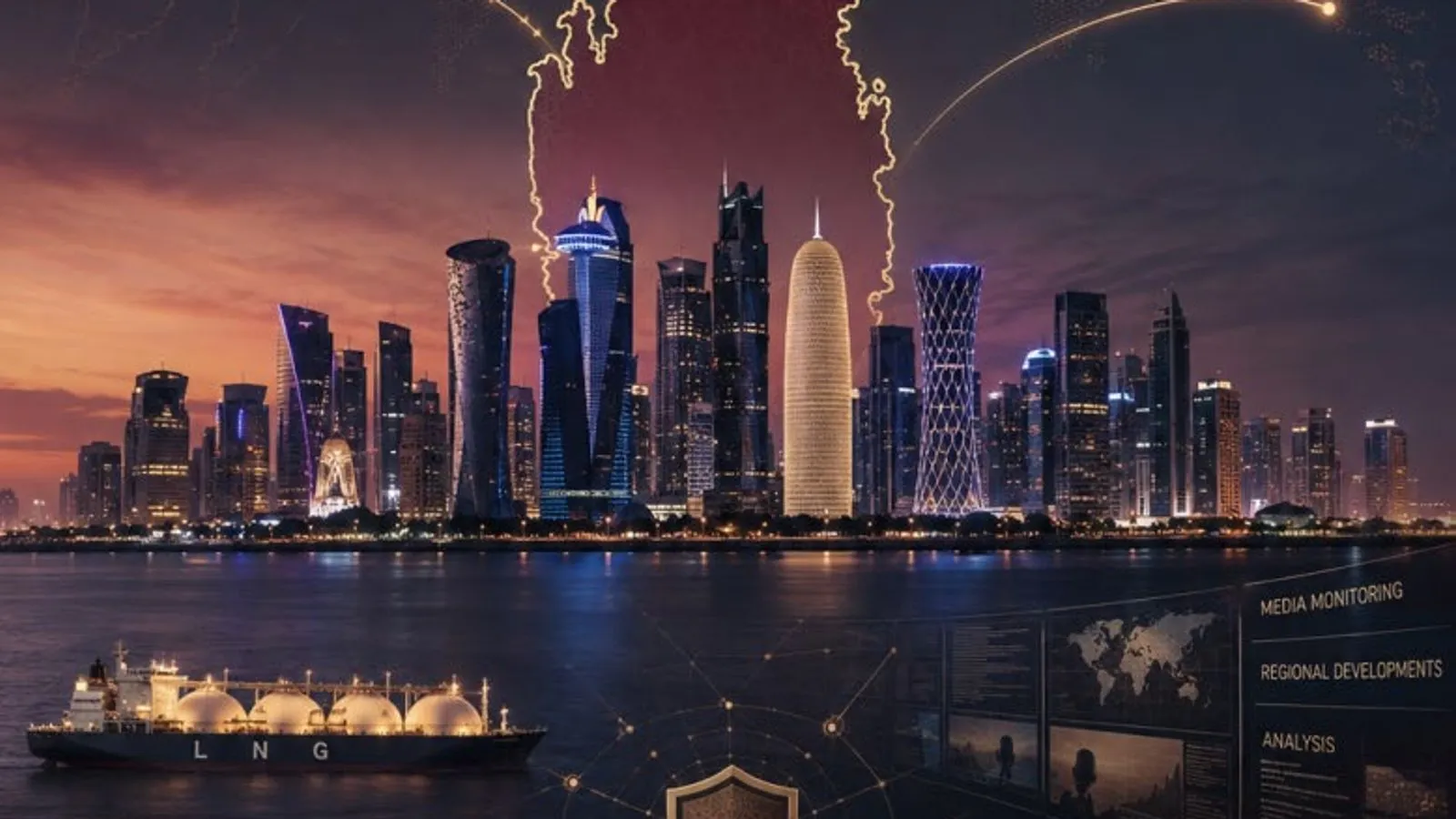
Qatar’s revenue loss comes from lost volume. A Bloomberg investigation published October 14 describes how QatarEnergy rebuilt its export chain under fire. Laden tankers cross Hormuz, often with lights and transponders off, and transfer their cargo to other vessels in the Gulf of Oman. Qatar recalled older leased-out tankers because they are cheaper to insure, chartered third-party ships at rates reported at about ten times the market, and recruited Indonesian crews at double or triple normal pay. About 20 tankers carrying Qatari LNG left the strait in the four weeks after the first crossing in early September, although transits slowed after an attack on a QatarEnergy-linked tanker. Deliveries reached about a third of pre-war levels by late September, and each week without normal exports costs roughly $1 billion.
Qatar is also trading its way around the blockade. QatarEnergy Trading is on track to handle more than 15 million tonnes this year, up from about 10 million in mid-2025. It is sourcing cargoes from Golden Pass in Texas, a plant largely owned by QatarEnergy, and is in advanced talks with Louisiana and Texas projects on multi-year supply. The report assesses that Doha is turning QatarEnergy from a single-site producer into a portfolio trader with a growing U.S. supply base. That shift protects customer relationships and deepens Qatar’s commercial footprint in the American energy sector. It does not replace the revenue lost at Ras Laffan, where two of 14 trains were damaged in March.
Higher prices are not translating into equal net receipts. Brent settled at $109.86 a barrel on October 16, up 4.9 percent on the week, and WTI at $101.41. At the same time, Al-Araby Al-Jadeed reports that Gulf producers, Qatar included, are under pressure to discount cargoes as war-risk insurance reaches 7.5 to 10 percent of a vessel’s value. The insurance and crew-pay figures are secondhand estimates. Unlike Saudi Arabia and the UAE, which can reroute crude through Yanbu and Fujairah, Qatar has no pipeline bypass for LNG. The IMF projects that Qatar’s economy will contract 15.6 percent this year.
In Bangkok, Finance Minister Ali bin Ahmed Al Kuwari urged the World Bank, Gulf donors, and the Arab Coordination Group to coordinate reconstruction financing for Syria, Lebanon, and Gaza. He also stressed private-capital mobilization and investment in AI and digital skills. Doha will host the World Investment Forum with UNCTAD on October 25 to 27, and announcements there will need checking against signed financing.
Media: Two Registers on American Power
Official Qatari media keep a cooperative register. QNA’s coverage of Beirut and the UN presents Qatar as a defender of international law that mediates and stands with its Gulf partners, and it stresses coordination with Washington on Lebanon and Gaza. The Peninsula and Gulf Times carried no criticism of U.S. policy.
The Qatari-funded outlets read American power differently. Al Jazeera Arabic’s opinion pages this cycle hosted Mark Pfeifle, a former deputy national security adviser under President George W. Bush, who urged Trump not to leave Saudi Arabia to fight the Houthis alone. Alongside him, Arab guest writers described the conflict as an American war on Iran and portrayed U.S. protection as a paid service. Across the set, the U.S. military presence appears necessary for Gulf security and unreliable in practice. Al-Araby Al-Jadeed’s October 17 edition treated Trump negatively throughout. It presented Washington as steering Israel’s post-election coalition toward a unity government that could deliver Saudi normalization, and its online cartoon showed Netanyahu setting olive groves alight. The paper’s coverage of the Qatari prime minister in Beirut, by contrast, was detailed and sympathetic.
The report assesses that the division of labor holds. QNA and the English-language dailies speak for the state and keep the U.S. partnership intact, while Al-Araby Al-Jadeed and Al Jazeera’s opinion pages carry the criticism. Neither outlet’s editorial line should be read as Qatari government policy, and alignment on selected themes does not establish central editorial control.
Washington, Soft Power, and Labor
No U.S. official commented on Qatar on October 16 or 17. Trump’s defense of the Qatari 747 at his October 14 Arizona rally remains the latest presidential remark. The Section 117 file is unchanged. Judge Chutkan’s restraining order runs to October 29, the AAU’s reply is due October 20, and there has been no fresh Qatari response to the allegations. Our Section 117 special report explains the order. Katara awarded its 12th Prize for the Arabic Novel on October 15 after a record 2,610 submissions, although the ceremony was scaled back. The prize keeps Doha at the center of Arab literary life on a wartime budget.
The war has opened a maritime labor issue. Bloomberg reports that Qatar recruited Indonesian crews for the Hormuz runs after the Philippines resisted sending its seafarers, and Manila has allowed Filipino crew to refuse deployment to war-risk areas since March. Crew safety on dark transits through a mined strait is a likely source of future complaints. No new Qatar-specific rights report or enforcement figure appeared in the reporting window, which does not mean long-standing concerns about migrant workers have been resolved.
Key Points
- Qatar is turning political support for Lebanon into a financed stake in its power sector, but delivery depends on terms that have not been published (moderate confidence).
- Qatar backs the second-phase roadmap of the Trump plan for Gaza while maintaining its criticism of Israeli settlement policy, and it has announced no new initiative on the crossings or reconstruction (high confidence).
- Doha has moved closer to Riyadh while keeping its channel to Tehran open. A demand for exclusivity from either Washington or Tehran would narrow its mediating room (high confidence).
- Government advances near Marib and Houthi strikes on Saudi targets raise the risk to Red Sea shipping. Battlefield claims come from parties to the fighting, and there is still no evidence of Qatari funding for the Turkish or Pakistani deployments (moderate confidence).
- QatarEnergy is becoming a portfolio trader with a growing U.S. supply base, keeping about a third of pre-war deliveries moving at high cost (high confidence).
- Qatari-funded outlets portray U.S. power as erratic and transactional, while official Qatari media keep a cooperative register (high confidence).
What to Watch
- A signed Qatar-Lebanon electricity agreement, with its capacity, BOT terms, tariffs, and treasury exposure, and the shape of U.S.-Qatari coordination on southern reconstruction.
- Agreed second-phase mechanisms under Resolution 2803 and any new Qatari fuel grant or reconstruction contract for Gaza.
- Any Iranian reaction to Qatar’s condemnation at the UN and new exchanges on Hormuz through Qatari or Pakistani channels.
- The Marib and Taiz front lines, Turkish ratification of the Mecca pact, and any Gulf financing of the Turkish and Pakistani deployments.
- The weekly count of Qatari LNG transits, attacks on QatarEnergy-linked tankers, progress in U.S. LNG purchase talks, and war-risk premiums.
- The AAU’s October 20 filing, any extension of the restraining order before October 29, and remarks on Qatar during the midterm campaign.
- Deals at the October 25 to 27 World Investment Forum, separating signed financing from memoranda.
- Complaints from Indonesian or Filipino crews on Qatari LNG carriers.
This post summarizes the Qatar Watch daily intelligence brief for October 17, 2026. The report draws on the Qatar News Agency and its UN coverage, The Peninsula and Gulf Times, Al-Raya Al-Iqtisadiya, Al Jazeera Arabic opinion and blog pages, the October 17 print edition of Al-Araby Al-Jadeed and its online cartoon of October 16, Bloomberg, Al-Monitor, EnergyNow, Gulf News, The New Arab, Philstar, UNCTAD, and AAU court filings. Yemeni battlefield claims are unverified, and the war-risk insurance and crew-pay figures are secondhand estimates. Signed opinion pieces are attributed commentary and do not set Qatari state policy. Earlier posts in the series are collected on the Qatar Watch hub.