Parallel Tracks: Doha Holds Its Hormuz Line After Salalah, Breaks Ground at Sandhurst, and Sees Florida Open a State Route to Designating the Brotherhood
Qatar’s official line did not move in the day after the postponed Salalah meeting. The prime minister’s late September 14 calls with the UAE and Turkish foreign ministers restated de-escalation, freedom of maritime navigation, and a comprehensive settlement, and both Al-Arab and the Qatar Tribune carried the calls on their front pages. The Qatar News Agency issued no new Qatari policy statement on September 15. Its morning feed carried a UAE-Kuwait call and an Omani letter to Ankara instead, which shows the Gulf consultation round continuing without Doha at its center. Doha did not use the morning after Salalah to assign blame to Tehran or Muscat, and it did not endorse an Iranian right to regulate the strait. Security and financial reach moved in parallel. The deputy prime minister and defense minister laid the foundation stone of a Qatari-funded innovation center at Sandhurst and met the chair of the House of Commons Defense Committee, while QNB Syria launched the first locally issued, internationally accepted Mastercard in Syria in more than 15 years. On the same day, Qatar-funded platforms demanded British accountability over Gaza. The war economy remains the highest-risk file. Reuters counted four commodity-vessel transits through Hormuz on Monday against about 125 a day before the war, roughly 36 million tonnes of Middle East LNG have been lost this year, and Brent traded near $107. In the United States the file moved at state level: on September 11 the Florida Cabinet approved the rule that lets the state designate CAIR and the Muslim Brotherhood as terrorist organizations. Qatar is not named, and the report judges that litigation will likely block any designation before it takes effect, so the near-term effect is narrative. This post summarizes the Qatar Watch daily intelligence review for September 15.
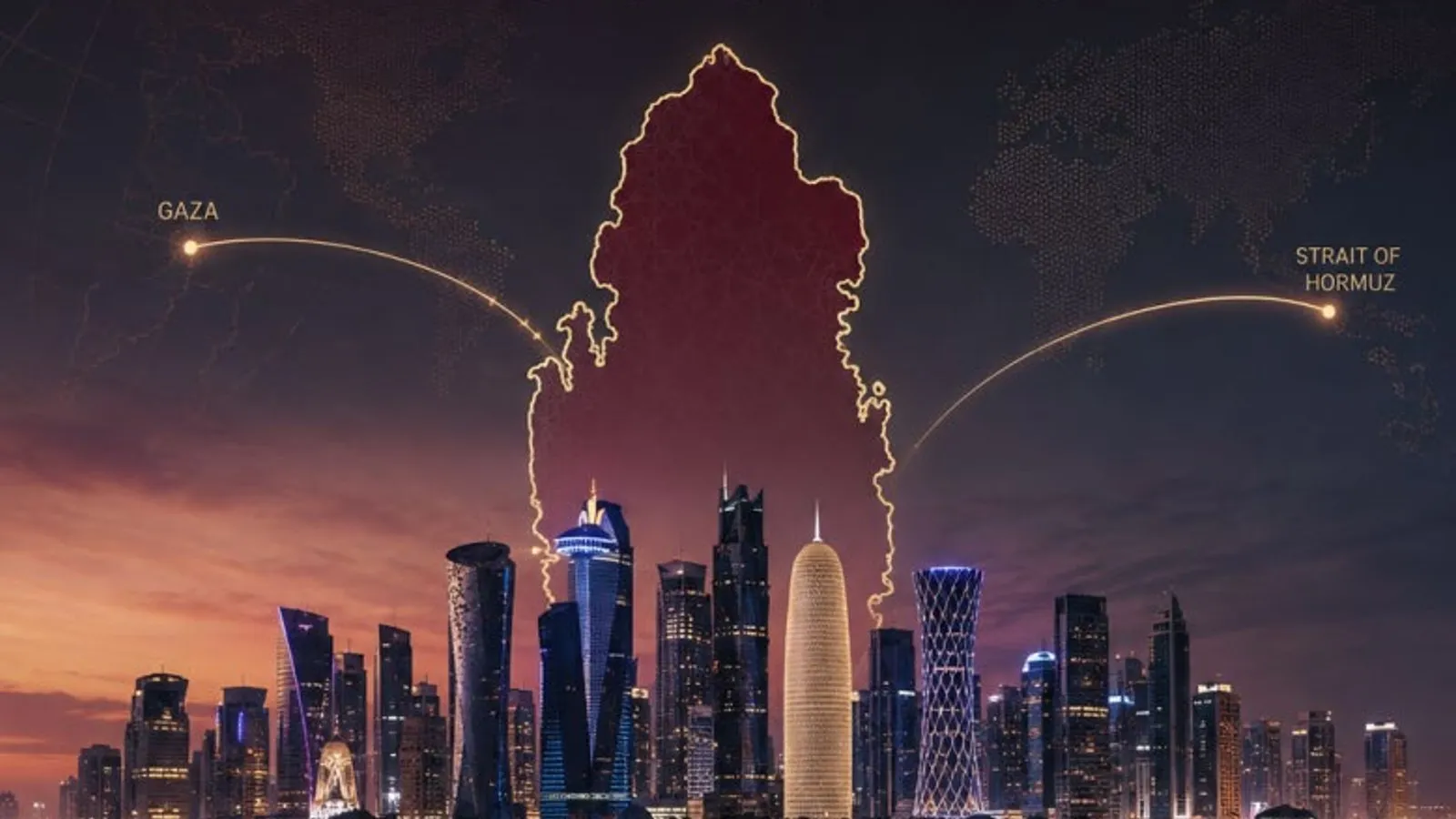
Doha’s Post-Salalah Line Holds, and the Gulf Round Moves On
The QNA policy feed carried no new Qatari foreign-policy statement on September 15. The live feed had fresh international and market items, but nothing superseded the prime minister’s late September 14 calls with the UAE and Turkish foreign ministers, which remain the official Qatari line: joint coordination, de-escalation, security and stability, freedom of navigation, and a comprehensive agreement. The report treats the absence as meaningful. Doha did not use the morning after Salalah to harden its rhetoric against Iran or Oman, and it did not endorse the Iranian-Omani navigation proposal as Tehran describes it. The same feed carried the UAE-Kuwait foreign ministers’ call and a letter from the Omani foreign minister to his Turkish counterpart, so the post-Salalah consultation round continued among Qatar’s partners on a day when Doha itself added nothing. The report’s assessment is that Qatar is trying to keep disagreement over the legal and political meaning of a new Hormuz route from killing the mediation process itself. The calls with Abu Dhabi and Ankara complement the earlier Saudi, Omani, and Kuwaiti consultations covered in Diplomacy Without Acquiescence, and they confirm the choice of bilateral consultation over public confrontation.
The domestic press followed the official cue. Al-Arab’s September 15 edition led its early coverage with the prime minister’s calls, sourced to QNA, and repeated the formula of de-escalation, maritime freedom, and a comprehensive agreement. Iran was not attacked and the Salalah postponement was not used to assign blame. Turkey appeared as a diplomatic partner, and the UAE appeared as both a Gulf security partner and a bilateral interlocutor. Al-Sharq, Al-Rayah, and Al-Watan carried no Qatar-specific item of comparable weight. The Qatar Tribune’s front page paired the same calls with its lead on the Sandhurst ceremony. The market gave a modest risk-off reading. The Qatar Exchange opened at 9,815 on September 15, down 8.51 points, with insurance, transportation, and real estate up and telecoms, consumer goods, banks, and industrials down, and turnover of QR 29.3 million by 10:00 Doha time. Reuters later put the Qatar market about 0.3 percent lower, with QNB among the drags. The report reads that as a small risk-off move and sees no sign of domestic stress. Gulf Times, by contrast, gave Qatari readers a far more severe picture of the strait than the diplomatic language of reopening. It carried Reuters data showing five commodity vessels crossing on Saturday and none on Sunday, against 31 the previous weekend, and reported that one inbound VLCC had its AIS switched off and an Indian-flagged gas carrier used the Iranian route. The report notes that this is external verification printed inside a Qatari paper, and it should not be read as official messaging.
Sandhurst and Westminster: Defense Integration Beside Editorial Hostility
The strongest evidence of the day on Qatar’s external model came from Britain. The Qatar Tribune led its September 15 front page with Deputy Prime Minister and Minister of State for Defense Affairs Sheikh Saoud bin Abdulrahman Al Thani at Sandhurst, where the foundation stone was laid for the Sheikh Tamim bin Hamad Al Thani Center for Innovation. The story emphasized training, academic qualification, and the strategic defense partnership. The Peninsula reported that Sheikh Saoud also met Tanmanjeet Singh Dhesi, chair of the House of Commons Defense Committee, to discuss the strategic military and defense partnership and regional security. The report judges this the clearest sign of the day that Qatar’s security integration with Britain is untouched by Qatar-funded media criticism of London over Gaza.
That criticism ran on the same day. Al Jazeera English published a guest opinion by Neve Gordon of Queen Mary University of London arguing that Prime Minister Andy Burnham must establish a public inquiry into British political, military, and economic support for Israel since October 2023. The piece cites Jeremy Corbyn’s proposed inquiry, testimony to a non-governmental Gaza Tribunal, arms-export licensing, F-35 components, RAF surveillance, and diplomatic support. The report records these as the author’s and the tribunal’s allegations and legal-political framing, and it does not treat them as findings. A second English opinion piece, by Tamam Abusalama, argues that left-wing Zionism is internally contradictory and uses Labor Zionism, Mapai, the Histadrut, and kibbutz history to make a structural critique. In Al-Araby Al-Jadeed’s September 15 print edition, columnist Ghazi al-Aridi treats Burnham’s harder language on Israeli policy as an overdue break with British restraint, praises pro-Palestinian mobilization, reads settlement sanctions and import restrictions as recognition of a broader dispossession policy, and argues that a sustained Britain-Israel confrontation is emerging. The report marks the column as polemical opinion that represents neither the paper’s formal line nor a Qatari government position. Its significance for Qatar Watch is the contrast with the same day’s Qatar-UK defense partnership. State-to-state defense ties and editorial hostility to British policy coexist without visible friction, and the report describes that separation as a standing feature of Qatar’s external model. Turkey sits on the diplomatic side of the same pattern: it remains a regional partner on de-escalation, and no new high-significance bilateral agreement was identified in the window.
The War Economy: Four Transits, 36 Million Tonnes, and No Bypass
The war-economy file remains the highest risk in the report, and the September 15 picture is worse than a week ago. Reuters and Kpler data show only four commodity-vessel transits through Hormuz on Monday, against ten on Sunday and about 125 a day before the war. Gulf Times had already carried the weekend collapse. The gap between a strait that is nominally open and one that is commercially normal remains the central Qatar risk variable, and the report cautions that AIS-off traffic may cause undercounting. Two other corridors deteriorated at the same time. Saudi Arabia’s East-West pipeline, the main bypass for Gulf crude, stayed shut after Friday’s drone strikes, and the Houthi seizure of Perim Island put Bab al-Mandab under threat, so both Gulf export corridors are now impaired. Brent traded near $107 and WTI near $103 at midday on September 15, a four-month high. Tehran’s reading of the same two-chokepoint shock is the subject of the day’s Economic Press Review.
The gas numbers describe a disruption that is global in scale and well beyond a Qatari scheduling problem. Reuters reports that the war has blocked Qatar and the UAE from using Hormuz normally, a route that previously carried about one-fifth of global LNG supply. Roughly 36 million tonnes of Middle East LNG have been lost this year and Asian spot prices have approached $30 per million British thermal units. Industry executives cite $7 to $9 as the sustainable range, which shows how far current spot conditions sit from demand-normalizing levels. Demand destruction is already visible: India has reportedly restored 90 to 95 percent of its gas consumption by sourcing alternatives, and executives expect Chinese and Indian demand to recover only when prices normalize. The structural baseline is unchanged from the September 11 Reuters reporting summarized in The Multilateral Test. Missile damage has sidelined about 12.8 million tonnes a year of Ras Laffan capacity, repair could take three to five years, and QatarEnergy Trading is reportedly seeking 2 to 3 million tonnes a year of U.S. LNG through 2031, which the report reads as strong evidence of portfolio hedging against a prolonged shortfall. No new public QatarEnergy force majeure change was identified, a negative indicator only, and the Qatar Central Bank took part in three GCC financial meetings in Manama, routine but useful evidence of continued Gulf institutional coordination.
Al-Araby’s economy page carried the corridor debate. The paper puts curtailed Qatari flows at about 20 percent of global LNG supply and says prices have risen roughly 25 percent since the Iran war began. Omani Energy Minister Salim al-Aufi urged producers to examine LNG export routes northward, through Oman or through Yemen, and the article cites Shell’s expectation of 4 to 5 percent annual LNG sales growth through 2030 and ExxonMobil’s view that U.S. LNG could approach 30 percent of the global market by the same year. The report’s Qatar implication is geographic. Oman has a terminal east of Hormuz. Qatar has no operational bypass of comparable value, and the Omani corridor idea remains a conference proposal with no route behind it. The assessment follows: Qatar can manage cargoes, contracts, financing, and replacement purchases, but it cannot quickly change geography. Until it has either restored full Ras Laffan capacity and routine Hormuz passage or built a credible physical bypass, war-economy constraints will limit its foreign-policy freedom of maneuver.
Florida Opens a State Route to Designation
In a vote that took under two minutes on Friday, September 11, Governor Ron DeSantis and the Florida Cabinet approved the rule that governs how the Florida Department of Law Enforcement designates domestic and foreign terrorist organizations under HB 1471, the law enacted earlier this year. FDLE Commissioner Mark Glass recommended in July that the Council on American-Islamic Relations, the Muslim Brotherhood, and Antifa be designated, alongside more than 90 foreign groups including the IRGC and the Mexican cartels. Under the rule, a designation takes effect 30 days after publication in the Florida Administrative Register, and a listed organization has seven days after notice to object in writing. The underlying law bars state agencies, political subdivisions, and school districts from spending or accepting state funds in support of a designated group, bars campus programs that promote one, and requires universities to report student-visa holders who promote a designated group, who can then be expelled. The litigation history matters. DeSantis first tried to designate CAIR and the Brotherhood by executive order in December 2025. CAIR Florida sued, and in March U.S. District Judge Mark Walker issued a preliminary injunction blocking enforcement against CAIR on First Amendment grounds, which the state appealed. In July the ACLU, the ACLU of Florida, and two other legal groups filed a second suit challenging HB 1471 itself. The rule approved on Friday is the state’s attempt to proceed under the statute instead of the enjoined order.
Qatar is not named in the rule, the law, or the recommendations, and the report is explicit about that. The relevance runs through two channels. The first is the state-level designation trend. Texas designated the Brotherhood and CAIR by gubernatorial proclamation in November 2025, and Attorney General Ken Paxton sued in February to shut CAIR’s Texas operations; Florida now has a statutory mechanism. Each state step raises the demand on Washington to extend the January federal designations beyond the Lebanese, Jordanian, and Egyptian branches, and Fox framed those designations at the time as a decision that could affect Washington’s relationships with Qatar and Turkey. The second is the CAIR-Qatar bridge already on the record. At the August 5 Senate Judiciary subcommittee hearing, retired FBI agent Lara Burns testified that CAIR’s executive director attended meetings of the Qatar-based International Union of Muslim Scholars between 2012 and at least 2022 and was received by its secretary-general, Ali al-Qaradaghi. Critics of Doha will read the Florida rule through that testimony. The report’s assessment is that the near-term effect is political, not legal. The Walker injunction and the pending ACLU challenge make it likely that any Florida designation of CAIR is enjoined before it takes effect. The rule’s value to Doha’s critics is narrative: two large states now treat the Brotherhood network as a terrorist matter, which strengthens the argument in Congress for a Qatar-specific certification requirement of the kind already drafted in earlier bills on Major Non-NATO Ally status.
The federal files produced no increment. The Education Department’s publication of foreign-source names from prior reporting cycles remains set for September 25 after the fifth postponement announced on September 11, and no new enforcement action, congressional hearing, or Qatar-specific university disclosure appeared. The Brandeis Center’s FARA referrals on Georgetown in May and on Northwestern on August 26, over $737 million from the Qatar Foundation, remain with the Justice Department without public action, and the DETERRENT Act, S. 1296, remains in committee. Ambassador Mike Huckabee has made no on-record statement on Qatar since his Republican Jewish Coalition remarks of August 31. On the cybermercenary file, no verified congressional, Commerce, Justice Department, FBI, court, or investigative-media increment followed the September 10 bipartisan letter on BellTroX, CyberRoot, and Sunkissed Organic Farms and Appin, and the allegation that these firms acted for the Qatari government remains an allegation. September 25 is the next hard date. A sixth postponement would strengthen the Brandeis Center’s case that the Department is yielding to the universities, a point the report has carried since the September 13 review.
Network Reach: A Mastercard in Damascus and a Platform in Education City
Two items extend Qatari reach through channels outside diplomacy and aid. The Peninsula reported on September 14 that QNB Syria, in collaboration with Mastercard, has issued the first locally issued, internationally accepted payment card in Syria in more than 15 years, moving from restoring international card acceptance to local issuance. The new card gives eligible Syrian customers access to international payments. The report rates this a higher-value influence indicator than investment rhetoric, because it connects Syrian consumers and businesses to global payment infrastructure through a Qatari bank. Qatari banking is becoming part of Syria’s reintegration into global payment networks, a concrete form of commercial influence. The second item is cultural. Qatar Foundation is preparing BilAraby 2026, its annual gathering for ideas and experiences from Arabic-speaking communities, scheduled for September 19 and 20 in Education City. The report treats it as an Arabic-language soft-power and convening instrument with no policy content. Neither item proves political influence on its own. Both expand durable Qatari networks beyond formal diplomacy, and the report flags financial infrastructure and Arabic cultural convening as influence channels distinct from the mediation file.
The Barometer: A Fuel Cartoon With No Actor, Lebanon Under Fire, and Washington Talking to the Houthis
The most telling editorial signal of the day is a drawing. Al-Araby Al-Jadeed’s caricature page for September 13 carries a two-panel cartoon by the Qatari cartoonist Saad Al-Muhannadi under the title band “Global Fuel Supply Shortage.” In the right panel, marked “previously,” a suited arm squeezes a green fuel nozzle and gasoline gushes into a jerrycan that is already full. In the left panel, marked “currently,” the same arm and nozzle release a single drop into the same can, which holds only a thin layer at the bottom. No flag, map, missile, ship, or strait appears. The report reads it as the first energy-crisis drawing of the week that names no actor. Emad Hajjaj’s cartoons on the same site during the week worked through named figures: his September 14 oil-tanker drawing is tagged by the outlet to Iran, America, the energy crisis, and Hormuz, and his September 10 and 11 pieces also attribute. Al-Muhannadi’s frame is different. It presents scarcity as a global condition and a consumer’s loss, with the cause left outside the picture. For a Qatari-funded paper printing a Qatari artist, the omission matters, since Qatar’s curtailed LNG exports are among the largest single components of the shortage the cartoon depicts, and official Qatar describes the cause as a war it wants ended through negotiation. The blameless frame lets the outlet register the pain of the crisis for its Arab readership without attributing it to Iran, whose position Al-Araby has been careful about, or to the war’s Western belligerents. The report carries the content at high confidence and the editorial intent at medium.
The rest of the barometer runs along familiar lines. Al Jazeera Arabic’s blog by Alaa Kanaan describes expanded Israeli checkpoints and inspections around Bethlehem and Ramallah through the author’s own travel from Hebron, frames the effect as daily-life disruption for workers, students, patients, and families, and cautions readers against both exaggeration and rumor. Israel is the actor imposing restrictions; Hamas, Iran, the United States, and the Gulf states are absent. The report notes that the usual assumption that Arabic output is automatically harsher does not hold in this sample. The Arabic checkpoint essay is practical and deliberately cautious about unverified explanations, while the two English opinion pieces on Zionism and on a British inquiry are categorical and ideological. Hamas is absent from all three, and the common denominator is a shift from Hamas-centered war coverage toward structural scrutiny of Israeli control and Western support. Al-Araby’s print edition adds three files. On page 3, it reports that the eighth Lebanon-Israel negotiating round, expected in September, has slipped to October while Israeli artillery, demolitions, and clearing operations continue across southern towns. It says Israel insists on remaining in a security belt covering dozens of communities until Hezbollah is disarmed, quotes Israel Katz putting the zone at roughly 700 square kilometers, about 7 percent of Lebanon, and reports, by contrast, Israeli public broadcasting on a limited local withdrawal from Ali al-Taher toward Beaufort. The paper frames Israel as negotiating under fire and questions U.S. mediation, while official Qatar continues to privilege negotiation and regional de-escalation. On page 4, it reports Vice President JD Vance confirming direct U.S.-Houthi talks while Washington stays in contact with Saudi Arabia, the UAE, and other affected states, and calling Houthi control of Mayyun concerning. The same report carries competing battlefield claims, including Houthi claims of strikes on King Khalid Air Base and Saudi-led strikes on Houthi positions, which the report keeps as claims. Its Qatar reading is that a direct U.S.-Houthi channel reduces Doha’s necessity as an intermediary in this subfile but supports Qatar’s broader preference for direct de-escalation as Bab al-Mandab risk spreads across the Gulf. The edition also reprints a Cartoon Movement drawing titled “The Burden of October 7” on its Britain-Israel opinion page. Tehran’s press for the same day is summarized in the Iranian Press Monitor.
Key Points
- Doha’s post-Salalah line is unchanged, and no new QNA policy statement had appeared by midday on September 15. Qatar is keeping the Omani mediation alive while adding Gulf and Turkish consultations, without endorsing Iran’s draft on the strait (high confidence).
- Qatar-UK defense integration deepened at Sandhurst on the same day Qatar-funded media escalated against London over Gaza. The two tracks run in parallel and neither constrains the other (high confidence).
- Hormuz commercial traffic is near zero, about 36 million tonnes of LNG have been lost, Asian LNG is near $30, and Brent is near $107. The exposure is structural, there is no operational bypass, and Omani corridor ideas remain conference proposals (medium-high confidence).
- The Florida Cabinet approved the terrorist-designation rule on September 11, opening the way to list CAIR and the Muslim Brotherhood. Florida joins Texas with a state mechanism, but the March federal injunction and the July ACLU suit mean the near-term effect is political, not legal, and Qatar is not named (high confidence on the fact, medium on the Qatar linkage).
- Section 117 foreign-source names are due on September 25, and no new federal increment appeared on universities, FARA, or hack-for-hire. A sixth postponement would strengthen the Brandeis Center’s case that the Department is yielding to the universities (high confidence).
- QNB Syria’s Mastercard issuance and Qatar Foundation’s BilAraby gathering extend Qatari network reach. Financial infrastructure and Arabic cultural convening are durable influence channels distinct from diplomacy (high confidence).
- Al-Araby’s Qatari cartoonist depicts global fuel scarcity with no actor named. The blameless frame diverges from Hajjaj’s actor-driven cartoons the same week and from official Qatar’s call to end the war (high confidence on content, medium on editorial intent).
What to Watch
- Any new Qatar Foreign Ministry or QNA statement on rescheduling the Salalah meeting or modifying the Iranian-Omani navigation proposal.
- Whether Doha opens direct follow-up with Tehran, Washington, or Muscat after the UAE and Turkey calls.
- Qatar-linked laden and ballast LNG tanker movements, including AIS behavior, waiting patterns, and destination changes.
- QatarEnergy confirmation of U.S. LNG purchases, volumes, suppliers, or duration through 2031; Ras Laffan repair milestones; and any change in force majeure notices.
- Whether Oman’s alternative LNG-corridor proposal becomes a formal feasibility study or remains conference rhetoric.
- Restart timing for the Saudi East-West pipeline and the effect of Houthi control of Perim on Qatar-linked shipping bound for Suez.
- Further Qatar-UK defense initiatives alongside the hardening British-Israel dispute carried by Qatar-funded media.
- QNB Syria expansion from card issuance into payments, trade finance, or reconstruction-linked banking.
- Publication of the FDLE designation notice in the Florida Administrative Register, the seven-day objection window, any emergency motion by CAIR, and whether Florida or Texas officials reference Qatar or the IUMS in the designation record.
- Whether the Education Department publishes the Section 117 foreign-source names on September 25 or postpones a sixth time, and whether Qatari intermediaries beyond the Qatar Foundation appear in the release.
- Whether Al-Araby’s cartoon strand keeps the actor-free framing of the energy crisis or returns to Hajjaj-style attribution to Iran and the United States.
This post summarizes the Qatar Watch daily intelligence review for September 15, 2026, covering the period to 12:45 PM on September 15. Primary sourcing is Qatari: the Qatar News Agency’s Arabic and English feeds for the prime minister’s calls, the UAE-Kuwait and Oman-Turkey contacts, and the Qatar Exchange opening; Al-Arab, Al-Sharq, Al-Rayah, and Al-Watan for the Arabic domestic press; the Qatar Tribune and The Peninsula for the Sandhurst ceremony, the Commons Defense Committee meeting, and the QNB Syria launch; Gulf Times for the Reuters shipping data; Qatar Foundation for BilAraby; Al Jazeera Arabic and English for the media barometer; and Al-Araby Al-Jadeed’s September 15 print edition and website for the cartoon, the Lebanon, Yemen, and gas-corridor reporting, and the opinion pages. External verification rests on Reuters and Kpler for Hormuz traffic, the LNG loss, Asian prices, and Gulf markets; Investing.com for crude benchmarks; the Florida Phoenix report carried by WLRN, the Daily Wire, the Florida House bill record, the ACLU, and the Texas Attorney General for the designation file; and the Education Department’s electronic announcement, the Brandeis Center, and the Counter Extremism Project for the federal files. The report’s evidentiary flags are preserved here. Confidence is high on the QNA calls, the Sandhurst activity, QNB Syria, and the QSE opening data, and high on the content and framing of the Al Jazeera and Al-Araby items. It is medium-high on the war-economy direction, because Reuters and local Qatari evidence converge, and medium on exact current Qatar-only tanker counts, because no complete public AIS dataset is available. It is medium on Al-Araby battlefield and political claims where the paper relies on unnamed or partisan sources. It is high on the Florida Cabinet vote and the rule’s mechanics, and medium on the Qatar linkage, which rests on the August 5 testimony and not on anything in the Florida record. It is high on the September 25 Section 117 date, and high that no new Brandeis Center, Huckabee, FARA, or cybermercenary increment appeared in the window. External sources are used only to test operational claims, and they do not imply a new Qatari policy decision.