Iranian Press Monitor - Tuesday, 15 September 2026 (Day 196)
Tuesday, 15 September 2026 · 24 Shahrivar 1405 · 3 Rabi al-Thani 1448 - Ten front pages (nine Persian from the Tuesday 24 Shahrivar Tasnim kiosk album, including the IRGC weekly Sobh-e Sadegh dated the previous day, and Iran Daily from the English kiosk), plus the Kayhan, Vatan-e Emrooz, Jam-e Jam, Etemad, Iran and Sobh-e No channels and the Defa Press, Fars and Nour News wires; Tehran Times and the leadership websites were unavailable at the time of compilation. Updated later the same day with a second survey of the same morning covering nineteen titles, which recovered the Tehran Times, Etemad and Vatan-e Emrooz front pages
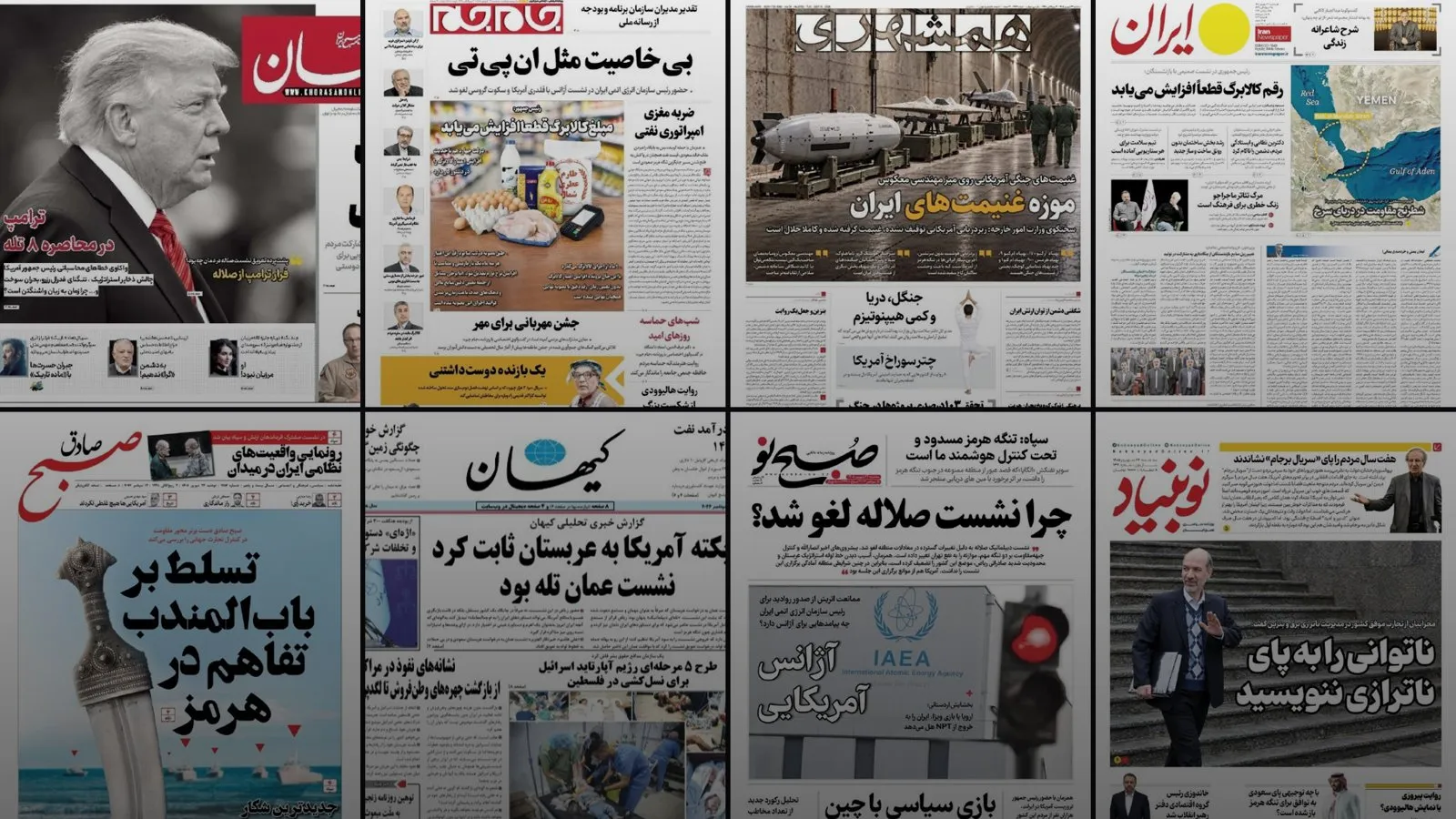
Bottom line: The Salalah meeting was cancelled, and the Iranian press published at least three incompatible explanations for it in a single morning while a coordinated argument for leaving the Non-Proliferation Treaty ran across three institutional families on the same pages, which indicates that the diplomatic track has stopped without an agreed Iranian account of why and that the nuclear file is being prepared as the ground the next phase is fought on. A second survey of nineteen front pages, folded in below, widens both findings. The Salalah postponement is read across the whole spectrum as Saudi subordination to Washington and is being used against the Foreign Ministry’s Oman track, the attack on the CBS rescue broadcast runs on six front pages, and the case for leaving the NPT now has an owned editorial and a 130-signature Majlis statement behind it, with the reformist counter-argument appearing in Sharq and Sazandegi. The recovered pages also show that the government’s English-language surfaces did not fall entirely silent on Hormuz: Tehran Times reported the Iran-Oman bilateral understanding as finalized on an inside page.
Executive Summary
The lead judgment of this cycle is that the Hormuz settlement track has stopped, and that Tehran has no single story about how. Sobh-e No gives its entire front page to the question in its headline, «چرا نشست صلاله لغو شد؟», why was the Salalah meeting cancelled, and answers it in a pulled quote: the region’s equations changed, Ansarallah’s advances and the resistance front’s control of two straits moved the balance to Tehran’s favour, the damage to Saudi Arabia’s strategic pipeline and Riyadh’s export restrictions weakened that country, and America was among the obstacles. Kayhan answers the same question differently on its own front page, in a news-analysis lead headed «دیکته آمریکا به عربستان ثابت کرد نشست عمان تله بود», America’s dictate to Saudi Arabia proved the Oman meeting was a trap, arguing that Riyadh requested the postponement to tune the outcome to American benefit and that Oman agreed. Khorasan answers it a third way, printing «فرار ترامپ از صلاله», Trump’s flight from Salalah, across a full-page portrait of the American president. Three accounts, one morning, mutually exclusive in their mechanics and identical in their conclusion that no part of the cause lies in Tehran. That pattern is what centrally supplied conclusions look like when the centre has issued a verdict without issuing a narrative.
The most consequential single sentence in the edition is not about Salalah at all, and it is not on a front page as a headline. Inside Kayhan’s lead, in the course of accusing Saudi Arabia of manufacturing an excuse, the paper states as settled fact that Riyadh acted «به بهانه حمله یمن به خطوط لوله», on the pretext of the Yemeni attack on the pipelines. No party has publicly claimed the drone strikes that shut Saudi Arabia’s east-west Petroline system on 11 and 12 September, a line carrying roughly 5 million barrels a day to Yanbu and now expected to be mostly out of service for weeks; open reporting describes drones launched from Iraq and no claim of responsibility. The daily published under the Supreme Leader’s office has placed that attack in Yemen’s column in passing, inside a subordinate clause, while arguing about something else. Attributions made incidentally are among the more reliable kinds of open-source evidence, precisely because the speaker is not guarding them.
The second thread is a treaty-exit argument that arrived on three front pages at once. Jam-e Jam, the state broadcaster’s daily, leads with «بی خاصیت مثل انپیتی», as useless as the NPT, decked with the cancellation of the Atomic Energy Organization chief’s attendance at the IAEA General Conference through, in its words, American bullying and Grossi’s silence. Sobh-e No runs an IAEA sign beside a red traffic light under «آژانس آمریکایی», the American Agency, and carries an interview arguing that Europe is pushing Iran towards NPT withdrawal. Kayhan places a contributed article on its front page titled «از هسته اتمی تا خروج از NPT», from the nuclear core to exiting the NPT. Jam-e Jam’s channel carries a video asking why demands for withdrawal and for weapons development are rising. The underlying event is real and confirmed: Austria withdrew Mohammad Eslami’s visa after the Security Council sanctions committee refused a travel-ban exemption over an American objection, with Iran’s IAEA ambassador Reza Najafi confirming that the visa had first been granted. What every one of these pages omits is the mechanism, the snapback travel ban, which converts a procedural exclusion into an act of bullying and the Agency into an instrument. That omission is uniform, and uniform omissions are decisions.
The third thread is a counter-narrative campaign of unusual precision. Four titles from four institutional families, Khorasan, Jam-e Jam, Nobonyad and Seda-ye Iran, attacked the same American television production on the same morning: a CBS segment on the rescue of a pilot whose aircraft the Iranian account says was brought down by an indigenous system. Khorasan names the purpose, asking why the piece was a domestically made promotional video produced before the congressional midterm elections. Nobonyad’s Mohsen Pourdadfar pairs it directly with the claimed capture of an American submersible in the Strait of Hormuz. Seda-ye Iran leads its whole front page on it under «اکران شکست روی پرده», the defeat screened on the silver screen. Four newsrooms do not converge on one foreign broadcast this exactly by independent news judgment; the mechanism indicated is centrally guided message discipline. The companion claim travels with it everywhere: Hamshahri, a Tehran municipal daily with no security remit, gives its top half to «موزه غنیمتهای ایران», the museum of Iran’s spoils, quoting the Foreign Ministry spokesman that the American submarine was not impounded but «غنیمت گرفته شده و کاملا حلال است», taken as spoils and entirely licit. The United States military has described that vessel, identified in Iranian state media as an Anduril Dive-LD, as defective and carrying no sensitive or classified equipment. Neither account is adopted here; the coordination is the finding.
Against all of that, the two surfaces with the most at stake said nothing. Iran, the government’s own daily, led on President Pezeshkian’s pledge that the food-voucher figure will rise, and put its only foreign-policy graphic on Bab al-Mandab; the Strait of Hormuz, Oman and Salalah appear nowhere on its front page, while its own Telegram channel reports shipping through the strait at its lowest level in weeks. Iran Daily, which on 14 September led in English on the government’s limiting formula that the Oman agreement does not open the strait, omits Oman entirely and leads instead on Ansarallah striking Saudi bases. The bilingual indicator this monitor has tracked since 12 September has therefore inverted: the English surface, which was where concessions were introduced before being domesticated in Persian, is now where the file has gone silent. Etemad, the reformist daily of record, kept two items in its retrieved window, both of which price the war rather than argue about it, and published no answer of any kind to the treaty-exit argument running on three front pages.
The institutional finding of the edition belongs to a conservative paper and concerns process rather than policy. Nobonyad prints «مجلس، همچنان خارج از گود», parliament, still outside the ring, stating that while decisions on the future of the Strait of Hormuz and on agreements bearing on national security have been placed on the diplomatic apparatus’s agenda, the role of the Islamic Consultative Assembly as supervisory and legislative body remains shrouded in ambiguity. The same page asks on what justification Saudi Arabia was admitted to a Hormuz agreement at all, and reports, confirmed independently, that Seyyed Ehsan Khandouzi, economy minister under Raisi, has taken over the economic group inside the Office of the Leader of the Revolution from Ali Aghamohammadi. A settlement file run by the executive and the leadership apparatus with the legislature outside the room is a description a principlist daily has now put in print, and it is harder to dismiss than Kayhan’s objections to substance because it is an objection to method.
Net assessment: this is an edition about a diplomatic event that did not take place, and the shape of the reaction to it is more informative than the event. The hardline title that opposed the track claims vindication but did not press its own vengeance frame when it was cheapest to do so, and the leadership-affiliated bulletin declined that frame for a second consecutive cycle. The IRGC’s own weekly states the establishment’s operating formula in a cover headline, «تسلط بر بابالمندب، تفاهم در هرمز», command at Bab al-Mandab, understanding at Hormuz, which is an explicit commitment to settle the chokepoint Iran pays for and to keep coercing at the one it does not. The government’s surfaces have gone quiet in both languages. And in the space the diplomatic argument has vacated, a treaty-exit argument has arrived with three front pages behind it in a single morning. The direction of travel is from a maritime file that has stalled towards a nuclear file that is being prepared.
Update: What the Nineteen-Front Survey Adds
Added later on 15 September. The first pass above scanned nine Persian fronts and Iran Daily, and read Etemad, Vatan-e Emrooz and Tehran Times from their channels or not at all. A second survey of the same morning covered nineteen titles, including the recovered Etemad, Vatan-e Emrooz and Tehran Times pages and the reformist Sharq and Sazandegi, the principlist Asr-e Iranian, Farhikhtegan and Agah, the IRGC-affiliated Javan, and Kayhan International. The findings below extend the edition, and the earlier judgments stand except where noted. The same survey’s economic assessment overlaps with the day’s Economic Press Review, which carries the VTB designation and the rial in full.
What the recovered pages change
Three of the first pass’s caveats can now be closed, and each closure adjusts a judgment. Vatan-e Emrooz’s front page leads on the CBS rescue segment under the headline “Escape to Bollywood,” describing the broadcast as an attempt by the U.S. war secretary to cover the failure of the Isfahan operation. Farhikhtegan carries the same story as “Bravo, Khan, Bollywood actor,” a play on the callsign CBS gave the interviewed officer. The count of titles attacking the broadcast therefore rises from four to six, spanning hardline, IRIB, principlist, university and leadership-adjacent papers. The second survey adds a detail about method. The papers leave the rescue itself unchallenged, dispute the frame around it, and build their case on CNN’s own reporting that the Pentagon pressed the crew to appear. Khorasan adds the midterm timing.
Etemad’s recovered front page shows the reformist daily of record adopting the two-strait frame. Ali Bigdeli’s guest column is titled “The intersection of deterrence in Hormuz and Bab al-Mandab,” which places a reformist paper on the same conceptual ground as the IRGC weekly’s cover. Etemad’s main headline is on government service amid simultaneous crises, and a second item defends the de-escalation policy as a way to contain costs. Etemad still prints no answer to the NPT exit argument, so KJ-10 stands for that title. The reformist counter-argument does exist elsewhere. Sazandegi’s Note of the Day, also by Bigdeli, treats the Eslami visa refusal as a reason to open other channels before the negotiating window closes, and Sharq carries a guest note calling the NPT a time bomb of Washington’s making, arguing in effect that exit is the trap. The absence recorded in KJ-10 is therefore specific to Etemad, and the confidence in that judgment should be read accordingly.
Tehran Times, the state-aligned English daily, leads on Grossi’s record at the IAEA but reports on page two that the Hormuz ministerial in Oman was postponed at Saudi request and that Tehran and Muscat have announced the formal finalization of their bilateral understanding on safe commercial navigation. The same page carries Foreign Ministry spokesman Esmail Baghaei rejecting allegations that Iran was involved in Yemen’s decision-making or in the attack on the East-West pipeline. Foreign Minister Araghchi’s own channel says the two littoral states will decide management arrangements and consult the other Gulf states afterward. KJ-6 stands for the government’s own titles, Iran and Iran Daily, which are the surfaces the bilingual indicator tracks. It should not be read as a blackout across the English-language press, since a state-aligned English title did carry the postponement and the bilateral text, though inside the paper and beneath the IAEA story.
The postponement as a consensus story
The second survey finds that the Salalah postponement has become a consensus story of Saudi subordination to Washington, with Kayhan, Sobh-e No, Javan, Vatan-e Emrooz and Nobonyad all leading on it. The three incompatible mechanics recorded above remain, but the fuller set shows a shared political use: the hardline press is turning the postponement against the Foreign Ministry’s Oman track. Kayhan’s Day 199 war report ties the Salalah text to Clause 5 of the Islamabad memorandum, which it calls an obsolete document that Washington never honored, complains that the Majlis Hormuz Strategic Action Plan is gathering dust while the ministry holds unjustified meetings, and states that Iran’s management of the strait needs no signatures on paper. Nobonyad asks by what justification Saudi Arabia was admitted to a Hormuz arrangement at all. Javan, the IRGC-affiliated daily, prints an oil-at-110 graphic and credits the Yemeni campaign for the price. On the other side, Sazandegi describes the Oman agreement as in a coma and Sharq says the meeting’s opportunity has been lost for now.
The survey’s assessment is that the episode has strengthened the hardline argument that diplomacy on Hormuz is either unnecessary or a trap, and that it has done so at the Foreign Ministry’s expense. The Foreign Ministry is exposed on two flanks at once, Riyadh’s amendments abroad and the Paydari camp at home. The strategic convergence between Hormuz coercion, the pipeline strike and the Red Sea advance is now openly celebrated in Tehran. Iranian denial of command over Sanaa is formally maintained and should be treated as a deniability line, not as evidence either way. The survey’s confidence is moderate on convergence and low on centralized tasking.
The NPT argument widens, and acquires an owner
The first pass judged the treaty-exit argument to be carried in borrowed voices. The second survey qualifies that. Asr-e Iranian’s editorial, signed by its editor Hamid Lashgari, is headed “Exit from the NPT, the answer to the Agency” and asks what would have to happen for Iran to leave, which is an editorial position the paper owns, unlike the contributed article on Kayhan’s front page. Tehran Times leads in English on Grossi’s toxic legacy. Kayhan International reports a statement by 130 lawmakers urging the Majlis to begin the legal process for withdrawal, quoting Mashhad MP Meysam Zohourian. Vatan-e Emrooz enlists the UN Secretary-General against the Director General, printing Guterres’ remark that the world needs the Agency’s impartiality more than ever as a jab at Grossi. The survey notes that Austria says the UN sanctions committee, applying the snapback regime, refused the waiver, and that the U.S. ambassador said Washington objected because Eslami’s attendance would have been a stage for propaganda. The Iranian papers report it as an American veto executed by Vienna.
The survey’s assessment is that withdrawal advocacy is now mainstream in the state-aligned press but still lacks a Leader’s-office signal or a government decision. Its likelier near-term use is as leverage in any renewed talks and as a domestic instrument against the Foreign Ministry. Confidence is moderate. KJ-2’s core finding stands, since the uniform omission of the snapback mechanism holds across the wider set, and the indicator remains adoption by any office.
Two straits, the Yemeni coast and the road to Marib
The second survey supplies the operational picture behind the two-strait frame. Ansar Allah now holds Mokha, Mayun and Greater and Lesser Hanish, the last after government-aligned forces withdrew from the archipelago, which completes the Houthi presence along the Bab al-Mandab approaches. Yahya Saree claims a salvo of dozens of missiles and drones against King Khalid Air Base at Khamis Mushait, the largest declared salvo of the campaign and aimed at a military target. The Saudi coalition confirms attacks on Khamis Mushait, Abha and Taif that wounded 13 civilians and invokes Article 51. Saree puts Saudi F-15 sorties at 58 in 24 hours, against the 54 relayed by Vatan-e Emrooz’s channel in the first pass; both are Houthi figures. Mohammed bin Salman received CENTCOM commander Adm. Brad Cooper in Jeddah, and the Saudi readout announces no new strike campaign. The coast is contested, not settled: government military media report recaptures west of Taiz and a Houthi armored vehicle destroyed on the Kahbub front.
Marib is the item the Iranian press has not yet printed. Yemeni media report Houthi reinforcements massing around the province, the army says it repelled a large attack at al-Mashjah and al-Zour west of the city on Saturday, and al-Jawf is under simultaneous pressure. Marib holds the government’s oil and gas fields, its power station and its last northern anchor. The survey judges that the next two weeks decide whether Ansar Allah converts coastal control into inland dominance or has to defend a long shoreline under Saudi air attack, with Egypt’s posture after bin Salman’s Cairo visit and any U.S. kinetic-support announcement as the variables. Confidence is moderate. Whatever the outcome, the Iranian papers will report it as the Yemeni epic, and the terms of that coverage are already set. Agah, a young ultra-conservative daily, states the frame most plainly, headlining revenge as the engine of Iran’s regional authority and warning against the security downsides of restoring relations with the UAE.
On the pipeline, the second survey is more careful than Kayhan. Baghdad has identified Iraqi territory as the launch origin of the drone strike on the East-West pipeline and has seized a launch platform, and no Iraqi militia has claimed it. Sharq’s main headline calls the attack a riddle and reports from the Iran-Iraq border on origin and attribution, which means a reformist front page is treating as open the question Kayhan settled in a subordinate clause. The strike should be carried as Iraqi-origin, Axis-consistent and unattributed, with high confidence on origin and low on organizational attribution. In Lebanon, Al-Akhbar treats Israel’s claimed control of the Ali al-Taher ridge as a bargaining asset in the Lebanon negotiations, and no fresh Naim Qassem order entering a regional energy campaign was located; confidence in near-term direct Hezbollah entry remains low to moderate.
Hormuz: the surveillance and insurance layers
Kayhan International’s lead states the enforcement picture that the Persian papers carry piecemeal. Under the headline “Iran expands maritime authority over Strait of Hormuz,” it reports that Tehran has blacklisted 77 vessels, warned insurers and asserted a service-fee authority, and it carries the IRGC claim that an advanced Aerospace Force air-defense system destroyed an MQ-1 over the waterway. Sobh-e No’s top item, headed as an IRGC statement that the strait is blocked and under smart control, names the supertanker reported to have hit mines in the restricted zone south of the strait; no independent confirmation of the mine claim or the MQ-1 loss was located. Reuters and Kpler data cited by the survey show four commodity vessels transited on Monday against ten on Sunday and a prewar average near 125 large vessels a day. The survey’s judgment is that Hormuz remains coercive without being closed, and that Tehran is contesting the surveillance layer and the insurance layer, not only surface traffic, while the Iran-Oman formula seeks to institutionalize a management role under the language of safe passage. Confidence is high.
Inside Iran: promises, audits and two dead clerics
The domestic front is being held with promises, audits and security framing. President Pezeshkian’s pledge to retirees that the goods voucher will definitely rise leads Iran and is carried by Etemad, Jam-e Jam and Kayhan; Jam-e Jam and Etemad’s economist Hadi Khoshshanas both note that nine months into the scheme the increase still has no figure, date or funding source. The gasoline structure is unchanged at 60 liters a month at 1,500 tomans, a further 50 at 3,000 and a station-card tier at 10,000, and the argument has shifted to narrative, with Hamshahri on the forging of a gasoline narrative and Nobonyad telling the government not to chalk up incapacity to imbalance. The judiciary supplies the accountability story: Ejei’s audit of 300 state companies and 1,535 managers found in violation runs on Javan and Kayhan, and Vatan-e Emrooz reports fines on ten banks and eleven dismissed branch managers over 300 trillion tomans of suspicious transfers. Sazandegi gives its main headline to press censorship, reporting a session at which Mohammad Atrianfar, Ahmad Zeidabadi and Alireza Moezzi examined the effects of restriction on journalists.
The killing of Molavi Yousef Gorgij, a pro-government Sunni cleric in Zahedan, five days after the Kurdish cleric Mamosta Mohammad Nezhati, is reported through a security lens. IRIB and the IRGC Quds Base attribute it to Zionist mercenaries and to an effort to break Shia-Sunni unity; local outlets suspect Jaish al-Adl, and heavy fighting was reported in Saravan on Saturday. Only Vatan-e Emrooz and Kayhan International carry it on the front page; most Tehran dailies leave it off. The survey reads this as the Sistan-Baluchistan file being attached to the war so that any escalation there can be presented as foreign, with high confidence on the framing and moderate on the underlying security picture. Venice splits the press: Agah alone gives its main headline to the Israeli documentary NAZA and the ministers who attacked its directors, while Khorasan, Asr-e Iranian and Kayhan attack Laleh Marzban’s Orizzonti prize as a betrayal of national zeal.
Washington’s attrition track
The U.S. increment in the window is financial. Treasury designated VTB, Russia’s second-largest bank, under E.O. 13902 for operating in Iran’s financial sector, citing offices in Iran, correspondent relationships with sanctioned Iranian banks, the movement of frozen Iranian assets and a rial-ruble settlement system. The Iran designation gives Washington a legal basis that survives any change in the Ukraine sanctions, and Operation Economic Outcast is moving from designations toward secondary-sanctions warnings, briefings to global institutions and a public call for whistleblowers. The survey calls this the sharpest test yet of the Iranian claim that BRICS and local-currency settlement create sanctions-resistant space, with high confidence. On the Iranian side, the last confirmed free-market close was 233,890 tomans to the dollar on 14 September, with early-Tuesday commentary between 231,000 and 235,000, and Brent traded near $107 after settling around $108 on Monday. Kayhan’s two supporting pieces, a Day 199 war report and a compilation of Foreign Policy, Wall Street Journal and AP material on a hollowed-out Pentagon, record U.S. diesel and $1 billion a day in war costs, use American sources to certify the Iranian message; the survey notes that the conclusion attributed to Foreign Policy reaches Kayhan through Tasnim and may be Tasnim’s paraphrase.
On the factional file, no Qalibaf statement appears on any of the nineteen front pages. The pressure on him is indirect, through Kayhan’s complaint about the dormant Majlis Hormuz plan and Nobonyad’s charge that parliament is outside the ring and that the government insists on shutting down the law. Both are attacks on the negotiating track the Speaker has defended, and both implicate the Majlis leadership by omission. A Majlis move on the Hormuz plan would be the tell. Confidence is moderate.
Key Points
- KJ-1 [HIGH] The Salalah track has stopped, and the Iranian press was given a conclusion without a narrative. Sobh-e No devotes its front page to asking why the meeting was cancelled and answers with changed regional equations, a weakened Riyadh and American obstruction; Kayhan answers with a Saudi postponement request made at American dictation under cover of the pipeline attack; Khorasan answers with «فرار ترامپ از صلاله», Trump’s flight from Salalah. Three front pages, one morning, three incompatible causal mechanisms and one shared conclusion that no part of the cause lies in Tehran. On 14 September, by contrast, three institutionally distinct outlets carried the government’s limiting formula in a single identical sentence, which is what a prepared line looks like. The significance is that the difference between those two mornings is evidence about who decided: a cancellation Tehran had chosen would have arrived with a line attached, and this one did not.
- KJ-2 [HIGH] A coordinated argument for leaving the Non-Proliferation Treaty has moved from commentary to the front pages, and is being carried in borrowed voices rather than owned. «بی خاصیت مثل انپیتی», as useless as the NPT, is the state broadcaster daily’s banner; «آژانس آمریکایی», the American Agency, with an interview saying Europe is pushing Iran to withdraw, is on a principlist front page; «از هسته اتمی تا خروج از NPT» is a contributed article on the front of the Leader’s office daily; the broadcaster’s channel asks why withdrawal demands are rising. Every one of them rests on the Vienna visa refusal and every one omits that the refusal followed a Security Council sanctions committee declining a travel-ban exemption over an American objection, which obliged Austria to withdraw a visa it had granted. The significance is twofold: a uniform omission across three institutional families is a decision rather than an editorial coincidence, and positions introduced as a reader’s article and an interviewee’s warning are positions being tested rather than announced. The indicator that would convert this from press to policy is the adoption of the argument by any office. Second survey: the argument now has at least one owner, Asr-e Iranian’s signed editorial calling exit the answer to the Agency, and a 130-signature Majlis statement reported by Kayhan International; the reformist counter-argument appears in Sazandegi and Sharq. There is still no Leader’s-office signal, and the survey holds the judgment at moderate confidence.
- KJ-3 [MODERATE-HIGH] Kayhan has attributed the Saudi pipeline attack to Yemen, in passing, while arguing about something else. The clause is «به بهانه حمله یمن به خطوط لوله», on the pretext of the Yemeni attack on the pipelines, and its rhetorical purpose is to accuse Riyadh of manufacturing an excuse rather than to claim the strike. No party has publicly claimed the drone attacks that shut Saudi Arabia’s east-west Petroline system on 11 and 12 September; open reporting describes drones launched from Iraq and no claim of responsibility, with the line expected to be out of service for weeks. The evidence for weighting this is that unguarded attributions made in service of a different argument are less likely to be constructed; the evidence against is that Kayhan routinely asserts as fact what its own camp would like to be true, and that an Iraqi launch point is not a Yemeni one. The significance is that the daily published under the Supreme Leader’s office has assigned responsibility for the most economically consequential strike of this phase to Ansarallah without being asked, and that any subsequent Iranian denial of the attribution now has this sentence to answer.
- KJ-4 [MODERATE-HIGH] The IRGC has stated its operating formula for the two chokepoints in a cover headline, and it is explicitly asymmetric. Sobh-e Sadegh, the political-cultural weekly of the IRGC’s political bureau, headlines «تسلط بر بابالمندب، تفاهم در هرمز», command of Bab al-Mandab and understanding at Hormuz, over a Yemeni dagger, a line of warships and an Israeli flag on the sand, decked as an examination of the resistance axis’s upper hand in world trade. The same asymmetry is visible on surfaces answering to different institutions: the government’s daily claims Bab al-Mandab on its front page and leaves Hormuz to its channel, and Iran Daily substitutes an Ansarullah lead for the Hormuz file it carried a day earlier. The significance is that the security establishment is committing in print to settling the chokepoint Iran pays for and coercing at the one it does not, which confirms from the IRGC’s own bureau the divergence between the security and ideological estates that this monitor inferred on 14 September, and «تفاهم در هرمز» is the specific phrase to watch for in official language.
- KJ-5 [MODERATE-HIGH] The four-title attack on a single American broadcast is centrally guided rather than organic, and it exists to carry a contested capability claim. Khorasan, Jam-e Jam, Nobonyad and Seda-ye Iran ran the same attack on a CBS segment about a rescued American pilot on the same morning, Khorasan naming the congressional midterms as its purpose and Seda-ye Iran giving its entire front page to it under «اکران شکست روی پرده». In every instance the segment is paired with the claimed capture of an American uncrewed submersible in the Strait of Hormuz, which Hamshahri simultaneously curates as a museum of spoils and which the United States military has described as a defective vessel carrying no sensitive or classified equipment. Four newsrooms across four institutional families do not independently elevate one foreign television segment to front-page treatment. The significance is that message discipline is being exercised on the information contest rather than on the diplomatic file, on the morning the diplomatic file stopped, and the discipline is sharper here than on anything Hormuz-related in this edition. Second survey: the recovered Vatan-e Emrooz and Farhikhtegan pages raise the count to six titles, and the shared method is to dispute the frame, not the rescue, using CNN’s own reporting on Pentagon pressure. The survey rates intent high and effect moderate, and notes the campaign’s dependence on continued U.S. press criticism of the administration.
- KJ-6 [MODERATE] The government has withdrawn from the Hormuz file on both its language surfaces, and the bilingual early indicator has inverted. Iran, the government’s daily, leads on the president’s food-voucher pledge and prints neither Hormuz nor Oman nor Salalah anywhere on its front page, while placing its only foreign-policy graphic on Bab al-Mandab; its own channel reports shipping through the strait at its lowest level in weeks. Iran Daily, which on 14 September led in English on «the Oman agreement does not open the strait», omits the file and leads on Ansarullah striking Saudi bases. For three cycles the English surface was where concessions were introduced before being domesticated in Persian; it is now where the file has gone silent. The significance is that governmental silence in both languages on a file the government owns, while hardline and principlist titles argue about it in public, indicates a position that has not been settled rather than one being withheld, and the reappearance of the Hormuz formula in English would be the earliest signal that it has been. Second survey: the finding holds for Iran and Iran Daily, the government’s own titles. The recovered Tehran Times page shows a state-aligned English daily reporting the postponement and the finalized Iran-Oman bilateral understanding on page two, with Baghaei’s denial of any Iranian role in Yemen or the pipeline attack, so the silence belongs to the government’s own titles and does not extend to the English-language press as a whole.
- KJ-7 [MODERATE] Negative evidence, and it is the most important finding in the edition after the cancellation itself: the vengeance frame was available, cheap and unused. On 14 September, Hossein Shariatmadari’s Kayhan column attached blood-vengeance for the assassinated Leader to any reopening of the Strait of Hormuz, alongside American withdrawal, reparations, a halt to Israeli operations in Lebanon and Palestine, and exclusion of the nuclear file. On 15 September, with the meeting cancelled and the argument apparently won, the same column spent itself entirely on returning expatriate artists and silent cultural institutions and did not mention Hormuz. In the same cycle, Seda-ye Iran, which prints the khamenei.ir affiliation on its masthead, again carried no Hormuz condition and no vengeance framing, for the second consecutive edition. The benign reading is that a won argument needs no repetition. The alternative is that the frame was a bid that did not land. The significance is that the succession’s legitimacy debt has now failed twice to attach to the maritime file on the office’s own surfaces, and this monitor continues to weight the condition list as a newspaper’s bid until an office adopts any element of it.
- KJ-8 [MODERATE] Principlist criticism of the settlement process has shifted from substance to procedure, which makes it more durable. Nobonyad prints that decisions on the future of the Strait of Hormuz and on agreements bearing on national security sit with the diplomatic apparatus while the Majlis’s supervisory and legislative role «همچنان در هالهای از ابهام قرار دارد», remains shrouded in ambiguity, and asks on what justification Saudi Arabia was admitted to a Hormuz agreement. The same page carries the confirmed appointment of Seyyed Ehsan Khandouzi, the Raisi government’s economy minister, to head the economic group in the Office of the Leader of the Revolution in place of Ali Aghamohammadi. The significance is that a complaint about who decides survives changes in what is decided, in a way that Kayhan’s objections to the terms do not, and that a formal parliamentary demand for a role in the Hormuz file is now a plausible next development and would be an indicator that the track is expected to restart.
- KJ-9 [MODERATE] The escalation in this cycle is Saudi-Yemeni, not Iranian-American, and it is running ahead of the diplomacy. Iran Daily leads on Ansarullah targeting Saudi military bases in retaliation for air strikes; Fars reports a Security Council emergency session on Yemeni control of the Bab al-Mandab coastline, strikes with warning sirens at Yanbu, Taif, Jeddah, Abha, Jizan and Ula, airport suspensions and Jizan oil facilities hit; Vatan-e Emrooz’s channel relays a Yahya Saree statement promising a response to Saudi air strikes on five provinces and counts 54 Saudi sorties in 24 hours; Kayhan’s front page reports Riyadh asking Israel for help while Vatan-e Emrooz’s channel reports it asking the United Kingdom. The significance is that Saudi Arabia is simultaneously the party Kayhan blames for the Salalah postponement and the party under sustained attack, which means the actor Tehran needs at the table is the actor its allies are hitting, and that the Saudi-Yemeni file is now the likeliest source of the shock that would determine whether the Hormuz track restarts at all.
- KJ-10 [LOW-MODERATE] Negative evidence: the reformist surface published no answer to the treaty-exit argument. Etemad’s retrieved window carries two items, shipping through the Strait of Hormuz at its lowest level in weeks, and a United States Department of Justice action against Iranian oil-revenue cryptocurrency, and nothing on Salalah, Saudi Arabia, Yemen, the IAEA, the NPT or Israel. On 14 September the same title led on a ballistic-missile profile printed beneath the president’s own statement that Iran would not have joined the NPT had it sought a weapon, which was an argument that conventional deterrence makes a bounded settlement survivable. No equivalent argument appears anywhere in this edition against three front pages carrying the case for withdrawal. The caveat is material and limits the confidence: no Etemad scan was in the album, so this rests on a channel window rather than on a page, and a channel window is not a front page. The significance is that the absence of a reformist counter-argument on a treaty question is either editorial caution or an absence of permitted ground, and which of the two it is would be worth establishing; recovering the Etemad and Vatan-e Emrooz pages is the first task of the next cycle. Second survey: both pages were recovered. Etemad’s front page carries no NPT item, so the finding stands for that title, but its guest column adopts the two-strait deterrence frame and a second item defends de-escalation. The reformist counter-argument on the treaty exists in Sazandegi and Sharq, which narrows this judgment from the reformist press as a whole to Etemad in particular.
- KJ-11 [HIGH] Hormuz remains coercive, not closed, and Tehran is contesting the surveillance and insurance layers, not only surface traffic. Kayhan International’s lead bundles the 77-vessel blacklist, a warning to insurers and an asserted service-fee authority with the IRGC’s MQ-1 claim; Sobh-e No names the supertanker it says hit mines in the restricted zone; Reuters and Kpler data show four commodity transits on Monday against ten on Sunday and a prewar norm near 125. Neither the mine claim nor the MQ-1 loss is independently confirmed. The significance is that the Iran-Oman formula, now reported by Tehran Times as finalized, seeks to institutionalize a management role under the language of safe passage while the enforcement picture tightens beneath it.
- KJ-12 [MODERATE] Marib is the next Yemeni battle, and its loss would collapse the government’s northern position. Houthi reinforcements are reported around the province, the army says it repelled a large attack west of the city on Saturday, and Al Jazeera and Arab News frame Marib as decisive. No Iranian front page has yet printed Marib; the papers prefer the islands. The significance is that the Iranian press will report the outcome as the Yemeni epic whichever way it goes, and that a Houthi announcement of an offensive would reach the front pages within a day.
- KJ-13 [HIGH] The government is buying time on the domestic economy. A goods-voucher increase is promised without figure or date on four front pages, two of which say so; the gasoline tiers stand; the rial trades near 233,000 to 235,000 to the dollar. Nobonyad tells the government not to chalk up incapacity to imbalance. The survey reads this as localized stress, not a protest wave, and the significance is that relief is not on offer and the state’s answer is promises, audits and security framing.
- KJ-14 [MODERATE] The killings of two Sunni clerics in five days, Gorgij in Zahedan and Nezhati in West Azerbaijan, are being folded into the war narrative as attacks by Zionist mercenaries. IRIB, the IRGC Quds Base and Kayhan International carry that attribution; local outlets point to Jaish al-Adl; heavy fighting was reported in Saravan on Saturday. Only two of nineteen front pages carry the Zahedan killing. The significance is that the Sistan-Baluchistan file is being securitized as a foreign front while the Sunni clergy’s alignment with the state is stressed, and a claim of responsibility or a third killing would test the framing.
- KJ-15 [MODERATE] No Qalibaf statement appears on any front page a week after his confrontation with Shariatmadari, and the hardline camp is pressing both the government and the Majlis on Hormuz. Kayhan says the Majlis Hormuz Strategic Action Plan gathers dust; Nobonyad says the Majlis is still outside the ring. The significance is that the confrontation has moved from personal exchange to institutional positioning, and a Majlis move on the Hormuz plan would be the tell.
Macro Trends
- A cancellation without an agreed cause, and every cause lies abroad. Sobh-e No attributes the collapse of the Salalah meeting to changed regional equations, a weakened Riyadh and American obstruction; Kayhan attributes it to a Saudi request made on American instruction under cover of the pipeline attack; Khorasan attributes it to the American president fleeing the venue. These are not three emphases on one account, they are three different actors causing one event, and they ran on three front pages on one morning. What they share is the absence of any Iranian agency in the outcome, including the negative kind: no page considers that Tehran’s own terms contributed, and no page reports the postponement as a loss. A press system that has been told what to conclude but not what happened produces exactly this signature. The operational implication is that the cancellation was not prepared in advance with the press, which in turn suggests it was not Tehran’s decision to make.
- The treaty-exit argument moved onto the front pages, and the mechanism was removed from it. In one cycle, «بی خاصیت مثل انپیتی» leads the state broadcaster’s daily, «آژانس آمریکایی» and an NPT-withdrawal interview run on a principlist front page, and «از هسته اتمی تا خروج از NPT» appears on the front of the Leader’s office daily as a contributed article. Three institutional families, one morning, one direction. The occasion is genuine: Austria withdrew Mohammad Eslami’s visa for the IAEA General Conference after the Security Council sanctions committee refused a travel-ban exemption over an American objection. The uniform editorial act is the removal of that mechanism. Every page renders a snapback travel ban as American bullying and the Director General’s conduct as complicity, which converts a procedural exclusion into evidence that the Agency itself is an instrument and that membership buys nothing. Presenting NPT exit as a reader’s contribution and an interviewee’s warning rather than as an editorial demand is how a position is tested before it is owned. This is the thread most likely to produce the next significant escalation, and the resolving indicator is whether any office adopts the argument that a newsroom is currently carrying.
- The captured-hardware story left the security estate and entered civic culture. The claimed seizure of an American uncrewed submersible was, ten days ago, a military claim contested by an American denial that the vessel was anything but defective. This morning it is the top half of the Tehran municipality’s newspaper, curated as «موزه غنیمتهای ایران», a museum of spoils, with an inventory of claimed drone captures, a Foreign Ministry ruling that the taking was «حلال», licit, and a short explainer for the general reader that reverse engineering means building something better than the original rather than a copy. The IRGC’s own weekly ran the same story a day earlier as «جدیدترین شکار نیروی دریایی سپاه», the IRGC Navy’s newest catch. What this trend measures is not the truth of the claim but its promotion: a contested military assertion has been converted into settled civic property, at which point it becomes very difficult to retract and starts to function as a public expectation of further such catches.
- Four newsrooms, one foreign broadcast, one morning. Khorasan, Jam-e Jam, Nobonyad and Seda-ye Iran all attacked the same CBS segment about the rescue of a downed American pilot, in the same terms, on the same day, and one of them, Khorasan, named the United States midterm elections as its purpose. Seda-ye Iran built its entire front page on it. This is the cleanest instance of centrally guided message discipline in several cycles, and it is cleaner than the convergence this monitor recorded on 14 September around the government’s Hormuz formula, because a foreign television segment is not an event that four Iranian newsrooms would independently elevate to front-page treatment. The paired claim travels with it in every instance, which tells you what the campaign is for: the American production is offered as the fake, and the captured submersible as the real. Watch for the same pairing appearing in an official statement, which would mark the campaign’s graduation from press to policy.
- The government has gone quiet in both languages, and the bilingual indicator has inverted. Since 12 September this monitor has tracked the English state surface as the place where concessions are introduced abroad before being domesticated in Persian. That cycle completed on 14 September, when Iran Daily and Javan carried the foreign minister’s limiting formula identically in both languages. This morning the government’s Persian daily leads on food vouchers and does not print the words Hormuz, Oman or Salalah anywhere on its front page, while its own channel reports shipping through the strait at its lowest level in weeks; and Iran Daily omits the file entirely and leads on Ansarullah striking Saudi bases. The substitution is the point: Tehran’s governmental surfaces will still claim Bab al-Mandab, where the gains are Ansarallah’s and cost Iran nothing, and have stopped discussing Hormuz, where the bill is arriving. The indicator to watch is the reappearance of the Hormuz formula in English, which on the pattern of the last four cycles would precede its return to the Persian pages.
- A conservative daily has put the exclusion of parliament in print. Nobonyad’s «مجلس، همچنان خارج از گود», parliament still outside the ring, states that decision-making on the future of the Strait of Hormuz and on agreements bearing on national security sits with the diplomatic apparatus while the Majlis’s supervisory and legislative role remains in ambiguity, and asks on the same page on what justification Saudi Arabia was brought into a Hormuz agreement at all. This is a procedural complaint from inside the principlist camp, and it arrives alongside the confirmed transfer of the economic group inside the Office of the Leader of the Revolution to Seyyed Ehsan Khandouzi, the Raisi government’s economy minister, from Ali Aghamohammadi. Together they describe a file being run between the executive and the leadership apparatus. Objections to method outlast objections to substance, and this one is the thread most likely to produce a formal parliamentary demand if and when the Salalah track restarts.
- The war did not pause for the diplomacy that stopped. The wires and channels carried, in one window: an advanced MQ-1 destroyed over the western Strait of Hormuz, reported identically by Defa Press, Fars, Vatan-e Emrooz’s channel and the Iran newspaper’s channel and therefore counted here as one claim; a drone attack on two fishing boats twelve nautical miles from Larak Island and thirty miles from Kangan with fishermen missing; a supertanker reported destroyed by naval mines south of the strait; a United Nations Security Council emergency session on Yemeni control of the Bab al-Mandab coastline; Yemeni strikes on Saudi targets with warning sirens at Yanbu, Taif, Jeddah, Abha, Jizan and Ula, airport suspensions and Jizan oil facilities hit; and Saudi Arabia reported requesting outside military intervention, to Israel on Kayhan’s account and to the United Kingdom on Vatan-e Emrooz’s. Shipping through Hormuz is meanwhile at its lowest level in weeks on the reformist and governmental channels alike. The standing judgment holds without amendment: the corridor that was being negotiated is a corridor in a strait where vessels are still being hit, and the theatre now generating the escalation is the Saudi-Yemeni one rather than the Iranian-American one.
Front-Page Snapshot
- Sobh-e No - “Why was the Salalah meeting cancelled?” (Principlist morning daily) - The cancellation explained as a regional balance shifted to Tehran, with the Hormuz closure reasserted above the masthead [HIGH]
- Kayhan - “America’s dictate to Saudi Arabia proved the Oman meeting was a trap” (Hardline, published under the Supreme Leader’s office, managing editor Hossein Shariatmadari) - Vindication claimed for opposing the track, with the pipeline attack attributed to Yemen in passing [SEVERE]
- Khorasan - “Blood zeal” (Conservative Mashhad-based national daily) - Salalah as Trump’s flight, the American midterms named as the purpose of a US broadcast, and blood donation as a measure of national will [MODERATE-HIGH]
- Jam-e Jam - “As useless as the NPT” (State daily of IRIB, the national broadcaster) - The treaty declared worthless after the Vienna visa refusal, with the Security Council mechanism omitted [HIGH]
- Sobh-e Sadegh - “Command of Bab al-Mandab, understanding at Hormuz” (Political-cultural weekly of the IRGC political bureau, dated 23 Shahrivar) - The two-chokepoint doctrine stated explicitly: coerce where it is free, settle where it is costly [HIGH]
- Hamshahri - “The museum of Iran’s spoils” (Centrist daily of the Tehran municipality) - Captured American hardware curated as civic property, with American security guarantees framed as worthless to Gulf states [MODERATE-HIGH]
- Vatan-e Emrooz - “Escape to Bollywood” (Hardline principlist morning daily; front page recovered in the second survey) - The CBS rescue segment as cover for the Isfahan failure, Guterres set against Grossi, and Riyadh’s desperation in Yemen; the channel window had priced the delay through the oil market and relayed a reported British request [MODERATE-HIGH]
- Seda-ye Iran - “The defeat screened on the silver screen” (Leadership-messaging daily carrying the khamenei.ir affiliation on its masthead) - American narrative-making attacked; Hormuz conditions and vengeance framing absent for a second consecutive cycle [MODERATE]
- Nobonyad - “Do not charge incapacity to the imbalance account” (Conservative principlist morning daily) - Parliament reported excluded from the Hormuz file, and a Leader’s-office economic appointment confirmed [MODERATE]
- Iran Daily - “Pezeshkian says unity key to resisting ‘US bullying’” (English-language state daily published by IRNA) - Unity messaging abroad and Bab al-Mandab escalation carried, with the Hormuz file dropped after leading on it a day earlier [MODERATE]
- Iran - “The food-voucher figure will definitely increase” (Official daily of the government, published by IRNA) - Welfare over diplomacy; Bab al-Mandab claimed on the page while Hormuz is left to the channel [LOW-MODERATE]
- Etemad - “Service amid simultaneous crises” (Reformist daily of record; front page recovered in the second survey) - Government service under strain, a guest column adopting the two-strait deterrence frame, de-escalation defended as cost containment, and still no answer to the treaty-exit argument; the channel window had priced the war without arguing it [LOW-MODERATE]
- Tehran Times - “Grossi’s toxic legacy: greenlighting aggression, smearing Iran” (State-aligned English daily; recovered in the second survey) - The IAEA chief attacked in English for foreign pickup; the Salalah postponement and the finalized Iran-Oman understanding carried inside, with Baghaei’s denial of any role in Yemen or the pipeline attack [MODERATE-HIGH]
- Kayhan International - “Iran expands maritime authority over Strait of Hormuz” (State-aligned English daily) - The 77-vessel blacklist, insurer warning, service-fee claim and MQ-1 shootdown bundled as maritime authority; the 130-lawmaker NPT statement and the Zahedan killing carried [HIGH]
- Javan - “Omani calculations and the Yemeni epic” (IRGC-affiliated daily) - Oil at $110 credited to the Yemeni campaign more than to the postponement; Trump’s fear of the November elections [MODERATE-HIGH]
- Asr-e Iranian - “The people, the true owners of the revolution” (Principlist daily) - A signed editorial calling NPT exit the answer to the Agency, the first owned editorial position on withdrawal in the set; Saudi Arabia’s oil scramble mocked in a cartoon [MODERATE-HIGH]
- Sharq - “The riddle of the attack on the Saudi pipeline” (Reformist daily) - Pipeline attribution treated as an open question from the Iran-Iraq border; the NPT called a time bomb of Washington’s making; the Oman opportunity lost for now [MODERATE]
- Sazandegi - “The scourge of the red line” (Reformist daily, Kargozaran) - Press censorship on the main headline; the visa refusal read as a reason to open more channels before the negotiating window closes; the Oman agreement described as in a coma [MODERATE]
- Farhikhtegan - “Iranium, day 200” (Principlist daily, Islamic Azad University) - Domestic mobilization on day 200 of the war by its count; the CBS segment mocked as Bollywood [LOW-MODERATE]
- Agah - “NAZA, the documentary that said the unsayables” (Young ultra-conservative principlist daily) - The only front page on the Israeli documentary at Venice; revenge named as the engine of Iran’s regional authority; a warning against restoring relations with the UAE [LOW-MODERATE]
What to Watch
- Salalah: a rescheduled date, the published text of the Iran-Oman understanding, or a Foreign Ministry reply to Kayhan’s trap line. The reappearance of the Hormuz formula in Iran Daily would be the earliest sign that the government has settled its position.
- NPT: a Leader’s-office signal, a government position on the 130-signature statement, or a Majlis vote to open the withdrawal process. Adoption of the newspapers’ argument by any office remains the resolving indicator.
- Qalibaf: any Majlis move on the Hormuz Strategic Action Plan, or a statement answering Kayhan and Nobonyad on the Majlis role.
- Marib: a Houthi announcement of an offensive, or government reporting of a breakthrough at al-Mashjah, al-Zour or Jabal Murad. Loss of Marib would reach the Iranian front pages within a day.
- Saudi response to the King Khalid Air Base salvo: an expansion of strikes beyond current fronts, a coalition naval move against Mokha or Hanish, or a public request for U.S. kinetic support. Egypt’s posture after the bin Salman visit, and any Cairo-Riyadh mechanism on Bab al-Mandab.
- Red Sea: Houthi deployment of coastal missiles, drones, radar or air defenses on Mayun and Hanish, and any Saree statement announcing a maritime rule or an attack on Yanbu, Saudi tankers or Red Sea energy infrastructure.
- Hormuz: daily transits, insurer behavior after the 77-vessel blacklist, and any independent confirmation of the mine claim or the MQ-1 loss.
- Maysan: attribution evidence from the Iraqi investigation, whether arrests, communications, drone components or a militia claim.
- Hezbollah: any Naim Qassem, Mohammad Raad or Hassan Fadlallah statement linking Ali al-Taher to a specific retaliation threshold, or an accepted Hezbollah attack claim.
- Sistan-Baluchistan: a claim of responsibility for the Gorgij killing, IRGC operations in Saravan, or a third clerical killing.
- The goods voucher: a figure and a date; and the free-market dollar’s direction from the 233,890 close.
- NAZA: migration from Agah to Kayhan’s foreign pages or to IRIB, and any Iranian use of the Israeli ministers’ citizenship threat.
- Washington: a CENTCOM or Pentagon announcement of direct kinetic support against Houthi positions, and further Operation Economic Outcast designations of third-country banks.
Full report
The complete edition - per-paper front-page analysis and full translation appendices - is available as a PDF: Download the full report.
Compiled from Iranian front pages and outlet channels via open-source monitoring. Translations are editorial; named-figure attributions are verified against the source pages where possible. Updated on 15 September with a second survey of the same edition covering nineteen titles, which recovered the Etemad, Vatan-e Emrooz and Tehran Times front pages and contributed the Update section, the second-survey notes on KJ-2, KJ-5, KJ-6 and KJ-10, KJ-11 to KJ-15, the additional front-page entries, and the What to Watch indicators.