Iranian Press Monitor - Wednesday, 28 October 2026 (Day 239)
Wednesday, 28 October 2026 · چهارشنبه ۶ آبان ۱۴۰۵ · 17 Jumada al-Awwal 1448 - Eight Iranian front pages of 6 Aban 1405 read in full, with one English page, six newspaper channels and three agency wires. Kayhan is read from its own channel because its page did not reach the kiosk album. One page in the album, Javan’s, is yesterday’s edition and is excluded. Tehran Times was not available at the time of compilation. Updated later on 28 October with our combined daily intelligence report and Iranian press monitor, which reads 27 publications, including the Tehran Times front page and the Kayhan editorial unavailable at compilation; its additions are marked as updates below.
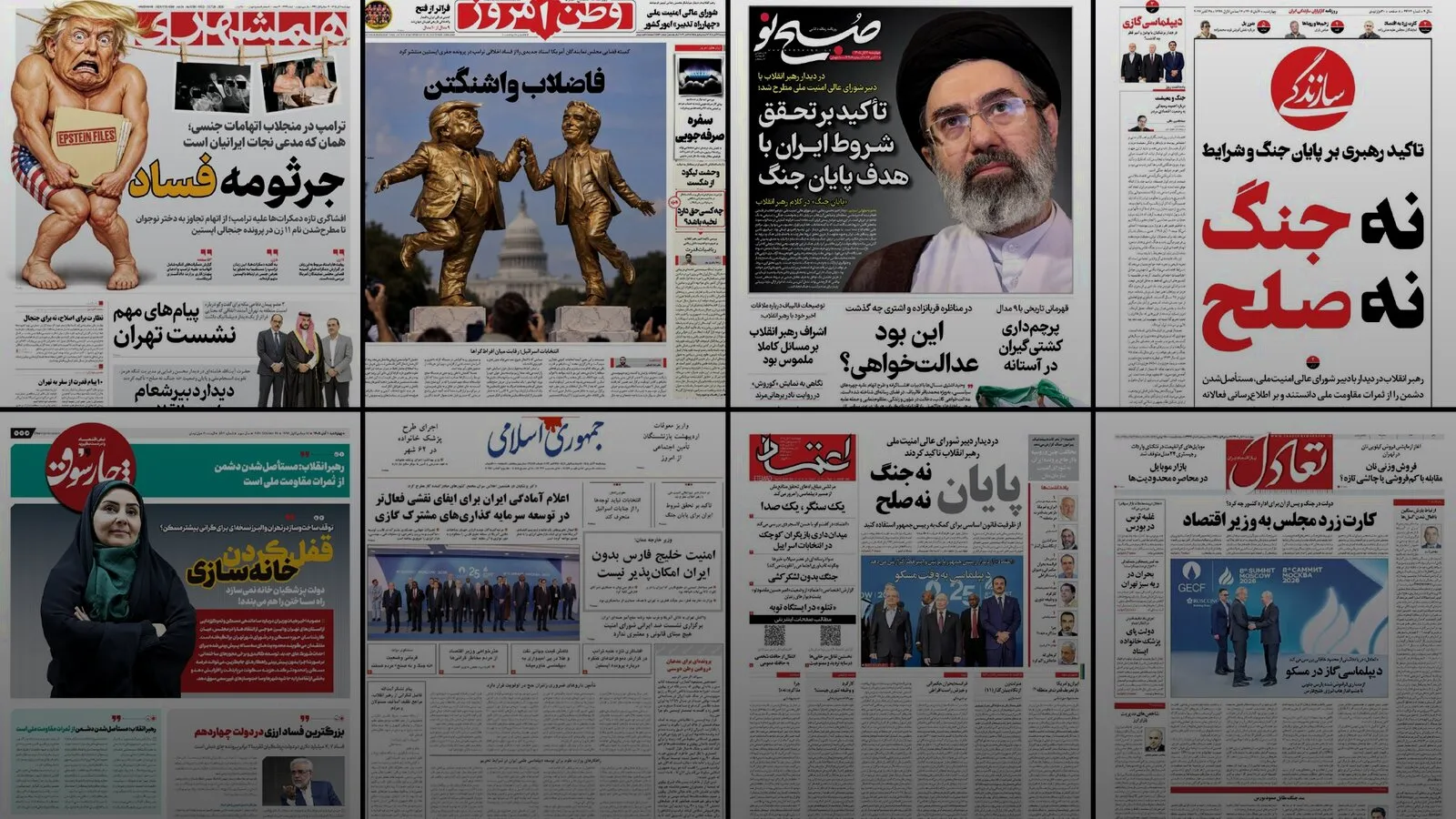
Bottom line: The Leader of the Islamic Republic has, for the first time in this monitor’s record, made ending the war and ending the ‘neither war, nor peace’ condition the declared object of Iranian policy, and in the same breath named the management of the Strait of Hormuz as a standing item on his agenda: an exit is being opened and the chokepoint is being kept.
Executive Summary
The lead judgment of this cycle is that Iran’s exit argument has acquired the only sponsor that can settle it. On 27 October, Major General Mohsen Rezaei, Secretary of the Supreme National Security Council, met the Leader of the Revolution, named across the Iranian press as Seyyed Mojtaba Hosseini Khamenei. Six Iranian renderings published the next morning agree on the load-bearing sentence: that the rights and interests of the Iranian nation and of the resistance front are to be pursued «از طریق تحقق شروط مطرحشده از سوی مسئولان کشور», through the realization of the conditions raised by the country’s officials, «با هدف پایان جنگ و شرایط «نه جنگ، نه صلح»», with the aim of ending the war and the condition of neither war nor peace. One cycle ago this monitor recorded that formula being revived on Nobonyad’s front page specifically in order to be denounced as «خطای محاسباتی», a miscalculation. Today it is the thing the Leader says must end. Sazandegi gives its entire front page to the four words; Etemad leads on «پایان نه جنگ نه صلح»; Sobh-e No leads on the conditions; Iran Daily carries it in English above its own masthead rule. The argument about how the war ends is over, in the sense that it now has an answer from the top. What the answer contains is not stated anywhere: no condition is specified, no mechanism named, no interlocutor identified, no date given.
The second finding is the company the exit keeps. The same readout places «مدیریت تنگه هرمز», management of the Strait of Hormuz, among the Leader’s emphases, printed as such on Hamshahri’s front page and in Kayhan’s channel report. This monitor has tracked Hormuz across five cycles from deniable consequence, to doctrine argued for by the Leader’s own newspaper, to a lever Defa Press claimed as deliberate strategy. It is now an item on the Leader’s own agenda, and it is an item of management, and not of closure. On the same morning the government’s paper reports two things that give the word content: that the President discussed the Strait with the Emir of Qatar at the Moscow gas summit, and that the Persian Gulf waterway authority has warned that vessels of the Sinokor shipping line face legal action from 1 November, citing at least seven enforcement cases. A named carrier, a dated deadline and a stated enforcement record are a different order of evidence from a slogan. Iran is negotiating the chokepoint and administering it in the same week.
The third finding is institutional and will outlast the week. The readout lists the use of Article 176 of the constitution, the article that constitutes the Supreme National Security Council under the chairmanship of the President. Etemad renders it on its front page as a direct instruction, «از ظرفیت قانون اساسی برای کمک به رییسجمهور استفاده کنید», use the capacity of the constitution to help the President. No hardline front page in the batch carries that line. One cycle ago the Leader’s own paper, over the signature of its managing editor, instructed the Supreme National Security Council by name, demanded an answer on whether Yemen was being traded and called the Tehran summit a mirage. Today the same paper leads on the Leader calling that Council «چهارراه تدبیرِ» امور کشور, the crossroads of prudent management of the country’s affairs, and the Council’s secretary is separately reported receiving Yemen’s ambassador and thanking Yemen for its stance. The quarrel of 5 Aban has been closed from above, in public, in favour of the body that was attacked.
The adversary file moved in two directions at once and neither reached a Persian lead honestly. Israel voted on 27 October; the count reaching Iranian surfaces through Yedioth Ahronoth, Channel 12 and Channel 13 shows Likud largest at about 28 seats, Gadi Eisenkot’s Yashar second at about 21, and neither bloc at 61. Nour News reports Eisenkot seeking an inclusive government; Etemad Online carries his line that the people voted against Netanyahu continuing. Not one Persian front page leads on it. Vatan-e Emrooz files it as «رقابت میان افراطگراها», a contest among extremists, and Jomhouri Eslami as a distraction from Israel’s crimes. Meanwhile the wires carry what the pages will not: the Pentagon’s own figure that the war has cost the United States 47.1 billion dollars as of mid-October, American Patriot systems moving to Israel, a 694 million dollar hypersonic missile contract, Saudi aircraft striking Yemeni provinces more than eighty times in a day by the Yemeni spokesman’s claim, Yemeni missiles claimed against the Saudi Defence Ministry in Riyadh, and a Dutch carrier extending its suspension of Riyadh and Dammam flights to 27 November. Israeli artillery shelled al-Mansouri in southern Lebanon and reached no page at all.
The fourth finding is that two of the eight front pages treated a day of strategic decision as a day for American sexual scandal. Hamshahri’s whole upper page is a caricature of a near-naked Trump clutching an EPSTEIN FILES folder under the single word «جرثومه فساد», a cesspit of corruption, with three numbered boxes recording eleven women, five direct accusations and a twenty-three page congressional report. Vatan-e Emrooz runs the gilded Trump and Epstein statue under «فاضلاب واشنگتن», the sewer of Washington. The hardline paper put the Leader’s exit remarks above its masthead as a one-line banner and gave the page to the scandal. That is a choice about what Iranian readers should carry out of this week, and it is the oldest move in this press: when your own side has made a decision you would rather not discuss, publish the adversary’s decay.
Net assessment. This is the most significant edition this monitor has recorded since the Tehran summit, and its significance is almost entirely domestic. The Iranian system has, in public and from the top, named an end state and assigned the file to the body the constitution puts under the President. It has done so without naming a single condition, which preserves every option including the option of never arriving. Around that decision the war’s actual tempo is unchanged: Saudi Arabia and Yemen are exchanging strikes daily, American interceptors are moving to Israel, and the state’s own English-language daily publishes an Iranian analyst saying that after 3 November the likelihood of an American attack is very high. The coherent reading is not that Iran has decided to end the war. It is that Iran has decided to be seen to want it ended, on conditions it has not published, while keeping the chokepoint in hand and the fronts running. Both halves are deliberate, and the gap between them is the thing to watch.
Key Judgments
-
KJ-1 [HIGH] The Iranian system has, for the first time in this monitor’s record, made ending the war and ending the ‘neither war, nor peace’ condition the declared object of policy, stated by the Leader himself. The evidence is six independent Iranian renderings of the same meeting published on the morning of 6 Aban: Sazandegi’s whole front page given to «نه جنگ نه صلح» under «تأکید رهبری بر پایان جنگ و شرایط», with the full clause that Iran’s and the resistance front’s rights are to be pursued «از طریق تحقق شروط مطرحشده از سوی مسئولان کشور با هدف پایان جنگ و شرایط «نه جنگ، نه صلح»»; Etemad’s lead «پایان نه جنگ نه صلح»; Sobh-e No’s «تأکید بر تحقق شروط ایران با هدف پایان جنگ»; Hamshahri’s deck naming the end of the condition as one of three emphases; Iran Daily’s English banner ‘Leader meets top security chief; urges realization of Iran’s conditions to end war’; and Kayhan’s own report. The significance is that the argument this monitor has tracked since early October, over whether the formula is an exit or a miscalculation, has been resolved by the only authority that can resolve it, and resolved in favour of exit. Calibration: this is a judgment about the declared objective, not about the likelihood of an end to the war; reading it as the latter would overstate it badly.
-
KJ-2 [HIGH] The declared exit is empty of content, and the emptiness is deliberate and not accidental. The evidence is negative and consistent: across eight front pages, one English page, six newspaper channels and three agency wires, not one surface names a condition, a mechanism, an interlocutor, a venue or a date. The nearest approach to content is Rezaei’s own statement to Pakistan’s army chief on the summit day, carried by the Sobh-e No channel, that «حتی ذرهای از مواد هستهای غنیشده از ایران خارج نخواهد شد», not a particle of enriched material will leave Iran, and that «تا اعتمادسازی از سوی آمریکا صورت نگیرد مذاکرهای در کار نخواهد بود», there will be no negotiation until America builds trust. Those are preconditions for talks, not terms for ending a war. The significance is that an unspecified condition set can be declared met or unmet at will, which preserves every option including never arriving; the announcement is therefore better read as positioning than as a plan. Update: the wider read adds a count and a sequence, though still no content. Nobonyad leads on Iran’s “seven conditions” replacing the memorandum of the failed Islamabad track, and credits Ali Bagheri Kani with insisting on television that the conditions be implemented in full before any new decision, with practical American action coming first and Iran’s decision second. No paper in the 27-publication batch lists the seven conditions, so this judgment stands.
-
KJ-3 [HIGH] The Strait of Hormuz has moved from doctrine to administration, and the evidence is a named carrier with a dated deadline. The evidence is threefold: the Leader’s readout listing «مدیریت تنگه هرمز» among his emphases, printed on Hamshahri’s front page and in Kayhan’s channel report; the Iran newspaper reporting that the President raised the Strait directly with the Emir of Qatar at Moscow; and the Iran newspaper’s item that the Persian Gulf waterway authority has warned that vessels of the Sinokor shipping line face legal action from 1 November, citing at least seven enforcement cases. Five cycles ago this monitor recorded Hormuz as a consequence nobody owned; three cycles ago as a doctrine the Leader’s paper argued for; one cycle ago as a lever Defa Press claimed as strategy. The significance of the shift to «مدیریت», management, is that it is simultaneously less alarming than closure and more operational: it describes a regime of permissions and penalties that can be tightened by degrees without a single declaratory act.
-
KJ-4 [HIGH] The public quarrel between the Leader’s newspaper and the Leader’s security council has been closed from above, and both of the newspaper’s demands were answered without the newspaper being named. The evidence is the contrast across one cycle: on 5 Aban, Kayhan’s «یادداشت روز», signed by managing editor Hossein Shariatmadari, named deputy secretary Ali Bagheri, called the Tehran summit a mirage and demanded that «عزیزان شورای عالی امنیت ملی» answer whether Saudi Arabia had stopped fighting Yemen. On 6 Aban, Kayhan’s lead is the Leader describing that Council as «چهارراه تدبیرِ» امور کشور, and the Sobh-e No channel reports Rezaei receiving Yemen’s ambassador and thanking Yemen for its stance. The significance is that the system demonstrated it can shut down a public challenge from its own hardline flank within twenty-four hours, which bears directly on how much factional noise around the exit track should be weighted. Calibration: the day’s «یادداشت روز» could not be retrieved, so this monitor cannot establish whether Kayhan accepted the closure or merely moved the argument inside. Update: the editorial has since been read. It is Jafar Bolouri’s “Poor bin Salman!”, which ridicules the Saudi crown prince as unable to negotiate without Washington’s permission and ran two days after the Saudi defense minister sat with Rezaei. Kayhan did not renew its attack on the Council. It moved the argument to the Saudi leg of the Council’s regional track, and our combined report judges that its opposition now stays inside the Leader’s formula of realizing the conditions.
-
KJ-5 [MODERATE-HIGH] Article 176 has been invoked to move the war file toward the President, and only the reformist press is printing it. The evidence is Kayhan’s own report listing «استفاده از ظرفیت اصل ۱۷۶ قانون اساسی» among the meeting’s subjects; Etemad’s front-page rendering of it as the instruction «از ظرفیت قانون اساسی برای کمک به رییسجمهور استفاده کنید»; Sazandegi locating the conditions in «مسئولان کشور», the country’s officials, and not in the Leader’s office; Morteza Mobaleq’s Etemad column «یک سنگر، یک صدا» arguing the national interest through diplomacy; and the absence of the Article 176 line from every hardline front page in the batch. The significance is institutional more than rhetorical: Article 176 constitutes the Supreme National Security Council under the President’s chairmanship, so an instruction to use its capacity to help the President is an instruction about who holds the file. Track whether the hardline press engages the article or continues to omit it.
-
KJ-6 [MODERATE-HIGH] The serving Leader’s three-cycle absence has ended, but the system is still corroborating his capacity through third parties. The evidence is both halves. He now has a dated meeting with a named official on a named subject, and Sobh-e No gives its upper page to his portrait. Against that, the same page carries «توضیحات قالیباف درباره ملاقات اخیر خود با رهبر انقلاب» under «اشراف رهبر انقلاب بر مسائل کاملا ملموس بود», the Speaker testifying that the Leader’s command of the issues was entirely tangible, which is the third such second-hand attestation this monitor has recorded in four cycles after the head of the judiciary’s account one cycle ago. The significance is that an institution which did not doubt its Leader’s capacity would not keep publishing witnesses to it. The remarks themselves are also reported only in indirect speech: no transcript, no audio, no dated image of the meeting reached any surface available here.
-
KJ-7 [MODERATE-HIGH] The state’s outward-facing daily published, on the same page as the exit banner, a dated threshold after which it expects an American attack, and a disclaimer of Iranian command over Ansarallah. The evidence is Iran Daily’s front-page exclusive interview with Hassan Beheshtipour, conducted by staff writer Delaram Ahmadi, which states that the likelihood of a military confrontation between the United States and Iran after November 3, following the US congressional elections, is very high, and that the Trump administration has still not learned the lessons of the two previous wars; and which states that the Houthis are not a group that takes orders from Iran, that they are allies much like Hezbollah in Lebanon, and that they pursue their own particular interests. The significance is the placement, not the opinions: deniability about the campaign against Saudi Arabia and a deterrence warning with a date on it, both issued in English on the morning the exit track goes to the English banner. Calibration: an analyst’s view in a state daily is not state policy, and treating it as policy would overstate it; treating it as unconnected commentary would understate the page it is printed on.
-
KJ-8 [MODERATE-HIGH] The war’s tempo did not change on the day its end was declared the objective, and the evidence for that sits entirely on the wires. The evidence is Defa Press carrying the Yemeni spokesman Yahya Saree claiming more than eighty Saudi air and missile strikes on Yemeni provinces in twenty-four hours and a cumulative 3,379 since hostilities resumed; unverified reports of a Yemeni missile attack on Taif with explosions at Jeddah and Yanbu; the Sobh-e No channel carrying Saree’s claim of a ballistic strike on the Saudi Defence Ministry in Riyadh; the Vatan-e Emrooz channel carrying the dispatch of American Patriot systems to Israel, a 694 million dollar hypersonic missile contract, and a Dutch carrier extending its suspension of Riyadh and Dammam flights to 27 November; and the Pentagon’s figure of 47.1 billion dollars as of mid-October, which matches a US Central Command estimate reported on 27 October. All Yemeni and Saudi strike figures are belligerent claims and are recorded as such. The significance is the gap: the Iranian reader of a front page sees a decision to end a war; the Iranian reader of a wire sees a war being fought and resupplied.
-
KJ-9 [MODERATE] Negative evidence, filed as a finding: Israel voted and not one Persian front page led on the result. The evidence is the absence set against the coverage. Nour News reports Likud at 28 seats and the second party at 21 on about 2.12 million votes with neither bloc at 61, and Eisenkot seeking an inclusive government; Etemad Online carries the Yedioth Ahronoth count and Eisenkot’s line that the people voted against Netanyahu continuing; the Vatan-e Emrooz channel carries an earlier count. On the printed pages the result is a right-rail item on Vatan-e Emrooz under «وحشت لیکود از شکست», an interview with Hassan Lasjerdi inside Etemad, and an instruction in Jomhouri Eslami that elections must not divert attention from Israel’s crimes. The significance is that Iran Daily’s own interviewee names the Israeli outcome as one of the two factors deciding whether there is a new war, while the Persian press declines to let its readers weigh it. Calibration: all seat figures remain provisional pending certification, which is a reason for caution in reporting, not for silence. Update: the finding holds for the eight pages read here but not for the wider press. Quds, the Mashhad daily of Astan Quds Razavi, leads on the election under “Netanyahu in limbo,” Khorasan and Farhikhtegan carry it on their front pages as fraud claims and a “coup in Tel Aviv,” and Kayhan International leads on Netanyahu’s fight for survival. Every one of these frames the vote around Netanyahu’s personal fate. The Tehran Times reports Channel 13’s final poll at Yashar 22 and Likud 19, which differs from the counts above; all of these figures remain provisional.
-
KJ-10 [MODERATE] The press that is not covering the war is building the domestic case against the government that an end to the war would license. The evidence is Ta’adol’s lead «کارت زرد مجلس به وزیر اقتصاد» kicked «دولت در جنگ و پس از آن برای اداره کشور چه کرد؟»; the same yellow card for the economy minister carried by Sazandegi’s rail and by Kayhan’s page; Chaharsouq’s lead «قفل کردن خانهسازی» with the charge that the Pezeshkian government neither builds houses nor permits building, and its uncorroborated allegation of a 6.7 billion dollar currency scandal; and Chaharsouq’s cartoon of an official explaining that inflation is completely natural. The significance is that this is the first cross-factional parliamentary move against a serving minister this monitor has recorded since the ceasefire, and it is being made by principlist and reformist economic papers simultaneously. The protection that war confers on a government is being withdrawn in advance of the war ending. Update: the wider read puts the currency allegation at 4.7 billion dollars of unrepatriated oil revenue, attributes it to Qalibaf adviser Hossein Ghorbanzadeh, who names Oil Minister Mohsen Paknejad, and finds it on the pages of Nobonyad, Asr-e Iranian, and Kayhan as well. The allegation is now widely printed but remains unproven.
-
KJ-11 [MODERATE] Negative evidence, filed as a finding: Lebanon has now spent two consecutive cycles entirely outside the Iranian front-page register. The evidence is Defa Press reporting Israeli artillery shelling al-Mansouri in southern Lebanon, against eight Persian front pages and one English page on which Lebanon does not appear at all. One cycle ago the same pattern held, with shelling of Wadi Zebqin, Mayfadoun, Baraachit, Haddatha and Aita al-Jabal reaching the wires and no page. The significance is that a file which was a declared flashpoint through the summer, and which Iran Daily’s interviewee still names as the template for the Ansarallah relationship, now generates no editorial decision at all. Calibration: absence from front pages is evidence about Iranian editorial priority, not about the tempo of fire in southern Lebanon, and a file carried this quietly can be reactivated without any front-page warning. Update: in the wider batch, only Kayhan International, in English, carries Israeli shelling in Lebanon, at the edge of its page. Off the pages, Reuters reports renewed Iranian funding for Hezbollah’s reconstitution, citing Lebanese security sources, while Hezbollah MP Hassan Fadlallah said Iran has not asked the party to enter another war.
-
KJ-12 [MODERATE] The honorific attached to the serving Leader’s printed name escalated this cycle, on a single outlet. The evidence is Kayhan naming him «حضرت آیتالله سیدمجتبی حسینی خامنهای رهبر معظم انقلاب اسلامی» in its report of the meeting and «حضرت آیتاللهالعظمی امام سیدمجتبی حسینی خامنهای» in its pinned summary of the same material, the second formula adding both the grand-ayatollah rank and the title «امام», which in this press has belonged to the founder of the Republic; against Vatan-e Emrooz printing the plainer «حضرت آیتالله سیدمجتبی خامنهای» on the same morning. The significance is that clerical rank is the weakest point of this succession and the one its opponents attack, so inflation of the title is a measure of how much work the system still thinks it has to do. Calibration: this rests on one outlet and two posts; it is recorded as an observation pending repetition elsewhere, and a single editor’s usage is not a policy. Update: Kayhan’s page 2 adds a third instance on the same outlet, printing a cleric’s letter addressed to “Grand Ayatollah Imam Seyyed Mojtaba Khamenei.” The observation still rests on one outlet.
-
KJ-13 [LOW-MODERATE] Iran applied public pressure and private negotiation to Qatar on the same morning, through different institutions, with neither acknowledging the other. The evidence is the Foreign Ministry public relations head Mahmoud Maleki, carried by Etemad Online and the Vatan-e Emrooz channel, telling Doha to abide by the requirements of mediation, not to let its territory be used by aggressors against Iran, and to be more careful in its media remarks; against the Iran newspaper reporting the President meeting the Emir of Qatar at Moscow and discussing the Strait of Hormuz with him. The significance is that this reproduces exactly the two-track pattern this monitor recorded around the Tehran summit, when a de-escalation meeting and an escalation signal were published on the same surfaces on the same morning. Calibration: ministries contradicting each other can indicate deliberate division of labour or simple indiscipline, and a single instance cannot separate them; a second instance would. Update: the Foreign Ministry statement was a reply to remarks by Qatari ministry spokesman Ibrahim al-Hashemi about the quadrilateral visit, and it came hours after the Emir met Pezeshkian. Qatar’s Amiri Diwan confirmed that the two leaders discussed negotiations, Hormuz, and energy supplies.
-
KJ-14 [HIGH] The Leader is consolidating command of the war-or-settlement decision through a public sequence of audiences. (Added from the wider read.) Within days he received Speaker Qalibaf, Judiciary Chief Mohseni-Ejei, and Rezaei. Farhikhtegan calls him “Mr. Field” and reads the three meetings as one directive, and Khorasan calls the readout a roadmap for ending the war. Qalibaf’s Majlis speech, the fullest account yet of a meeting with the new Leader, listed an agenda running from macroeconomic indicators and production chains to the purchasing power of the armed forces and relations with strategic partners, China above all. Our combined report judges that the conditions are written so that either outcome, a settlement on Iran’s terms or another round, can be presented as loyalty to the Leader’s line.
-
KJ-15 [MODERATE-HIGH] The Leader’s ideological organs are preparing the public and the ranks for a third round. (Added from the wider read.) The political deputy of the Leader’s Ideological-Political Office promised new surprises and said Iran would set aside its previous restraints. The Leader’s representative in the IRGC said Iran knows the enemy’s vital arteries and spoke of a “London Hezbollah and Washington Hezbollah.” The Army’s ideological organization called defense an individual religious duty for the armed forces. The religious framing raises the cost of any retreat.
-
KJ-16 [MODERATE] The nuclear fatwa has entered public debate through a cleric’s letter in Kayhan. (Added from the wider read.) Ayatollah Abdullah al-Daqqaq, head of the Bahraini seminary in Iran, asked the Leader to review Iran’s nuclear doctrine and the religious basis of the fatwa that bans weapons of mass destruction. The author carries little authority of his own. The publication matters because the IAEA says it cannot account for about 440 kilograms of uranium enriched to 60 percent. Pickup by a senior cleric or an outlet of the Leader’s office would turn a trial balloon into a policy signal.
-
KJ-17 [MODERATE] The oil-money file has become a three-way factional contest. (Added from the wider read.) The Qalibaf camp is pressing the oil minister over 4.7 billion dollars of unrepatriated revenue, Sobh-e No is defending Qalibaf’s adviser against the activist Vahid Ashtari, and the government is absorbing the Majlis yellow card to its economy minister. An impeachment motion against Madanizadeh or Paknejad would be the next escalation.
-
KJ-18 [MODERATE] The 1 November Sinokor deadline and the 3 November U.S. midterms frame the next danger window. (Added from the wider read.) The Wall Street Journal reports that Washington has warned Gulf governments of a possible short, intense renewal of strikes after the midterms; no order has been confirmed. No Iranian front page carries the report. Tehran’s decision-makers are likely to treat the period after 3 November as the moment of greatest risk, which helps explain the push to settle the roadmap now.
Macro Trends
-
The exit formula changes owner. «نه جنگ، نه صلح» organized five of nine front pages two cycles ago as the President’s contested argument, was denounced on Nobonyad’s page one cycle ago as «خطای محاسباتی», a miscalculation, and today is the thing the Leader says must end. Sazandegi gives the four words its entire front page; Etemad leads «پایان نه جنگ نه صلح»; Sobh-e No leads on the conditions attached to it; Iran Daily banners it in English. A formula that was evidence of factional conflict is now the system’s declared objective, which removes the argument and leaves the content unresolved.
-
The Leader returns as a dated meeting after three cycles of absence. This monitor filed the serving Leader’s absence as a finding in each of the last three editions: a message read out at an event, stock portraits, and his condition attested at second hand by the head of the judiciary. Today he has a dated meeting with a named official on a named subject, his portrait fills Sobh-e No’s upper page, and the Speaker’s account of his own recent audience is published under «اشراف رهبر انقلاب بر مسائل کاملا ملموس بود», his command of the issues was entirely tangible. The attestation habit has not stopped; it has been joined by an event.
-
Hormuz becomes an agenda item and an enforcement action in the same cycle. The readout lists «مدیریت تنگه هرمز» among the Leader’s emphases, printed on Hamshahri’s front page. The Iran newspaper reports the President raising the Strait directly with the Emir of Qatar at Moscow, and separately that the Persian Gulf waterway authority has warned that Sinokor line vessels face legal action from 1 November on the basis of at least seven enforcement cases. The journey this monitor has tracked, from deniable consequence to claimed strategy, reaches its administrative stage: a named carrier, a dated deadline, a case record.
-
The quarrel between the Leader’s paper and the Leader’s security council is closed from above. Kayhan’s managing editor used his column one cycle ago to name the Council’s deputy secretary, call the Tehran summit a mirage and demand an answer on whether Yemen was being traded. Today Kayhan’s lead is the Leader calling that same Council «چهارراه تدبیرِ» امور کشور, the crossroads of prudent management, and Sobh-e No’s channel reports Rezaei receiving Yemen’s ambassador and thanking Yemen for its stance. Both of the editorial’s demands have been answered without the editorial being mentioned. The day’s «یادداشت روز» could not be retrieved, which is the one piece of evidence that would show whether the closure was accepted.
-
The constitution is named, and only the reformists print it. Article 176, which constitutes the Supreme National Security Council under the President’s chairmanship, appears in the readout. Etemad renders it as a front-page instruction to use the constitution’s capacity to help the President. Sazandegi locates the conditions in «مسئولان کشور», the country’s officials, and not in the Leader’s office. No hardline front page in the batch carries either line. The same sentence is being read as a transfer of initiative by one camp and ignored by the other, which is how a consensus is built that both sides can later deny.
-
Israel voted and no Persian front page led on it. The count reaching Iranian surfaces puts Likud largest at about 28 seats and Gadi Eisenkot’s Yashar second at about 21, with neither bloc at 61, Eisenkot seeking an inclusive government and saying the people voted against Netanyahu continuing. Nour News, Etemad Online and the Vatan-e Emrooz channel all carry it. On the printed pages it is a right-rail item on Vatan-e Emrooz under «وحشت لیکود از شکست», an interview inside Etemad, and an instruction in Jomhouri Eslami that elections must not distract from Israel’s crimes. A result that Iran Daily’s own interviewee calls one of the two factors deciding whether there is a new war is not a Persian lead anywhere.
-
The English surface opens on the war for the first time in five cycles and still withholds Hormuz. Iran Daily’s banner is ‘Leader meets top security chief; urges realization of Iran’s conditions to end war’. The chokepoint doctrine that fills the Persian and wire surfaces is still absent from the English page, and the lead remains energy supply. But the page publishes Hassan Beheshtipour saying the Houthis do not take orders from Iran, and that after 3 November the likelihood of American-Iranian military confrontation is very high. Deniability over Yemen and a dated deterrence warning, issued together in the language of the audience they are aimed at.
-
Two front pages answered a day of strategic decision with American sexual scandal. Hamshahri leads on «جرثومه فساد», a cesspit of corruption, over a caricature of a near-naked Trump holding an EPSTEIN FILES folder, with boxes counting eleven women, five direct accusations and a twenty-three page congressional report. Vatan-e Emrooz leads on «فاضلاب واشنگتن», the sewer of Washington, over the gilded Trump and Epstein statue. Both had the Leader’s remarks available and both chose otherwise, Vatan-e Emrooz reducing them to a line above its masthead. Adversary decay is the reliable substitute when the day’s Iranian news requires a position.
-
The economic press is prosecuting the government, not covering the war. Ta’adol leads «کارت زرد مجلس به وزیر اقتصاد», Parliament’s yellow card to the economy minister, kicked with the question of what the government did to run the country during the war and after it. Chaharsouq leads on housing under «قفل کردن خانهسازی» and alleges a 6.7 billion dollar currency scandal that nothing else in the batch corroborates. Sazandegi and Kayhan both carry the yellow card too. This is the first cross-factional domestic move against a serving minister this monitor has recorded since the ceasefire, and it is the shape of the politics an end to the war would release.
-
Lebanon, for a second consecutive cycle, is artillery on a wire and nothing on a page. Defa Press reports Israeli artillery shelling al-Mansouri in southern Lebanon. No front page in the batch carries Lebanon at all. The standing Lebanese file, a declared flashpoint through the summer, has now spent two consecutive cycles entirely outside the printed register. This is filed as negative evidence about editorial priority, not as evidence of calm on the ground, and it is the thread most likely to be reactivated without warning.
-
The regional architecture file widens past the three Mecca Pact signatories. Defa Press carries Iraq’s foreign minister Fuad Hussein promoting a ‘six plus two’ meeting between Iran and the six Gulf Cooperation Council states and welcoming the Tehran quadrilateral. Jomhouri Eslami leads its page on Oman’s foreign minister arguing that Gulf security is impossible without Iran, a tightening of his Cambridge address on inclusive security. Rezaei reports to the Leader that the secretariat is pursuing «ترتیبات و نظم درونزای منطقهای», indigenous regional arrangements and order. The summit is being retrofitted as a programme and not as an episode.
-
Iran is quarrelling with Qatar on the day it negotiates with Qatar. The Foreign Ministry’s public relations head Mahmoud Maleki tells Doha publicly to abide by the requirements of mediation, not to allow aggressors to use its territory against Iran, and to be more careful in its media remarks. On the same day the President meets the Emir of Qatar in Moscow and, the government’s paper reports, discusses the Strait of Hormuz with him. Pressure and negotiation are being applied to one capital simultaneously, by different institutions, on the same morning, which matches the two-track pattern this monitor recorded around the Tehran summit.
-
The wider press converges on the exit, including the paper that called it a miscalculation. (Added from the wider read.) Across 27 publications the formula leads or tops the page at Nobonyad, Asr-e Iranian, Khorasan, Sharq, Jam-e Jam, Al-Vefagh, and the Iran government daily, in addition to the papers listed above. Nobonyad, which denounced it one cycle ago, now leads on the seven conditions. Asr-e Iranian, a hardline paper, leads on ending “neither war nor peace” once the conditions are met. The Tehran Times reduces the meeting to “Maintain Control of Hormuz.”
-
Kayhan’s quarrel moves from the security council to Riyadh and to London. (Added from the wider read.) Its editorial attacks the Saudi crown prince, and its satire column claims that Iran International is run from Tel Aviv by Baha’is and insinuates that a staff member died after an editorial dispute. The channel is based in London, and Kayhan cites no source for the death. Our combined report flags the Baha’i charge as a regime trope that has historically preceded pressure on the community inside Iran, and reads the column as intimidation aimed at London-based Persian media.
Front-Page Snapshot
- Sobh-e No - “Emphasis on the realization of Iran’s conditions with the aim of ending the war” (Principlist) - The exit track declared from the top, with the Leader’s portrait filling the upper page and the conditions left unspecified [MODERATE-HIGH]
- Sazandegi - “Neither war nor peace” (Reformist (Kargozaran)) - The whole front page given to the formula the Leader has now said must end, with the conditions located in the government [MODERATE]
- Etemad - “The end of neither war nor peace” (Reformist) - The exit read as a constitutional transfer of initiative to the President under Article 176, with Moscow given the photograph [MODERATE]
- Hamshahri - “A cesspit of corruption” (Tehran municipality, centrist) - Trump’s Epstein file above the fold, and below it the only page to print the Leader’s Strait of Hormuz instruction [HIGH]
- Vatan-e Emrooz - “The sewer of Washington” (Hardline / principlist) - The Epstein statue as the whole page, the Leader’s exit remarks reduced to a masthead line, the Israeli count on the rail [MODERATE]
- Jomhouri Eslami - “Iran declares readiness to play a more active role in developing joint gas investments” (Traditional establishment) - Gas diplomacy and Omani inclusive-security framing promoted above the Leader’s exit remarks, which are referred to an inside page [LOW-MODERATE]
- Chaharsouq - “Locking up housebuilding” (Economic, principlist in temper) - The Leader’s line above the masthead, the page spent on housing and an uncorroborated currency allegation against the government [LOW]
- Ta’adol - “Parliament’s yellow card to the economy minister” (Economic) - The war used as the yardstick for a domestic prosecution of the government, with Moscow’s gas diplomacy below it [LOW]
- Iran Daily (English) - “Pezeshkian warns US military intervention threatens global energy markets” (English-language state daily) - The exit track banner-lined in English for the first time in five cycles, with a named post-midterm war threshold and a disclaimer of command over Ansarallah inside [MODERATE-HIGH]
- Kayhan - “The enemy’s desperation is one of the fruits of the Iranian nation’s resistance” (Hardline, closest to the Leader’s office (read from the paper’s channel)) - The Leader’s words taken as the lead by the paper that attacked his security council one cycle ago, with the day’s editorial unobtainable [HIGH]
- Iran - “Pezeshkian, Putin’s special guest at the Kremlin” (Official government daily (read from its channel)) - The Kremlin visit and the exit formula in one line, Hormuz raised with the Emir of Qatar, and a named carrier warned of enforcement from 1 November [HIGH]
- Agency wires - “The occupying regime’s election result after two million votes counted” (Nour News, Fars News, Defa Press) - The Israeli count, the Saudi-Yemeni exchange at war tempo, American Patriots moving to Israel and artillery in southern Lebanon, none of which reach a Persian front page [HIGH]
Added from the wider read (headlines as rendered in our combined report):
- Nobonyad - “Seven conditions replace the memorandum” (Principlist) - The paper that called the exit a miscalculation one cycle ago now leads on its conditions, and asks where 4.7 billion dollars of oil money went
- Asr-e Iranian - “End of ‘neither war, nor peace’ conditions with the realization of the conditions” (Hardline principlist) - A hardline lead on the exit, beside the oil-revenue charge against the government
- Farhikhtegan - “Mr. Field” (Principlist, Azad University) - Three audiences read as one new order for the state, and Bessent attacked for speaking through Iran International
- Tehran Times - “Maintain Control of Hormuz” (English-language, official) - The meeting reduced to the chokepoint, with China’s special envoy confirmed inside
- Khorasan - “Roadmap for ending the war” (Conservative, Mashhad) - The readout read as approval for war and negotiation at once, and the food-voucher retreat on the same page
- Quds - “Netanyahu in limbo” (Astan Quds Razavi) - The only Persian lead on Israel’s election, with Oman’s non-aggression proposal and China’s envoy in the photo story
- Javan - “The region with Iranian logic” (IRGC-affiliated) - The Tehran quadrilateral presented as regional states adopting Iran’s security doctrine
- Seda-ye Iran - “Phoenix Rising” (Wartime paper of the Leader’s office) - The Leader’s message to elites as the cover, and Netanyahu’s nuclear image as proof of Iran’s centrality
- Jam-e Jam - “The lasting initiative of Iran’s martyred Leader” (State broadcaster daily) - Putin’s tribute to Ali Khamenei at the gas forum as the lead
- Al-Vefagh - “American sanctions and economic terrorism have exposed energy markets to danger” (IRNA’s Arabic daily) - The gas forum lead, and an Iran-Russia gas swap reported at its final stage
- Sharq - “First density, then metro?” (Reformist) - An urban lead, with Moscow and the quadrilateral framed as everyone scrambling to contain the war
- Kayhan International - “Netanyahu Fights for Survival as Prison for Corruption Looms Over Election” (Kayhan’s English edition) - Datelined “Occupied Al-Quds,” with Israeli shelling in Lebanon at the page edge
- Economic dailies - Donya-ye Eqtesad, Asia, Jahan-e Sanat, and Jahan-e Eqtesad lead on credit, inflation, health costs, and food prices (Economic) - The household squeeze, with the economy minister’s claim of slowing inflation in Asia
The Wider Read: What the 27-Publication Report Adds
Our combined daily intelligence report for 28 October confirms this edition’s lead finding and fills two of its gaps. It confirms that the exit formula dominates the press well beyond the eight pages read above. It also recovers the Tehran Times front page and the Kayhan editorial, and it adds material from the wires and from inside pages that changes the weight of several judgments. Those changes are marked as updates in the Key Judgments above. For the day’s war and Hormuz picture in full, see our Hormuz-axis daily for 28 October; for markets and the economy, see the Economic Press Review.
Qalibaf’s speech to the Majlis on 27 October is the fullest public account so far of a meeting with the new Leader. He opened by stating that the Leader is in complete health and described him as having full command of the issues in general and in detail. Deputies closed the session chanting slogans against the United States and Israel. Our combined report judges that the need for such testimony shows the new Leader still relies on his lieutenants to project authority.
Hormuz, the Security Council, and the U.S. Calendar
Armed Forces Chief of Staff Abdollahi said, as carried by Kayhan from Tasnim, that the strait is completely closed outside Iranian arrangements and that any vessel leaving the designated route will see its security endangered. CENTCOM publicly rejected the IRGC Navy’s claim that U.S. forces had pulled back hundreds of kilometers, saying U.S. and partner forces remain present. Gulf producers continue to move substantial volumes by rerouting, so our combined report reads the closure claim as a statement of Iranian intent more than of physical fact. The Sinokor notice also warns cargo owners and insurers, and Korean shipping representatives dispute its description of the company’s ownership. The body issuing it calls itself the Persian Gulf Strait Authority, and its jurisdiction is contested. Kayhan’s page 12 extends the leverage argument to the Gulf’s digital economy. It describes the 2Africa Pearls subsea cable left unconnected on the Gulf floor since a force majeure declaration in March, and it openly credits Iranian drone strikes on data centers in Bahrain and the UAE.
At the UN Security Council on 27 October, in a session requested by Western states and Bahrain after the IAEA Board’s September referral, the procedural vote passed 11 to 2, with Russia and China opposed and two abstentions, according to Kayhan citing IRNA. IAEA Director General Grossi told the Council that the agency cannot verify the whereabouts of the 60 percent stock. Iran’s envoy argued that Resolution 2231 had expired and cited more than 4,000 civilian dead. No Persian front page led on the session. Our combined report judges that the nuclear file is moving on a separate and less favorable track.
The Iranian press covered Trump through the Epstein files and through his remark, carried by Kayhan, that Iran now has a missile able to reach Europe. Farhikhtegan attacked Treasury Secretary Scott Bessent for giving an interview to Iran International, in which he forecast an Iranian GDP contraction above 25 percent for the year to March 2027; those are contested U.S. assessments. On the fronts, Yahya Saree claimed that Houthi missiles hit two Saudi military transport aircraft at Najran and Khamis Mushait, which is unconfirmed. Saudi Civil Defense confirmed only debris damage in Riyadh from two intercepted missiles, and no Saudi statement confirms a hit on Ras Tanura. A drone was intercepted near Baghdad’s Green Zone on 27 October, and its launch point has not been identified.
Diplomacy and the Money Behind the Exit
Pezeshkian’s Moscow visit produced more than the photograph. Putin reported 10.4 percent growth in bilateral trade in the first eight months of 2026 and said work at Bushehr continues. Al-Vefagh reports that an Iran-Russia gas swap has reached its final stage, which would be the first concrete deliverable if signed. Quds reports that Oman has proposed a non-aggression pact covering Iran and that China, insisting on Iran’s inclusion, is sending a special envoy to the region; the Tehran Times confirms the envoy. Our combined report judges that Tehran is running parallel channels so that no single mediator defines the terms, and that the rebuke to Doha is meant to keep Qatar’s mediation inside Iranian red lines without ending the channel.
Our combined report judges that economic pressure is the main reason the leadership is talking about an exit, and also the main lever the factions are using against each other. The Tehran Stock Exchange fell back below eight million points, and the open-market rate stands near 269,500 tomans to the dollar. Tehran housing prices are reported up 154 percent since the 12-day war, a per-kilo bread trial has begun in Tehran, and the government retreated from cutting three income deciles from the food voucher program. The economy minister apologized to the public for price rises, and the government spokesperson called the people victims of the neither-war-nor-peace condition. Brent traded at 115.90 dollars a barrel at 07:35 UTC on 28 October. We assess that sanctions relief and access to funds held abroad will stay at the center of any Iranian terms.
What to Watch
- Enforcement against Sinokor vessels from 1 November: boardings, detentions, or a quiet climb-down.
- Any U.S. order, deployment, or Gulf notification pointing to strikes after the 3 November midterms.
- Further audiences by the Leader, with Pezeshkian or the armed forces chiefs, or a public appearance that settles the health question.
- Publication of the seven conditions, by Bagheri Kani or anyone else.
- Any follow-up to the al-Daqqaq letter on the nuclear doctrine and the fatwa in Kayhan, outlets of the Leader’s office, or senior clerical circles.
- Whether the hardline press engages Article 176 or continues to omit it.
- Qatar’s response to the Foreign Ministry rebuke, a second quadrilateral session with a published agenda, and the itinerary of China’s special envoy.
- Signature of the Iran-Russia gas swap contract.
- Final Israeli results, the first coalition moves, and any official Iranian reaction.
- Majlis moves toward impeachment of Madanizadeh or Paknejad, and further turns in the oil revenue dispute.
- Saudi-Houthi exchanges with independently confirmed damage to Saudi energy infrastructure.
- The rial, the Tehran Stock Exchange, and the final decision on food voucher coverage.
Full report
The complete edition - per-paper front-page analysis and full translation appendices - is available as a PDF: Download the full report.
Compiled from Iranian front pages and outlet channels via open-source monitoring. Translations are editorial; named-figure attributions are verified against the source pages where possible. The later update draws on our combined daily intelligence report and Iranian press monitor for 28 October, which reads 27 publications, Kayhan’s pages 2 and 12, Tasnim, IRNA, Defa Press, the Wall Street Journal, Reuters, the Associated Press, CENTCOM, UKMTO, the UN transcript, and Rigzone. Its confidence levels are carried in Key Judgments 14 through 18. Houthi strike claims, the Kayhan refinery and Iran International claims, and the oil-revenue allegation remain unverified, and Bessent’s figures are U.S. forecasts. That report’s source PDF is not published here.