Iranian Press Monitor - Thursday, 29 October 2026 (Day 240)
2026-10-29 · پنجشنبه ۷ آبان ۱۴۰۵ · 16 Jumada al-Awwal 1448 - Ten front pages read in full (nine Persian, one English) from the morning of 29 October 2026, plus nine Iranian newspaper and agency channels; Tehran Times and khamenei.ir were unavailable at the time of compilation.
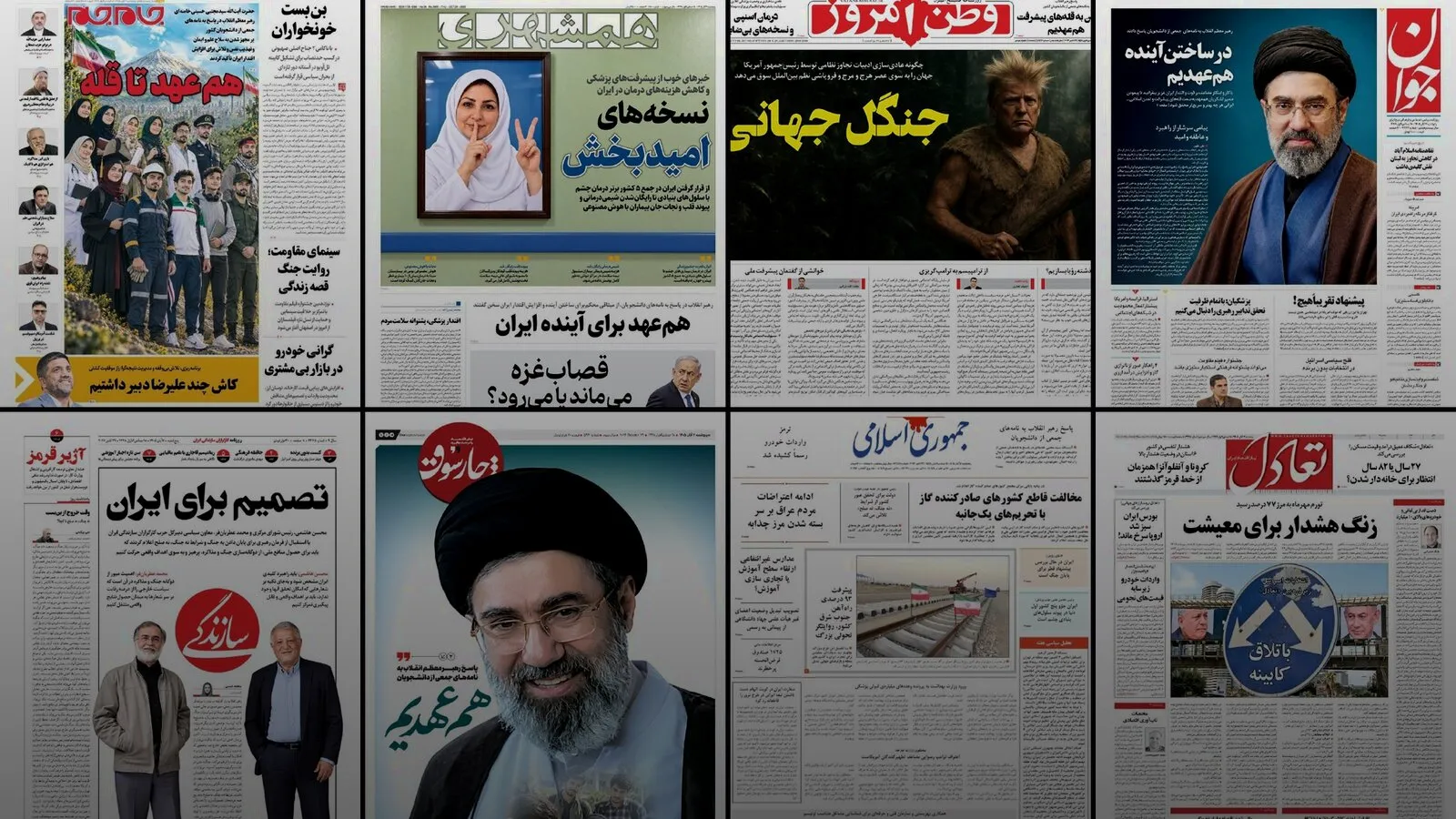
Bottom line: On the morning of Day 240 the Iranian system spent its front pages on cohesion rather than on the exit it had declared two days earlier: nine of ten scanned papers carried the Leader’s covenant message to students, the IRGC-affiliated daily used the same page to reduce the Qatari draft to ‘an idea’ before any official rejection was published, and not one Persian front page printed a condition, a mechanism, an interlocutor or a date.
Executive Summary
The lead judgment of this cycle is that the exit declared on 27 October has acquired a text and, within forty-eight hours, an organised front-page opposition. Javan, the daily closest to the Islamic Revolutionary Guard Corps, led its lower front page with «پیشنهاد تقریباً هیچ!», ‘an almost-nothing proposal’, decked with the claim that Tehran, insisting the United States is not serious about diplomacy, treats the plan attributed to Qatar as being at the level of an ‘idea’. That is not a report of a decision; it is a headline written to lower the value of the only document in play, and it reproduces almost exactly the line a senior Iranian official gave Reuters on 28 October. Jomhouri Eslami, one column over, prints the bare sentence that Iran is reviewing Qatar’s proposal to end the war. Neither page carries a condition, a mechanism or a date. The emptiness this monitor recorded on 28 October has survived the arrival of a text.
The dominant feature of the edition, however, is not the war but a word. The Leader’s written reply to letters from a body of students was published on nine of the ten scanned pages, and six different mastheads built their headline out of the same root: Jam-e Jam’s «هم عهد تا قله», Javan’s «در ساختن آینده همعهدیم», Hamshahri’s «همعهد برای آینده ایران», Vatan-e Emrooz’s «تا رسیدن به قلههای پیشرفت همعهدیم», Etemad’s «لشکریان همعهد» and, in the strongest single piece of evidence available, Chaharsouq’s entire front page given to the one word «همعهدیم» over a composite portrait, with no market figure anywhere above the fold. An economic daily suspending its own subject for a leadership message indicates centrally-guided message discipline rather than organic editorial convergence. Jam-e Jam’s deck prints the serving Leader’s name in full, سیدمجتبی حسینی خامنهای, which closes the identification question for this edition and for the appendices.
The content of that message is worth separating from its distribution. It instructs students to arm themselves with the weapon of science and knowledge, to practise self-purification, and to strive so as to add to Iran’s اقتدار. It is addressed to endurance and national capability. It says nothing about the war, the conditions, the mediators or the timetable. Read beside the 27 October audience with the Secretary of the Supreme National Security Council, the pattern is a leadership that has made ending the war the declared objective in front of a security audience and has made endurance the declared virtue in front of a civilian one, on consecutive cycles, without reconciling the two in public.
Both flanks moved on the gap between them on the same morning. Against Javan’s devaluation, Sazandegi gave its whole front page to Mohsen Hashemi and Mohammad Atrianfar of the Kargozaran-e Sazandegi party, who welcomed what they called the Leader’s instruction to end the war and then argued that national interests require abandoning the manufactured dichotomy of war versus negotiation for real action, with Hashemi demanding that Iran stop leaning on slogans it has no possibility of realising. Ali Bigdeli’s signed column on the same page asks, with a question mark, whether the emphasis on ending the ‘neither war, nor peace’ condition is the negotiating path opening, and argues that military positions do not convert themselves into political outcomes. That is the furthest any front page went this cycle, and it went in the opposite direction to the IRGC-affiliated title.
Israel arrived on the Iranian front pages in force, and the frame every outlet chose was paralysis rather than an outcome. Jam-e Jam led its rail with «بنبست خونخواران»; Javan with «فلج سیاسی اسرائیل در انتخابات بدون برنده», printing the arithmetic correctly; Hamshahri with the two scenarios for ‘the butcher of Gaza’; Ta’adol, an economic paper, with a photographed road sign captioned «باتلاق کابینه»; Etemad with a named analyst on a coalition to unseat Netanyahu; and Kayhan with «پایان رقابت بین دو نسلکُش هیچکدام پیروز نشدند!». The uniformity is the finding: not one title claimed the result as an Iranian success, and the hardline flagship denied legitimacy to both blocs rather than preferring either. This closes the negative-evidence judgment filed on 28 October, when Israel voted and no Persian front page led on it; that silence was a timing artefact.
What the front pages did not carry is as instructive as what they did. The Wall Street Journal’s report that Vice President JD Vance wrote to Mohsen Rezaei to reopen a channel, and Axios’s addition that the letter requires any talks to cover the nuclear file, appear on the Etemad, Vatan-e Emrooz and Nour News channels and on no scanned front page. Al-Hadath’s report of consultations about a meeting in Turkey before 4 November, with Iran asking to compress a seven-day period to four and the nuclear file inside the timetable, is on Etemad’s channel only. The reported strike on Saudi Arabia’s Ras Tanura, the suspension of flights at King Fahd International in Dammam and explosions in the Eastern Province and Najran run on four channels and lead nothing. The Strait of Hormuz appears as administration rather than threat: a fourteenth MQ-1 claimed off Sirik, carried identically by five channels; global food companies warning on prices; American diesel at $6.25 a gallon; and a recirculated Obama clip saying Iran now holds a veto over the strait. The escalation is being kept where it can be read and not where it would have to be defended.
Beneath all of it sits a number. Ta’adol led on inflation in the month of Mehr reaching the 77 percent threshold, alongside its housing series asking whether the wait to own a home is twenty-seven years or eighty-two. Sazandegi ran a red-alert box carrying a Labour Ministry warning about the consequences of the negative trend continuing to year end. Jam-e Jam reported car prices rising in a market with no buyers. Etemad, meanwhile, broke the cycle’s only genuine domestic scoop: the Siyanat internet-control bill moving quietly through a special parliamentary commission with the instruction that it not yet be publicised, on the same morning a deputy communications minister conceded that filtering has degraded connection quality.
Net assessment: this is a cohesion edition, not a war edition. The system used its highest-value asset, the Leader’s own voice, on a civilian constituency and on the vocabulary of endurance, while the one live diplomatic text was devalued by the Guard’s paper and acknowledged in a single unadorned line by the establishment paper. The adversary was presented as paralysed rather than defeated, which supports waiting rather than acting. The two things that could change that calculation, a 77 percent inflation print and a reported strike on Saudi energy infrastructure, were both published, and neither was given a front-page lead on any political title. Read together, the edition is the press of a system preparing its public for a longer wait while leaving the exit open, unspecified, and in somebody else’s hands.
Key Judgments
- KJ-1 [HIGH] KJ-1. The Leader’s first mass civilian address of the post-succession period was published as a covenant, with near-total uniformity across the factional spectrum, and it says nothing about the war. The evidence is six mastheads building a headline from the same root on one morning: Jam-e Jam «هم عهد تا قله», Javan «در ساختن آینده همعهدیم», Hamshahri «همعهد برای آینده ایران», Vatan-e Emrooz «تا رسیدن به قلههای پیشرفت همعهدیم», Etemad «لشکریان همعهد» and Chaharsouq’s entire front page given to the single word, with Kayhan carrying the same message as a direct imperative and Jomhouri Eslami top-right. An economic daily suspending its own subject matter for a leadership message indicates centrally-guided distribution rather than organic convergence. The significance is the register: the instructions are study, self-purification and redoubled work toward اقتدار, which is a vocabulary of endurance, published two cycles after the same office made ending the war the declared objective in front of a security audience. Calibration: this is a judgment about publication and content, not about reception; nothing here measures whether students or the public accept the framing.
- KJ-2 [HIGH] KJ-2. The Qatari exit draft now exists as a text, and the Guard’s newspaper moved to devalue it before any official Iranian rejection was published. The evidence is Javan’s «پیشنهاد تقریباً هیچ!» with the deck that Tehran, insisting the United States is not serious about diplomacy, treats the plan attributed to Qatar as being at the level of an ‘idea’; Jomhouri Eslami’s single unadorned line that Iran is reviewing Qatar’s proposal to end the war; and Foreign Minister Araghchi’s statement, carried by Iran’s channel and Defa Press, that Iran will keep communicating through intermediaries to give diplomacy a chance. Open reporting of 28 October carries both a Qatari seven-day framework handed to Tehran with guarantor states, and a senior Iranian official telling Reuters that Qatar brought no proposal, only unacceptable ‘ideas’. Javan’s headline reproduces the second in a form the first cannot answer. The significance is that the pre-emptive devaluation appeared on the same page as the Leader’s covenant message, which is the clearest available indication of where resistance to the declared exit sits institutionally. Calibration: a newspaper headline is not a policy decision, and reading it as a rejection would overstate it; reading it as merely one paper’s opinion would understate the position of this particular paper.
- KJ-3 [HIGH] KJ-3. Israel’s electoral deadlock entered the Iranian front-page register in force, and every outlet chose paralysis rather than victory as the frame. The evidence is six titles on one morning: Jam-e Jam «بنبست خونخواران» with the deck that the two principal blocs failed to reach the quorum for a cabinet; Javan «فلج سیاسی اسرائیل در انتخابات بدون برنده», whose body prints 61 of 120 needed, the Netanyahu bloc at 53, the Eisenkot bloc at 48 and the Arab parties at 19; Hamshahri’s two scenarios for Netanyahu personally; Ta’adol’s «باتلاق کابینه»; Etemad’s interview with Rahman Ghahremanpour on a coalition to unseat him; and Kayhan’s «پایان رقابت بین دو نسلکُش هیچکدام پیروز نشدند!». The arithmetic matches open reporting with counting incomplete. The significance is twofold: KJ-9 of 28 October, filed as negative evidence when Israel voted and no Persian front page led on it, is closed as a timing artefact; and a paralysed adversary is an argument for waiting, which is consistent with the rest of this edition.
- KJ-4 [MODERATE-HIGH] KJ-4. A reformist party used a whole front page to attack the war-versus-negotiation binary by name, and claimed the Leader’s own instruction as its licence. The evidence is Sazandegi’s front page given to Mohsen Hashemi, head of the Kargozaran-e Sazandegi central council, and Mohammad Atrianfar, deputy for political affairs to its secretary-general, welcoming what the deck calls the Leader’s order to end the war and declaring that the national interest requires avoiding the dichotomy of war and negotiation (دوگانهسازی جنگ و مذاکره) and moving to real action, with Hashemi’s pull-quote demanding that Iran stop relying on slogans it cannot realise; and Ali Bigdeli’s signed column on the same page asking whether the emphasis on ending the ‘neither war, nor peace’ condition is the negotiating path opening. The significance is symmetry: on the same morning that the Guard’s paper devalued the only text in play, the reformist flank spent the Leader’s authority in the opposite direction. The exit’s content is now contested in public by both flanks simultaneously. Calibration: Kargozaran is a party, not a government, and this is advocacy, not a statement of Iranian policy.
- KJ-5 [MODERATE-HIGH] KJ-5. The American diplomatic channel is now in the Iranian press, carried as a foreign claim and printed on no Persian front page. The evidence is Etemad’s channel carrying the Wall Street Journal report that Vice President JD Vance wrote to the Secretary of the Supreme National Security Council to restart talks; Vatan-e Emrooz’s channel carrying Axios’s version, that a US official says any talks must address the nuclear issue; Nour News carrying it as a ‘Wall Street Journal claim’ of a confidential letter sent with Trump’s knowledge; and Etemad’s channel carrying Al-Hadath on consultations about a meeting in Turkey before 4 November, with Iran seeking to compress seven days to four and the nuclear file, including an invitation to inspectors, inside the timetable. Not one of the ten scanned front pages prints any of it. The significance is that the system is permitting the channel to be known while conceding nothing: a letter reported by the adversary’s press can be read by Iranians without any Iranian institution having to acknowledge receipt. Calibration: absence from ten scanned pages is not absence from the thirty-odd national dailies, and this judgment is bounded by the scan set.
- KJ-6 [MODERATE-HIGH] KJ-6. The most consequential reported escalation of the cycle, damage to Saudi energy infrastructure, was left entirely to the channels. The evidence is four channels carrying the same cluster: flight data indicating operations suspended at King Fahd International Airport in Dammam; Saudi reports of explosions in the Eastern Province and in Najran; and, citing OSINT accounts and satellite imagery, the claim that Ras Tanura’s main cracking unit was disabled, with Yemen’s armed forces claiming to have targeted Aramco facilities. Open reporting records a Houthi claim of a ballistic missile strike on Ras Tanura on 27 October, a contained fire near the export terminal, and no Saudi confirmation of refinery damage. Not one scanned front page leads on any of it. The significance is that this is precisely the development the previous cycle’s watch list named as the escalation to look for, and the Iranian press has handled it the way it handles things it wants circulated but not owned. Calibration: everything in this cluster is a claim; this monitor reports no confirmed battle damage, and the absence of Saudi confirmation is itself evidence worth weighing.
- KJ-7 [MODERATE-HIGH] KJ-7. The Tehran quadrilateral has become the system’s preferred architecture story, and the establishment paper has given it a frame that exceeds anything the participants published. The evidence is Jomhouri Eslami’s «تحلیل سیاسی هفته», which names Monday’s Tehran session on regional security arrangements attended by Saudi Arabia’s defence minister, Pakistan’s army commander and the head of Turkey’s intelligence service under the Supreme National Security Council secretary’s chairmanship, and then argues that because those three states are signatories of the ‘Mecca Pact’, Iran will be its complementary side. Open reporting confirms the meeting of 26 October, its participants (Khalid bin Salman, Asim Munir, Ibrahim Kalin, hosted by Mohsen Rezaei) and an agreement to continue consultations; no participant’s statement carries the complementary-side claim. The significance is the gap: Tehran is publicly converting a first consultative session into membership of an existing arrangement, which is the alternative on offer to a bilateral deal with Washington. Watch whether any of the other three states contradicts the framing.
- KJ-8 [MODERATE] KJ-8. The Strait of Hormuz held its place as administered coercion priced for foreign audiences rather than as a domestic threat. The evidence is the IRGC’s claim of a fourteenth MQ-1 destroyed east of the strait off Sirik, carried in identical wording by Defa Press, Nour News, Fars, Jam-e Jam’s channel and Vatan-e Emrooz’s channel; Iran Daily’s above-the-masthead banner that a new Israeli-instigated attack would be ‘devastating’ for global markets; Vatan-e Emrooz’s channel carrying global food companies’ warning on next year’s prices; Nour News on American diesel at $6.25 a gallon; and a recirculated Obama clip, on three channels, saying Iran now holds a veto over the strait. The significance is continuity with the administration thread recorded on 28 October: the chokepoint is being invoiced rather than brandished. Negative evidence, filed as part of this judgment: the 1 November enforcement deadline against a named carrier, which led this monitor’s watch list a cycle ago, appears on no scanned front page three days out.
- KJ-9 [MODERATE] KJ-9. Lebanon returned to the register after two cycles of silence, through Hezbollah’s own leader and not through any Iranian front page. The evidence is Sobh-e No’s channel carrying Naim Qassem rejecting the Lebanese government’s framework agreement with Israel as illegitimate and unconstitutional, refusing any discussion of disarming the resistance while occupation continues, and reading the Israeli election result as an example of the enemy’s failure; and Defa Press carrying Israeli shelling of Kafr Tebnit and Wadi al-Saluqi and demolitions in Khiam. No scanned Persian front page carries Lebanon at all. The significance is that KJ-11 of 28 October is only half closed: the file is active again in Iranian media space, but front-page Lebanon remains absent, which is the measure that matters for how much political weight Tehran is currently placing on that front.
- KJ-10 [MODERATE] KJ-10. The economic press published the cycle’s hardest constraint on any endurance strategy, and the political press did not engage it. The evidence is Ta’adol’s lead that inflation in the month of Mehr reached the 77 percent threshold, run with its housing series asking whether the wait to own a home is twenty-seven or eighty-two years; Sazandegi’s «آژیر قرمز» box carrying a Labour Ministry warning about the consequences of the negative trend running to year end; Jam-e Jam on car prices rising in a market with no buyers; and Ta’adol again on Covid and influenza crossing the red line together. Against that, Chaharsouq, an economic daily, printed no number at all and gave its page to the Leader. The significance is that the figure which governs how long Iran can wait is appearing only where the mass audience is not, and the one economic paper closest to the kiosk suspended its own coverage to carry a cohesion message. Calibration: the 77 percent figure is as printed by Ta’adol and was not independently verified here; it should be corroborated from a second title before being carried forward as established.
- KJ-11 [MODERATE] KJ-11. The internet-control file has returned under parliamentary cover and the reformist press broke it while attention was on the leadership message. The evidence is Etemad’s lead «طرح محرمانه», reporting that the ‘ordering of cyberspace’ is now before a special parliamentary commission and that the instruction attached to it is that it not yet be publicised, strapped as the paper’s own report on the silent reproduction of the Siyanat bill; and, the same morning, a deputy communications minister telling Etemad’s channel and Fars that domestically originated denial-of-service traffic outnumbered foreign traffic over ten days and that this, together with filtering, has degraded connection quality. The significance is procedural: a control measure moving under a special commission during a war, with publicity deferred, is the standard route by which contested legislation has advanced before, and it warrants a standing tracker row.
- KJ-12 [MODERATE] KJ-12. Proxy coercion against two Gulf land borders was advertised on the Leader’s flagship rather than by any state institution. The evidence is Kayhan’s front-page line attributing to Kataib Hezbollah the threat that if Iran’s borders are not opened, the Saudi and Jordanian borders will be closed; and, on Jomhouri Eslami’s front page, continuing Iraqi protests over the closure of the Chazabeh crossing. Open reporting dates that closure to about 21 October, records Baghdad’s official explanation as a security and equipment review, and records claims from Iraqi officials and from the Islamic Resistance in Iraq that Washington pressed for it; this monitor found no independent confirmation of the Kataib Hezbollah statement as worded. The significance is the choice of vehicle: a threat against Saudi and Jordanian trade, published in the Supreme Leader’s flagship and attributed to an Iraqi faction, applies pressure to the Qatari track without any Iranian official saying anything. Calibration: attribution by Kayhan is not verification, and the threat is reported here as the paper’s claim.
- KJ-13 [LOW-MODERATE] KJ-13. Negative evidence, filed as a finding: Kayhan’s daily editorial was not published to any surface this monitor could reach, for the second time in recent record. The evidence is that the Kayhan channel’s posts for 7 Aban carry the front-page headline list, the Leader’s message and a run of Saudi and American items, but no «یادداشت روز»; the paper’s own site was unavailable at compile time; and no Kayhan scan reached the scan set. The significance is a coverage gap rather than an editorial silence: the hardline flagship’s daily argument is the single highest-value read in this product, and on this cycle it is missing. It should not be interpreted as the paper having nothing to say. Calibration: this is a judgment about this monitor’s access, not about Kayhan’s output.
Macro Trends
- Covenant as the instrument of endurance. The word عهد and its compound همعهد did the work of policy on six front pages. The construction is reciprocal: the students pledge, the leadership pledges back, and the object of the pledge is اقتدار, national standing, rather than victory, settlement or survival. Nothing in the published message touches the war. A leadership that needed to prepare its public for a settlement would not spend its mass address on study, self-purification and redoubled work; a leadership preparing its public for a longer wait would spend it on exactly that. The treatment also advances the succession file: Chaharsouq and Javan put a large portrait of the serving Leader on the page, and Jam-e Jam printed his name in full, which is a step beyond the third-party corroboration this monitor recorded earlier in the month.
- The exit acquires a text and an organised opposition. Within forty-eight hours of the Leader making an end to the war the declared objective, both flanks had moved on the vacuum inside that declaration. Javan reduced the Qatari draft to ‘an idea’ in a headline before any official rejection was published; Sazandegi gave a whole front page to a party demand that the war-versus-negotiation binary be abandoned for pursuable objectives; Jomhouri Eslami acknowledged the review in one bare line. The structure of the argument has changed since early October: it is no longer about whether an exit is legitimate, it is about whether the only text in play is worth anything. Track whether Kayhan adopts Javan’s framing, which would make it a system position rather than an IRGC-flank one.
- The adversary framed as paralysed, not defeated. Six Iranian titles covered the Israeli election and none claimed it as a win. Kayhan denied victory to both blocs; Javan called it paralysis; Jam-e Jam called it deadlock; Ta’adol illustrated it as a wrong turn. The frame is analytically convenient for Tehran because a paralysed adversary is an argument for waiting rather than for acting, and it fits the covenant message on the same pages. It also means the Iranian press has, for the first time in weeks, a foreign political story it can run at length without having to make a claim about the battlefield.
- Regional architecture ahead of bilateral diplomacy. Jomhouri Eslami’s weekly analysis made the Tehran quadrilateral of 26 October the main story of the week, correctly naming the Saudi defence minister, the Pakistani army chief and the head of Turkish intelligence around the Supreme National Security Council secretary’s table, and then adding a claim nobody at that table made: that Iran becomes the complementary side of the ‘Mecca Pact’ for regional security. The distance between the event and the frame is the thing to watch, because it shows what Tehran wants the format to become, and because an architecture story is the available alternative to a bilateral deal with Washington.
- Escalation on the channels, cohesion on the pages. The cycle’s most consequential reporting, a claimed strike on Ras Tanura with Dammam’s airport suspended, the Vance letter, a Turkey venue with a compressed clock, a parliamentary bill to leave the NPT, Kataib Hezbollah threatening the Saudi and Jordanian borders, ran on Telegram channels and, where it reached paper at all, only as a headline list. This separation is now a stable pattern across the factional spectrum rather than a hardline device. Its effect is deniability: readers get the escalation, the system does not have to own it.
- The war priced in households. A 77 percent monthly inflation print, a housing wait measured in decades, car prices rising in a market with no buyers, a Labour Ministry red alert and a simultaneous Covid and influenza warning appeared on the economic and reformist pages while the political pages carried covenant language. The war’s cost is being published, accurately and without euphemism, in the part of the press that decision-makers read and the mass audience does not. That is the constraint on endurance, and it is the number any assessment of Iranian staying power has to start from.
Front-Page Snapshot
- Iran Daily - “President condemns US-Israel’s attacks on civilians as violation of int’l law” (State-affiliated English daily; the system’s outward-facing title) - The next round priced in markets; the US threat read as signalling [MODERATE-HIGH - economic deterrence for foreign markets]
- Javan - “In building the future we are bound by covenant / An almost-nothing proposal!” (Hardline, IRGC-affiliated) - Covenant at home; the Qatari draft reduced to ‘an idea’ [HIGH - pre-emptive devaluation of the live mediation track]
- Kayhan - “Add to dear Iran’s strength and standing with redoubled work and initiative” (Hardline flagship, editor appointed by the Leader’s office; read from its channel) - Leader as command; proxy pressure on the Saudi and Jordanian borders [HIGH - proxy coercion plus unverified strike claims on Saudi energy]
- Vatan-e Emrooz - “Global jungle” (Hardline principlist) - Trump as the collapse of international order [HIGH - escalation on the channel, delegitimisation on the page]
- Jomhouri Eslami - “Firm opposition of the gas-exporting countries to unilateral sanctions” (Establishment daily of the revolution’s founding generation) - Gas-exporter solidarity; the Tehran quadrilateral framed as a pact [MODERATE - regional architecture as the alternative to a bilateral deal]
- Jam-e Jam - “Bound by covenant, all the way to the summit” (Daily of the state broadcaster IRIB) - Leader’s covenant; Israeli deadlock; the war’s cost to America [MODERATE - cohesion and adversary-cost messaging]
- Etemad - “The confidential plan” (Leading reformist daily) - Internet-control bill revived; a coalition to unseat Netanyahu [MODERATE - domestic control measure surfaced; mediation kept off the page]
- Ta’adol - “An alarm bell for livelihoods” (Economic daily of the Iran Chamber of Cooperatives) - 77 percent inflation; the Israeli cabinet quagmire [MODERATE - economic stress at a level that constrains strategy]
- Sazandegi - “A decision for Iran” (Reformist daily of the Kargozaran-e Sazandegi party) - Reformist party demands real objectives over slogans [LOW - de-escalation advocacy from inside the system]
- Hamshahri - “Hope-giving prescriptions” (Tehran municipality daily, centrist) - Medical capability as national standing; Netanyahu’s survival [LOW-MODERATE - national-capability reassurance]
- Chaharsouq - “We are bound by covenant” (Economic daily, third year) - The covenant word given an entire front page [LOW - message discipline, no operational content]
Full report
The complete edition - per-paper front-page analysis and full translation appendices - is available as a PDF: Download the full report.
Compiled from Iranian front pages and outlet channels via open-source monitoring. Translations are editorial; named-figure attributions are verified against the source pages where possible.