Iranian Press Monitor - Monday, 5 October 2026 (Day 216)
Monday, 5 October 2026 · دوشنبه ۱۳ مهر ۱۴۰۵ · 23 Rabi’ al-Thani 1448 - Nine Persian front pages and one English front page of 13 Mehr 1405, read alongside six outlet channels and three agency wires; Kayhan is reconstructed from its own channel and Tehran Times from its own site.
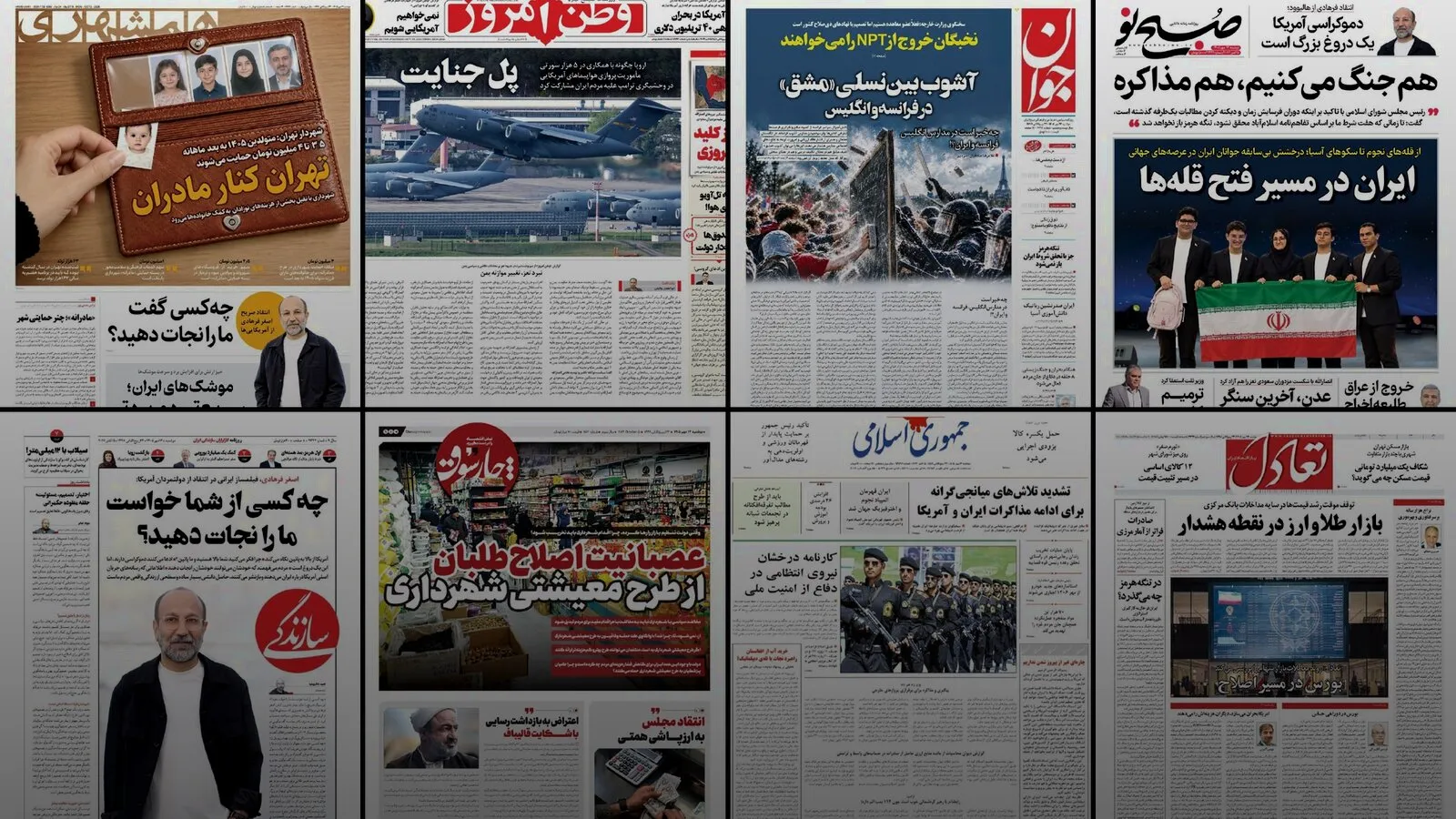
Bottom line: On the morning after Washington’s answer reached Tehran through Qatari mediation, the Iranian press published the negotiation as settled in substance and unsettled in sequence: three covers carried the Speaker’s seven conditions for reopening the Strait of Hormuz, a reformist broadsheet reduced the whole question to who takes the first step, and the Guard-affiliated daily placed withdrawal from the Non-Proliferation Treaty above its own masthead as the alternative.
Executive Summary
The lead judgment of this edition is that the Iranian press has stopped arguing about whether to negotiate and has begun arguing about the order of operations. Jomhouri Eslami, the clerical establishment daily that answers to no faction, gave the full width of its page to «تشدید تلاشهای میانجیگرانه برای ادامه مذاکرات ایران و آمریکا», the intensification of mediation efforts to continue the Iran-America negotiations, and sourced it to the foreign minister: «عراقچی: مسیر دیپلماسی برای پایان جنگ آمریکا علیه ایران همچنان باز است». Etemad, reformist, reduced the entire question to three words, «اول پایان جنگ», first, the end of the war, and then printed the actual obstacle in its deck: «گام نخست را چه کسی بر میدارد», who takes the first step. Sazandegi, from the same estate, put the agenda order in a top-bar box, «اول هرمز، بعد هستهای», Hormuz first, then the nuclear file, attributed to Araghchi. The independently reported state of the talks is that an American counterproposal reached Tehran through Qatari mediators, that the two sides largely agree on what has to happen, and that they remain divided over the order in which it happens. The Iranian front pages are not describing that disagreement. They are conducting it.
The counterweight is the Speaker, and he is the single most-published figure in the batch. Sobh-e No led with «هم جنگ میکنیم، هم مذاکره», we both fight and negotiate, over a quotation that is the enforcement standard of the whole edition: until our seven conditions based on the Islamabad memorandum are met, the Strait of Hormuz will not be opened. Iran Daily, the state’s English title, led with the same line in English. Javan carried it down its right rail as «تنگه هرمز جز با تحقق شروط ایران بازنمیشود». Three titles from three different estates printing one man’s conditions on one morning is the strongest message-discipline indicator in this batch, and it matters because of what it revises: this file recorded on 3 and 4 October that the Islamabad memorandum had vanished from the covers and that both factions were arguing the war would end inside the American political system instead. The memorandum is back, and it is back as a numbered instrument rather than as a grievance.
The escalation lever was published on the same morning, by the Guard-affiliated daily, above its own masthead. Javan’s banner reads «نخبگان خروج از NPT را میخواهند», the elites want withdrawal from the Non-Proliferation Treaty, over a strapline in which the Foreign Ministry spokesman says that for the moment Iran is a party to the treaty but that the decision rests with the country’s competent bodies. The independent record matches: Esmaeil Baqaei said on 4 October that Iranian elites are seriously discussing withdrawal, that Iran remains a member for now, and that the ministry will abide by the competent authorities’ decision. Placing the treaty on a front page as an elite consensus, with the ministry declining to rule it out and no official owning it, is how a reserve option is set on the table at no political cost. It is the only genuine escalation instrument in this edition, and it was published by the one title that has now gone six consecutive cycles without printing an Iranian military engagement.
Two named-belligerent constructions advanced. Vatan-e Emrooz gave its whole front page to a photograph of United States Air Force transports under two words, «پل جنایت», the bridge of crime, and a kicker charging that Europe took part in Trump’s savagery against the people of Iran by cooperating in five thousand American sorties. This is the first cover in this file’s record to name the European states as participants in the war rather than as diplomatic actors, and the construction is identical to the one the batch used for the United Arab Emirates on 3 and 4 October: a named party, a hidden contribution, a figure nobody can check. Separately, the Saudi thread opened on 4 October advanced from an unclaimed refinery fire to a claimed ground conquest: Kayhan’s front page asserts that Yemeni forces have entered Taiz city and that Saudi commanders and mercenaries have fled, Vatan-e Emrooz maps the governorate under «تعز کلید پیروزی», Taiz is the key to victory, and Sobh-e No banners «عدن، آخرین سنگر بنسلمان», Aden, bin Salman’s last redoubt. The independent record for 4 October has Ansar Allah taking ground in the Ash Shamayatayn and Al-Ma’afer districts of Taiz province while government forces still held the city centre. The Iranian claim is one step ahead of the ground.
The edition’s widest convergence is not political at all. Five titles carried the same interview with the film director Asghar Farhadi, given to Variety at the Rio film festival on 3 October, in which he said of American films about Iran that it is always a white man from the United States saving others and asked who had asked them to come and save us. Sazandegi gave him two thirds of its front page. Hamshahri ran «چه کسی گفت ما را نجات دهید؟» beside a full-length portrait. Vatan-e Emrooz, hardline, put him in the top-left box under «نمیخواهیم آمریکایی شویم», we do not want to become American. Sobh-e No rendered him as «دموکراسی آمریکا یک دروغ بزرگ است». Iran Daily carried the English original for foreign readers. A reformist party daily and a hardline principlist daily running the same auteur on the same morning is a convergence no instruction produced, because the material was not produced for them; what it shows is the press reaching for an anti-American argument carried by a figure it does not own and cannot be accused of scripting.
The domestic fracture sits on the economic pages and it points at the Speaker. Charsoogh, a principlist economic daily, printed «اعتراض به بازداشت رسایی با شکایت قالیباف», protest at Rasaei’s detention on Qalibaf’s complaint, over a portrait of the jailed cleric. The independently established record is that the judiciary confirmed on 28 September that the hardline deputy Hamid Rasaei had been transferred to Evin prison to serve ten months over a January 2024 article accusing the Speaker of manipulating parliamentary documents, and that he is the first sitting member of parliament imprisoned during his term. Sobh-e No carries a sympathetic commentary line on the continuing attacks on the Speaker. The man whose seven conditions three covers published this morning is, on a fourth cover from his own side of the factional line, the man who put a deputy in prison.
Net assessment: this is the most negotiation-forward edition this file has recorded, and it is also the edition in which the alternatives were published most explicitly. The press is preparing its readership for a settlement whose terms are numbered, documented and attributed to the legislature, while keeping two instruments visible in case it fails: the treaty, on the Guard’s daily, and the European allies, on the hardline daily, pre-assigned as the party to blame. Three things are missing and the absences are findings. The Leader published nothing and appears nowhere, for a second consecutive cycle, so the conditions now circulating carry parliamentary and ministerial authority and not his. Lebanon is absent from all ten covers for a fourth consecutive cycle while a Hezbollah official statement ran on the wires overnight. And the campaign against the president that resumed from Kayhan’s signed editorial slot on 4 October was not renewed today, even though an oil minister resigned in the middle of a war about oil and every cover that carried it treated it as administration.
Key Judgments
- KJ-1 [HIGH] The Iran-United States negotiation has moved from substance to sequence, and the Iranian press printed the sequencing problem itself on the same morning the American response was acknowledged. This is the edition’s highest-significance finding. The evidence is four covers. Jomhouri Eslami, a clerical establishment daily with no executive interest to serve, gave its banner to «تشدید تلاشهای میانجیگرانه برای ادامه مذاکرات ایران و آمریکا» and quoted the foreign minister saying «مسیر دیپلماسی برای پایان جنگ آمریکا علیه ایران همچنان باز است». Etemad led with «اول پایان جنگ» and put the obstacle in its deck: «گام نخست را چه کسی بر میدارد». Sazandegi boxed «اول هرمز، بعد هستهای» and attributed the agenda order to Araghchi. Tehran Times reported the Foreign Ministry spokesman saying Iran will submit further observations on the American response to its seven-day plan. The independently reported state of the talks is that Washington’s counterproposal reached Araghchi through Qatari mediators in Doha and that the two sides largely agree on the steps required but remain divided over their order. The significance is that the Iranian press is preparing its readership for a settlement rather than for a victory, and is doing so by naming the one remaining obstacle as procedural. Confidence is high on the press behaviour, which is documentary, and is not extended to any prediction about the outcome: reading four covers as insider knowledge would overstate them, and reading an exact match between the printed question and the reported sticking point as coincidence would understate them.
- KJ-2 [HIGH] The Islamabad memorandum returned to the Iranian front page as the legal basis for a numbered condition set, and this file revises its reading of 3 and 4 October that the document had been dropped. The evidence is a quotation printed in full. Sobh-e No’s deck reads «رئیس مجلس شورای اسلامی با تاکید بر اینکه دوران فرسایش زمان و دیکته کردن مطالبات یکطرفه گذشته است، گفت: تا زمانی که هفت شرط ما بر اساس تفاهمنامه اسلامآباد محقق نشود، تنگه هرمز باز نخواهد شد». Iran Daily leads with the same statement in English; Javan carries it in its rail as «تنگه هرمز جز با تحقق شروط ایران بازنمیشود». The independent record confirms the Speaker made the statement on 4 October, and reports that Tehran’s seven-point proposal was conveyed to Washington through Qatar and covers an end to the fighting in Iran and Lebanon, release of frozen assets, lifting of oil sanctions and an end to the naval blockade. The significance is in the register: on 3 and 4 October the memorandum appeared only as a grievance about the other side’s non-compliance, and today it appears as the instrument Iran is asking to have executed. A party that cites a document as the measure of its own conditions expects the document to be performed. Confidence is high; the revision is explicit.
- KJ-3 [HIGH] Withdrawal from the Non-Proliferation Treaty was published on an Iranian front page as an elite demand that the Foreign Ministry declined to foreclose, and it appeared on the Revolutionary Guard’s daily on the morning the rest of the batch published terms for de-escalation. The evidence is Javan’s banner, set above the masthead line in yellow on blue: «نخبگان خروج از NPT را میخواهند», over «سخنگوی وزارت خارجه: فعلاً عضو معاهده هستیم اما تصمیم با نهادهای ذیصلاح کشور است». The independent record has Esmaeil Baqaei saying on 4 October that Iranian elites are holding serious discussions on withdrawal, that Iran remains a party and is aware of its obligations, that the ministry will abide by the competent authorities’ decision, and that a member state should be able to exercise its treaty rights rather than face attacks and threats. The significance is the structure of the attribution: the demand belongs to unnamed elites, the decision belongs to unnamed competent bodies, and no office is exposed if it is withdrawn. That is how a state keeps an escalation option visible at zero political cost while negotiating. Confidence is high on the publication and on the spokesman’s words, and this file makes no judgment on whether a withdrawal is being prepared; the discriminating test is whether a named office, rather than a category, endorses it within the month.
- KJ-4 [MODERATE-HIGH] The European states have been named as participants in the air campaign against Iran, which is the first time this file has recorded the charge on a front page. The evidence is Vatan-e Emrooz’s whole cover: a photograph of United States Air Force C-17 transports under «پل جنایت», the bridge of crime, with the kicker «اروپا چگونه با همکاری در ۵ هزار سورتی مأموریت پروازی هواپیماهای آمریکایی در وحشیگری ترامپ علیه مردم ایران مشارکت کرد». The sortie figure is uncorroborated anywhere in this batch and is carried as the paper’s claim. The significance is that the construction matches, step for step, the one this file logged for the United Arab Emirates on 3 and 4 October: a party not previously named, a hidden operational contribution, a number nobody can check, published first by one title. On that occasion the test proposed was whether a second title picked the target up within the week, and it is the test here too. Confidence is moderate-high on the characterisation, which is a direct reading of the cover, and none at all on the sortie count. The alternative reading, that this is one hardline editor’s enthusiasm rather than a line, is live until a second cover names Europe.
- KJ-5 [MODERATE-HIGH] Five titles spanning the full factional range carried one interview given to a Western trade publication at a Brazilian film festival, which makes it the edition’s widest convergence and the first this file has recorded that no instruction could have produced. The evidence is the distribution. Sazandegi, reformist and party-owned, gave Asghar Farhadi two thirds of its front page under «چه کسی از شما خواست ما را نجات دهید؟». Hamshahri, the municipality’s centrist daily, ran «چه کسی گفت ما را نجات دهید؟» beside a full-length portrait. Vatan-e Emrooz, hardline, ran «نمیخواهیم آمریکایی شویم». Sobh-e No, principlist, rendered it as «دموکراسی آمریکا یک دروغ بزرگ است». Iran Daily carried the English original. The independent record places the remarks in a Variety interview at the Rio film festival on 3 October, where Farhadi said that in these films it is always a white man from the United States saving others and asked who had asked them to come and save us. The significance is that the Iranian press has found an anti-American argument whose author it does not employ and cannot be accused of scripting, which makes it usable abroad in a way Kayhan’s own prose is not. Confidence is moderate-high: the convergence is documentary, and reading it as centrally directed would go beyond the evidence, since the material was published by a third party before any of them could have commissioned it.
- KJ-6 [MODERATE-HIGH] The Saudi-as-target thread opened on 4 October has advanced from an unclaimed refinery fire to a claimed ground conquest, and the Iranian claim runs one step ahead of the independent record. The evidence is three covers plus a channel. Kayhan’s front-page headline list opens with «ورود یمنیها به شهر تعز؛ فرماندهان و مزدوران سعودی فرار کردند» and its analysis post pairs Taiz with Aramco still burning. Vatan-e Emrooz maps Taiz governorate in red under «تعز کلید پیروزی» with a kicker on striking Ansar Allah advances against the Saudi mercenaries. Sobh-e No banners «عدن، آخرین سنگر بنسلمان» and sources confirmation of Taiz’s liberation to a senior movement figure named on the page. The independent record for 4 October has Ansar Allah making fresh gains in the Ash Shamayatayn and Al-Ma’afer districts of Taiz province, having earlier taken Mokha on the Red Sea coast and cut the Sanaa-Taiz road, while Saudi-backed forces still held the city centre and the road south to Aden. The significance is twofold: the reciprocal-targeting doctrine published as accomplished on 4 October is now being followed by territorial claims published as accomplished, and the gap between claim and record is the measure of how far ahead of events the Iranian press is willing to run. Confidence is moderate-high on the convergence and on the gap; no confidence is placed in the conquest claim itself.
- KJ-7 [MODERATE-HIGH] The Speaker is simultaneously the most-published figure in this batch and the target of a principlist backlash inside it, and no higher authority has endorsed the conditions he is fronting. The evidence is a split across four covers. Three titles print Mohammad Baqer Qalibaf’s seven conditions as the terms on which the Strait reopens. Charsoogh, a principlist economic daily, prints «اعتراض به بازداشت رسایی با شکایت قالیباف» over a portrait of the jailed cleric, and Sobh-e No carries a commentary line questioning the continuing attacks on him. The independently established record is that the judiciary confirmed on 28 September that Hamid Rasaei, a hardline deputy, had entered Evin prison on a ten-month sentence arising from the Speaker’s complaint over a January 2024 article in the weekly 9 Dey accusing him of manipulating parliamentary documents, and that he is the first sitting member of parliament imprisoned during his term. The significance is that the public guarantor of Iran’s negotiating conditions is under attack from the estate whose acquiescence the conditions would need, and that the Leader’s office has endorsed nothing. Confidence is moderate-high: the backlash is documented and its connection to the negotiation is inference, which this file holds open.
- KJ-8 [MODERATE] The campaign against the president run from the Leader’s own newspaper was not renewed this cycle, and the obvious weapon was left on the ground. The evidence is a slot and a resignation. Kayhan’s «یادداشت روز», which on 4 October carried Davoud Manzour, bylined as the Raisi government’s budget chief, indicting the sitting executive for failing to rearrange the financial system for war and failing to implement resistance-economy policy, today carries a commemorative piece on Police Week signed Hassan Rashvand. On the same morning an oil minister resigned in the eighth month of a war about oil, and no cover converted it into an indictment: Hamshahri reported «تغییر سکاندار وزارت نفت» and the appointment of Hamid Bovard as acting minister, Sobh-e No placed it under «ترمیم کابینه» with a procedural demand that parliament receive a nominee quickly, and the government daily’s channel carried it flat. The currency complaint survives only as a parliamentary protest in Javan’s rail and in Charsoogh’s Hemmati item, with no office printed beside the name. The significance is that the domestic attack and the negotiating position are not being run on the same morning, which suggests sequencing rather than retreat. Confidence is moderate: one cycle is not a withdrawal, and this file revised the same thread in the opposite direction two days ago.
- KJ-9 [MODERATE] Negative evidence, filed as a finding: Lebanon reached no Iranian front page for a fourth consecutive cycle, on a morning when a Hezbollah official statement and a resumption of Israeli operations on the Syrian front both ran on the wires. The evidence is the split. The Defa Press wire carried, at 20:32, the head of Hezbollah’s executive council affirming that resistance continues as long as occupation persists, and separately carried Qatari and Jordanian condemnation of the resumption of Israeli operations on the Quneitra line. Across nine Persian covers and one English cover, neither item appears, and no other Lebanon material appears either. The significance is that the omission is now too long-running to be a print-deadline artefact: this is the fourth cycle, the one-cycle propagation lag established on 3 October has been allowed for, and the northern front is being withheld from the Iranian reading public while the Strait is given to it three times over. Confidence is moderate: four cycles establish a practice, and this file cannot distinguish between a decision not to publicise the northern front and an absence of Iranian-attributable activity on it.
- KJ-10 [MODERATE] A missile capability-growth claim was attributed to the regular Army rather than to the Revolutionary Guard, and it was carried on a municipal centrist daily rather than on a military title. The evidence is Hamshahri’s cover: «خیز ارتش برای افزایش برد و سرعت موشکها» over «موشکهای ایران؛ سریعتر، دوربردتر», the Army’s drive to increase the range and speed of missiles, Iran’s missiles faster and longer-ranged. The attribution on the page is to ارتش, the regular armed forces, which is not where Iranian missile claims normally originate in the press: the Guard-affiliated daily in this same batch printed no Iranian capability claim at all for a sixth consecutive cycle. The significance is institutional rather than technical. Publishing a capability claim under the Army’s name, on a paper owned by the Tehran municipality, broadens the set of bodies credited with the missile force and lowers the claim’s factional charge. Confidence is moderate: this is one cover’s attribution, the underlying claim is unverifiable from open sources, and a single instance does not establish a pattern. The discriminating test is whether a second title credits the Army with missile development within the month.
- KJ-11 [MODERATE] Negative evidence, filed as a finding: the Leader published nothing and appeared nowhere for a second consecutive cycle, so the conditions now circulating across the Iranian press carry parliamentary and ministerial authority and not his. The evidence is the absence across the whole batch: no message, photograph, citation or signature on any of the ten front pages of 13 Mehr 1405, and none in the Kayhan headline list for the same morning. The most recent message on this file’s record remains the wholly devotional text of 9 Mehr 1405 addressed to the 33rd National Prayer Conference, signed «سید مجتبی حسینی خامنهای»; the most recent statement in the independent record is from 28 September, carried by state television, saying the United States will be forced out of the region after painful blows and dares not advance beyond the Arabian Sea. The significance is specific to this edition rather than general: a seven-point condition set is being published as national policy by the Speaker, an American response to it is under review by the Foreign Ministry, and the office that would ordinarily have to bless any settlement has said nothing in public that any Iranian newspaper reader saw this morning. Confidence is moderate, and no inference is drawn about the Leader’s own position, which this batch does not support.
Macro Trends
- The argument moved from whether to negotiate to who moves first. Three covers from three estates published the sequencing question on one morning. Jomhouri Eslami gave its banner to «تشدید تلاشهای میانجیگرانه برای ادامه مذاکرات ایران و آمریکا» and quoted Araghchi saying the diplomatic path to ending America’s war against Iran remains open. Etemad reduced it to «اول پایان جنگ» and asked «گام نخست را چه کسی بر میدارد». Sazandegi boxed «اول هرمز، بعد هستهای» and attributed the order to the foreign minister. Tehran Times, in English, reported the Foreign Ministry spokesman saying Iran will submit further observations on the American response to its seven-day plan. The independently reported sticking point is the order of steps rather than their content, and the Iranian covers have printed exactly that.
- The Islamabad memorandum came back, as a numbered instrument. This file recorded on 3 and 4 October that the memorandum had disappeared from the covers and that both estates were arguing the war would end inside the American political system instead. Today Sobh-e No prints the Speaker’s line in full: until our seven conditions based on the Islamabad memorandum are met, the Strait of Hormuz will not be opened, with the preface that the era of grinding down time and dictating one-sided demands is over. Iran Daily leads with it in English and Javan carries it in its rail. The document has returned not as a grievance about Western non-compliance but as the legal basis for a condition set Iran is asking to have met, which is the register of a party that expects to sign something.
- The treaty was placed on the table without an owner. Javan’s banner, above its own masthead, reads «نخبگان خروج از NPT را میخواهند» over the Foreign Ministry spokesman saying that for now Iran is a member of the treaty but the decision rests with the country’s competent bodies. Attributing the demand to unnamed elites and the decision to unnamed competent bodies means no office has to own it and none has to withdraw it. It is the only escalation instrument published in this edition, it appeared on the Guard-affiliated daily, and it appeared on the same morning the rest of the batch published terms for de-escalation. Those two facts belong together: the lever exists to make the terms credible.
- Europe joined the named-belligerent list. Vatan-e Emrooz gave its entire front page to American transport aircraft under «پل جنایت» and a kicker charging that Europe, by cooperating in five thousand American flight-mission sorties, took part in Trump’s savagery against the people of Iran. No source in this batch corroborates the figure. What matters is the construction, which is the one this file logged for the United Arab Emirates on 3 and 4 October: name a party that has not been named before, assign it a hidden operational contribution, attach a number that cannot be checked. Building an indictment of the European allies on the morning three covers publish settlement terms suggests the function is domestic: to have a party to blame for whatever the settlement does not recover.
- Saudi Arabia went from target to claimed defeat, one step ahead of the ground. Kayhan’s front page asserts that Yemeni forces have entered Taiz city and that Saudi commanders and mercenaries have fled, and its analysis post pairs it with Aramco still burning. Vatan-e Emrooz maps the governorate in red under «تعز کلید پیروزی» with a kicker on striking Ansar Allah advances against the Saudi mercenaries. Sobh-e No banners «عدن، آخرین سنگر بنسلمان» and sources the confirmation of Taiz’s liberation to a senior movement figure named on the page. The independent record for 4 October is narrower: Ansar Allah gained ground in the Ash Shamayatayn and Al-Ma’afer districts of Taiz province, having earlier taken Mokha on the Red Sea coast, while government forces still held the city centre. The pattern to keep is that the Iranian press is now publishing Yemeni territorial claims as accomplished, which is a step beyond the capital-for-capital doctrine it published as accomplished on 4 October.
- The anti-American argument was outsourced to a figure the press does not control. Five titles carried Asghar Farhadi’s Rio film festival remarks: Sazandegi gave him two thirds of its cover, Hamshahri headlined «چه کسی گفت ما را نجات دهید؟», Vatan-e Emrooz ran «نمیخواهیم آمریکایی شویم», Sobh-e No rendered the line about American democracy being a big lie, and Iran Daily carried the English quotation. The material was produced for a Western trade publication at a Brazilian festival and was not commissioned by any of them. A hardline daily and a reformist party daily reaching for the same non-regime voice on the same morning is a different kind of convergence from message discipline: it is the press recognising that an argument against American tutelage is more useful when the person making it cannot be dismissed as a state employee.
- The Speaker is both the face of the conditions and the target of his own side. Charsoogh, principlist and economic, printed «اعتراض به بازداشت رسایی با شکایت قالیباف» over a portrait of the jailed cleric; Sobh-e No ran a commentary line questioning the continuing attacks on the Speaker. The independently established record is that Hamid Rasaei, a hardline deputy, was confirmed by the judiciary on 28 September to have entered Evin prison on a ten-month sentence arising from the Speaker’s complaint over a January 2024 article, and that he is the first sitting deputy imprisoned during his term. Mohammad Baqer Qalibaf is simultaneously the most-published figure in this batch and the subject of an ultraconservative backlash in it. Whether his standing survives as a settled asset is now a tracked question, because the conditions he is fronting have no higher endorsement on any cover in this batch.
- The campaign against the president was not renewed, and the obvious weapon was left unused. An oil minister resigned in the eighth month of a war fought over oil, and every cover that carried it handled it as administration. Hamshahri printed «تغییر سکاندار وزارت نفت» with the appointment of Hamid Bovard as acting minister; Sobh-e No put it bottom-left under «ترمیم کابینه», cabinet repair, with a demand that the government present a nominee to parliament quickly; the government daily’s channel carried it flat. Kayhan’s signed editorial slot, which on 4 October carried a Raisi-government budget chief indicting the sitting executive over the currency, today carries a commemorative police piece by Hassan Rashvand. The currency complaint survives only as a parliamentary protest in Javan’s rail and in Charsoogh’s Hemmati item. One cycle is not a withdrawal, and this file keeps the thread open at reduced weight.
- Lebanon is live on the wires and absent from the covers for a fourth consecutive cycle. The Defa Press wire carried, at 20:32, the head of Hezbollah’s executive council affirming that resistance continues as long as occupation persists, and carried Qatari and Jordanian reactions to the resumption of Israeli operations on the Quneitra line in Syria. Across ten front pages, nothing on either. This file rated the northern front a live flashpoint and has now recorded four consecutive cycles in which the only Lebanon material is on wires. The one-cycle propagation lag established on 3 October has been allowed for and does not cover a fourth absence; this is a standing editorial decision, and it is the clearest available indication that Tehran is not currently using the northern front to address its own public.
- The chokepoint was argued everywhere and enforced nowhere. Three covers published the conditions for reopening the Strait; none published an event in it. Ta’adol, the economic daily, was the only title to treat it as a question rather than a position, asking «در تنگه هرمز چه میگذرد؟». Kayhan, which sustained the lock formula longest, carried no chokepoint item at all for a fifth consecutive cycle. On the wires, a British maritime authority reported a security incident involving a tanker sixty nautical miles south of Al-Mokha in Yemeni waters, and Rear Admiral Ali Fadavi was carried claiming that no American or allied vessel remains in the Persian Gulf and that the Strait has been under Iranian control for an extended period. The claim is carried as a claim. The pattern this file logged on 4 October holds: maritime events reach the wires and reach the covers only when they can be captioned as something done to Iran.
Front-Page Snapshot
- Sobh-e No - “We both fight and negotiate” (Principlist) - The Speaker’s seven conditions anchored to the Islamabad memorandum; Hormuz stays shut until they are met [HIGH]
- Iran Daily - “Speaker says Strait of Hormuz will not reopen until conditions are met” (English-language state daily) - The same conditions published in English; the President’s claim that the economic war has failed [HIGH]
- Jomhouri Eslami - “Intensification of mediation efforts to continue the Iran-America negotiations” (Traditional clerical establishment) - Diplomacy given its own banner and sourced to the foreign minister; police commemoration below it [MODERATE]
- Etemad - “First, the end of the war” (Reformist) - Sequencing made explicit: who takes the first step [LOW-MODERATE]
- Javan - “Intergenerational unrest, the “homework” of France and England” (Hardline, IRGC-affiliated) - NPT withdrawal floated above the masthead as an elite demand; Hormuz conditions carried in the rail [HIGH]
- Vatan-e Emrooz - “The bridge of crime” (Hardline principlist) - Europe charged as a co-participant in the air campaign; Taiz framed as the decisive battle [HIGH]
- Kayhan - “The Yemenis enter the city of Taiz; Saudi commanders and mercenaries have fled” (Hardline, published under the Supreme Leader’s office) - Ground conquest claimed in Yemen; sanctions circumvention via Russian banking claimed; no chokepoint item for a fifth cycle [HIGH]
- Tehran Times - “Iran vows a stronger response to military attack while holding the diplomatic track open” (English-language state daily) - An American response acknowledged and under review; Araghchi keeps the track open, Qalibaf promises surprises [MODERATE-HIGH]
- Hamshahri - “Tehran stands with mothers” (Tehran municipality, centrist) - Municipal natalism leads; the Army credited with longer-ranged missiles; the oil ministry changes hands [MODERATE]
- Ta’adol - “The gold and currency market at the warning point” (Economic daily) - Intervention conceded to have halted the slide; the Strait asked about rather than asserted [MODERATE]
- Sazandegi - “Who asked you to save us?” (Reformist, Kargozaran party) - Farhadi given the whole page; Araghchi’s order, Hormuz before the nuclear file, boxed in the top bar [LOW]
- Charsoogh - “The reformists’ anger at the municipality’s livelihood plan” (Economic daily, principlist editorial line) - Municipal welfare defended; protest at a deputy jailed on the Speaker’s complaint [LOW]
Full report
The complete edition - per-paper front-page analysis and full translation appendices - is available as a PDF: Download the full report.
Compiled from Iranian front pages and outlet channels via open-source monitoring. Translations are editorial; named-figure attributions are verified against the source pages where possible.