Iranian Press Monitor - Saturday, 31 October 2026 (Day 242)
2026-10-31 · شنبه ۹ آبان ۱۴۰۵ · 20 Jumada al-Awwal 1448 - Nine front pages read in full (eight Persian, one English) from the morning of 31 October 2026, plus nine Iranian newspaper and agency channels; Tehran Times was unavailable at the time of compilation.
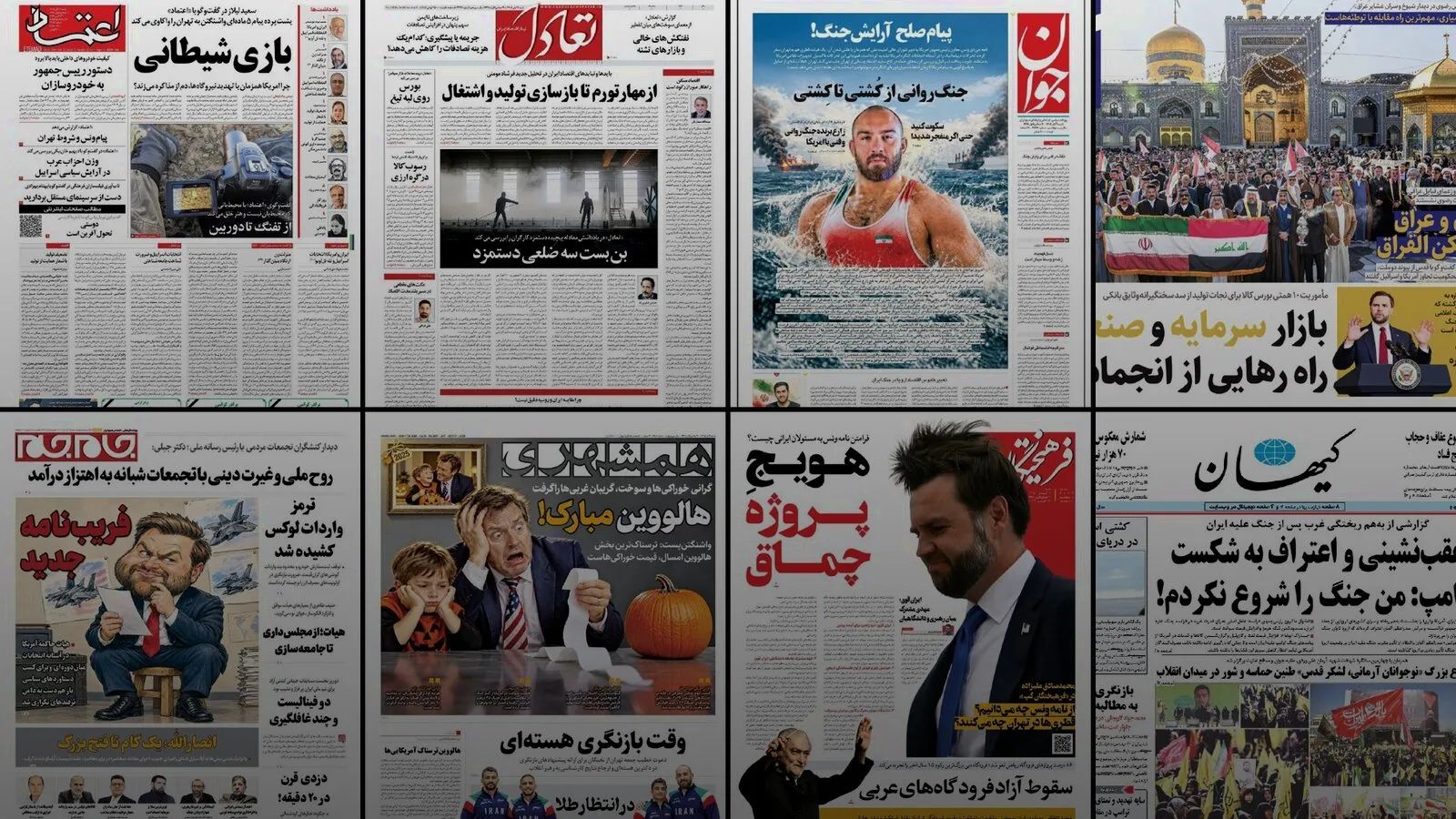
Bottom line: On the morning of Day 242 the Vance letter moved from the Telegram channels onto four Iranian front pages and was given a single shared reading, the carrot belonging to the stick project, while the Revolutionary Guard’s daily printed the decision that matters: Tehran will not answer before the American midterms on 3 November.
Executive Summary
The lead judgment of this cycle is that the American channel has been admitted to the front pages and simultaneously dated out of effect. Two cycles ago this monitor filed the Vance letter as a development visible only on Telegram and printed on no Persian front page. That finding is now closed in the strongest possible way: Farhikhtegan gives its entire upper page to a photograph of the US Vice President under the question «فرامتن نامه ونس به مسئولان ایرانی چیست؟», what is the subtext of Vance’s letter to Iranian officials, and answers it with «هویجِ پروژه چماق», the carrot of the stick project; Jam-e Jam gives its page to a caricature of a bearded American official reading a letter under the coinage «فریبنامه جدید», the new letter of deception; Qods photographs Vance at his podium under «واشنگتن در محاصره تناقضها», Washington besieged by contradictions; and Etemad asks «چرا امریکا همزمان با تهدید نیروگاهها، دم از مذاکره میزند؟», why America speaks of negotiation while threatening the power plants. Four papers from three factions reached the same construction on one morning. That indicates a distributed line rather than editorial coincidence.
The operative sentence of the edition is not in any of those headlines. It is in the lede paragraph of Javan, the daily closest to the Islamic Revolutionary Guard Corps, which prints the letter, its recipient, its carrier and its clock in one paragraph: the letter from Vice President J.D. Vance to the Secretary of the Supreme National Security Council, arriving alongside a Qatari delegation in Tehran, has intensified diplomatic movement on the eve of the US congressional elections, and «تهران فعلاً نشانهای از تمایل به پاسخگویی به پیام امریکا تا زمان انتخابات میاندورهای کنگره در سوم نوامبر (سهشنبه این هفته) نشان نمیدهد», Tehran currently shows no inclination to answer the American message before the midterm elections of 3 November, this coming Tuesday. A published decision rule with a date on it is the most actionable item this monitor has recorded in several cycles, and it is consistent with the external record: the letter is independently confirmed, its recipient is Mohsen Rezaei, and it was delivered through Qatari intermediaries.
Against that refusal, the system advertised the mediation tempo in English and suppressed it in Persian. Iran Daily’s banner reads ‘US carrot-and-stick approach will not work against Iran: Speaker’, and straps it with the one plain fact no Persian page prints: ‘Qatari delegation makes second visit to Tehran in a week.’ The English edition is written for foreign readers, and the choice to put the shuttle’s frequency there rather than in Kayhan is a message about availability rather than about willingness. Behind both, the Etemad channel carried an Axios report that Qatari-mediated talks continue in Doha with positive progress claimed, and that Doha is pressing Tehran to admit IAEA inspectors to the bombed nuclear sites as a confidence-building step. None of that reached a Persian front page.
The edition’s highest-significance finding is a second story running underneath the first. Revision of Iran’s nuclear doctrine appeared on three of the eight Persian front pages on one morning, in three registers. Kayhan carried it as a political fact, «بازنگری در دکترین هستهای به مطالبه ملی تبدیل شده است», revision has become a national demand, decked with Mohammad-Javad Larijani saying Iran is ahead of Pakistan, India and Israel in nuclear industry and that building a bomb is for Iran like making a toy. Hamshahri, the Tehran municipal mass-market daily, carried it as civic process: «وقت بازنگری هستهای», the Friday prayer leader inviting the elites to submit revision proposals and to refer the expert findings to the Leader of the Revolution. Qods carried it as clerical permission: «ضرورت گفتوگو در باب دکترین هستهای», the necessity of a debate, among possibilities that cannot be removed from national-security calculation. A doctrine question that one year ago lived in the security press is now being prepared on the page a Tehran commuter reads, as an orderly expert consultation ending on the Leader’s desk. That is how a taboo is revised rather than broken, and the mechanism named in public, proposals to the Leader, is the one that would actually be used.
The war itself did not pause for the letter. Across the agency channels, the Revolutionary Guard’s navy announced the explosion of a third and then a fourth tanker on what it calls the unauthorized southern route through the Strait of Hormuz, the fourth a supertanker carrying more than two million barrels; Nour News and Fars both carried the claim that eight tankers were struck in forty-eight hours and used it to attack CENTCOM’s statement that the strait had been cleared of mines. Kayhan’s front page carries the third tanker and, separately, the destruction and sinking of an Israeli container ship with 421 containers in the Black Sea, a claim with no named attacker and no Iranian institution behind it. The external record is genuinely contested here rather than simply unverified: CENTCOM stated on 28 and again on 30 October that primary transit routes had been cleared, and independent monitors have described the recent incidents using the language of projectiles and explosive devices rather than mine detonations, which is consistent with both accounts being narrowly true. What is not contested is the price: Brent above 119 dollars on the channels, and Farhikhtegan’s own banner reporting 86 percent of Riyadh airport flights cancelled and Dubai in its worst slump in fifteen years.
Two changes in register deserve recording because they run against this series’ expectations. The first is Kayhan’s. The Supreme Leader’s flagship built its entire lead out of the adversary’s published cost admissions, attributing to the German chancellor the admission that Europe is paying for the war and to the French president the statement that France’s purchasing-power crisis is caused by the war, the closure of the Strait of Hormuz and fuel prices, and running the headline «ترامپ: من جنگ را شروع نکردم!», Trump saying he did not start the war, as the admission of defeat. There is no Iranian battle-damage claim above the fold. A paper that has spent this war on the vocabulary of «خونخواهی», revenge, has spent this morning arguing that endurance is working. The second is Ta’adol’s. The economic daily, which this monitor treats as the edition’s control case, ran «نفتکشهای خالی و بازارهای تشنه», empty tankers and thirsty markets, over its report on middle-distillate fuels. That is the first front-page acknowledgement in this series that Iran’s own fuel logistics are being degraded by the maritime campaign Iran is prosecuting.
Net assessment: this is a cycle in which the Iranian system did three things at once and kept them in separate compartments. It acknowledged the American channel in print and voided it by dating it to an American election. It escalated the chokepoint campaign to a tempo its own agencies measure in tankers per day while publishing, in an establishment editorial, the proposition that Hormuz arrangements belong in a negotiated package. And it moved nuclear-doctrine revision from the security press to the mass-market page under clerical sponsorship, with the decision explicitly reserved to the Leader. None of the three compartments contradicts the others operationally, and that is the point: each is a distinct form of leverage being prepared for a decision point that the press has now dated for the first time. The edition’s silences are consistent with that reading. Lebanon appears on no front page for a third consecutive cycle, no Persian page prints the number of Qatari visits, and no page prints an Iranian condition apart from Etemad’s single word «شروط».
Key Judgments
- KJ-1 [HIGH] KJ-1. The Vance letter crossed from the Telegram channels to the front pages in a single cycle, and the Revolutionary Guard’s daily published a dated decision not to answer it before the American midterms. The evidence is four front pages on one morning: Farhikhtegan’s full-page Vance photograph under «فرامتن نامه ونس به مسئولان ایرانی چیست؟» and the headline «هویجِ پروژه چماق»; Jam-e Jam’s caricature under «فریبنامه جدید»; Qods’s photograph of Vance captioned «واشنگتن در محاصره تناقضها»; and Etemad’s «پیام ونس و شروط تهران». Javan supplies the decision in its lede: «تهران فعلاً نشانهای از تمایل به پاسخگویی به پیام امریکا تا زمان انتخابات میاندورهای کنگره در سوم نوامبر (سهشنبه این هفته) نشان نمیدهد». Open reporting independently confirms the letter, its recipient Mohsen Rezaei as Secretary of the Supreme National Security Council, and its delivery through Qatari intermediaries. The significance is that KJ-5 of 29 October, filed when the letter appeared on no Persian front page, is closed, and what replaced the silence is not an answer but a date. Calibration: a newspaper lede is not a cabinet decision, and reading Javan as the government would overstate it; but Javan is the title whose front page most reliably tracks the Guard’s institutional position, and treating this as one paper’s guess would understate it.
- KJ-2 [HIGH] KJ-2. Revision of Iran’s nuclear doctrine is being prepared in public, through a described procedure that reserves the decision to the Leader, and it has reached the mass-market page. The evidence is three of eight Persian front pages on one morning: Kayhan’s «بازنگری در دکترین هستهای به مطالبه ملی تبدیل شده است» decked with Mohammad-Javad Larijani’s claim that Iran leads Pakistan, India and Israel in nuclear industry and that a bomb is for Iran like making a toy; Hamshahri’s «وقت بازنگری هستهای» decked with the Friday prayer leader inviting elites to submit revision proposals and refer the expert findings to the Leader of the Revolution; and Qods’s «ضرورت گفتوگو در باب دکترین هستهای» among possibilities that cannot be excluded from national-security calculation. The sermon is independently confirmed, including the claim that more than seventy percent of respondents in earlier surveys favoured reconsideration and the statement that whatever the Leader decides will be followed. Beneath it, the channels carry a Majlis National Security Committee member saying Iran should build a weapon before leaving the NPT because the martyred Leader’s fatwa addressed an offensive posture, another calling for ninety percent enrichment so a new fatwa could be acted on at once, and ten registered NPT-withdrawal bills. The significance is procedural rather than technical: nothing has been decided, but the route by which it would be decided is being rehearsed in the papers with the widest circulation. Calibration: overstating this as a weapons decision would be a serious error, and as recently as September the Secretary of the Supreme National Security Council stated publicly that the doctrine had not changed; understating it as clerical rhetoric would miss that the mass-market framing is new in this series.
- KJ-3 [HIGH] KJ-3. The maritime campaign reached its highest claimed tempo of the war in the same cycle in which mediation doubled, and the two were kept in separate compartments of the press. The evidence is the IRGC Navy’s claim of a third and then a fourth tanker exploding on the ‘unauthorized’ southern Hormuz route, the fourth a supertanker carrying over two million barrels, carried identically by Kayhan’s front page and the Defa Press, Fars, Sobh-e No and Jam-e Jam channels; Nour News and Fars both carrying the claim of eight tankers struck in forty-eight hours as a refutation of CENTCOM’s clearance statement; and against that, Iran Daily’s banner that a Qatari delegation has made its second visit to Tehran in a week, with the Etemad channel carrying an Axios report of continuing Doha talks and a Qatari push for IAEA access to bombed sites. Not one Persian front page carries the mediation tempo, and the English page carries no tanker. The significance is that the system is running escalation and diplomacy on the same days while allocating each to a different readership. Calibration: every element of the tanker cluster is an Iranian claim; CENTCOM states the primary routes are clear, independent monitors describe projectiles and explosive devices rather than mine detonations, and this monitor reports no confirmed battle damage. The tempo claim is what matters analytically even where the individual incidents are unconfirmed, because the claim itself is the instrument.
- KJ-4 [MODERATE-HIGH] KJ-4. Kayhan abandoned battlefield claims for the adversary’s own cost accounts, which is a register change in the direction of endurance rather than escalation. The evidence is the whole front page: the lead strapped «گزارشی از بههمریختگی غرب پس از جنگ علیه ایران» and built from statements attributed to the German chancellor that Europe is paying for the war and to the French president that France’s purchasing-power crisis is caused by the war, the closure of the Strait of Hormuz and fuel prices, headlined with Trump disclaiming the war’s origin; a ‘dangerous Saturday’ in France with 70,000 personnel deployed; and a day-242 war report claiming seventy percent of Americans are pleading for an end. There is no Iranian damage claim above the fold. The German chancellor’s cost statement is independently corroborated at above one hundred billion euros over eight months, explicitly linked to the closure of the strait; the French rendering and the polling figure are Kayhan’s and are not corroborated here. The significance is that the Supreme Leader’s flagship is arguing that waiting is working, which is the editorial precondition for a longer war rather than for a near-term strike. Calibration: a register change in one cycle is not a trend; the test is whether the same construction appears after 3 November.
- KJ-5 [MODERATE-HIGH] KJ-5. The Strait of Hormuz appeared in Iranian print for the first time as a negotiable file and as an active weapon in the same cycle. The evidence is the Jomhuri Eslami editorial carried on the Etemad channel, «فرصت نامه ونس را جدی بگیرید؛ مذاکره به معنای تسلیم نیست», which proposes a comprehensive Iranian package containing nuclear steps, sanctions relief and «ترتیبات تنگه هرمز», arrangements for the strait, each with verification mechanisms, set against the IRGC Navy’s tanker claims on the same days. The significance is that the administration thread this monitor has tracked since early October, the chokepoint invoiced rather than brandished, now has a counterpart inside the establishment press: the asset is being priced for a negotiating table as well as for the market. Calibration: Jomhuri Eslami is an establishment title and its editorials are unsigned and institutional, but it is not the government, and a published proposal is advocacy rather than an Iranian position. The editorial was read through another outlet’s channel rather than from the paper, which lowers the confidence a step.
- KJ-6 [MODERATE-HIGH] KJ-6. The Saudi energy file moved from the channels to a front page, and the framing offered is explicitly reciprocal rather than retaliatory. The evidence is Jam-e Jam’s «انصارالله؛ یک گام تا فتح بزرگ», decked that with the liberation of the strategic southern province approaching, the «محاصره در برابر محاصره» equation, siege for siege, has intensified against Aramco facilities; with Defa Press reporting rapid Yemeni advances in Taiz province and a tightening encirclement toward Lahij, Fars carrying Saudi reports of a drone attack from Yemen on its southern regions, and the Saudi air force striking Shamaytain district in Taiz. The significance is that KJ-6 of 29 October, filed when claimed damage to Ras Tanura appeared only on the channels, is now half closed: the campaign has front-page sponsorship from the state broadcaster’s daily, and the stated logic, siege answered by siege, ties Saudi energy infrastructure directly to the Hormuz closure rather than to Yemen’s own war. Calibration: the Aramco claim is Jam-e Jam’s and no Saudi confirmation of facility damage is available to this monitor; the ground advance is an Iranian and Yemeni claim.
- KJ-7 [MODERATE] KJ-7. Two system titles coordinated a transnational allegiance story three days before the American midterms. The evidence is Qods’s entire upper page, headlined in Arabic rather than Persian as «ایران و عراق لاینفک الفراق», photographing Iraqi tribal sheikhs holding the two flags in the Imam Reza shrine courtyard under the custodian’s line that unity and vigilance are the means of countering plots, with the deck reporting that the sheikhs spoke of state linkage, «بیعت با ولایت», allegiance to the velayat, and condemnation of American and Israeli aggression; and Kayhan’s matching rail item «لبیک با خامنهای در دارالذکر؛ عهد دوباره عراقیها در حرم امام رضا(ع)». The significance is the audience and the timing: an Arabic headline in an Iranian paper is addressed outward, and a demonstration of Iraqi allegiance published in the week of continued border friction is a claim about reach made where the American campaign can read it. Calibration: a shrine reception is a managed event, and the published allegiance of attending sheikhs is not a measure of Iraqi opinion.
- KJ-8 [MODERATE] KJ-8. Negative evidence: Lebanon is absent from every front page in this scan set for a third consecutive cycle, while the file remains active in Iranian media space. The evidence is that none of the eight Persian pages and neither the English page carries Lebanon in any position, against the Vatan-e Emrooz channel reporting renewed Israeli fighter overflights of southern Lebanese towns on the morning of 31 October. KJ-9 of 29 October recorded the file as half open: active on the channels, absent from the pages. It remains exactly there. The significance is the measure rather than the fact: front-page placement is how this press indicates where political weight is being applied, and Lebanon is receiving none of it in a cycle whose entire attention went to an American letter and a maritime campaign. Watch whether a Lebanese escalation after the midterms is matched by front-page placement, because a continued mismatch would indicate a deliberate decision to hold that front out of the public argument.
- KJ-9 [MODERATE] KJ-9. The economic press published the first front-page acknowledgement that Iran’s own fuel logistics are being degraded by the campaign Iran is prosecuting. The evidence is Ta’adol’s banner «گزارش «تعادل» از معمای سوختهای میانتقطیر: نفتکشهای خالی و بازارهای تشنه», empty tankers and thirsty markets, over its middle-distillate report, printed beside «بنبست سه ضلعی دستمزد», the three-sided wage deadlock, and «بورس روی لبه تیغ», the bourse on a knife edge. Until this cycle the maritime dimension appeared in the Iranian economic press only as a cost imposed on others. The significance is that the clock strategy published by Javan has a denominator, and the paper that prints the denominator is the one decision-makers read rather than the mass audience. Calibration: a single banner is not a trend, and no quantity is attached to it on the page. The 77 percent Mehr-month inflation print from 29 October did not reappear in this cycle and remains uncorroborated by a second title.
- KJ-10 [MODERATE] KJ-10. The system published its mediation tempo in English and withheld it in Persian, which is a signalling choice rather than an editorial one. The evidence is Iran Daily’s strap, ‘Qatari delegation makes second visit to Tehran in a week’, printed under the banner that the carrot-and-stick approach will not work, against eight Persian front pages none of which prints the number of visits, the mediators’ schedule or the Doha venue, and against Sobh-e No’s channel carrying only the generic formulation that consultations continue through intermediaries and that Iran is prepared for both scenarios. The significance is that an English state daily is the system’s quotable surface: putting availability there while putting refusal in Persian lets Tehran hold a public position of resistance for its own audience and a public position of reachability for Washington and Doha simultaneously. Calibration: absence from eight scanned pages is not absence from the thirty-odd national dailies, and this judgment is bounded by the scan set.
Macro Trends
- The channel admitted, the clock substituted for the answer. Four front pages from three factions printed the Vance letter on one morning and gave it one reading: an inducement attached to a coercion design rather than an alternative to it. Farhikhtegan’s «هویجِ پروژه چماق» and Jam-e Jam’s «فریبنامه جدید» are the same argument in think-tank and broadcast register respectively, and Jam-e Jam supplies the motive that makes a reply unnecessary, that the American establishment is manoeuvring before its midterms. Javan then converts the frame into a schedule by printing that no answer will come before 3 November. The construction lets the system be seen to know about the offer, be seen to refuse nothing, and concede no condition, all at once. The thing to watch is what replaces the clock on 4 November, because the argument as published has no content after that date.
- Nuclear doctrine moves from the security press to the kiosk. Three of eight Persian front pages carried revision of the nuclear doctrine on one morning, and the significant variable is not the hardline page but the municipal one. Hamshahri frames the question as an invitation to experts whose findings go to the Leader; Qods frames it as a calculation that cannot be excluded; Kayhan frames it as an accomplished national demand and attaches a named adviser’s claim that a weapon is trivially within reach. Underneath, the channels carry a Majlis National Security Committee member arguing that Iran should build a weapon before leaving the NPT and that the martyred Leader’s fatwa addressed an offensive posture while the present posture is defensive, another member calling for enrichment to ninety percent so that a new fatwa could be acted on quickly, and ten registered bills to leave the NPT. The decision remains reserved to one person and nothing has been decided; what has changed is that the route to a decision is now being described in public, in the papers with the widest circulation.
- The chokepoint as weapon and as file, published on the same morning. The maritime campaign reached its highest tempo of the war on the agencies’ own numbers, a third and fourth tanker claimed on the southern route and eight claimed in forty-eight hours, used to attack CENTCOM’s clearance statement rather than to threaten anyone. In the same cycle an establishment editorial argued that any Iranian package must contain «ترتیبات تنگه هرمز», arrangements for the Strait of Hormuz, alongside nuclear steps and sanctions relief, with verification. This is the first cycle in which the strait appears in Iranian print simultaneously as an instrument being used and as an asset to be traded. The administration thread this monitor opened in October, the chokepoint invoiced rather than brandished, has acquired its second half: it is now being priced for the table as well as for the market.
- Kayhan argues endurance from the adversary’s accounts, not from the battlefield. The Supreme Leader’s flagship built its entire front page out of Western cost admissions, European leaders on the price of the war and an American president disclaiming its origin, and printed no Iranian damage claim above the fold. The same construction runs through Hamshahri’s Halloween satire on Western food prices and through Farhikhtegan’s Gulf aviation collapse. The register is new for Kayhan in this war and it is analytically cheaper than victory: a case built from the adversary’s own ledgers cannot be falsified by an Iranian reverse, and it supports waiting rather than acting. Track whether it survives the midterms.
- Transnational legitimation timed to the American vote. Qods gave its whole top page, in Arabic rather than Persian, to Iraqi tribal sheikhs at the Imam Reza shrine pledging «بیعت با ولایت», allegiance to the velayat, and condemning American and Israeli aggression, under the custodian’s line that unity and vigilance are the means of countering plots; Kayhan ran the matching rail item on the same gathering. Two titles coordinating a transnational allegiance story three days before the US midterms, in a week of continuing friction over the Iraqi border crossings, is a demonstration of reach aimed at Iraqi and Gulf readers rather than at Iranians. It is the regional-architecture argument of previous cycles expressed in religious rather than diplomatic form.
- The cost of the campaign reaches Iran’s own page. Ta’adol ran «نفتکشهای خالی و بازارهای تشنه», empty tankers and thirsty markets, over a report on middle distillates, beside a wage settlement it calls a three-sided deadlock and a bourse on a knife edge. Until this cycle the war’s maritime dimension appeared in the Iranian economic press as a price Iran imposes on others. Printing a domestic distillate shortage on the front page of the Chamber of Cooperatives’ daily converts the chokepoint from an export of pressure into a shared cost, and it is the number that bounds how long the clock strategy can run.
Front-Page Snapshot
- Farhikhtegan - “The carrot of the stick project” (Principlist daily of Islamic Azad University) - The Vance letter read as the inducement phase of coercion; Gulf aviation in free fall [MODERATE-HIGH - the American channel acknowledged on the front page and pre-emptively delegitimized]
- Javan - “A message of peace, a formation for war!” (Hardline daily affiliated with the Revolutionary Guard) - The letter, the mediator and the decision not to answer before 3 November [HIGH - a published refusal to answer before the US midterms, printed beside US strike-option reporting]
- Jam-e Jam - “The new letter of deception” (Daily of the state broadcaster IRIB) - The letter voided as midterm manoeuvring; siege-for-siege named against Aramco [HIGH - the offer dated rather than refused while Saudi energy is named as a reciprocal target]
- Kayhan - “Retreat and an admission of defeat / Trump: I did not start the war!” (Hardline flagship of the Supreme Leader’s office, managing editor Hossein Shariatmadari) - Western cost admissions as proof endurance works; nuclear doctrine as national demand [HIGH - doctrine revision promoted on the Leader’s flagship alongside an unclaimed maritime attack]
- Qods - “Iran and Iraq: inseparable” (Conservative Mashhad daily of Astan Quds Razavi) - Iraqi tribal allegiance published at the shrine in Arabic; doctrine debate as unavoidable calculation [MODERATE-HIGH - transnational allegiance messaging plus clerical cover for doctrine revision]
- Etemad - “A devil’s game” (Leading reformist daily) - Simultaneous threat to the power plants and offer of talks; Tehran’s conditions named [MODERATE-HIGH - a named threat to Iranian power plants beside an argument for conditional engagement]
- Hamshahri - “Happy Halloween!” (Daily of the Tehran municipality, centrist and mass-market) - Western cost-of-living satire; nuclear doctrine framed as civic consultation [MODERATE - doctrine revision normalized for a mass audience]
- Iran Daily - “US ‘carrot-and-stick’ approach will not work against Iran: Speaker” (State-affiliated English daily published by IRNA) - Pressure rejected in English while the Qatari shuttle’s tempo is advertised [MODERATE - refusal of pressure paired with a published mediation tempo; no escalation content]
- Ta’adol - “From curbing inflation to rebuilding production and employment” (Economic daily of the Iran Chamber of Cooperatives) - Wage deadlock and a domestic distillate shortage: the binding constraint [LOW-MODERATE - no military content; the domestic cost of the maritime campaign surfaced]
Full report
The complete edition - per-paper front-page analysis and full translation appendices - is available as a PDF: Download the full report.
Compiled from Iranian front pages and outlet channels via open-source monitoring. Translations are editorial; named-figure attributions are verified against the source pages where possible.