Iranian Press Monitor - Wednesday, 19 August 2026 (Day 169)
Wednesday, 19 August 2026 · 28 Mordad 1405 · 6 Rabi al-Awwal 1448 - 13 Iranian front pages surveyed: nine Persian print titles read from scan (Javan, Sobh-e No, Kayhan, Nobonyad, Sedaye Iran, Charsou, Ta’adol, Etemad, Jomhouri Eslami) plus Iran Daily in English from scan, and three dailies read from their own channels (Vatan-e Emrooz, Jam-e Jam, Iran); Defa Press, Fars News and Nour News monitored for corroboration; Tehran Times was unavailable at the time
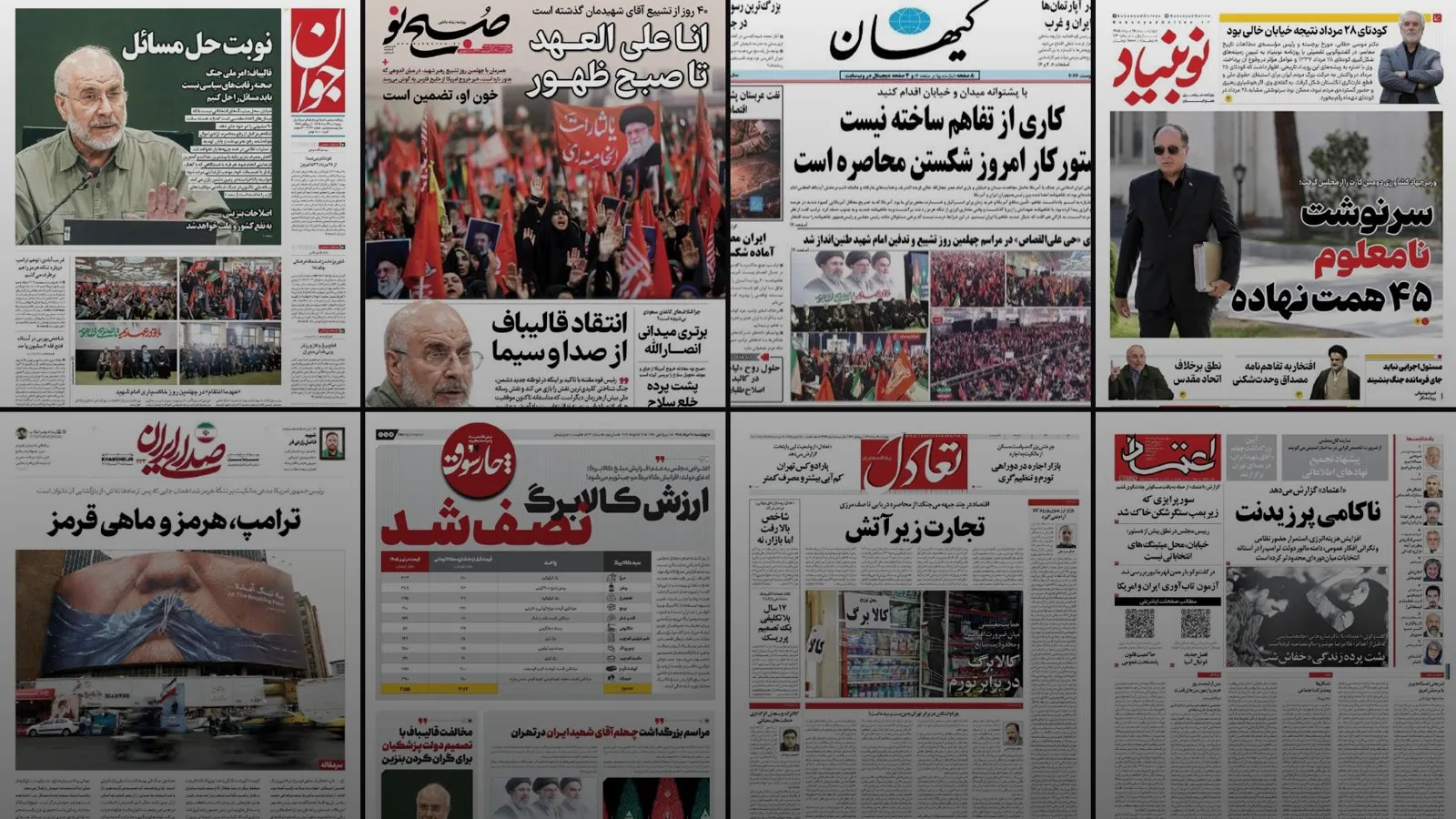
Bottom line: The day the accord’s sixty-day clock had run out, Iran converted its Hormuz ultimatum into declared policy: Speaker and lead negotiator Qalibaf stated, on the record and in English, that the strait stays shut until Washington lifts its port blockade, oil sanctions, asset freeze and military operations, while Kayhan foreclosed the diplomatic exit outright, the whole press tier read a Washington Post report of a possible Pentagon Gulf drawdown as proof of American retreat, and a real UAE-Iran rupture that the front pages pointedly did not carry ran underneath it all.
Executive Summary
The lead development of the 19 August edition is the hardening of the Strait of Hormuz from ultimatum into declared, conditioned state policy, stated by name and for external audiences. Iran Daily, the government’s English-language shop window, fronts Speaker of Parliament and lead negotiator Mohammad Bagher Qalibaf placing on the record that the strait will remain shut until Washington lifts its blockade of Iranian ports, lifts oil sanctions, releases Tehran’s frozen assets, and ends military operations. International wire reporting confirms the statement, dated a day after the Islamabad accord’s sixty-day deadline lapsed. Where the 18 August edition carried a Reuters-sourced seven-week ultimatum as reformist-fronted system messaging, this cycle the Speaker attaches his own name and a four-point condition set, and the state prints it in English: the closure is now official policy addressed to a foreign readership, not a hardline flourish.
The edition’s second axis is the split the closure exposes inside the system. On the same morning that Qalibaf keeps a conditional door open - comply, and the strait reopens - the hardline flagship Kayhan slams it shut. Its front-page Yadasht-e Rooz editorial, authored by Hossein Shariatmadari (channel post #81267), argues that the accord has been violated to the point of being void (‘nothing comes of the accord’) and that ‘today’s agenda is breaking the siege’ through military and field capability and popular mobilization, not negotiation. The accord dispute this monitor has tracked as a three-way argument thus resolves this cycle into a cleaner binary: conditional-leverage diplomacy (Qalibaf, the government daily) against maximalist rupture (Kayhan, and the principlist Nobonyad, whose front calls ‘pride in the memorandum an instance of breaking unity’). The strait is the instrument both camps claim.
Onto the closure the press welds a coordinated ‘America in retreat and decline’ construction that this cycle is anchored to a real external report. The government daily Iran and the principlist Sobh-e No amplify a Washington Post account that the Pentagon is weighing a reduced Persian Gulf posture after the war; Sobh-e No renders it as ‘news of America’s withdrawal from the Persian Gulf’ beside the fortieth-day commemoration. The original report describes an options study prompted by damage to more than 200 base facilities, not an ordered withdrawal - a distinction the Iranian framing erases. In parallel the reformist Etemad (‘the president’s failure’) and the establishment Jomhouri Eslami (‘the collapse of Trump’s standing in American public opinion’) make the US president’s domestic weakness the story, tying it to energy costs, the continued military presence and the coming midterms; Vatan-e Emrooz claims only about 35 percent of US senators back continuing operations. That the adversary-decline line now runs on the reformist tier as well marks it as centrally seeded rather than a hardline monopoly.
The single most consequential thing the edition does not say is the day’s sharpest finding. International reporting confirms a genuine UAE-Iran rupture: the Emirates suspended all trade, commercial exchanges and financial transactions with Iran ‘until further notice’ after accusing Tehran of firing two ballistic missiles toward the UAE on 18 August, one landing in its territorial waters, amid UAE charges that Iran struck its ADNOC vessels in the strait. The Iranian front pages carry none of this. They front instead the enforcement fact that flatters the closure narrative - the government daily reports a detained UAE-flagged tanker rerouted from Jebel Ali to Bandar Abbas - while omitting both the missile allegation and the Emirati trade break. The asymmetry is itself the signal: the press amplifies Iran’s own coercion leverage and suppresses the retaliation and the attribution that would complicate it.
Domestically the day belongs to Qalibaf, who surges across the batch on several fronts at once: an appeal for elite unity (‘the war is a national matter, not an arena for political rivalries’, Javan), a rebuke that ‘the street is not the venue for election rallies’ (Etemad), open criticism of the state broadcaster IRIB (Sobh-e No), and opposition to the Pezeshkian government’s petrol-price increase (Charsou). The Speaker is simultaneously the face of the Hormuz closure abroad and the arbiter of intra-elite competition at home, and he is the one the current Leader sends to Karbala as his representative. The economic press supplies the counter-current: Charsou’s ‘the ration coupon’s value has been halved’ and Ta’adol’s ‘trade under fire’ quantify a subsidy erosion of up to 70 percent and reframe the war as economic warfare, while Parliament hands the agriculture minister a second yellow card over 450 trillion tomans of livestock inputs. Even Ta’adol deflates the bourse rally that Javan celebrates (‘the index went up but the market did not’).
Two continuity threads persist beneath the external file. The current Supreme Leader, Mojtaba Khamenei, again issues no message of his own; the leadership appears only through the state-directed fortieth-day (chelom) commemoration of the martyred predecessor, Ali Khamenei, which Iran Daily dates forty days after the burial (reconciling the calendar earlier editions flagged), and through Qalibaf standing in for the Leader at the Karbala rite. The commemoration runs in an avenging register - Sobh-e No’s ‘O avengers of Khamenei’ banner, Kayhan’s ‘hasten to retribution’ cry. And the 28 Mordad anniversary of the US and UK-backed 1953 coup, its seventy-third, is worked across tiers (Nobonyad’s ‘the empty street’, Jomhouri Eslami’s ‘negligence and discord’, Iran Daily’s retrospective) into the historical-intervention frame that legitimizes present grievance.
Net assessment: this is a declared-closure edition in which the Hormuz leverage crosses from messaging into named, conditioned state policy printed for foreign readers, and in which the internal argument over the accord sharpens into a binary between conditional diplomacy and outright rupture. The regime anchors its ‘America in retreat’ construction to a real Pentagon-review report it overstates, and runs a suppression as deliberate as any amplification: the genuine UAE-Iran break and the missile allegation behind it are kept off the front pages. The threads to watch are whether Qalibaf’s four conditions harden into a formal negotiating text or prove rhetorical; whether the UAE rupture and the reported missile exchange escalate; whether the Pentagon posture review is confirmed or is being read into more than it says; and whether the accord split tips toward Kayhan’s rupture or the government’s conditional line. The current Leader remains present only by proxy and by mourning.
Key Points
- KJ-1 [HIGH] Iran converted its Hormuz ultimatum into declared, conditioned state policy, stated by name and for external audiences. Iran Daily fronts Speaker and lead negotiator Qalibaf placing on the record that the strait stays shut until Washington lifts its port blockade, lifts oil sanctions, releases frozen assets and ends military operations; international wire reporting confirms the statement, dated a day after the accord’s sixty-day deadline lapsed, and the government daily reports a detained UAE-flagged tanker rerouted to Bandar Abbas as the enforcement counterpart. Significance: where the prior edition carried the closure as a reformist-fronted, Reuters-sourced seven-week ultimatum, the Speaker now attaches his own name and a four-point condition set and the state prints it in English, moving the closure from messaging to official policy addressed to a foreign readership. Whether the four conditions harden into a formal negotiating text or prove rhetorical is the single most consequential thread to track.
- KJ-2 [HIGH] The accord dispute sharpened this cycle into a binary between conditional leverage and maximalist rupture, visible on one morning. Qalibaf’s front keeps a conditional door open (comply, and the strait reopens); Kayhan’s Shariatmadari editorial forecloses it (‘nothing comes of the accord; today’s agenda is breaking the siege’, channel post #81267), and Nobonyad calls ‘pride in the memorandum an instance of breaking unity’. Significance: the three-way argument the monitor tracked (‘almost nothing’ / ‘must not dead-end’ / ‘ultimatum’) resolves into a cleaner split between the government’s conditional-diplomacy line and a principlist rupture camp, with the strait as the shared instrument; the internal resolution of that split, not any external statement, is the concrete stake.
- KJ-3 [MODERATE-HIGH] Negative-evidence finding: a genuine UAE-Iran rupture was conspicuously absent from the Iranian front pages. International reporting confirms the UAE suspended all trade and financial transactions with Iran ‘until further notice’ after accusing Tehran of firing two ballistic missiles toward the Emirates on 18 August, amid UAE charges that Iran struck its ADNOC vessels in the strait; the Iranian press carries neither the missile allegation nor the trade break, fronting only the seized-tanker diversion that flatters the closure narrative. Significance: the suppression is as deliberate as the amplification and is a first-class finding - the press advertises Iran’s coercion leverage while withholding the retaliation and the attribution that would complicate it; whether the missile exchange and the trade rupture escalate is a live risk the domestic coverage conceals.
- KJ-4 [MODERATE-HIGH] The ‘America in retreat and decline’ construction now spans all tiers and is anchored to a real report the press overstates. Iran and Sobh-e No amplify a Washington Post account of a Pentagon study of a reduced Persian Gulf posture as ‘America’s withdrawal from the Persian Gulf’; the original describes an options study after more than 200 base facilities were damaged, not an ordered withdrawal. Etemad (‘the president’s failure’) and Jomhouri Eslami (‘the collapse of Trump’s standing’) run the adversary-decline line on the reformist and establishment tiers, with Vatan-e Emrooz’s claimed 35-percent Senate support. Significance: the near-simultaneous appearance across reformist, establishment and hardline titles marks a centrally seeded line rather than organic convergence; the load-bearing external claim is real but is being read into more than it states.
- KJ-5 [MODERATE] Leadership by delegation: the current Supreme Leader again issued no message of his own and was represented at the fortieth-day rite by the Speaker. Across the batch Mojtaba Khamenei appears only through the state-directed chelom commemoration of the martyred predecessor - which Iran Daily dates forty days after the burial, reconciling the calendar earlier editions flagged - and through Qalibaf attending the Karbala commemoration as his representative (Jam-e Jam, Iran channels). Significance: on a coordinated-messaging cycle, the current Leader’s continued editorial silence, filled by mourning for the predecessor and by a proxy standing in for him, remains a standing marker in the succession picture and should be logged as negative evidence, not silence.
- KJ-6 [MODERATE] Qalibaf emerged as the day’s central figure on both the external and domestic files. He is the face of the Hormuz closure abroad (Iran Daily), the voice of elite unity at home (‘the war is a national matter, not an arena for political rivalries’, Javan), a rebuke to electioneering (‘the street is not the venue for election rallies’, Etemad), a public critic of the state broadcaster (Sobh-e No) and an opponent of the government’s petrol-price hike (Charsou). Significance: the Speaker is consolidating a role as simultaneous chief external spokesman and arbiter of intra-elite competition, positioning against both the Pezeshkian government and IRIB while carrying the Leader’s proxy - a concentration of visibility worth tracking in the succession and 2027-cycle context.
- KJ-7 [MODERATE] The economic-realism dissent hardened into a quantified check on the chokepoint triumphalism. Charsou fronts ‘the ration coupon’s value has been halved’ with a 70-percent purchasing-power figure and an itemized price table; Ta’adol’s ‘trade under fire’ recasts the war as economic warfare across trade, currency, housing and drug supply and deflates the bourse rally Javan celebrates; Parliament handed the agriculture minister a second yellow card over 450 trillion tomans of livestock inputs. Significance: aimed at a decision-maker readership, this lane keeps insisting the binding constraints are structural and self-inflicted, an implicit rebuttal to the front-page coercion-confidence; the intra-establishment petrol-price fight (Qalibaf against the government) gives it a concrete budgetary edge.
Macro Trends
- Hormuz closure crosses from ultimatum to declared, conditioned policy - stated by name and in English. Iran Daily fronts Qalibaf, Speaker and lead negotiator, stating the strait stays shut until Washington lifts its port blockade, lifts oil sanctions, releases frozen assets and ends military operations. Confirmed by international wires and printed for a foreign readership a day after the accord’s sixty-day deadline lapsed, this converts the 18 August seven-week ultimatum into named state policy with an explicit condition set. The government daily supplies the enforcement counterpart: a detained UAE-flagged tanker rerouted to Bandar Abbas.
- The accord split sharpens into a binary: conditional leverage against maximalist rupture. On the same morning Qalibaf keeps a conditional door open, Kayhan’s Shariatmadari editorial forecloses it (‘nothing comes of the accord; today’s agenda is breaking the siege’, channel post #81267), and Nobonyad calls ‘pride in the memorandum an instance of breaking unity’. The three-way argument the monitor tracked resolves this cycle into conditional-diplomacy (Qalibaf, the government daily) versus outright-rupture (Kayhan, Nobonyad), with the strait as the instrument both claim.
- ‘America in retreat and decline’, anchored this cycle to a real report it overstates. Iran and Sobh-e No amplify a Washington Post account of a Pentagon study of a reduced Persian Gulf posture as ‘America’s withdrawal from the Persian Gulf’; the original describes an options study after more than 200 base facilities were damaged, not an ordered withdrawal. Etemad (‘the president’s failure’) and Jomhouri Eslami (‘the collapse of Trump’s standing’) carry the adversary-decline line on the reformist and establishment tiers, with Vatan-e Emrooz’s claimed 35-percent Senate support - marking a centrally seeded construction, not editorial convergence.
- The suppression that is the signal: a real UAE-Iran rupture the front pages omit. Outside reporting confirms the UAE suspended all trade and financial transactions with Iran after accusing Tehran of firing two ballistic missiles toward the Emirates on 18 August. The Iranian front pages carry neither the trade break nor the missile allegation; they front only the seized-tanker diversion that flatters the closure narrative. The asymmetry - amplify one’s own leverage, suppress the retaliation and the attribution - is a first-class finding, not an absence.
- Qalibaf’s multi-front surge: closure abroad, arbiter at home, Leader’s proxy in Karbala. The Speaker fronts the batch as the face of the Hormuz closure (Iran Daily), the voice of elite unity (‘the war is above politics’, Javan), the scold of electioneering (‘the street is not for rallies’, Etemad), a critic of the state broadcaster (Sobh-e No) and an opponent of the petrol-price hike (Charsou) - and the man the current Leader sends to represent him at the fortieth-day rite in Karbala. Qalibaf is simultaneously the day’s chief external spokesman and its central domestic actor.
- Economic-realism dissent hardens as a check on chokepoint triumphalism. Charsou’s ‘the ration coupon’s value has been halved’ and its 70-percent purchasing-power figure, Ta’adol’s ‘trade under fire’ recasting the war as economic warfare, the agriculture minister’s second parliamentary yellow card over 450 trillion tomans of feed inputs, and Ta’adol’s deflation of the bourse rally Javan celebrates keep insisting the binding constraints are domestic and self-inflicted - aimed at a decision-maker readership weighing coercion leverage against fragility.
- Succession by commemoration, and the 1953 coup as historical-grievance frame. Mojtaba Khamenei issues no message of his own; the leadership appears only through the fortieth-day commemoration of the martyred predecessor (dated forty days after burial by Iran Daily) and the Speaker’s Karbala delegation, in an avenging register (‘O avengers of Khamenei’; ‘hasten to retribution’). In parallel the seventy-third anniversary of the US and UK-backed 1953 coup is worked across tiers (Nobonyad, Jomhouri Eslami, Iran Daily) into the intervention narrative that legitimizes present grievance.
Front-Page Snapshot
- Iran Daily - “Strait of Hormuz to remain shut until US meets Islamabad MoU conditions: Qalibaf” (Official English-language daily) - The Speaker’s on-the-record, four-condition Hormuz closure, printed for external audiences [HIGH]
- Kayhan - “Nothing comes of the accord; today’s agenda is breaking the siege” (Ultra-hardline flagship (Shariatmadari)) - Diplomacy foreclosed; break-the-siege maximalism; twin-chokepoint economic war [HIGH]
- Sedaye Iran - “Trump, Hormuz and the goldfish” (Pro-leadership conservative) - Mockery of Trump’s Hormuz claim; the ‘breaking point’ mural [MODERATE-HIGH]
- Javan - “Time to solve the problems” (Hardline / IRGC-affiliated) - Qalibaf’s elite-unity appeal; Gharibabadi on Trump’s Hormuz ‘illusion’; backs petrol reform [MODERATE]
- Iran - “A detained UAE-flagged tanker is diverted to Bandar Abbas” (Official government daily (channel)) - Concrete Hormuz enforcement; amplifies the Pentagon Gulf-drawdown report [MODERATE-HIGH]
- Sobh-e No - “I am faithful to the covenant until the dawn of the appearance” (Principlist) - Fortieth-day revenge liturgy; ‘America’s withdrawal from the Persian Gulf’; Qalibaf vs IRIB [MODERATE-HIGH]
- Vatan-e Emrooz - “War after war” (Hardline / principlist (channel)) - Second chokepoint via Bab-el-Mandeb (Ansarallah); US Senate dissent as fracture [MODERATE-HIGH]
- Jomhouri Eslami - “The collapse of Trump’s standing in American public opinion” (Traditional / establishment) - Adversary decline plus statecraft (Iraq, Afghanistan, migration, AI, coup anniversary) [MODERATE]
- Etemad - “The president’s failure” (Reformist) - Trump constrained ahead of the midterms; Qalibaf ‘street not for rallies’; intelligence-merger proposal [LOW-MODERATE]
- Jam-e Jam - “What lies behind the alleged backing shortfall of online gold-and-silver platforms?” (State broadcaster / IRIB (channel)) - Domestic economy leads; Qalibaf to represent the Leader at Karbala [MODERATE]
- Nobonyad - “The agriculture minister’s second yellow card: the unknown fate of 450 trillion tomans in feed inputs” (Conservative / principlist) - Accord-skeptic (‘MoU pride breaks unity’); accountability; ration-coupon erosion [LOW]
- Charsou - “The ration coupon’s value has been halved” (Economic / business) - Subsidy erosion quantified; Qalibaf vs the government on petrol pricing [LOW]
- Ta’adol - “Trade under fire” (Economic / business) - War as economic warfare; deflates the bourse rally; housing and drug-supply strain [LOW]
Full report
The complete edition - per-paper front-page analysis and full translation appendices - is available as a PDF: Download the full report.
Compiled from Iranian front pages and outlet channels via open-source monitoring. Translations are editorial; named-figure attributions are verified against the source pages where possible.