Iranian Press Monitor - Tuesday, 18 August 2026 (Day 168)
Tuesday, 18 August 2026 · 27 Mordad 1405 · 5 Rabi al-Awwal 1448 - 12 Iranian front pages surveyed: nine Persian print titles read from scan (Kayhan, Nobonyad, Sedaye Iran, Sobh-e No, Sazandegi, Charsou, Jomhouri Eslami, Ta’adol, Etemad) plus three dailies read from their own channels (Vatan-e Emrooz, Jam-e Jam, Iran); Defa Press, Fars News and Nour News monitored for corroboration; the English scan was Iran Daily’s prior-day edition and Tehran Times was unavailable at the time
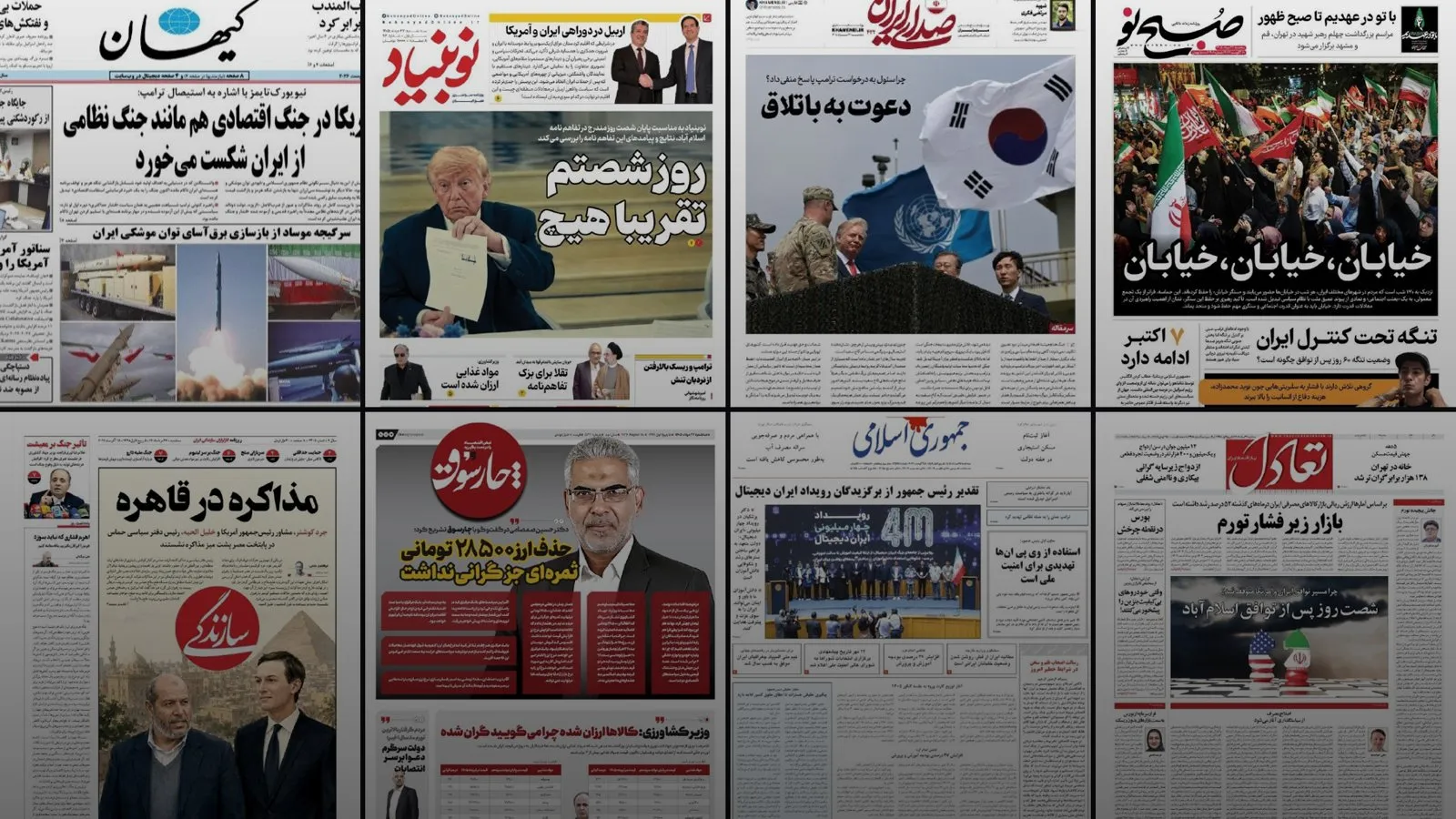
Bottom line: On the day the Islamabad accord’s sixty-day window closed, a real projectile strike on a cargo ship at the Hormuz exit, a Reuters-sourced Iranian ultimatum giving Washington seven weeks or a strait closure, and a reported U.S. threat to bomb Oman turned the two maritime chokepoints into the edition’s dominant coercion frame, while the reformist and economic press pushed back with Cairo diplomacy, a skeptical sixty-day verdict, and an insistence that inflation, not the war, is the binding problem.
Executive Summary
The lead development of the 18 August edition is the hardening of the Strait of Hormuz from rhetoric into a live, physical flashpoint, on the very morning the Islamabad accord’s sixty-day window expired. A cargo vessel was struck by an unidentified projectile at the exit of the strait, a maritime incident the government daily Iran, the state broadcaster’s Jam-e Jam and the agency Fars all carry in near-identical terms (حادثه برای کشتی باری در خروجی تنگه هرمز) and that Nour News sources to UK Maritime Trade Operations; independent reporting corroborates a cargo vessel hit by an unknown projectile northeast of Al Khasab, Oman, with a crew member missing. No party had claimed the strike at compile time. Onto this concrete event the reformist Etemad welds the day’s sharpest signaling: its banner اولتیماتوم ایران (‘Iran’s ultimatum’), sourced to Reuters quoting a senior Iranian official, reports that Tehran has given Washington seven weeks to fully implement the accord, failing which ‘all Iran’s arrangements for escalating tension in the Strait of Hormuz and closing it’ will be readied. That the reformist press, not a hardline title, fronts the ultimatum indicates it is being carried as system messaging rather than one camp’s provocation.
The chokepoint frame runs on two straits at once. The hardline flagship Kayhan opens the batch by fusing Hormuz and Bab-el-Mandeb into a single coercion narrative and monetizing it (انسداد تنگه هرمز و بابالمندب کرایه کشتیها را ۳ برابر کرد, ‘closure of Hormuz and Bab-el-Mandeb tripled ship freight rates’), while Vatan-e Emrooz elevates the southern strait explicitly as کابوس هرمز دوم (‘the second Hormuz nightmare’) with Yemen’s Ansarallah as the lever. The agencies supply the southern kinetic content: Defa Press reports an Indonesian-flagged vessel said to be carrying Saudi military equipment struck in Bab-el-Mandeb, with Yemen claiming responsibility, and a Yemeni ‘reciprocal blockade’ warning to Saudi Arabia. The two-chokepoint squeeze that the hardline titles theorize is, this cycle, matched by two real maritime incidents, though only the Hormuz strike is independently corroborated and neither is tied to a claimed Iranian operation.
The reported U.S. threat to strike Oman is the edition’s second major axis and its clearest ‘adversary in disarray’ construction. Jam-e Jam and Fars report that after Trump threatened to ‘heavily bomb’ Oman over the Hormuz obstruction, U.S. senators moved to constrain him, with Fars attributing a war-powers resolution to Senator Tim Kaine; the establishment Jomhouri Eslami surfaces the same story more cautiously as a question (ترامپ عمان را به حمله نظامی تهدید کرد؟). The state paper also carries a Wall Street Journal line that an Iran-Oman understanding could consolidate Tehran’s control over Hormuz, and Nour News reports Egypt and Kuwait urging both sides back to the memorandum. The Iranian press thus runs Oman two ways at once: as the target of an American threat that Washington’s own Senate is trying to block (proof of U.S. isolation), and as Tehran’s partner in a transit accommodation that alarms Washington.
The ‘America’s alliances are fracturing’ theme is seeded across tiers. Sedaye Iran leads on دعوت به باتلاق (‘an invitation into the quagmire’), asking why Seoul rejected a Trump request and generalizing it into ‘the forty-day war and the despair in the camp of America’s allies’; Jam-e Jam corroborates from Trump’s own complaint that South Korea declined to help against Iran; Vatan-e Emrooz reports Gulf ruling houses ‘dissatisfied with Washington’; and Kayhan imports an unnamed U.S. senator’s claim that Trump ‘dragged America into the war with lies.’ That the allies-recoiling line appears on a pro-leadership title, the state broadcaster’s paper and the hardline flagship on one morning marks a coordinated construction, though its load-bearing claims are adversary-press and second-hand.
Against the coercion frame, the reformist and economic desks press a de-escalatory counter-current, and the sixty-day accord milestone is read three incompatible ways. The reformist Sazandegi leads its entire front on مذاکره در قاهره (‘negotiation in Cairo’), the U.S.-Hamas track, correctly reporting that Jared Kushner met Hamas leader Khalil al-Hayya in Egypt’s capital, a meeting international reporting confirms took place on 16-17 August with Egyptian and Qatari mediators over a Gaza road map Netanyahu has rejected. On the accord itself, the principlist Nobonyad delivers a deflationary verdict, روز شصتم تقریبا هیچ (‘Day sixty: almost nothing’); the economic daily Ta’adol mounts the opposite case, چرا مسیر توافق ایران و آمریکا به بنبست نمیخورد؟ (‘why won’t the Iran-America path hit a dead end?’); and Etemad reframes the same expiry as an ultimatum. One milestone, three readings, is the sharpest evidence yet that the Islamabad accord’s standing inside the system is genuinely contested rather than settled.
Beneath the external file, two domestic threads persist. The counter-infiltration security drive advances into internet control: the establishment Jomhouri Eslami runs استفاده از ویپیانها تهدیدی برای امنیت ملی است (‘using VPNs is a threat to national security’) as its lead argument, extending the nofuz project this monitor has been tracking. And the economic-realism dissent hardens: the economic daily Charsou fronts a named economist, Hossein Samsami, arguing that scrapping the 28,500-toman preferential currency rate ‘yielded nothing but inflation,’ and both Charsou and Nobonyad stage the agriculture minister’s ‘goods have become cheaper’ claim against itemized prices. Ta’adol quantifies the squeeze (a 52 percent rise in the consumer market, a 138,000-fold long-run housing shock, 12 million youths of marriageable age with rising singlehood). For a decision-maker readership this lane keeps insisting the binding constraints are self-inflicted and structural.
Net assessment: this is a chokepoint-pressure edition in which, for the first time in several cycles, the coercion rhetoric is matched by a real, externally corroborated event, a projectile strike on a ship at the Hormuz exit, arriving precisely as the accord’s sixty-day clock runs out and as a seven-week Iranian ultimatum and a reported U.S. threat to bomb Oman raise the maritime stakes on both sides. The regime is running the two straits as a single leverage system while insulating an Iran-Oman transit accommodation and letting the state paper import U.S. domestic constraints on Trump as proof of American isolation. Cutting against all of it are the reformist spotlight on a negotiated Gaza exit, the open three-way fight over whether the Islamabad accord is worth keeping, and the economic press’s refusal to let the war narrative obscure inflation. The threads to watch are whether the Hormuz strike is attributed or escalated, whether the seven-week ultimatum is honored or is messaging, and whether the sixty-day accord reckoning tips the internal balance toward the hardline ‘almost nothing’ verdict or the economic ‘must not dead-end’ case. The current Leader again issued no message of his own, present only through the state-directed commemoration of his martyred predecessor.
Key Points
- KJ-1 [HIGH] The Strait of Hormuz shifted this cycle from rhetoric to a real, externally corroborated flashpoint. A cargo ship was struck by an unidentified projectile at the strait’s exit, carried in near-identical terms by the government daily Iran, the state broadcaster’s Jam-e Jam and the agency Fars, sourced by Nour News to UK Maritime Trade Operations, and consistent with independent reporting of a cargo vessel hit northeast of Al Khasab, Oman, with a crew member missing. Significance: for the first time in several editions the hardline chokepoint rhetoric is matched by a physical event at Hormuz, sharply raising the maritime risk, though no party had claimed the strike at compile time and it is not tied to any declared Iranian operation; the incident is documented, the attribution is open.
- KJ-2 [MODERATE-HIGH] Iran issued, and the reformist press fronted, a seven-week ultimatum tying full implementation of the Islamabad accord to the threat of closing Hormuz. Etemad’s banner ‘Iran’s ultimatum,’ sourced to Reuters quoting a senior Iranian official, reports that Tehran gave Washington seven weeks to implement the understandings or it will ready arrangements to escalate tension in and close the strait, published on the very day the accord’s sixty-day window expired and alongside the maritime strike. Significance: that a reformist title, not a hardline one, carries the threat indicates it is being circulated as system messaging; the deadline converts the accord’s milestone into a countdown, and whether it is honored or proves rhetorical is the single most consequential thread to track. The ultimatum’s terms are the outlet’s Reuters-attributed claim, held behind the firewall.
- KJ-3 [MODERATE-HIGH] The Islamabad accord’s standing inside the system is openly contested, read three incompatible ways on one morning. The principlist Nobonyad’s front-page verdict ‘Day sixty: almost nothing’ registers hardline buyer’s remorse; the economic daily Ta’adol argues ‘the Iran-America path won’t hit a dead end’; and Etemad reframes the expiry as an ultimatum. Significance: the coordination visible on Hormuz and Oman does not extend to the accord, where the factional spectrum divides between abandoning it as worthless and defending it as economically indispensable; the internal resolution of this split, not any external statement, is the concrete stake, and it is unusually visible this cycle.
- KJ-4 [MODERATE] The regime ran Oman simultaneously as the target of an American threat and as its own transit partner, using both to project U.S. isolation. Jam-e Jam and Fars report Trump threatening to bomb Oman over the Hormuz obstruction and U.S. senators (an attributed Kaine war-powers resolution) moving to block him; the state paper also carries a WSJ line that an Iran-Oman understanding could consolidate Tehran’s Hormuz control, and Nour News reports Egypt and Kuwait urging a return to the memorandum. Significance: casting Washington as restrained by its own Senate while Muscat deepens ties with Tehran advances the ‘America isolated’ construction and shields the accommodation track; the Oman-strike threat and the Senate resolution are attributed claims pending primary confirmation.
- KJ-5 [MODERATE] A coordinated ‘allies recoiling from America’ construction was seeded across the pro-leadership, state and hardline tiers. Sedaye Iran’s ‘invitation into the quagmire’ turns South Korea’s reported refusal of a Trump request into allied despair; Jam-e Jam corroborates it from Trump’s own complaint about Seoul; Vatan-e Emrooz reports Gulf houses ‘dissatisfied with Washington’; and Kayhan imports an unnamed senator’s claim that Trump ‘lied America into war.’ Significance: the near-simultaneous appearance across three tiers indicates a centrally seeded line rather than editorial convergence, and it is the signal worth logging; the underlying claims are adversary-press and second-hand and carry no independent confirmation.
- KJ-6 [MODERATE] The reformist and economic desks sustained the de-escalatory counter-current, spotlighting negotiated exits and domestic cost. Sazandegi led its entire front on the Kushner-al-Hayya Cairo talks, a Gaza road map confirmed in international reporting and rejected by Netanyahu; Charsou fronted economist Hossein Samsami blaming the scrapped preferential currency rate, ‘not war,’ for inflation; and both Charsou and Nobonyad rebutted the agriculture minister’s ‘goods are cheaper’ claim with itemized prices, while Ta’adol quantified a 52 percent consumer-market rise and a housing and marriage crisis. Significance: aimed at a decision-maker readership, this lane keeps insisting the binding constraints are structural and self-inflicted, an implicit check on the chokepoint triumphalism running on the hardline fronts.
- KJ-7 [MODERATE] Negative and domestic finding: the current Leader again issued no message of his own, and the security state advanced into internet control. Across the batch the leadership appears only through a state-directed commemoration of the martyred predecessor, memorial ceremonies in Tehran, Qom and Mashhad (Sobh-e No) and a textbook-revision program in his name (Iran), with no fresh statement from Mojtaba Khamenei. In parallel, Jomhouri Eslami’s ‘using VPNs is a threat to national security’ extends the counter-infiltration drive into digital-access control. Significance: on a coordinated-messaging cycle, the current Leader’s continued editorial silence, filled by commemoration of his predecessor, remains a marker in the succession picture, while the VPN framing shows the nofuz project widening toward internet restriction. The ‘fortieth’ (چهلم) commemoration label does not fit a late-February martyrdom and is reported as the outlet’s framing, not a verified fortieth-day count.
Macro Trends
- The two straits run as one leverage system, now matched by real incidents. Kayhan fuses Hormuz and Bab-el-Mandeb into a single coercion narrative (tripled freight rates), Vatan-e Emrooz elevates Bab-el-Mandeb as ‘the second Hormuz nightmare’ with Ansarallah as the lever, and the day supplies two concrete maritime events: a UKMTO-corroborated projectile strike on a cargo ship at the Hormuz exit (carried by Iran, Jam-e Jam and Fars) and an agency-reported, Yemen-claimed strike on a vessel in Bab-el-Mandeb. The hardline two-chokepoint doctrine is, this cycle, illustrated by real disruption, though only the Hormuz incident is independently confirmed and neither is tied to a claimed Iranian operation.
- A seven-week ultimatum converts the sixty-day accord mark into a countdown. The reformist Etemad fronts ‘Iran’s ultimatum,’ sourced to Reuters citing a senior Iranian official: seven weeks for Washington to fully implement the Islamabad understandings or Tehran readies arrangements to escalate and close Hormuz. Coming on the exact day the accord’s sixty-day window expires, and alongside the maritime strike, this reframes the milestone from a scorecard into a deadline. That a reformist title carries the threat indicates it is system messaging rather than a hardline outlier.
- Oman run two ways: American threat-target and Iranian transit partner. Jam-e Jam and Fars report Trump threatening to ‘heavily bomb’ Oman over the Hormuz obstruction and U.S. senators (a Kaine war-powers resolution) moving to block him, which Jomhouri Eslami surfaces hedged as a question. Simultaneously the state paper carries a WSJ line that an Iran-Oman understanding could consolidate Tehran’s Hormuz control, and Nour News reports Egypt and Kuwait urging a return to the memorandum. The regime thus casts Oman both as proof of U.S. isolation (its own Senate restraining it) and as the partner in a transit accommodation.
- The ‘America isolated, allies recoiling’ construction, seeded across tiers. Sedaye Iran’s ‘invitation into the quagmire’ (Seoul’s refusal), corroborated by Trump’s own complaint carried in Jam-e Jam, Vatan-e Emrooz’s ‘Gulf houses dissatisfied with Washington,’ and Kayhan’s imported U.S.-senator claim that Trump ‘lied America into war’ form a coordinated adversary-in-decline package spanning the pro-leadership, state-broadcaster and hardline titles. The signal is the cross-tier coordination; the underlying claims are adversary-press and second-hand.
- The Islamabad accord read three ways: ‘almost nothing,’ ‘must not dead-end,’ ‘ultimatum’. The principlist Nobonyad’s ‘Day sixty: almost nothing,’ the economic Ta’adol’s ‘why the path won’t hit a dead end,’ and the reformist Etemad’s reframing of the expiry as an ultimatum give one milestone three incompatible readings. The open split is the clearest evidence that the accord’s standing inside the system is genuinely contested, not settled system policy, and its resolution is the concrete internal stake to track.
- Reformist diplomacy spotlight and the standing economic-realism dissent. Sazandegi leads the batch on the Kushner-al-Hayya Cairo talks (a negotiated Gaza track, confirmed in international reporting, that Netanyahu has rejected), pointing readers to an off-ramp the hardline titles ignore. In parallel, Charsou’s named-economist verdict that scrapping the preferential currency rate ‘yielded nothing but inflation,’ the shared rebuttal of the agriculture minister’s ‘goods are cheaper’ claim, and Ta’adol’s inflation, housing and marriage-crisis leads keep insisting the binding problems are domestic and structural, an implicit check on front-page triumphalism.
- Internet control folded into the counter-infiltration drive; succession by commemoration. Jomhouri Eslami’s ‘using VPNs is a threat to national security’ advances the nofuz security project into digital-access control, the domestic stake this monitor tracks. Meanwhile the current Leader issued no message of his own; the leadership appears only through a state-directed commemoration of the martyred predecessor, memorial ceremonies in Tehran, Qom and Mashhad (Sobh-e No) and a program to revise school textbooks around ‘the martyred Leader of the Revolution’ (Iran), an institutional succession-legitimation effort running in the predecessor’s name.
Front-Page Snapshot
- Etemad - “Iran’s ultimatum” (Reformist) - Reuters-sourced seven-week deadline to implement the accord or close Hormuz [HIGH]
- Kayhan - “America, in the economic war too, is being defeated by Iran, as in the military war” (Ultra-hardline flagship) - Twin-chokepoint coercion (tripled freight rates) fused to economic-war triumphalism [HIGH]
- Iran - “An incident for a cargo ship at the exit of the Strait of Hormuz” (Official government daily (channel)) - The maritime strike and the U.S. escort-operations response; textbook revision on the martyred Leader [MODERATE]
- Jam-e Jam - “The [U.S.] Senate moves to block a Trump strike on Oman” (State broadcaster (IRIB) (channel)) - Oman-strike threat and Senate restraint; WSJ Iran-Oman-Hormuz line; the ship incident [MODERATE-HIGH]
- Vatan-e Emrooz - “The second Hormuz nightmare” (Hardline / principlist (channel)) - Bab-el-Mandeb as a second chokepoint (Ansarallah); Gulf states unhappy; U.S. in retreat [MODERATE-HIGH]
- Nobonyad - “Day sixty: almost nothing” (Conservative / principlist) - Deflationary hardline verdict on the sixty-day Islamabad accord milestone [MODERATE]
- Ta’adol - “The market under the pressure of inflation” (Economic / business) - 52% consumer-market rise, housing and marriage crisis; economic case for keeping the accord [LOW]
- Sedaye Iran - “An invitation into the quagmire” (Pro-leadership conservative) - Seoul’s refusal of a Trump request framed as allied despair; martyr commemoration [MODERATE]
- Sazandegi - “Negotiation in Cairo” (Reformist (Kargozaran)) - Kushner-al-Hayya Gaza talks in Cairo; cost of war and de-escalation [LOW-MODERATE]
- Sobh-e No - “The streets, the streets, the streets” (Principlist) - 170 nights of street mobilization; martyr commemoration in three cities; ‘strait under Iran’s control’ [MODERATE-HIGH]
- Jomhouri Eslami - “President honors the winners of the ‘Iran Digital’ event” (Traditional / establishment) - ‘Using VPNs is a threat to national security’; the Oman-strike item hedged; domestic governance [MODERATE]
- Charsou - “Scrapping the 28,500-toman preferential currency rate yielded nothing but higher prices” (Economic) - Named economist blames currency policy, not war, for inflation; rebuts ‘goods are cheaper’ [LOW]
Full report
The complete edition - per-paper front-page analysis and full translation appendices - is available as a PDF: Download the full report.
Compiled from Iranian front pages and outlet channels via open-source monitoring. Translations are editorial; named-figure attributions are verified against the source pages where possible.