Iranian Press Monitor - Thursday, 20 August 2026 (Day 170)
Thursday, 20 August 2026 · 29 Mordad 1405 · 7 Rabi al-Awwal 1448 - 13 Iranian front pages surveyed: nine Persian print titles read from scan (Hamshahri, Vatan-e Emrooz, Javan, Jam-e Jam, Sazandegi, Charsou, Ta’adol, Etemad, Jomhouri Eslami) plus Iran Daily in English from scan, and three dailies read from their own channels (Kayhan, Iran, Sobh-e No); Defa Press, Fars News and Nour News monitored for corroboration; Tehran Times was unavailable at the time
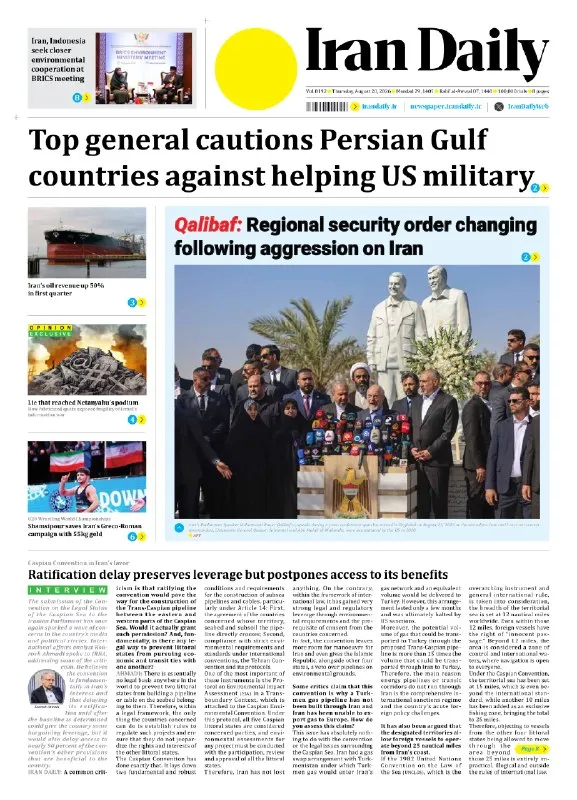
Bottom line: Iran widened its coercion this cycle from the strait to the shore: a top general, printed in English, warned the Persian Gulf states against helping the US military, and Qalibaf declared the regional security order itself changing, all inside a ‘Middle East without America’ construction run word-for-word across the hardline flagships, while the reformist and economic tier quietly insisted the binding constraints are domestic and the accord’s text says less than the hardliners claim.
Executive Summary
The lead development of the 20 August edition is the widening of Iran’s coercion from the Strait of Hormuz to the Persian Gulf littoral states themselves. The government’s English-language shop window, Iran Daily, fronts a warning attributed to a senior Iranian commander that the Gulf Arab governments should not host, help or facilitate the US military, and pairs it with a Qalibaf banner declaring the regional security order ‘changing following aggression on Iran.’ Where the 19 August edition converted the Hormuz closure into named, conditioned state policy addressed to Washington, this cycle turns the instrument on Washington’s regional partners: the message is aimed, in English, at the capitals whose alignment choices Iran now seeks to constrain. The government daily Iran supplies the semi-official grammar, an unnamed security official calling the US naval blockade ‘an act of aggression’ and warning regional countries of ‘consequences’ if restrictions on Iran continue.
Around that warning the hardline tier runs a single, coordinated construction: a Middle East without America. Kayhan’s front banner (‘Say hello to a Middle East without America’) and Vatan-e Emrooz’s (‘A Middle East without America,’ beside a torn US flag) carry the thesis in nearly identical words, and Javan frames it as ‘a new regional order without foreign intervention.’ The verbatim convergence across three separately owned flagships indicates centrally guided message discipline rather than organic editorial agreement. Vatan-e Emrooz welds the thesis to a domestic ‘narrative of reconstruction’ of war-damaged industry and to the Yemen front, while Javan pushes the doctrine from deterrent ‘warning’ to kinetic ‘action’ against the ‘origin of aggression.’ Defa Press corroborates the register: Qalibaf captioned an image of the Gulf and Oman Sea as ‘the center of gravity of the new regional order.’
The Speaker of Parliament, Mohammad Bagher Qalibaf, is again the batch’s central figure, now on the external file above all. He hosts a visiting Iraqi delegation, including Prime Minister Mohammed Shia al-Sudani, telling his Iraqi counterpart that ‘if we are not ready for war, negotiation too is fruitless’ (Hamshahri) and that ‘America is the cause of insecurity in the region’ (Sobh-e No), and warns that ‘America’s aim is to plunder the Persian Gulf countries.’ His war-readiness-as-precondition framing is the doctrinal bridge between the coercion abroad and the accord dispute at home; against it, Sobh-e No also carries an Erdogan mediation line (‘the only solution to the US-Iran conflict is negotiation’) that the hardline register rejects.
The intra-system contest the monitor has tracked broadened this cycle from one fault line to three. On the accord, the reformist Etemad mounts a documentary defense of the Islamabad memorandum, calling it ‘the new axis of radical claims’ and arguing those claims ‘have no standing when one refers to the text of the document.’ On national unity, Kayhan’s Yadasht-e Rooz by Hossein Shariatmadari red-lines the government’s own ‘vefaq’ (national concord) slogan, ruling that concord ‘cannot and must not’ include those ‘at an angle to the foundations of the revolution’ or ‘dependent on American support.’ And on security legislation, Jomhouri Eslami reports the government’s declared opposition to the hardline ‘anti-infiltration bill.’ The government and the reformist press are defending the accord’s letter, inclusive governance, and civil-liberties guardrails on three fronts at once against a principlist push to foreclose all three.
Two continuity threads persist beneath the external file. First, the suppression flagged a day earlier holds: the front pages advertise Iran’s coercion leverage over the Gulf while still carrying nothing of the UAE-Iran rupture reported on 19 August, and the escalation they do amplify is the Yemen front, where Vatan-e Emrooz’s ‘Sanaa’s full hand against Riyadh’ and Defa Press (Houthi spokesman Yahya Saree, nine missile and drone operations on Saudi oil facilities at Yanbu, Najran, Jizan and Abha) foreground an Ansarallah offensive as the axis-on-the-move story. Lebanon remains live but marginal, with Fars News noting Israeli operations in the south. Second, the sanctions-leak signaling continues: Defa Press reports a Chinese tanker transiting Hormuz despite Washington’s ‘iron wall’ blockade claim, presenting the closure as porous to Iran’s partners and airtight only to its adversaries.
The reformist and economic tier supplies the counter-current the front pages will not. Sazandegi indicts a domestic ‘oligarch class’ and warns in an editorial that ‘the costs of war are being ignored’; Ta’adol reads the PMI as merely ‘at the threshold’ of recovery, not recovered, and re-opens the preferential-currency rent file; Charsou documents frozen marriage and childbearing credit against 540 trillion tomans of nominal interest-free resources and currency-rent capture in car prices; Etemad and Ta’adol both carry the pharmaceutical industry’s financing strain. Aimed at a decision-maker readership, this lane keeps insisting the binding constraints are structural and self-inflicted, an implicit rebuttal to the ‘reconstruction’ and post-American-prosperity confidence broadcast above it. Even here the martial line is universal: Ta’adol prints the Pezeshkian cabinet’s pledge to ‘support the armed forces with all our might.’
Leadership again appears by commemoration rather than by voice. The current Supreme Leader, Mojtaba Khamenei, issues no message of his own; the leadership register is carried by the fortieth-day (chelom) commemoration of Iran’s martyrs at the Qom shrine (Jam-e Jam), by the religious mourning for the martyrdom of Imam Hasan al-Askari marked across Hamshahri and Jomhouri Eslami, and by the martyred predecessor Ali Khamenei invoked in Kayhan’s editorial. IRIB’s own daily, Jam-e Jam, defends the state broadcaster against a ‘suspicious Zionist-American move to erode its authority,’ the mirror image of the Qalibaf-versus-IRIB friction a day earlier.
Net assessment: this is a Gulf-on-notice edition in which Iran’s coercion crosses from the chokepoint to the shore, addressed in English to the Gulf Arab states and framed as a structural change in the regional security order, and in which a coordinated ‘Middle East without America’ construction runs verbatim across the hardline flagships. Beneath the unified external front, the internal contest widened to three fronts at once (the accord’s text, the government’s concord slogan, and the anti-infiltration bill), and the economic tier held its quantified line that the real constraints are domestic. The threads to watch are whether the Gulf-state warnings draw a public Arab response or a further alignment shift; whether the still-suppressed UAE rupture and the amplified Yemen-Saudi front escalate; whether the vefaq and anti-infiltration fights harden the government-versus-principlist split; and whether the sitting Leader’s continued editorial silence outlasts the commemorative cycle now filling it.
Key Points
- KJ-1 [HIGH] Iran extended its coercion from the Hormuz chokepoint to the Persian Gulf states themselves, warned in English against helping the US military. Iran Daily fronts a senior commander cautioning Gulf countries against hosting or assisting the US military, paired with a Qalibaf banner that the ‘regional security order is changing following aggression on Iran’; the government daily Iran calls the US naval blockade ‘an act of aggression’ and warns regional states of ‘consequences.’ Significance: where the prior edition addressed the closure to Washington as conditioned state policy, this cycle turns the instrument on Washington’s regional partners and prints it for an external readership, seeking to constrain the Gulf capitals’ alignment choices. Whether the warning draws a public Arab response or a further alignment shift is the single most consequential thread to track.
- KJ-2 [HIGH] The ‘Middle East without America’ construction was run verbatim across the hardline flagships, indicating centrally guided message discipline. Kayhan (‘Say hello to a Middle East without America’) and Vatan-e Emrooz (‘A Middle East without America’) carry the thesis in nearly identical words; Javan renders it ‘a new regional order without foreign intervention’; Defa Press corroborates with Qalibaf’s ‘center of gravity of the new regional order’ caption. Significance: the near-identical wording across three separately owned titles is evidence of coordinated seeding rather than organic convergence, and marks the post-American-order thesis as the cycle’s designated central line, not a hardline flourish.
- KJ-3 [MODERATE-HIGH] The intra-system contest broadened from one fault line to three simultaneous fronts. On the accord, Etemad defends the Islamabad memorandum by its text (‘radical claims that have no standing when one refers to the document’); on national unity, Kayhan’s Shariatmadari red-lines the government’s ‘vefaq’ slogan against those ‘dependent on American support’; on security legislation, Jomhouri Eslami reports the government opposing the ‘anti-infiltration bill.’ Significance: the government and reformist press are now defending the accord’s letter, inclusive governance and civil-liberties guardrails at once against a principlist push to foreclose all three, a widening of the split the monitor has tracked from foreign policy into the legitimacy of domestic reconciliation itself; its internal resolution is the concrete stake.
- KJ-4 [MODERATE-HIGH] Negative-evidence finding: the front pages continued to suppress the UAE-Iran rupture while amplifying the Yemen front as the escalation they will carry. The Iranian press advertises the Gulf-warning coercion line but still fronts nothing of the UAE trade break and missile allegation reported a day earlier; the escalation it does foreground is Ansarallah’s, with Vatan-e Emrooz’s ‘Sanaa’s full hand against Riyadh’ and Defa Press’s Houthi tally of nine strikes on Saudi oil facilities. Significance: the asymmetry persists as a first-class finding, the press advertising leverage it welcomes and withholding the retaliation and attribution that would complicate it; the substitution of the Yemen-Saudi front for the UAE rupture is itself a message-management choice, and whether either escalates is a live risk the domestic coverage conceals.
- KJ-5 [MODERATE] Qalibaf consolidated his role as the regime’s chief external voice, tying war-readiness to the value of negotiation. Hosting a visiting Iraqi delegation including Prime Minister al-Sudani, the Speaker states that ‘if we are not ready for war, negotiation too is fruitless’ (Hamshahri), that ‘America is the cause of insecurity in the region’ (Sobh-e No), and that ‘America aims to plunder the Gulf,’ while declaring the regional security order changing (Iran Daily). Significance: Qalibaf is the doctrinal bridge between the coercion abroad and the accord dispute at home, positioning readiness-for-war as the precondition for any talks and against the Erdogan mediation line Sobh-e No also carries; his concentration of external visibility remains worth tracking in the succession and 2027-cycle context.
- KJ-6 [MODERATE] Negative-evidence finding: the sitting Supreme Leader again issued no message of his own and was present only by commemoration. Across the batch Mojtaba Khamenei appears through the fortieth-day rite for the martyrs at Qom (Jam-e Jam), the mourning for Imam Hasan al-Askari (Hamshahri, Jomhouri Eslami) and the martyred predecessor invoked in Kayhan’s editorial, but issues nothing himself; senior officials carry the message discipline in his name. Significance: on a coordinated-messaging cycle, the current Leader’s continued editorial silence, filled by mourning for his predecessor and by proxy voices, remains a standing marker in the succession picture and is logged as negative evidence, not as absence of content.
- KJ-7 [MODERATE] The economic tier held a quantified line that the binding constraints are domestic and structural, against the front-page reconstruction confidence. Ta’adol reads the PMI as merely ‘at the threshold’ of recovery and re-opens the preferential-currency rent file; Charsou documents frozen marriage and childbearing credit against 540 trillion tomans of nominal interest-free resources and auto-sector currency-rent capture; Sazandegi warns ‘the costs of war are being ignored’ and indicts a domestic ‘oligarch class’; Etemad and Ta’adol both flag the pharmaceutical industry’s financing strain. Significance: aimed at a decision-maker readership, this lane is an implicit rebuttal to the post-American-prosperity and ‘narrative of reconstruction’ register above it, insisting recovery is stabilization at best and the deficits are self-inflicted.
Macro Trends
- Coercion crosses from the chokepoint to the shore, aimed at the Gulf states in English. Iran Daily fronts a top general warning the Persian Gulf countries against helping the US military, and the government daily Iran calls the US naval blockade ‘an act of aggression’ and warns regional states of ‘consequences.’ Where the prior cycle converted the Hormuz closure into named, conditioned policy addressed to Washington, this cycle turns the instrument on Washington’s regional partners, printed for an external readership. Qalibaf’s ‘the regional security order is changing’ banner supplies the doctrine and his ‘America aims to plunder the Gulf’ line the grievance.
- ‘A Middle East without America’ run verbatim across the hardline flagships. Kayhan (‘Say hello to a Middle East without America’) and Vatan-e Emrooz (‘A Middle East without America’) carry the thesis in nearly identical words, Javan frames it as ‘a new regional order without foreign intervention,’ and Vatan’s op-ed (‘the post-American world’) generalizes it. The word-for-word convergence across three separately owned titles indicates centrally guided message discipline, not organic agreement; Defa Press corroborates with Qalibaf’s ‘center of gravity of the new regional order’ caption.
- The internal contest widens from one fault line to three. On the accord, Etemad defends the Islamabad memorandum by its text and accuses the hardliners of manufacturing ‘radical claims’ the document does not support. On national unity, Kayhan’s Shariatmadari red-lines the government’s ‘vefaq’ slogan, excluding those ‘at an angle to the revolution’ and ‘dependent on American support.’ On security legislation, Jomhouri Eslami reports the government opposing the ‘anti-infiltration bill.’ The government-reformist side is defending the accord’s letter, inclusive governance and civil-liberties guardrails simultaneously against a principlist push to foreclose all three.
- The suppression holds; the amplified escalation is the Yemen front. The front pages advertise Iran’s Gulf coercion while still carrying nothing of the UAE-Iran rupture reported a day earlier. The escalation they do foreground is Ansarallah’s: Vatan-e Emrooz’s ‘Sanaa’s full hand against Riyadh’ and Defa Press (Houthi spokesman Yahya Saree, nine missile and drone operations on Saudi oil facilities) present the Yemen-Saudi front as the axis-on-the-move story, the escalation the government press will carry in place of the one it will not. Lebanon stays live but marginal (Fars News: Israeli operations in the south).
- Sanctions-leak signaling: the blockade as porous to friends, airtight to foes. Defa Press reports a Chinese tanker transiting Hormuz despite Washington’s ‘iron wall’ blockade claim, and Iran Daily prints a 59-percent first-quarter oil-revenue rise. The construction presents the US closure as leaking to Iran’s partners while binding only its adversaries, a resilience-and-defiance counter to the blockade narrative (attributed claims, not independently verified).
- The economic tier’s quantified counter-current to reconstruction confidence. Ta’adol reads the PMI as ‘at the threshold’ of recovery, not recovered, and re-opens the preferential-currency rent file; Charsou documents frozen marriage and childbearing credit against 540 trillion tomans of nominal resources and auto-sector currency-rent capture; Sazandegi indicts a domestic ‘oligarch class’ and warns ‘the costs of war are being ignored.’ Aimed at decision-makers, the lane insists the binding constraints are structural and self-inflicted, against the front-page post-American-prosperity register.
- Leadership by commemoration; the sitting Leader again silent. Mojtaba Khamenei issues no message of his own; the leadership appears through the fortieth-day commemoration of the martyrs at Qom (Jam-e Jam), the mourning for Imam Hasan al-Askari across Hamshahri and Jomhouri Eslami, and the martyred predecessor invoked in Kayhan’s editorial. IRIB’s Jam-e Jam defends the state broadcaster against a ‘Zionist-American’ erosion plot, reversing the intra-elite criticism of IRIB carried a day earlier.
Front-Page Snapshot
- Iran Daily - “Top general cautions Persian Gulf countries against helping US military” (Official English-language state daily) - Coercion extended to the Gulf states; ‘regional security order changing’ (Qalibaf), printed in English [HIGH]
- Kayhan - “Say hello to a Middle East without America” (Ultra-hardline flagship (Shariatmadari)) - Post-American regional order; editorial red-lines the government’s ‘vefaq’ concord policy [MODERATE-HIGH]
- Javan - “Firing at the ‘origin of aggression’: from warning to action” (Hardline / IRGC-affiliated) - New regional order without foreign intervention; escalation from deterrent warning to kinetic action [HIGH]
- Vatan-e Emrooz - “The narrative of reconstruction” (Hardline / principlist) - Post-war industrial reconstruction; ‘Middle East without America’; Ansarallah’s Saudi strikes [MODERATE-HIGH]
- Iran - “US naval blockade is an act of aggression; Gulf states warned of consequences” (Official government daily (channel)) - Semi-official grammar for the Gulf warning; Oman threat and Iraqi aviation restoration [MODERATE-HIGH]
- Sobh-e No - “Qalibaf: America is the cause of insecurity in the region” (Principlist (channel)) - Iraqi-delegation diplomacy; America as regional disruptor; Erdogan mediation noted [MODERATE]
- Hamshahri - “In a single province: 18 deaths in 4 months” (Tehran municipality daily, centrist) - Domestic social lead; carries Qalibaf war-readiness and ‘Gulf plunder’ lines [MODERATE]
- Jam-e Jam - “Exam of hope, display of will” (State broadcaster daily (IRIB)) - Konkur as national morale; judiciary reshuffle; defense of the state broadcaster [LOW-MODERATE]
- Etemad - “Eyes on the memorandum” (Reformist) - Documentary defense of the Islamabad MoU against hardline ‘radical claims’ [LOW-MODERATE]
- Jomhouri Eslami - “30,000 student-teachers to be admitted to Farhangian University” (Traditional / establishment) - Governance and food security; government opposes the anti-infiltration bill [LOW]
- Sazandegi - “The rise of the oligarch class” (Reformist / Kargozaran) - Anti-rentier cultural critique; editorial that ‘the costs of war are being ignored’ [LOW]
- Ta’adol - “PMI at the threshold of recovery” (Economic / business) - Hedged recovery read; drug-price inflation; preferential-currency rent [LOW]
- Charsou - “The uncertain fate of 540 trillion tomans of banks’ interest-free loan resources” (Economic / business) - Frozen household credit; auto-sector currency-rent capture [LOW]
Full report
The complete edition - per-paper front-page analysis and full translation appendices - is available as a PDF: Download the full report.
Compiled from Iranian front pages and outlet channels via open-source monitoring. Translations are editorial; named-figure attributions are verified against the source pages where possible.