Iranian Press Monitor - Monday, 17 August 2026 (Day 167)
Monday, 17 August 2026 · 26 Mordad 1405 · 4 Rabi al-Awwal 1448 - 11 Iranian front pages surveyed: nine Persian print titles read from scan (Hamshahri, Javan, Jam-e Jam, Sobh-e No, Sazandegi, Ta’adol, Etemad, Jomhouri Eslami and the economic daily Charsou) plus Iran Daily in English, with Kayhan and Vatan-e Emrooz read from their own channels; Defa Press, Fars News and Nour News monitored for corroboration; Tehran Times was unavailable at the time.
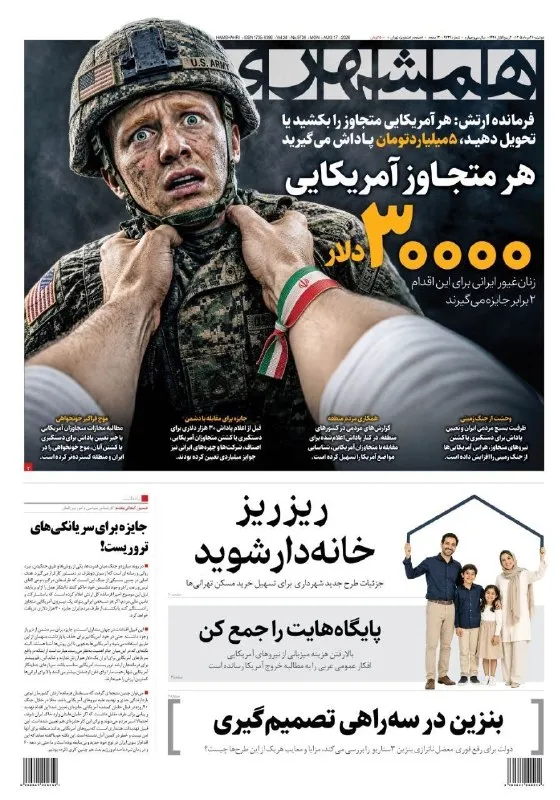
Bottom line: On a morning of no new combat, the Iranian press ran a coordinated state bounty offering 30,000 dollars to kill or capture each American serviceman, women at double rate, fused it to a negotiate-from-victory demand that officials rallied behind, and let a sharp reformist-versus-hardline fight over a domestic counter-infiltration bill and a quiet economic-realism dissent run underneath the unified anti-American front.
Executive Summary
The lead development of the 17 August edition is a coordinated escalation in incitement, not in combat: the Army commander’s offer of a 30,000-dollar reward (five billion tomans) to any Iranian who kills or captures an aggressor American serviceman, with civilian women incentivized at double the reward. The ultra-hardline flagship Kayhan makes it the primary headline (‘a 30,000-dollar bounty for hunting each aggressor American serviceman’); the state broadcaster’s daily Jam-e Jam carries it (‘every American soldier: 30,000 dollars’); and, most tellingly, the centrist, municipality-owned Hamshahri turns it into a full-bleed splash, a terrified U.S. Army soldier seized by an Iranian-flag-ribboned hand under ‘every American aggressor: 30,000 dollars’. That a near-identical bounty appears across the hardline, state-broadcaster and centrist-municipal tiers on the same morning indicates a centrally-seeded campaign rather than organic editorial convergence; the terms, and the extension of the kill-incentive to non-combatant women, are documented here as the outlets’ attributed claims and behind the attribution firewall, but the cross-tier coordination is itself the signal, and it is the sharpest threat rhetoric this monitor has logged.
The bounty sits on top of, and is rhetorically joined to, the batch’s authorized political line: negotiate from victory. Kayhan pairs the bounty with ‘America has lost the war and, to end it, must give concessions to Iran’; Iran Daily exports the same logic in English as ‘Qalibaf: Islamabad MoU document for consolidating Iran’s victory in the diplomatic front’; and Javan and Sobh-e No carry the Speaker’s now-standing line that ‘we won the war in the true sense of the word, but fell behind in the victory narrative’. Around this, officials moved to consolidate the Islamabad understanding as settled system policy. Etemad leads with the President defending the accord (‘a promise to solve the problems, and we stood firm against the enemy’); Jomhouri Eslami rallies ‘renewed support by the system’s officials and experts’ for it; and Sobh-e No frames it as having ‘advanced with dignity and on the basis of the Leader of the Revolution’s principles’, binding the accord to Mojtaba Khamenei’s authority to insulate it from hardline attack. The message discipline is the point: engagement is being sold to a hardline audience as the continuation, and the fruit, of victory.
Beneath the unified anti-American front runs the edition’s sharpest internal argument, and it is domestic: the parliamentary bill to counter ‘infiltration’ (nofuz). The state broadcaster’s Jam-e Jam praises the just-approved outline as a ‘revolutionary measure’; the reformist Sazandegi devotes almost its entire front to rejecting it as ‘the wrong address of infiltration’, an ‘alarm bell for intensifying censorship and constriction and for widening the social divide’; Etemad calls it ‘dangerous for the country’; and even the establishment Jomhouri Eslami cautions that ‘restricting infiltration should not fall on the media’. This is a genuine factional fault line over the domestic security state, running directly beneath the coordinated external messaging, and the bill’s passage is the concrete stake to track.
The Strait of Hormuz continues on its now-familiar dual track. The hardline organs keep it framed as an irreversible Iranian gain and a coercion lever: Javan’s ‘we will hold the strait until we lift the shadow of war’ converts control into a war-termination instrument, and Vatan-e Emrooz’s ‘it turned to smoke and vanished into the air’ recruits Israeli newspaper Haaretz as adversary-sourced proof that the prior order at the strait is gone. Against this, the de-escalatory counter-current strengthened: the establishment Jomhouri Eslami now confirms an Iran-Oman understanding on a ship-traffic chart through Hormuz, moving that thread from a single reformist report in the prior edition to cross-tier corroboration, and Iran Daily notably dropped the English-language ‘full control’ assertion it ran the day before. The strait remains an unresolved intra-regime argument between hardline irreversibility and a quiet, practical accommodation.
Two further threads round out the batch. Sobh-e No’s ‘War and Elections’, over a photo of Trump and Netanyahu, ties a predicted autumn power-shift to U.S. congressional elections and Israeli political fragility, casting both as running to Iran’s benefit; Vatan-e Emrooz’s ‘Netanyahu on the downward slope of collapse’ and Iran Daily’s ‘US maximum pressure unable to turn economic costs into political change’ complete a coordinated adversary-in-decline construction whose underlying claims remain second-hand. And a persistent economic-realism dissent cuts against the front-page triumphalism: the economic daily Charsou stages a claimed 60-expert consensus that scrapping the preferential currency rate, ‘not war’, is what drives inflation; Ta’adol leads on energy imbalance as the economy’s ‘mega-challenge’; and fuel-price restraint (Sobh-e No’s ‘the solution is not a price rise’, Etemad’s ‘the moment of truth’) protects the government’s reform space.
Net assessment: this is an incitement-and-discipline edition, not one of new combat. Its single new event is rhetorical, a coordinated state bounty on U.S. personnel that no front page ties to any fresh operation, and the day’s most consequential real argument is internal, over a domestic counter-infiltration bill. The regime is running four constructions with unusual coordination, the bounty, negotiate-from-victory, adversary-in-decline, and Hormuz-as-irreversible-gain, while insulating the Islamabad accord as system policy under the Leader’s authority. Cutting against all of it are the reformist liberties fight, the establishment-corroborated Iran-Oman transit accommodation, and the economic press’s insistence that the binding problems are domestic and structural. Notably absent are a standalone message from the Leader on an otherwise coordinated day, and the kinetic Lebanon file that led the prior edition, which recedes here to a single agency drone-analysis item. The threads to watch are whether the bounty is operationalized or stays rhetorical, whether the counter-infiltration bill passes, and whether the Iran-Oman strait understanding is the leading edge of a Hormuz off-ramp or is again foreclosed by the hardline irreversibility line.
Key Points
- KJ-1 [HIGH] The batch’s lead and single new escalation is a coordinated state bounty on U.S. personnel. The Army commander’s offer of 30,000 dollars (five billion tomans) to kill or capture each aggressor American serviceman, with civilian women at double the reward, leads Kayhan (‘a 30,000-dollar bounty for hunting each aggressor American serviceman’, kayhan.ir/001PQO), is turned into a full-bleed splash on the centrist municipal Hamshahri, and is carried by the state broadcaster’s Jam-e Jam in near-identical terms. Significance: the near-verbatim appearance across the hardline, state-broadcaster and centrist tiers on one morning indicates a centrally-directed incitement campaign rather than editorial convergence, and the incentivizing of non-combatants makes it the sharpest threat rhetoric logged in this series. Confidence attaches to the coordinated messaging, which is directly observed; the reward’s terms and the commander’s authority are the outlets’ attributed claims, held behind the firewall, and no specific commander is named because none was legibly readable.
- KJ-2 [MODERATE-HIGH] The regime consolidated a ‘negotiate-from-victory’ line and moved officials to lock the Islamabad memorandum in as settled system policy. Kayhan pairs the bounty with ‘America has lost the war and must concede’; Iran Daily exports ‘Qalibaf: MoU consolidates Iran’s diplomatic victory’; the President defends the accord (Etemad); ‘the system’s officials and experts’ renew support (Jomhouri Eslami); and Sobh-e No roots it in ‘the Leader of the Revolution’s principles’. Significance: the cross-title discipline and the invocation of Mojtaba Khamenei’s authority function to insulate a contested engagement from hardline attack by defining it as the fruit of victory rather than concession; the ‘victory’ and ‘must concede’ characterizations are attributed regime framing, not verified accounts of the accord’s terms.
- KJ-3 [MODERATE-HIGH] The counter-infiltration (nofuz) bill is the edition’s sharpest internal fault line, a domestic-liberties fight running beneath the unified external front. Parliament approved the outline; Jam-e Jam praises it as ‘revolutionary’, while Sazandegi’s near-full-page front rejects it as ‘the wrong address of infiltration’ and an ‘alarm bell’ for censorship, Etemad calls it ‘dangerous for the country’, and Jomhouri Eslami warns it should not fall on the media. Significance: the split runs the reformist press and even part of the establishment against the state broadcaster and hardline camp over the reach of the security state, indicating the coordination visible on foreign policy does not extend to this domestic project; the bill’s text is not yet final, and its passage is the concrete stake to track.
- KJ-4 [MODERATE] The Strait of Hormuz runs on a dual track, with the de-escalatory side gaining corroboration this cycle. Javan frames holding the strait as the lever that ‘lifts the shadow of war’ and Vatan-e Emrooz casts Iran’s gains as irreversible (recruiting Haaretz as proof), while Jomhouri Eslami now confirms an Iran-Oman understanding on a Hormuz ship-traffic chart, corroborating at establishment level the transit thread the reformist Sazandegi surfaced a day earlier, and Iran Daily dropped its English ‘full control’ assertion. Significance: a practical transit accommodation gaining cross-tier confirmation cuts against the hardline irreversibility line, and the unresolved gap between coercion and accommodation is the strait thread to watch; the Iran-Oman terms remain an attributed Foreign-Ministry-level report, not an independently confirmed accord.
- KJ-5 [MODERATE] The ‘adversary in decline’ construction was sustained and tied to an autumn timeline, on second-hand foundations. Sobh-e No’s ‘War and Elections’ predicts that U.S. congressional elections and Israeli political fragility will shift the regional balance to Iran’s benefit through the autumn; Vatan-e Emrooz renders Netanyahu ‘on the downward slope of collapse’; Iran Daily argues ‘US maximum pressure unable to turn economic costs into political change’. Significance: the cross-title coordination continues the standing thread and is the signal worth logging; the underlying claims about Trump’s and Netanyahu’s positions are the outlets’ framings and carry no independent confirmation.
- KJ-6 [MODERATE] Negative and domestic finding: the edition escalates rhetoric, not confirmed combat, and two files that led before recede. No front page ties the bounty to any fresh operation, and no new kinetic action is verified; the kinetic Lebanon file that led the prior edition drops here to a single agency drone-analysis item (Defa Press), with Gaza continued only via Gharibabadi’s atrocity-documentation line (Nour News). Meanwhile the economic press dissents: Charsou’s ‘not war’ inflation front, Ta’adol’s energy-imbalance lead, and fuel-price restraint (Sobh-e No, Etemad). Also absent is any standalone message from the Leader, present only by commemoration of the martyred predecessor and by proxy invocation. Significance: the regime is managing calm and cost at home while the fronts project ascendancy, and the recession of Lebanon plus the leadership’s silence on a coordinated-messaging day are themselves markers worth tracking.
Macro Trends
- A state bounty on American personnel, seeded across the factional spectrum. The Army commander’s offer of 30,000 dollars (five billion tomans) to kill or capture each aggressor American serviceman, women at double rate, leads Kayhan and Hamshahri and is carried by Jam-e Jam in near-identical terms. Its appearance on a centrist, municipality-owned daily and on the state broadcaster’s own paper, not only on the hardline titles, indicates a centrally-directed incitement campaign rather than an outlet’s provocation. The terms are documented as attributed claims behind the firewall; the cross-tier coordination is the signal, and the explicit incentivizing of non-combatants is the escalation.
- Negotiate-from-victory, and the accord insulated as system policy. Kayhan’s ‘America has lost the war and must concede’, Iran Daily’s ‘Qalibaf: Islamabad MoU consolidates Iran’s diplomatic victory’, and Ghalibaf’s ‘we won the war but fell behind in the victory narrative’ (Javan, Sobh-e No) present engagement as the fruit of victory. Officials moved to lock the Islamabad understanding in as settled policy: the President defends it (Etemad), ‘the system’s officials and experts’ renew support (Jomhouri Eslami), and Sobh-e No roots it in ‘the Leader of the Revolution’s principles’, binding it to Mojtaba Khamenei’s authority to shield it from hardline attack.
- The counter-infiltration bill: the batch’s sharpest internal fault line. Parliament’s approval of the outline of a bill to counter foreign ‘infiltration’ (nofuz) split the press along factional lines. Jam-e Jam calls it ‘revolutionary’; Sazandegi devotes its front to rejecting it as ‘the wrong address of infiltration’ and an ‘alarm bell’ for censorship; Etemad calls it ‘dangerous for the country’; and Jomhouri Eslami cautions that it should not fall on the media. This is a domestic-liberties fight over the security state, running underneath the unified external message, with the bill’s final passage as the concrete stake.
- Hormuz on a dual track: hardline irreversibility versus an Iran-Oman accommodation. Javan frames holding the strait as the lever that ‘lifts the shadow of war’; Vatan-e Emrooz casts Iran’s gains as irreversible, recruiting Haaretz as adversary-sourced proof. Against this, Jomhouri Eslami now confirms an Iran-Oman understanding on a ship-traffic chart through Hormuz, corroborating at establishment level the transit thread the reformist Sazandegi surfaced in the prior edition, while Iran Daily dropped its English ‘full control’ line. The strait remains an unresolved intra-regime argument between coercion and accommodation.
- The adversary-in-decline construction, tied to an autumn timeline. Sobh-e No’s ‘War and Elections’ predicts a power-shift favoring Iran through the autumn, driven by U.S. congressional elections and Israeli political fragility; Vatan-e Emrooz’s ‘Netanyahu on the downward slope of collapse’ and Iran Daily’s ‘US maximum pressure unable to turn economic costs into political change’ complete the picture. The coordination across titles is the signal; the specific claims about Trump’s and Netanyahu’s positions are the outlets’ framings, not verified assessments.
- An economic-realism dissent from the triumphalism. The economic press pushes back on the war-victory register. Charsou stages a claimed 60-expert consensus that scrapping the preferential currency rate, emphatically ‘not war’, drives inflation; Ta’adol leads on energy imbalance as the economy’s ‘mega-challenge’ and an under-pressure private sector; and fuel-price restraint (Sobh-e No, Etemad) protects the government’s reform space. Aimed at a decision-maker readership, this lane insists the binding constraints are domestic and structural, an implicit check on the front pages’ claims of ascendancy.
Front-Page Snapshot
- Kayhan - “A 30,000-dollar bounty for hunting each aggressor American serviceman” (Ultra-hardline flagship (channel)) - Bounty as lead; ‘America lost the war and must concede’ [SEVERE]
- Hamshahri - “Every American aggressor: 30,000 dollars” (Tehran municipality / centrist) - Bounty splash (women at double rate) above the paper’s municipal footer [SEVERE]
- Jam-e Jam - “Camera-rolling serials in Ghazali” (State broadcaster (IRIB)) - Cultural lead; carries the bounty; endorses the ‘revolutionary’ counter-infiltration bill [MODERATE-HIGH]
- Javan - “We will hold the strait until we lift the shadow of war” (Hardline / IRGC-affiliated) - Hormuz reframed as a war-termination coercion lever; Ghalibaf victory-narrative line [HIGH]
- Vatan-e Emrooz - “It turned to smoke and vanished into the air” (Hardline / principlist (channel)) - Hormuz gains cast as irreversible (Haaretz-sourced); Netanyahu and Trump in decline [MODERATE-HIGH]
- Sobh-e No - “War and elections” (Principlist) - U.S. elections and Israeli weakness predicted to shift the balance to Iran; accord tied to the Leader’s principles [MODERATE-HIGH]
- Etemad - “A promise to solve the problems” (Reformist) - President defends the memorandum; Khatami’s ‘honourable peace’; the nofuz bill called ‘dangerous’ [MODERATE]
- Jomhouri Eslami - “Renewed support by the system’s officials and experts for the Iran-America memorandum” (Traditional / establishment) - Establishment backing for the accord; confirms the Iran-Oman Hormuz transit understanding; Gaza solidarity [MODERATE]
- Sazandegi - “The wrong address of infiltration” (Reformist (Kargozaran)) - Front-page editorial against the counter-infiltration bill as a censorship instrument [LOW-MODERATE]
- Iran Daily - “Historic Si-o-se-pol bridge appears on global irrigation heritage list” (State English-language) - Softer English face: heritage lead, sanctions-resilience interview, ‘no retreat’ and MoU-victory banners [MODERATE-HIGH]
- Ta’adol - “Energy imbalance, the economy’s mega-challenge” (Economic / business) - Structural energy shortfall as the binding constraint; private sector under pressure; no war content [LOW]
- Charsou - “Consensus of 60 experts: scrapping the preferential currency rate drives price rises, not war” (Economic) - Inflation attributed to currency policy, explicitly de-linked from the war [LOW]
Full report
The complete edition - per-paper front-page analysis and full translation appendices - is available as a PDF: Download the full report.
Compiled from Iranian front pages and outlet channels via open-source monitoring. Translations are editorial; named-figure attributions are verified against the source pages where possible.