Iranian Press Monitor - Tuesday, 11 August 2026 (Day 161)
Tuesday, 11 August 2026 · 20 Mordad 1405 · 27 Safar 1448 - 13 daily front pages surveyed: 9 Persian print titles and Iran Daily (English) read from scan, with Kayhan, Vatan-e Emrooz and Sobh-e No from their own channels; Fars News, Nour News and Defa Press monitored for corroboration; Tehran Times was unavailable at the time.
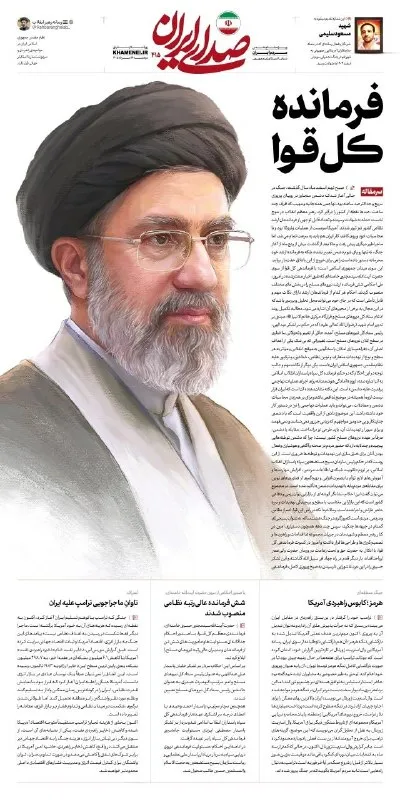
Bottom line: On the morning after moving its security secretary, the Leader personally re-issued the entire senior military command, and the same fronts that saluted the reshuffle shifted the war story off the battlefield and onto the Strait of Hormuz and the economy: the kinetic phase is being wound down into a ‘post-war’ consolidation in which Hormuz is the leverage and, by Tehran’s own account across both factions, the United States is now the party seeking the exit.
Executive Summary
The lead development of the 11 August edition is a personal reassertion of supreme military command. By separate decrees issued in the name of Ayatollah Seyyed Mojtaba Hosseini Khamenei (printed by name on Chaharsoo, over the Leader’s portrait as ‘Commander-in-Chief’ on Seda-ye Iran), six senior commanders and managers of the armed forces were given new responsibilities and ‘missions’ across the General Staff, the Islamic Revolutionary Guard Corps and the Basij. Khorasan led with ‘the commanders’ new missions’ and a row of six portraits; Qods labelled it a ‘redesign of field command’; Jomhouri Eslami tied it directly to the 10 August installation of Mohsen Rezaei at the Supreme National Security Council. Read with that prior change, this is the second stage of a single process: the Leader’s office taking direct, personal ownership of the military chain of command. The individual appointees are shown as uncaptioned portraits and named only in unverifiable channel previews, so their identities are withheld here.
The war narrative, notably, has moved off the battlefield. The decisive file is now the Strait of Hormuz, and it is being reported not as combat but as a transit negotiation. Jomhouri Eslami carried the batch’s highest-value claim, a ‘final understanding between Iran and Oman on the Strait of Hormuz transit map’, which if accurate converts last week’s ‘six conditions’ slogan into a bilateral operating arrangement; it is single-sourced on the fronts, with no joint text, map or notice to mariners reproduced, and is logged as an unconfirmed outlet claim. Around it, a striking cross-factional convergence formed: the reformist Etemad framed ‘America is looking for a solution to escape the Hormuz impasse’, while the hardline Vatan-e Emrooz ran ‘flight from Hormuz, Trump wanted to declare the reopening a victory, an outcome that did not materialize’. From opposite motives, both poles now agree that the United States is the demandeur at the strait.
That agreement is amplified by an energy-squeeze register. Sobh-e No assembled the fullest version, European gas prices up 8 percent on Hormuz uncertainty, the US Strategic Petroleum Reserve reported at a multi-decade low, and Trump reduced to demanding that Iran ‘compensate our damages’; Khorasan posed ‘the riddle of Iran’s oil and expensive gasoline in America’; Kayhan rendered a University of Chicago analyst warning the world energy market is heading ‘toward an iceberg’. These figures and quotations are outlet claims and second-hand renderings, recorded behind the attribution firewall, but their coordinated deployment is the point: Tehran is selling the reshuffle-and-Hormuz cycle domestically as leverage that is already moving world markets.
Beneath the security story, an explicit ‘post-war’ frame surfaced from non-triumphal quarters. The economic daily Ta’adol ran ‘changing the pattern of trade in the post-war [period]’ (pasajang) beside a container ship, and ‘housing at the crossroads of inflation and recession’ with inflation cited at 266 percent; the English-facing Iran Daily ran an opinion essay asking whether the Islamic Republic is ‘shifting from resistance to power-building’, explicitly naming a grand-strategy pivot; and Kayhan’s day-note, by managing editor Hossein Shariatmadari, was a Safar-season devotional (‘If the Messenger of God had not existed, what good is being?’) rather than a battlefield boast. From economic, foreign-facing and hardline registers alike, the elite signal is that the kinetic phase is treated as effectively closed and the contest has moved to consolidation, economics and doctrine.
The executive held to the loyalty-and-unity register it adopted on 10 August. The government daily Iran led with President Pezeshkian’s call to ‘replace discord with understanding’ at a meeting of party secretaries-general; the reformist Sazandegi reframed the same meeting as ‘rebuilding the state’s relationship with the people’ over an editorial titled ‘the crisis of distrust’; Iran Daily quoted Pezeshkian denying any ‘disagreement between officials and the Armed Forces on the Islamabad MoU’. The reformist press worked the domestic dividend, Etemad’s lead pressed ‘the end of arbitrary [internet] blocking’ with the President named as ‘guarantor of the survival of the platforms’. Against this, the hardline Chaharsoo devoted its main space to an economic satire of the ‘consensus government’ theorising ‘we cannot’, pairing a salute to the Leader’s command decrees with an indictment of the elected government’s competence on the same page.
Net assessment: this is a consolidation edition, not an escalation one. The one hard, cross-corroborated event is the Leader’s personal re-issuance of the military command, which completes the picture of a system centralising authority in the Leader’s office after the assassination and the war’s most intense phase. The war itself has been reframed as won-and-winding-down: the fronts no longer claim battlefield victories but leverage, at Hormuz and in world energy markets, and even the hardline titles let a ‘post-war’ vocabulary onto the page. Two silences define the cycle as much as its noise: Israel and Lebanon, the flashpoints this brief prioritises, are largely absent from the fronts, and the reshuffle’s six appointees go unnamed. The signals to watch are whether the Iran-Oman transit understanding produces any actual joint text or notice to mariners, whether the ‘US is the demandeur’ consensus is echoed by any American action rather than only Iranian rendering, and whether the ‘post-war’ framing survives contact with the next incident on the strait or the northern border.
Key Points
- KJ-1 [HIGH] The Leader has personally reasserted supreme military command, completing a command-consolidation begun at the security council. Six senior commanders and managers were given new missions by separate decrees issued in the name of Seyyed Mojtaba Hosseini Khamenei as Commander-in-Chief, across the General Staff, the IRGC and the Basij (Seda-ye Iran, Chaharsoo, Khorasan, Qods, Jomhouri Eslami, Kayhan), one day after the SNSC change that installed Mohsen Rezaei. Significance: this is the edition’s one hard, cross-corroborated event and it is a centralisation, not a policy shift, authority over the armed forces is being visibly gathered into the Leader’s office, and the reshuffle should be read as institutional consolidation after the assassination and the war’s peak, not as a battlefield move.
- KJ-2 [MODERATE] The Hormuz file may be moving from slogan toward a bilateral transit arrangement, but the evidence is single-source. Jomhouri Eslami alone reported a ‘final understanding between Iran and Oman on the Strait of Hormuz transit map’, with no joint text, map or notice to mariners reproduced; Sobh-e No still frames ‘reopening and transit security’ as unresolved. Significance: if genuine, this would operationalise the 10 August ‘six conditions’ into an actual traffic scheme and mark real movement, but it must be treated as an unconfirmed outlet claim until a joint Iran-Oman instrument surfaces; its plausibility is raised, not established, by the parallel Sobh-e No and Etemad framings.
- KJ-3 [MODERATE-HIGH] Hardline and reformist fronts now agree, from opposite motives, that the United States is the party seeking the exit at Hormuz. Etemad (reformist) ran ‘America is looking for a solution to escape the Hormuz impasse’; Vatan-e Emrooz (hardline) ran ‘flight from Hormuz, Trump wanted to declare the reopening a victory, an outcome that did not materialize’; Sobh-e No added ‘Trump: compensate our damages’ and a multi-decade-low US oil reserve; Jomhouri Eslami asked whether Trump seeks ‘escape or a plan’. Significance: the cross-factional convergence on Iran-holds-the-leverage raises confidence that Tehran genuinely reads itself as ascendant on the strait, though the specific claims of US distress are outlet-sourced and the underlying arrangement is unconfirmed, so the confidence attaches to Tehran’s self-perception, not to the US posture itself.
- KJ-4 [MODERATE-HIGH] The Iranian press is pivoting to an explicit ‘post-war’ consolidation frame. Ta’adol ran ‘changing the pattern of trade in the post-war [period]’ and led on stagflation rather than combat; Iran Daily’s opinion essay named a shift ‘from resistance to power-building’; Kayhan’s day-note chose Safar devotion over a battlefield boast. Significance: the appearance of ‘post-war’ (pasajang) language in economic, English-facing and hardline registers at once is an elite signal that the kinetic phase is being treated as effectively closed, which reframes the war onto economic and doctrinal terrain and is consistent with the reshuffle-as-consolidation and Hormuz-as-negotiation threads.
- KJ-5 [MODERATE-HIGH] The Mecca defence pact continues to be uniformly drained of deterrent value, now including the foreign-facing front. Baqaei, on Iran Daily, recast the Saudi-Turkey-Pakistan accord as proof ‘the region no longer trusts US security promises’; Vatan-e Emrooz reran it as ‘oil for security’ born of Saudi weakness. Significance: the convergence, and its deliberate extension to the diplomat-facing English edition, indicates centrally-congenial message discipline aimed at denying the pact any signaling power rather than independent assessment, a continuation of the standing enemy-in-retreat construction into its second week.
- KJ-6 [MODERATE] The executive remains in the unity register while the reformist press banks domestic dividends and the hardline lane presses economic delegitimation. Iran (‘replace discord with understanding’) and Sazandegi (‘rebuilding the state-people relationship’, editorial ‘the crisis of distrust’) read the Pezeshkian party meeting as repair; Etemad pressed ‘the end of arbitrary internet filtering’ with the President as guarantor; Pezeshkian denied any government-military rift on the Islamabad MoU. Against this, Chaharsoo saluted the Leader’s decrees above and satirised the ‘consensus government’ for ‘we cannot’ below. Significance: the pro-settlement camp is still muted on the war’s terms and is fighting on legitimacy, trust and civil liberties instead, while the hardline counter concedes the Leader’s command decisions but attacks the elected government’s competence, the system’s central fracture displaced but intact.
- KJ-7 [MODERATE] Negative finding: Israel and Lebanon are largely absent from the fronts, the reshuffle’s appointees are unnamed, and the loudest claims are uncorroborated. No front-page lead this cycle centred on Israel or Lebanon, the two flashpoints this brief prioritises, the war content ran through Hormuz, the United States and the Saudi-Yemen theatre instead; the six military appointees appear only as uncaptioned portraits; and Vatan-e Emrooz’s Aramco and al-Mokha strikes, Fars News’s oil-spill and Gaza figures, Sobh-e No’s US-reserve figure and Kayhan’s food-truck item are all outlet claims, with Tehran Times unavailable and khamenei.ir not retrieved. Significance: the quieting of the Israel and Lebanon fronts is itself a signal that the theatre has shifted to the strait and the economy, and the edition’s certainty about American distress again runs ahead of its documentation.
Macro Trends
- The Leader takes personal command. The load-bearing story is a six-post reshuffle of the senior military command, issued by separate decrees in the name of Ayatollah Seyyed Mojtaba Hosseini Khamenei as Supreme Commander-in-Chief and spanning the General Staff, the IRGC and the Basij. Seda-ye Iran reduced its entire front to the caption ‘Commander-in-Chief’ over the Leader’s portrait; Khorasan printed ‘the commanders’ new missions’ with six faces; Qods called it a ‘redesign of field command’. Coming the morning after the 10 August SNSC change that installed Mohsen Rezaei, this reads as the second stage of one process, the Leader’s office taking direct, personal ownership of the chain of command, and it continues the succession-consolidation thread this monitor has tracked since the assassination.
- The war moves to the strait. The decisive war file is now Hormuz, and it is reported as a negotiation, not combat. Jomhouri Eslami asserted a ‘final Iran-Oman understanding on the transit map’ (single-source, no text reproduced); Sobh-e No kept ‘the reopening and transit security of the strait’ framed as unresolved; and, in the cycle’s most notable cross-factional agreement, the reformist Etemad (‘America seeks a way out of the Hormuz impasse’) and the hardline Vatan-e Emrooz (‘flight from Hormuz, Trump wanted a victory he could not get’) converged, from opposite motives, on the United States as the party seeking the exit. This sharpens the 10 August ‘six conditions’ finding: the preconditions bloc’s leverage claim is now shared across the aisle, even as the operational arrangement remains unconfirmed.
- The ‘post-war’ pivot. An explicit ‘post-war’ (pasajang) vocabulary surfaced from non-triumphal quarters. Ta’adol ran ‘changing the pattern of trade in the post-war [period]’ and treated stagflation, not battle, as the front-page problem; Iran Daily’s opinion essay asked whether the state is ‘shifting from resistance to power-building’, naming a grand-strategy pivot for foreign readers; Kayhan’s day-note chose Safar devotion over a battlefield boast. The convergence of economic, English-facing and hardline registers on consolidation rather than conquest is an elite signal that the kinetic phase is being treated as effectively closed and the contest relocated to economics and doctrine.
- The Mecca pact, still denied deterrent value. The Saudi-Turkey-Pakistan accord of 7 August continues to be drained of threat, now for foreign as well as domestic audiences. On the English front, Foreign Ministry spokesman Esmaeil Baqaei recast it as proof that ‘the region no longer trusts US security promises’; Vatan-e Emrooz reran the ‘oil for security’ reading of it as Saudi weakness. The uniformity, and its extension to the diplomat-facing Iran Daily, indicates centrally-congenial message discipline aimed at denying the pact any signaling power, the standing enemy-in-retreat construction carried into a second week.
- Unity above, delegitimation below. The executive stayed in the loyalty-and-unity register: Iran’s ‘replace discord with understanding’ and Sazandegi’s ‘rebuilding the state’s relationship with the people’ both read the Pezeshkian party meeting as repair, while Etemad banked a reformist dividend with ‘the end of arbitrary [internet] blocking’, the President named as guarantor. The hardline counter came on the same terrain from Chaharsoo, whose main space satirised the ‘consensus government’ for theorising ‘we cannot’ even as its banner saluted the Leader’s command decrees. The pro-settlement camp remains muted on the war’s terms and is fighting instead on domestic legitimacy, trust and civil liberties, a displaced but persistent continuation of the negotiate-now pole.
Front-Page Snapshot
- Seda-ye Iran - “Commander-in-Chief” (Hardline, keyed to the Leader’s office) - The Leader as personal head of the armed forces [MODERATE-HIGH]
- Khorasan - “The commanders’ new missions” (Conservative, Mashhad) - Six-post military reshuffle, documented plainly [MODERATE]
- Chaharsoo - “Appointment of six high-ranking military commanders” (Principlist / hardline) - Reshuffle above, economic assault on the ‘consensus government’ below [LOW-MODERATE]
- Kayhan - “Six commanders appointed; ‘Trump’s escape by food truck’” (Ultra-hardline flagship (channel)) - Reshuffle, Safar legitimacy editorial, mocking US-vulnerability claims [MODERATE-HIGH]
- Qods - “The Iran of Imam Reza: blood-avenger and self-sacrificing” (Conservative (Astan Quds Razavi)) - ‘Redesign of field command’ in a devotional revenge register [MODERATE-HIGH]
- Jomhouri Eslami - “Final Iran-Oman understanding on the Strait of Hormuz transit scheme” (Traditional / establishment) - Reported bilateral Hormuz transit arrangement (single-source) [HIGH]
- Vatan-e Emrooz - “Flight from Hormuz: Trump wanted a victory he could not get” (Hardline / principlist (channel)) - Hormuz as US defeat; Mecca pact as Saudi weakness; Yemeni-strike leverage [MODERATE-HIGH]
- Sobh-e No - “The US energy squeeze around a Hormuz still not fully reopened” (Principlist (channel)) - Energy-leverage messaging: European gas up, US reserves low, Trump demanding compensation [MODERATE]
- Etemad - “The end of arbitrary blocking” (Reformist) - ‘America seeks the Hormuz off-ramp’; end internet filtering, President as guarantor [MODERATE]
- Iran Daily - “Baqaei: Saudi-Turkey-Pakistan pact shows region no longer trusts US security promises” (State English-language) - Mecca pact drained of meaning; ‘resistance to power-building’ pivot [MODERATE-HIGH]
- Ta’adol - “Housing at the crossroads of inflation and recession” (Economic / business) - ‘Post-war’ trade reorientation; stagflation with inflation cited at 266 percent [LOW-MODERATE]
- Iran - “Let us replace discord with understanding” (Official government daily) - Executive unity outreach to parties; reshuffle logged plainly [LOW-MODERATE]
- Sazandegi - “Rebuilding the state’s relationship with the people” (Reformist (Kargozaran)) - Same meeting read as trust repair; editorial ‘the crisis of distrust’ [LOW]
Full report
The complete edition - per-paper front-page analysis and full translation appendices - is available as a PDF: Download the full report.
Compiled from Iranian front pages and outlet channels via open-source monitoring. Translations are editorial; named-figure attributions are verified against the source pages where possible.