Iranian Press Monitor - Monday, 10 August 2026 (Day 160)
Monday, 10 August 2026 · 19 Mordad 1405 · 26 Safar 1448 - 12 daily front pages surveyed: 10 Persian print titles and Iran Daily (English) read from scan, with Kayhan and Sobh-e No from their own channels; Jam-e Jam and Iran also from scan; Defa Press, Fars and Nour News monitored for corroboration
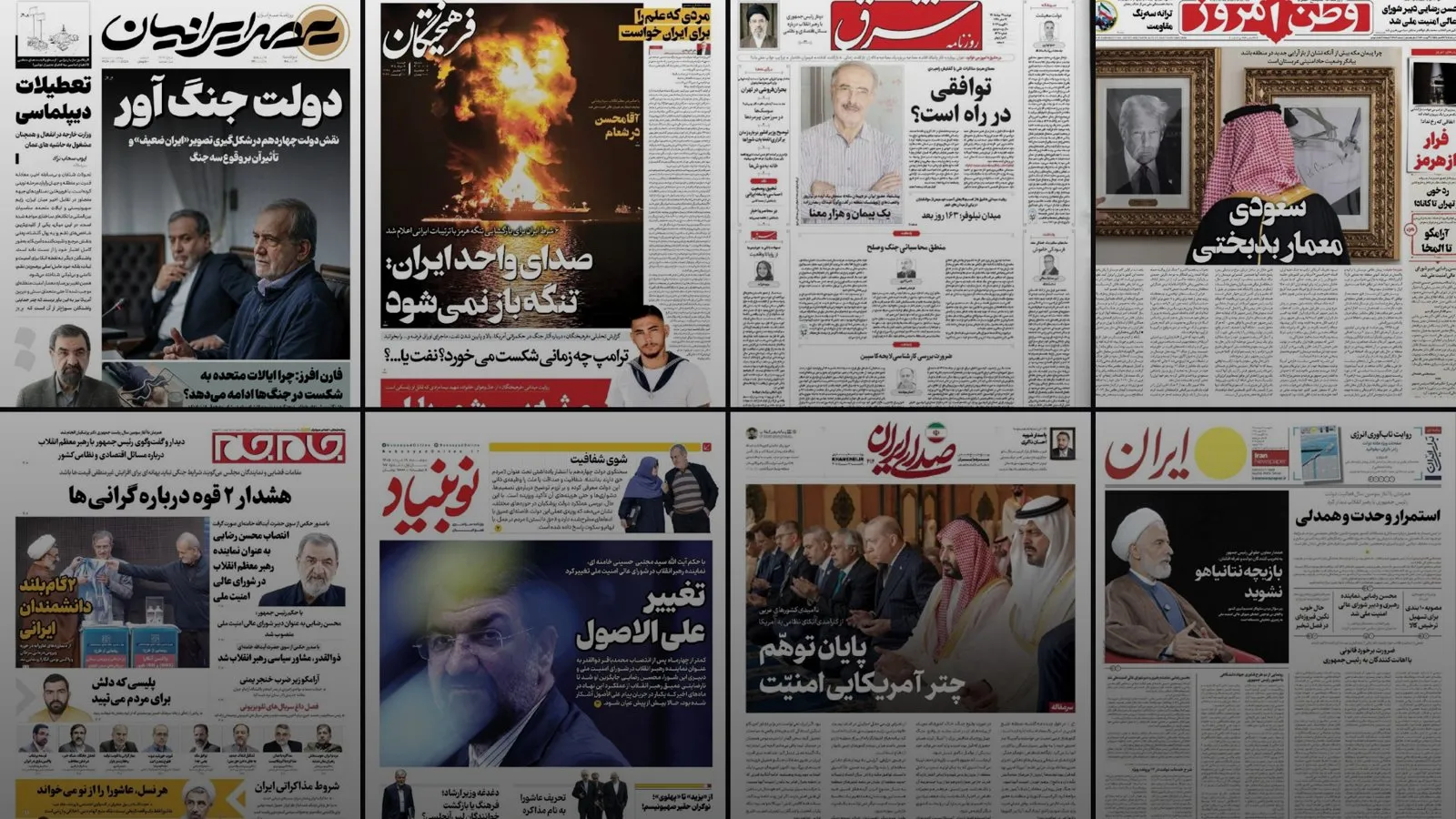
Bottom line: Mojtaba Khamenei has replaced the security-council secretary who embodied ‘we will not yield, in war or negotiation,’ moving Zolqadr aside for the veteran commander Mohsen Rezaei; but the Hormuz line did not move with him, and the same fronts that carried the reshuffle also hardened Iran’s terms into a published ‘six conditions’ for reopening the strait, indicating the hard line is set above the secretariat, not by it.
Executive Summary
The lead development of the 10 August edition is a change at the apex of Iran’s security architecture. By a decree issued in the name of Ayatollah Seyyed Mojtaba Hosseini Khamenei (printed in full on the No-Bonyad front page), Major General Mohsen Rezaei was named the Leader’s representative to the Supreme National Security Council and, by a paired presidential decree, its Secretary; Mohammad-Baqer Zolqadr, who had held both posts for less than four months, was reassigned as the Leader’s political advisor. The significance is sharpened by continuity: Zolqadr is the same official this monitor quoted on 9 August declaring that Iran ‘will not yield, whether in war or negotiation’ and that the strait stays closed ‘until America corrects its behaviour.’ The man who personified the yield-nothing pole of the system’s central fracture has been moved, and No-Bonyad alone reads the swap plainly, as the surfacing of ‘the leadership’s deep dissatisfaction with this body’s performance in recent months.’
The reshuffle did not, however, soften the line it might have been expected to. On the same morning, the fronts hardened Iran’s Hormuz posture into a codified menu: Farhikhtegan announced ‘Iran’s six conditions for reopening the Strait of Hormuz on Iranian terms’ under the banner ‘the strait will not be opened’; Iran Daily rendered the same as ‘six conditions’ set by the ‘top security chief’; Qods insisted ‘negotiation will not begin from point zero,’ demanding an end to threats and siege, compensation, and a mechanism to bar a repeat attack mid-talks; Kayhan set ‘Iran’s conditions… indifferent to Trump’s empty boasts’; and Defa Press reported the Majlis National Security Commission passing a Hormuz-control bill. This is a real advance over the 9 August picture of an arrangement ‘announced but not sealed’: the preconditions bloc has consolidated a shared, itemized negotiating floor, and it now carries a legislative instrument behind it.
The diplomatic anchor firmed in parallel. Foreign Minister Araghchi, on the English front, ruled out talks ‘as long as the US violates the Islamabad understanding,’ naming the Pakistan-brokered arrangement as the tripwire. Against that, a genuine off-ramp signal circulated: Khorasan led with ‘Trump’s war bewilderment,’ reporting a Wall Street Journal claim that Trump is ‘ready to end the war with Iran without reaching a nuclear agreement.’ The two lines are compatible in Tehran’s telling - if Washington wants out more than it wants a comprehensive deal, the preconditions bloc’s bet pays off - but the WSJ line is an attributed foreign-press item, and Iran Daily’s own careful read of the Saudi-Turkey-Pakistan pact (‘unlikely to affect Pakistan’s stalled mediation role’) concedes the mediation channel is stalled, not advancing.
The enemy-in-retreat register carried forward, now routed through the Mecca defence pact rather than fresh battlefield claims. Seda-ye Iran, the front most tightly keyed to the Leader’s office, made the pact its lead as proof of ‘the end of the illusion of the American security umbrella,’ pairing it with unverified ‘new images’ of damage to US bases; Vatan-e Emrooz recast the same pact as evidence of Saudi weakness (‘the Saudi: architect of misery’) and spun US reporting into ‘flight from Hormuz’; Farhikhtegan declared ‘King Salman’s alliance bubble burst.’ Three hardline mastheads converging to deny the pact any deterrent value, on the morning after it dominated as an adverse realignment, again reads as centrally-congenial message discipline rather than independent judgement. The Yemen-Saudi front supplied the day’s kinetic texture: strikes on Al-Mokha and Saudi oil and gas facilities, carried by Kayhan, Jam-e Jam, Farhikhtegan and the wires (Fars: ‘7 dead, 30 wounded’ per Saudi-backed forces) as leverage against Riyadh.
Beneath the security drama the war economy again broke through, and from unusually establishment quarters. Jam-e Jam, the state broadcaster’s paper, led with ‘two branches warn over price rises,’ reporting that judicial officials and MPs jointly insist ‘wartime conditions must not be a pretext for irrational price increases’; Khorasan documented a government crackdown on old cars that ‘resembles a livelihood dead-end for the lower deciles’; No-Bonyad ran ‘inflation has raised even Baharestan’s voice’ and ‘government tax revenue under the blade of inflation’ from the right. The cost-of-living complaint that was a reformist-and-economic register on 9 August has migrated to state and hardline-critical fronts, a broadening that matters more than any single figure.
Net assessment: this is a reshuffle-without-a-turn edition. The system changed the person at the security apex while holding the policy, printing both the removal of its yield-nothing secretary and a hardened, itemized Hormuz line on the same fronts - the clearest available evidence that the hard line is owned by the Leader’s office, not the secretariat, and that Rezaei’s arrival is being sold as corrective competence, not as a course change. The negotiate-now camp is quieter than on 9 August, its energy displaced by the personnel story and by the executive’s defensive turn (Iran’s ‘don’t be Netanyahu’s plaything,’ prosecuting insults to the President); the pragmatic case now speaks mainly through the economy, which even state and hardline titles can no longer keep off the front page. The signals to watch are whether Rezaei’s SNSC narrows or widens the negotiate-now/yield-nothing gap, whether the ‘six conditions’ and the Majlis Hormuz bill produce any actual text or notice to mariners, and whether the WSJ ‘US exit without a deal’ line is echoed by Iranian officials or left to circulate as convenient foreign-press validation.
Key Points
- KJ-1 [HIGH] The reshuffle at the security apex is a change of personnel, not of policy. Mojtaba Khamenei’s decree replaced Zolqadr - the ‘we will not yield, in war or negotiation’ secretary of 9 August - with Mohsen Rezaei, yet the same fronts hardened the Hormuz line into a published ‘six conditions’ rather than softening it. Significance: the yield-nothing posture is owned above the secretariat, by the Leader’s office, so the swap should be read as a bid for corrective competence (No-Bonyad: ‘deep dissatisfaction with this body’s performance’) and not as a signal of flexibility on the war’s terms.
- KJ-2 [HIGH] The Hormuz file advanced this cycle from slogan to itemized policy with a legislative instrument behind it. A shared ‘six conditions’ menu ran across Farhikhtegan, Iran Daily, Qods and Kayhan, Araghchi anchored it to ‘the Islamabad understanding,’ and the Majlis National Security Commission passed a Hormuz-control bill (Defa Press). Significance: unlike the 9 August ‘announced but not sealed’ picture, the preconditions bloc now has a common text and a law, raising the domestic cost of any compromise, though still with no joint Iran-Oman notice to mariners or map to show the strait has actually reopened.
- KJ-3 [MODERATE-HIGH] The hardline press has drained the Mecca defence pact of deterrent value in a coordinated fashion. Three mastheads converged on the same morning - Seda-ye Iran (‘collapse of the American security umbrella’), Vatan-e Emrooz (‘the Saudi: architect of misery,’ Saudi ‘acute security predicament’) and Farhikhtegan (‘King Salman’s alliance bubble burst’) - the day after the pact dominated as an adverse realignment. Significance: the uniformity indicates centrally-congenial message discipline aimed at denying an adversary coalition any signaling power, and Iran Daily’s more measured English read (‘unlikely to affect Pakistan’s stalled mediation’) is the tell that the Persian framing is domestic messaging, not assessment.
- KJ-4 [MODERATE-HIGH] A genuine US off-ramp signal is circulating, but only as attributed foreign-press material. Khorasan led with a Wall Street Journal claim that Trump is ‘ready to end the war with Iran without reaching a nuclear agreement,’ which - if real - would validate the preconditions bloc’s bet that Washington wants exit more than a comprehensive deal. Significance: the line is second-hand and unconfirmed, no Iranian official is yet quoted endorsing it, and Iran Daily concedes Pakistan’s mediation is ‘stalled’; the item is being used as convenient validation rather than reported as a negotiating breakthrough.
- KJ-5 [MODERATE] War-economy strain has broken onto establishment and hardline-critical front pages, broadening a signal that was reformist on 9 August. Jam-e Jam (state broadcaster) led with judiciary-and-MP warnings against wartime price gouging; Khorasan tied a government car-policy crackdown to a ‘livelihood dead-end for the lower deciles’; No-Bonyad ran inflation eroding tax revenue and ‘raising Baharestan’s voice.’ Significance: with the negotiate-now camp muted this cycle, the economy is now the principal vehicle for the pragmatic case that the war must end, and its spread across factional lines makes it harder for the triumphalist fronts to suppress.
- KJ-6 [MODERATE] The executive answered the surrender-and-war-guilt campaign by reframing its critics as instruments of the enemy rather than by defending the negotiating track on the merits. The government daily Iran ran ‘do not become Netanyahu’s plaything’ and demanded prosecution of those insulting the President, staking legitimacy on ‘unity’ from the Pezeshkian-Leader meeting; the hardline lane pressed ‘war-bringing government’ (Asr-e Iranian) and ‘distorting Ashura in the name of negotiation’ (No-Bonyad). Significance: the pro-settlement case is now being defended defensively and by loyalty framing, not by the confident ‘best time for an agreement’ argument that dominated 9 August, a retreat in the framing contest even if not in the underlying policy.
- KJ-7 [MODERATE] Negative finding: no verified Leader’s-office text beyond the personnel decree, and no confirmation of the day’s loudest external claims, surfaced in the window. khamenei.ir was not retrievable (Appendix A is reconstructed to template); Kayhan’s ‘greatest power defeated’ and ‘Saudi facilities ablaze,’ Seda-ye Iran’s ‘new US-base damage images,’ Farhikhtegan’s ‘half the Saudi fleet’ and the WSJ ‘US exit’ line are all uncorroborated or second-hand, and Tehran Times was unavailable. Significance: the edition’s certainty about American decline and Iranian ascendancy again runs well ahead of its documentation, and the reshuffle - the one hard, verified event - is precisely the item the fronts frame least, and most divergently.
Macro Trends
- The secretary changes, the line holds. The load-bearing story is the SNSC reshuffle: Mojtaba Khamenei’s decree installs Mohsen Rezaei as his representative and the Council’s secretary and moves Mohammad-Baqer Zolqadr, the ‘we will not yield’ voice of 9 August, to a political-advisor role. No-Bonyad reads it as a rebuke (‘deep dissatisfaction with this body’s performance’); Sobh-e No and Jam-e Jam absorb it as orderly succession with Qalibaf’s and Aref’s endorsements. Crucially, the hard Hormuz line did not move with Zolqadr - it hardened - which continues, and partly resolves, the negotiate-now-versus-yield-nothing thread this monitor has tracked since 6 August: the yield-nothing pole is being owned by the Leader’s office directly, not by the outgoing secretariat.
- From slogan to menu: the ‘six conditions’ for Hormuz. The Hormuz file advanced from assertion to itemized policy. Farhikhtegan (‘six conditions… the strait will not be opened’), Iran Daily (‘six conditions’ set by the top security chief), Qods (‘not from point zero’: end threats and siege, compensation, an anti-repeat-attack mechanism), Kayhan (‘conditions… indifferent to Trump’s boasts’) and Araghchi’s ‘no talks while the US violates the Islamabad understanding’ converge on one published negotiating floor, now backed by a Majlis National Security Commission Hormuz-control bill (Defa Press). This sharpens the 9 August ‘announced but not sealed’ finding: the preconditions bloc has a shared text and a legislative instrument, even as no joint Iran-Oman notice to mariners has surfaced.
- The Mecca pact, denied any deterrent value. The Saudi-Turkey-Pakistan defence pact, dominant on 8 August as an adverse realignment, is now uniformly drained of threat by the hardline fronts: ‘the end of the illusion of the American security umbrella’ (Seda-ye Iran), ‘the Saudi: architect of misery’ and Saudi ‘acute security predicament’ (Vatan-e Emrooz), ‘King Salman’s alliance bubble burst’ (Farhikhtegan). Iran Daily, for foreign readers, is the outlier, treating it as eroding trust in the US role but ‘unlikely to affect Pakistan’s stalled mediation.’ The convergence of three mastheads on ‘Saudi weakness / American decline’ is the standing enemy-in-retreat construction, its function to keep any Hormuz settlement resembling the pre-war normal domestically unaffordable.
- The war economy breaks the establishment fronts. Cost-of-living pressure, a reformist-and-economic register on 9 August, has migrated to state and hardline-critical titles: Jam-e Jam’s ‘two branches warn over price rises’ (judiciary and MPs: wartime is no pretext for gouging), Khorasan’s clunker-car crackdown that ‘resembles a livelihood dead-end for the lower deciles,’ and No-Bonyad’s ‘inflation has raised even Baharestan’s voice’ and ‘tax revenue under the blade of inflation.’ With the negotiate-now camp muted this cycle, the economy is now the main channel through which the pragmatic case that the war must end is being made, and it can no longer be kept off establishment front pages.
- The executive turns defensive; the Caspian frame stays contested. The government daily Iran met the war-guilt and surrender attacks (Asr-e Iranian’s ‘war-bringing government,’ No-Bonyad’s ‘distorting Ashura in the name of negotiation’) by reframing critics as unwitting instruments (‘do not become Netanyahu’s plaything’) and by demanding prosecution of those who insult the President, while staking legitimacy on ‘the continuation of unity and empathy’ from the Pezeshkian-Leader meeting. On the sovereignty-right’s second front, Shargh answered the 9 August ‘Caspian JCPOA’ surrender-frame with a call for ‘expert review of the Caspian bill’ on the merits, keeping that thread contested across the aisle rather than spreading unopposed.
Front-Page Snapshot
- No-Bonyad - “Change, on principle” (Hardline-critical conservative) - SNSC reshuffle read as a leadership rebuke [MODERATE]
- Farhikhtegan - “Iran’s united voice: the strait will not be opened” (Principlist (Azad University)) - Six conditions for reopening Hormuz [HIGH]
- Kayhan - “Iran’s conditions for reopening Hormuz, indifferent to Trump’s empty boasts” (Ultra-hardline flagship (channel)) - Hormuz conditions; ‘greatest power defeated’ [HIGH]
- Qods - “Negotiation will not begin from point zero” (Conservative (Astan Quds)) - Talks only with guarantees [MODERATE]
- Iran Daily - “Araghchi: No talks as long as US violates Islamabad understanding” (State English-language) - Preconditions diplomacy; six Hormuz conditions [MODERATE]
- Seda-ye Iran - “The end of the illusion of the American security umbrella” (Hardline, pro-Leader’s-office) - Mecca pact as US-umbrella collapse [MODERATE-HIGH]
- Vatan-e Emrooz - “The Saudi: architect of misery” (Hardline principlist) - Mecca pact as Saudi weakness; ‘flight from Hormuz’ [MODERATE-HIGH]
- Jam-e Jam - “Two branches warn over price rises” (State broadcaster (IRIB)) - War-economy strain; leadership meeting; reshuffle [MODERATE]
- Khorasan - “Trump’s war bewilderment” (Conservative, Mashhad) - US ‘ready to end war without a deal’; car policy hits the poor [MODERATE]
- Iran - “The continuation of unity and empathy” (Official government daily) - Leadership meeting as unity; executive pushes back on critics [LOW-MODERATE]
- Sobh-e No - “Pezeshkian’s second meeting with the Leader” (Principlist (channel)) - Leadership continuity; Hormuz demands hardened; Lebanon flashpoint [MODERATE-HIGH]
- Shargh - “Is an agreement on the way?” (Reformist) - Deal as open question; Caspian bill on the merits [LOW-MODERATE]
- Asr-e Iranian - “The war-bringing government” (Independent/centrist, here anti-executive) - Executive blamed for projecting weakness [MODERATE]
Full report
The complete edition - per-paper front-page analysis and full translation appendices - is available as a PDF: Download the full report.
Compiled from Iranian front pages and outlet channels via open-source monitoring. Translations are editorial; named-figure attributions are verified against the source pages where possible.