Iranian Press Monitor - Thursday, 6 August 2026 (Day 156)
Thursday, 6 August 2026 · 15 Mordad 1405 · 22 Safar 1448 - Eleven front pages read for 6 August: nine as same-day scans (eight Persian dailies plus the English-language Iran Daily), with Kayhan and Sobh-e No read via their outlet channels.
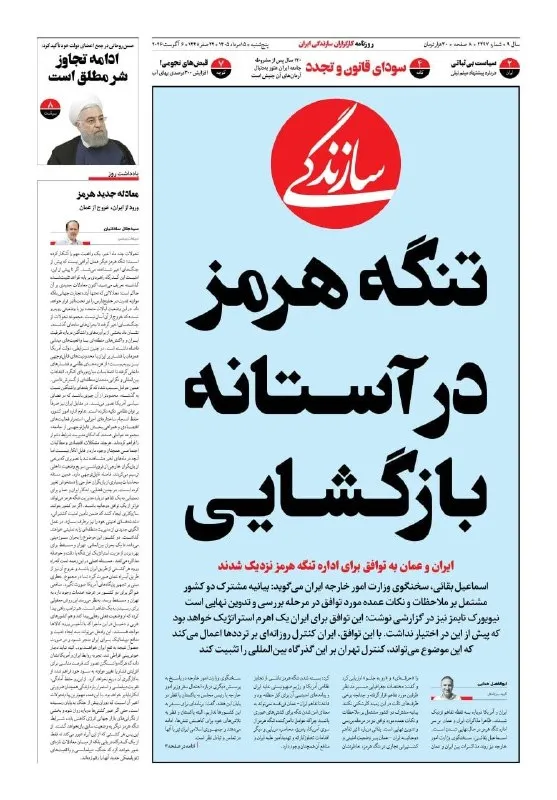
Bottom line: Day 156 turns on a deal announced but not sealed: the Foreign Ministry confirms on the record that Iran and Oman have agreed on Hormuz shipping-route coordinates, corroborated by Western wires, but the front pages split openly over whether America is a party and whether to reopen at all, with the hardline flagship and an economic-nationalist expert bloc mobilizing to condition or block the sign-off, so the loudest movement of the day is not the accord itself but the contest over it breaking into public view.
Executive Summary
The lead judgment of Day 156 is that the maritime file this monitor tracked on 5 August as a quietly drafted accord awaiting the Leader’s sign-off has broken into the open as a near-consensus front-page lead. Foreign Ministry spokesman Esmail Baqaei is quoted on the record, on Sazandegi’s banner ‘The Strait of Hormuz on the verge of reopening’ and in the English Iran Daily’s masthead ‘Baqaei: Iran, Oman agree on shipping route coordinates in Hormuz,’ that Iran and Oman have agreed on the geographic coordinates of a shipping route and that a joint statement covering the main technical, legal, security and environmental points is in final drafting. Western wire reporting (Euronews, Bloomberg, Reuters, 5-6 August) corroborates the announcement, while noting Baqaei’s own caution that the bilateral understanding alone does not guarantee safe navigation. The accord is therefore real as an announcement, but its operative security guarantees remain unsettled.
The day’s genuinely new movement is that yesterday’s unified denial of any US letter or channel has fractured into an open argument over whether Washington is a party to the deal. Farhikhtegan’s over-photo banner insists ‘the agreement with Oman has nothing to do with America’; Jomhouri Eslami, alone among the fronts, frames it as speculation about an ‘Iran, Oman and America’ agreement, naming the United States; Nour News reports a Deputy Foreign Minister acknowledging ‘messages from Washington’ alongside the Tehran-Muscat understanding; and Kayhan refuses the premise entirely. This is a shift from the 5 August posture, when the denial was uniform and functioned as the day’s principal information operation: the denial has now given way to a visible internal contest, and the contest itself is the tell that a US-linked channel is in play behind the Omani mediation.
The sign-off is contested inside the system, and the contest is now waged in public by the flagship hardline voice and an organized economic-nationalist bloc. Kayhan’s ‘Yadasht-e Rooz’ by managing editor Hossein Shariatmadari declares the Strait of Hormuz ‘not negotiable,’ invokes the Leadership’s directive to keep it closed as a deterrent, and warns that reopening would benefit the United States without reciprocal commitment. The economic daily read as Charsoo devotes its entire front to a montage of some forty named experts warning that reopening the strait without full sanctions removal, an end to maritime seizures, and the meeting of all Iran’s conditions ‘is only to America’s benefit.’ Against this, the reformist and business lanes (Sazandegi, Ta’adol, Etemad) and the state broadcaster’s daily (Jam-e Jam, filing Hormuz as ‘the initiative in Iran’s hands’) treat the accord as leverage to be cashed. The deal is announced but not sealed, and the preserve-the-leverage camp is mobilizing to condition it.
Beneath the maritime story, the fronts pivot hard from the vengeance-mobilization register that peaked on 5 August to domestic accountability, organized around President Pezeshkian’s televised dialogue with the public on the eve of his third presidential year. The Arba’een ‘blood-vengeance’ and ‘Ya Latharat al-Khamenei’ framing that dominated Day 155 is largely absent today. In its place: Farhikhtegan’s ‘Halfway’ audit of the government, Ta’adol’s ‘In the presence of the people’ report, and, most sensitively, Etemad’s pull-out of Pezeshkian’s Q&A lines. There the president reveres the martyred predecessor Leader (‘stood behind us like a mountain’) but says material published in the present Leadership’s name ‘does not match the character I have seen in him,’ and that a message held the Leader was ‘in principle not in agreement’ before ultimately permitting a process to take shape. The referent is unstated on the page and the reading is held carefully, but placed against the maritime sign-off it is the highest-value leadership-level cue of the day.
Net assessment: this is a deal-announced-but-not-sealed edition whose surface is diplomacy and whose substance is an unresolved internal contest over the terms and ownership of that diplomacy. The threat register stays live but low beneath it: a reported Strait of Hormuz tanker-explosion incident (UKMTO-corroborated, crew safe), a Yemeni claim of a ballistic-missile strike on the Saudi tanker ‘Daisy’ in the Gulf of Aden (Defa Press, per spokesman Yahya Saree), Reuters-sourced Iranian warnings to Gulf Arab states over their energy infrastructure, and continued Israeli strikes on south Lebanon with a claimed two Israeli soldiers killed. No new kinetic escalation was attributed to Iranian territory, and the economy is being staged as a front-page contest between a resilience narrative (Jam-e Jam’s bourse record) and a cost ledger (Ta’adol’s 2.6 billion barrels off market). The signals to watch are whether the Leadership’s office confirms or vetoes the announced accord, whether any front page names the US role as more than speculation, and whether the vengeance register returns if the sign-off stalls.
Key Points
- KJ-1 [HIGH] The Oman-Hormuz accord has moved from a quietly drafted arrangement to an on-record, front-page announcement, and it is externally corroborated. Foreign Ministry spokesman Esmail Baqaei is quoted (Sazandegi, Iran Daily) confirming agreement on shipping-route coordinates and a joint statement in final drafting, and Western wires (Euronews, Bloomberg, Reuters, 5-6 August) report the same. Significance: the maritime file, not the nuclear file, remains the axis of any near-term compromise; the announcement is real, but Baqaei’s own caveat, that the bilateral understanding alone does not guarantee safe navigation, and the absence of a signed statement mean the accord is announced, not operative.
- KJ-2 [HIGH] Whether the United States is a party to the accord is now openly contested on the front pages, and that contestation, not a unified denial, is the day’s principal information signal. Farhikhtegan insists the deal has ‘nothing to do with America,’ Jomhouri Eslami names an ‘Iran, Oman and America’ arrangement, Nour News reports a Deputy Foreign Minister acknowledging ‘messages from Washington,’ and Kayhan refuses the premise. Significance: the 5 August unified denial has fractured into a visible internal argument; the fracture is the tell that a US-linked channel is in play, and it should not be read either as confirmation of a direct US deal or as its exclusion.
- KJ-3 [MODERATE-HIGH] The sign-off is contested inside the system, and the preserve-the-leverage camp is mobilizing in public to condition or block it. Kayhan’s Shariatmadari editorial declares Hormuz ‘not negotiable’ and invokes the Leadership’s closure directive; the economic daily Charsoo musters ‘forty experts’ warning that reopening without full sanctions relief ‘is only to America’s benefit.’ Significance: the deal is announced but not sealed, and the Leadership’s posture is the decisive variable; the judgment is held at moderate-high because the veto is loud but its purchase on the actual decision is unmeasured.
- KJ-4 [MODERATE-HIGH] President Pezeshkian’s televised third-year Q&A produced a rare on-record hint of friction with the Leader’s office. On Etemad, he says material published in the Leadership’s name ‘does not match the character I have seen in him,’ and that a message held the Leader was ‘in principle not in agreement’ before ultimately permitting a process to proceed; the referent is unstated on the page. Significance: read against the maritime sign-off, this is the highest-value leadership-level cue of the day, but the calibration is bidirectional, overstating it would invent a rift the page does not assert, while understating it would miss a genuine on-record signal from the president himself about the Leadership’s posture.
- KJ-5 [MODERATE] The vengeance-mobilization register that peaked on 5 August has receded from the fronts, replaced by diplomacy and domestic accountability. The Arba’een ‘blood-vengeance’ and ‘Ya Latharat al-Khamenei’ framing that dominated Day 155 is largely absent; the fronts pivot to the Hormuz deal and Pezeshkian’s third-year audit. Significance: this de-escalation of the mobilization posture is consistent with protection of an active diplomatic track rather than demobilization, and the cue is whether the vengeance framing returns if the accord stalls or is vetoed.
- KJ-6 [MODERATE] Negative evidence: no new kinetic escalation was attributed to Iranian territory, and the live maritime friction is incident-level, not campaign-level. The reported Strait of Hormuz tanker explosions (UKMTO, crew and vessel safe) and the Yemeni claim of a strike on the Saudi tanker ‘Daisy’ in the Gulf of Aden (Defa Press, per Yahya Saree) are attributed incidents, not Iranian operations; the Israeli strikes on south Lebanon and a claimed two Israeli soldiers killed are the outlets’ claims. Significance: the pattern is diplomacy on the front pages over low-level kinetic friction underneath, consistent with a negotiating window being kept open; the cue is any incident attributed directly to Iran while the accord is unsealed.
- KJ-7 [MODERATE] An economic-confidence counter-narrative is being staged against the war’s cost accounting. Jam-e Jam leads with a ‘historic’ Tehran bourse record, while Ta’adol quantifies 2.6 billion barrels kept off market by the war. Significance: the economy is now a front-page contest between a resilience narrative and a cost-of-siege ledger, and the reformist and economic lanes are using the cost side to build the case for cashing the Hormuz lever through the Oman channel rather than hoarding it.
Macro Trends
- The Hormuz accord breaks into the open. The arrangement tracked on 5 August as a quietly drafted corridor accord awaiting sign-off is today announced on the record: Foreign Ministry spokesman Esmail Baqaei confirms Iran-Oman agreement on shipping-route coordinates and a joint statement in final drafting (Sazandegi’s ‘on the verge of reopening,’ Iran Daily’s masthead), corroborated by Euronews, Bloomberg and Reuters. The story has moved from the reformist lane into a near-consensus front-page lead, and the tracking cue shifts from ‘is there a draft’ to ‘will the Leadership seal it.’
- The US-as-party question fractures the denial. The uniform denial of any US channel that defined 5 August has splintered into a visible argument. Farhikhtegan insists the deal has ‘nothing to do with America,’ Jomhouri Eslami frames it as an ‘Iran, Oman and America’ arrangement and names Washington, Nour News reports a Deputy Foreign Minister acknowledging ‘messages from Washington,’ and Kayhan refuses the premise. The fracture, printed the same morning across competing titles, is the clearest indication that a US-linked channel sits behind the Omani mediation, whatever the official line.
- The hardline veto goes public. The preserve-the-leverage position, previously a caution in the reformist lane (Shargh’s ‘Hormuz trap’ on 5 August), is now an organized front-page veto. Kayhan’s Shariatmadari editorial declares the strait ‘not negotiable’ and invokes the Leadership’s closure directive; the economic daily Charsoo mobilizes ‘forty experts’ warning that reopening without full sanctions relief ‘only benefits America.’ The camp that wants the Hormuz card hoarded rather than cashed is naming its condition set and pressing it on the sign-off.
- The vengeance register recedes; diplomacy and domestic accountability return. The Arba’een ‘blood-vengeance’ and ‘Ya Latharat al-Khamenei’ mobilization that saturated the 5 August fronts is largely absent today. The fronts pivot to the Hormuz deal and to President Pezeshkian’s televised third-year Q&A (Farhikhtegan’s ‘Halfway,’ Ta’adol’s ‘In the presence of the people,’ Etemad, Jomhouri Eslami). The de-escalation of the mobilization posture is consistent with an active diplomatic track being protected, not with demobilization; the cue is whether the vengeance framing returns if the accord stalls.
- Kinetic friction persists beneath the diplomacy, and the economy becomes a front-page contest. The threat register stays live but low: a reported Strait of Hormuz tanker-explosion incident (UKMTO, crew safe), a Yemeni claim of a strike on the Saudi tanker ‘Daisy’ in the Gulf of Aden (Defa Press, per Yahya Saree), Reuters-sourced Iranian warnings to Gulf Arab states over their energy infrastructure, and continued Israeli strikes on south Lebanon. In parallel, the economy is staged as a contest between a resilience narrative (Jam-e Jam’s ‘historic’ Tehran bourse record) and a cost ledger (Ta’adol’s 2.6 billion barrels kept off market by the war), with the reformist and economic lanes using the cost side to argue for cashing the Hormuz lever.
Front-Page Snapshot
- Sazandegi - “The Strait of Hormuz on the verge of reopening” (Reformist / Kargozaran) - Oman-Hormuz accord as a strategic lever; near-reopening [LOW-MODERATE]
- Iran Daily - “Baqaei: Iran, Oman agree on shipping route coordinates in Hormuz” (English-language government daily) - On-record outward confirmation; Gaza deference [LOW-MODERATE]
- Kayhan - “The Strait of Hormuz is not negotiable” (Ultra-hardline flagship (editor Hossein Shariatmadari)) - Editorial veto; preserve the closure as deterrent [HIGH]
- Charsoo - “Forty experts warn on the reopening of the Strait of Hormuz” (Economic daily) - Preserve-the-leverage expert consensus [MODERATE]
- Vatan-e Emrooz - “Trump’s failed path” (Hardline / principlist) - Deal reframed as a US defeat; US-depletion claims [HIGH]
- Farhikhtegan - “Halfway” (Principlist (Azad University)) - Third-year government audit; ‘deal not about America’ [LOW-MODERATE]
- Jam-e Jam - “A historic record on the bourse” (State broadcaster (IRIB) daily) - Economic confidence; ‘Hormuz initiative in Iran’s hands’ [MODERATE-HIGH]
- Ta’adol - “In the presence of the people” (Economic daily) - Pezeshkian third-year report; oil-off-market cost [LOW-MODERATE]
- Etemad - “Authoritative administration of the country” (Reformist) - Pezeshkian Q&A; hint of leadership-office friction [LOW-MODERATE]
- Jomhouri Eslami - “The president’s frank dialogue with the people” (Establishment-critical principlist) - ‘Iran-Oman-America’ Hormuz framing; Iran-Pakistan MOU [LOW-MODERATE]
- Sobh-e No - “Iran-Oman Hormuz talks continue” (Principlist (channel-read continuity)) - Sovereignty-framed talks; Bab el-Mandeb transit data [MODERATE]
Full report
The complete edition - per-paper front-page analysis and full translation appendices - is available as a PDF: Download the full report.
Compiled from Iranian front pages and outlet channels via open-source monitoring. Translations are editorial; named-figure attributions are verified against the source pages where possible.