Iranian Press Monitor - Wednesday, 5 August 2026 (Day 155)
Wednesday, 5 August 2026 · 14 Mordad 1405 · 21 Safar 1448 - 12 front pages read for 5 August: 9 as same-day scans (8 Persian dailies plus the English-language Iran Daily), with Etemad, the Persian Iran and Sobh-e No read via their outlet channels.
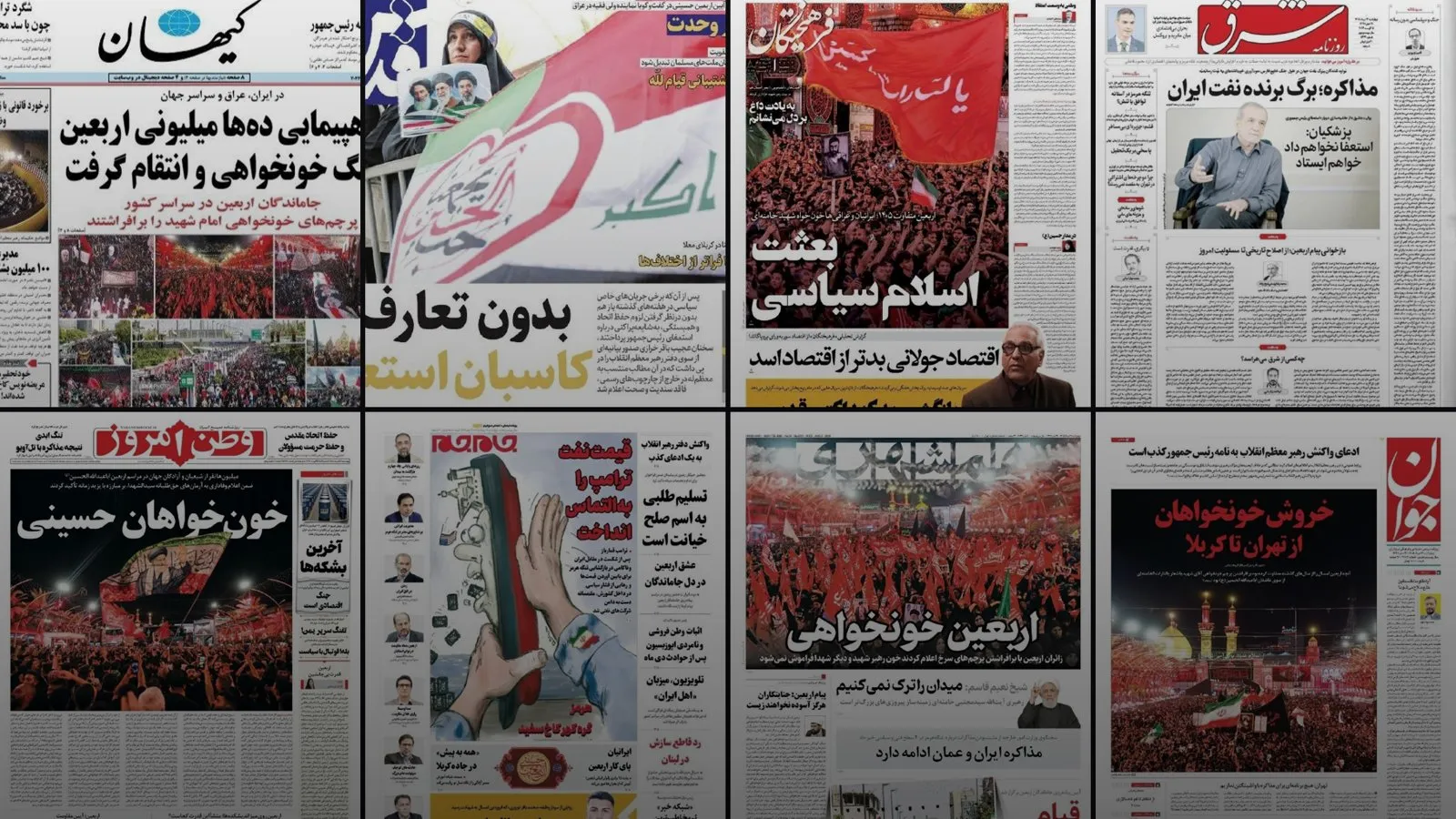
Bottom line: Day 155 turns on a contradiction the fronts are built to hold apart: the Arba’een crowds are coded as blood-avengers of the assassinated Leader under the slogan ‘Ya Latharat al-Khamenei’ and every hint of a US letter or channel is branded a fabrication, even as reformist titles and regional wires report an Araghchi-approved temporary Hormuz corridor accord awaiting the Leader’s and the security council’s sign-off, so the loudest signal is denial and the most consequential one is a maritime arrangement quietly being drafted.
Executive Summary
The lead judgment of Day 155 is that the edition fuses a peak of vengeance-mobilization rhetoric with a categorical denial of any US channel, while the substantive movement of the day sits underneath both in the maritime file. Across the scanned hardline and state fronts, Arba’een is not commemorated but operationalized: Kayhan’s ‘the tens-of-millions Arba’een march took on the color of blood-vengeance and revenge,’ Hamshahri’s ‘Arba’een of blood-vengeance,’ Vatan-e Emrooz’s ‘the Husseini blood-avengers,’ Farhikhtegan’s ‘resurrection of political Islam,’ and Javan’s ‘surge of the blood-avengers from Tehran to Karbala’ under the explicit slogan ‘Ya Latharat al-Khamenei’ (O avengers of Khamenei). The pilgrimage is bound directly to avenging the Leader assassinated on 28 February 2026, continuing and intensifying the Arba’een-as-vengeance thread this monitor tracked on 3 August, now sharpened from a general mourning register into a named succession-vengeance slogan.
The day’s genuinely new thread is a denial. The office of the Leader, Seyyed Mojtaba Khamenei (named in print on Hamshahri and in Iran Daily), is reported across Kayhan, Jam-e Jam and Javan to have rejected as false a claim about the Leader’s reaction to a letter from the US President; Javan hardens this into ‘we have no letter for negotiation with Washington,’ and the Foreign Ministry spokesman’s line, that Iran is not currently in talks with the United States, carries the same message outward on the English Iran Daily. The underlying claim itself is not printed and is not reproduced here; only the denial is documented, and it functions to foreclose any narrative of Tehran-Washington correspondence during the Arba’een window.
Against that denial sits the edition’s highest-significance finding: the maritime file appears to be advancing even as the front pages disown it. Hamshahri confirms an eighth round of Iran-Oman Hormuz negotiations at technical and political levels; Etemad reports that Foreign Minister Abbas Araghchi has given preliminary approval to a Gulf maritime accord covering mine-clearing and a corridor protocol, awaiting the Leader’s and the Supreme National Security Council’s sign-off; and regional wires (Nour News, and an Axios report amplified by Jam-e Jam) describe a temporary, roughly sixty-day arrangement to reopen the Strait via a merged central corridor in Omani and Iranian waters. The analytic caution is symmetrical: the hardline denial of any ‘US channel’ is technically compatible with an Oman-mediated arrangement, so the two need not be contradictory, but the distance between ‘no letter, no talks, economic war’ on the front pages and ‘a drafted accord awaiting sign-off’ in the reformist lane is the gap most worth watching.
The Hormuz doctrine has shifted register from sovereignty to economic siege. Where the 3 August edition hardened the ‘never return to the pre-war state’ line, today’s fronts reframe the Strait as an economic-war instrument: Jam-e Jam’s cartoon of ‘Hormuz, the White House’s grave-knot’ and its ‘oil prices forced Trump to plead’ lead, Vatan-e Emrooz’s ‘the last barrels: it is an economic war,’ and Kayhan’s front-page note that the closure burns roughly one hundred million barrels a week (attributed to Aramco CEO Amin Nasser, whose real statement it is, carried as his claim). The coercion is being generalized beyond Hormuz: Vatan-e Emrooz’s dual-strait ‘new order’ analysis and the government daily’s and Sobh-e No’s figures on Saudi shipping diverting from Bab el-Mandeb (transits down about 22 percent, tanker traffic down about 39 percent, vessels rerouting around the Cape of Good Hope) extend the chokepoint thread to the southern strait with concrete, if outlet-sourced, transit numbers.
Beneath the war register, a domestic contest over the presidency is now explicit. A coordinated hardline campaign delegitimizes calls for resignation, Kayhan’s attack on ‘surrenderism,’ Qods’s ‘profiteers of resignation,’ Vatan-e Emrooz’s ‘preserving the dignity of officials,’ and Jam-e Jam’s ‘surrenderism in the name of peace is treason’, while the reformist lane answers directly: Shargh prints President Pezeshkian’s ‘I will not resign, I will stand firm’ and government spokeswoman Fatemeh Mohajerani dismisses mass-resignation reports as recurrent false rumor. The reformist titles pair this with a diplomatic counter-doctrine, Shargh’s ‘negotiation is the winning card of Iran’s oil’ and its ‘Hormuz trap’ caution, positioning the Oman channel as leverage to be cashed rather than an end in itself.
Net assessment: this is a denial-and-mobilization edition whose loudest signals, the ‘Ya Latharat al-Khamenei’ vengeance crowds and the flat rejection of any US letter, are information-operation posture, while its most consequential signal is the quiet, cross-lane reporting that a temporary Hormuz corridor accord is drafted and awaiting the Leader’s sign-off. No new US strike inside Iran, no confirmed Hezbollah or Houthi action, and no signed agreement or verified Strait reopening existed at the cut-off; the Israel and Lebanon items (Sobh-e No’s espionage and cabinet-postponement claims, Qassem’s ‘we will not leave the field’ and anti-negotiation quotes) are rhetoric and unverified morale claims, not confirmed events. The signals to watch are whether the Leader’s office confirms or vetoes the drafted Oman accord, whether any Iranian front page names the Qatar-mediated channel as more than a foreign attribution, and whether the resignation fight produces named targets.
Key Points
- KJ-1 [HIGH] Arba’een has been operationalized as a named succession-vengeance mobilization for the assassinated Leader. The explicit crowd slogan ‘Ya Latharat al-Khamenei’ on Javan and Farhikhtegan, and the ‘blood-vengeance’ framing across Kayhan, Hamshahri and Vatan-e Emrooz, bind the pilgrimage directly to avenging Ali Khamenei and to the legitimacy of Seyyed Mojtaba Khamenei’s succession. Significance: the commemoration is being used as an escalation-signaling and cohesion instrument, and the fusion should be expected to continue through the mourning period; the calibration is bidirectional, since the crowds are real even where the vengeance framing is imposed.
- KJ-2 [HIGH] The front-page consensus flatly denies any US letter or channel, and that denial is itself the day’s principal information operation. The Leader’s office rejection of a ‘false claim’ about a reaction to the President’s letter, Javan’s ‘no letter for negotiation with Washington,’ and the Foreign Ministry’s ‘no current US talks’ are coordinated to foreclose a correspondence narrative during Arba’een. Significance: the denial is a posture, not necessarily a fact about the maritime channel, and it is technically compatible with an Oman-mediated arrangement, so it should not be read as ruling out an interim deal.
- KJ-3 [MODERATE-HIGH] The most consequential movement of the day is a reported temporary Hormuz corridor accord advancing beneath the denial. Hamshahri confirms an eighth-round Iran-Oman talk at technical and political levels; Etemad reports an Araghchi-approved draft awaiting the Leader’s and the Supreme National Security Council’s sign-off; Nour News and an Axios report amplified by Jam-e Jam describe a roughly sixty-day arrangement. Significance: the maritime file, not the nuclear file, remains the near-term point of an ambiguous compromise, and the Leader’s sign-off decision is the single highest-value cue; the judgment is held at moderate-high because the accord is reported, not confirmed, and the hardline titles are positioned to disown it.
- KJ-4 [MODERATE-HIGH] The Hormuz argument has shifted from a sovereignty claim to an economic-siege weapon, and the coercion is being generalized to Bab el-Mandeb. Jam-e Jam’s ‘oil prices forced Trump to plead,’ Vatan-e Emrooz’s ‘economic war,’ and Kayhan’s Aramco-sourced hundred-million-barrels note reframe the closure as leverage rather than cost, while transit figures at Bab el-Mandeb extend the doctrine south. Significance: this is doctrinal consistency with the standing chokepoint thread, but it raises Iran’s exposure to the same economic pain it is inflicting, a tension the reformist and business-tilted items are beginning to surface.
- KJ-5 [MODERATE] A coordinated hardline campaign is delegitimizing resignation demands while the reformist lane defends the president and diplomacy. The ‘surrenderism/profiteers-of-resignation/dignity-of-officials’ cluster on Kayhan, Qods, Vatan-e Emrooz and Jam-e Jam meets Shargh’s Pezeshkian ‘I will not resign’ and Mohajerani’s denial of mass resignations. Significance: the war’s political meaning is now being fought domestically over the presidency, and the reformist coupling of cabinet stability with the Oman channel positions diplomacy as the responsible exit; the cue is whether the hardline campaign names specific targets.
- KJ-6 [MODERATE] Negative evidence: no new confirmed kinetic event, on Israel, Lebanon or the Axis, was identified inside the reporting window. The Israel items (Sobh-e No’s settler-espionage arrest and a postponed security-cabinet meeting, tank shelling of northern Gaza) are unverified or reported claims, and the Lebanon signal is rhetorical (Qassem’s ‘we will not leave the field’ and his anti-negotiation line), with no confirmed Hezbollah or Houthi action. Significance: the pause across the Axis during Arba’een is best read as tactical restraint that preserves negotiating space around the maritime file, not demobilization; the cue is whether attacks resume if the Oman accord stalls.
Macro Trends
- Arba’een sharpened into a named succession-vengeance slogan. The mourning-into-vengeance framing tracked on 3 August is intensified today into the explicit crowd slogan ‘Ya Latharat al-Khamenei’ (O avengers of Khamenei), carried on Javan and Farhikhtegan and echoed as ‘blood-vengeance’ across Kayhan, Hamshahri and Vatan-e Emrooz. The pilgrimage is bound directly to avenging the assassinated Leader, and Farhikhtegan elevates it to a claimed civilizational revival (‘resurrection of political Islam’); the near-identical vengeance wording across otherwise competitive titles indicates centrally-guided message discipline, documented for defensive assessment only.
- A categorical denial of any US letter or channel. A new standing thread: the Leader’s office is reported to reject as false any claim of the Leader’s reaction to the US President’s letter (Kayhan, Jam-e Jam, Javan), Javan flattens it to ‘we have no letter for negotiation with Washington,’ and the Foreign Ministry’s ‘no current US talks’ line carries it outward on Iran Daily. The denial forecloses any Tehran-Washington-correspondence narrative during the Arba’een window and should be read as an information-operation move, not a neutral clarification.
- The Hormuz file: economic-siege rhetoric over a quietly drafted corridor accord. The ‘never-return’ sovereignty line of 3 August is reframed as deliberate economic warfare, Jam-e Jam’s ‘Hormuz, the White House’s grave-knot’ cartoon and ‘oil prices forced Trump to plead,’ Vatan-e Emrooz’s ‘the last barrels: it is an economic war,’ Kayhan’s Aramco-sourced hundred-million-barrels note, even as Hamshahri confirms an eighth-round Iran-Oman talk and Etemad and regional wires report an Araghchi-approved temporary corridor accord awaiting Leader/SNSC sign-off. The tracking cues remain shipping, insurance and transit data, and the sign-off decision, rather than the front-page declarations.
- Chokepoint coercion generalized to Bab el-Mandeb. Vatan-e Emrooz’s dual-strait ‘new order’ analysis, and concrete figures on the government daily and Sobh-e No, Saudi vessel transits down about 22 percent and tanker traffic down about 39 percent at Bab el-Mandeb, with rerouting around the Cape of Good Hope, extend the chokepoint-as-coercion doctrine from Hormuz to the southern strait. The transit numbers are the verifiable core beneath the coercion rhetoric and are carried as the outlets’ claims pending independent shipping data.
- The presidency as the domestic battleground. A coordinated hardline effort to delegitimize resignation demands, Kayhan’s ‘surrenderism,’ Qods’s ‘profiteers of resignation,’ Vatan-e Emrooz’s ‘dignity of officials,’ Jam-e Jam’s ‘surrenderism is treason’, meets a direct reformist answer: Shargh’s front-page Pezeshkian ‘I will not resign, I will stand firm’ and Mohajerani’s dismissal of mass-resignation reports. The reformist lane couples this with a diplomatic counter-doctrine (negotiation as the winning card, the ‘Hormuz trap’ caution), making the presidency the arena where the war’s political meaning is contested.
Front-Page Snapshot
- Kayhan - “The tens-of-millions Arba’een march took on the color of blood-vengeance and revenge” (Ultra-hardline flagship, managing editor Hossein Shariatmadari) - Arba’een as blood-vengeance; denial of any US channel [HIGH]
- Javan - “The surge of the blood-avengers, from Tehran to Karbala” (Hardline, IRGC-affiliated) - Ya Latharat al-Khamenei vengeance slogan; no US letter [HIGH]
- Hamshahri - “Arba’een of blood-vengeance” (Conservative, Tehran municipality) - Vengeance red flags over a confirmed 8th-round Oman Hormuz talk [MODERATE-HIGH]
- Vatan-e Emrooz - “The Husseini blood-avengers” (Hardline principlist) - Sacralized vengeance; anti-negotiation; two-straits economic war [HIGH]
- Farhikhtegan - “The resurrection of political Islam” (Principlist (Azad University)) - Arba’een as political-Islam revival; blood-vengeance for Khamenei [MODERATE-HIGH]
- Jam-e Jam - “The oil price forced Trump to plead” (State broadcaster (IRIB) daily) - Hormuz as economic siege; surrenderism-is-treason; letter denial [HIGH]
- Iran Daily - “Iran not currently engaged in talks with US, FM spox says” (English-language government daily) - Outward-facing denial with a Qatar-attributed diplomatic softener [LOW-MODERATE]
- Etemad - “Hormuz accord takes shape as officials tamp down resignation talk” (Reformist) - Drafted Oman-Hormuz accord awaiting sign-off; resignation denial [LOW-MODERATE]
- Shargh - “Negotiation: the winning card of Iran’s oil” (Reformist) - Diplomacy-as-leverage; Pezeshkian refuses resignation [LOW-MODERATE]
- Qods - “Bluntly, on the profiteers of resignation” (Conservative, Astan Quds Razavi (Mashhad)) - Resignation-profiteer attack; Arba’een unity; anti-Israel morale item [MODERATE]
- Iran - “Arba’een services scaled up; US denies missile-depletion claim” (Official government daily (Persian)) - Arba’een services; US missile-depletion denial aired; Bab el-Mandeb data [LOW-MODERATE]
- Sobh-e No - “Israeli distress on the front page over the Hormuz standoff” (Principlist) - Israeli-distress morale claims; Western corroboration; Oman talks [MODERATE]
Full report
The complete edition - per-paper front-page analysis and full translation appendices - is available as a PDF: Download the full report.
Compiled from Iranian front pages and outlet channels via open-source monitoring. Translations are editorial; named-figure attributions are verified against the source pages where possible.