Iranian Press Monitor - Tuesday, 21 July 2026 (Day 140)
Tuesday, 21 July 2026 · 30 Tir 1405 · 6 Safar 1448 - Nine Persian front-page scans, one English print (Iran Daily), three outlet Telegram channels and three agency wires; Tehran Times was unavailable at the time
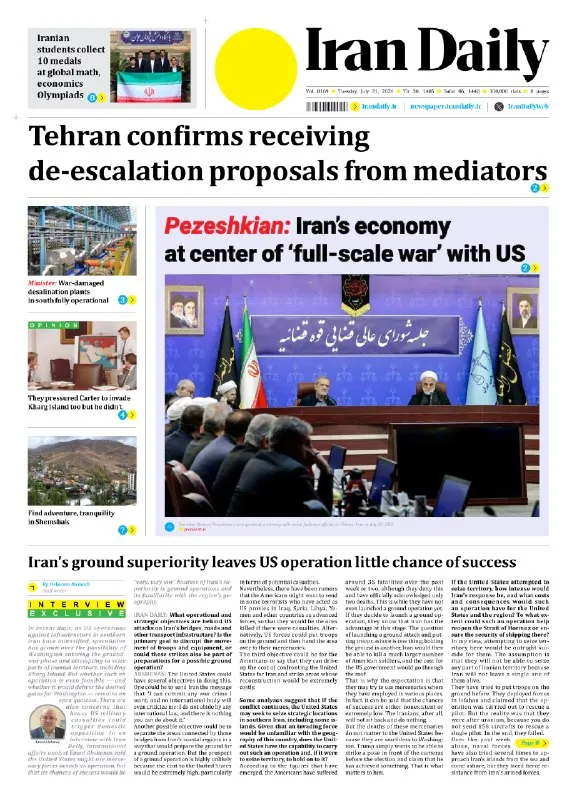
Bottom line: The single verifiable shift this cycle is that the diplomatic track is back on the front pages: the state’s English daily, an establishment title and the government daily all confirm that de-escalation and ceasefire proposals from mediators have reached Tehran, reversing the prior edition’s move to put negotiation on trial, but the hardline flagship immediately recodes the opening as an American defeat and ‘deception,’ the centrist and hardline titles wall off the Strait of Hormuz as a non-negotiable matter of ‘identity and civilization,’ and the strike-triumph claims, a Yemeni counter-siege of Saudi Arabia and a Palestine-inflected reading of the World Cup keep the momentum narrative running, so the fight on the page is no longer over whether to talk but over who is seen to be conceding.
Executive Summary
Day 140 is a mediators-return edition: the cross-cutting development is that the diplomatic track, which the prior cycle’s hardline press worked to delegitimize, is back at the top of the front pages, and the significant move is the split over how to frame it. The government’s English daily Iran Daily leads outright with ‘Tehran confirms receiving de-escalation proposals from mediators’; the establishment Jomhouri-ye Eslami states on its own front page that there are ‘new moves to halt the war and establish a ceasefire’; the reformist Etemad centers a feature titled ‘The Return of the Mediators’ on mounting Washington pressure channelled through third parties; and the government daily Iran carries a Guardian Council statement pegging council elections to ‘two months after the Supreme National Security Council declares an end to the war,’ an official body publicly presuming a coming close to the conflict. Four titles across three orientations thus converge on the same underlying fact: a mediation channel is live. This reverses the narrowing logged on Day 139, when the hardline press put negotiation itself on trial.
The hardline camp does not deny the opening; it re-scripts it. Kayhan, the Leader’s-office flagship, leads with ‘America took a hard slap, once again fled to the deception of negotiation,’ using a New York Times citation (‘Trump was forced to reach an understanding with Iran’) as borrowed proof that any talks reflect American weakness rather than an Iranian concession, and it adds a legal-warfare line claiming Iranian courts may try and punish Trump. Javan keeps a naked deterrent threat (‘we will teach the aggressors an unforgettable lesson’) and an op-ed on ‘American whitewashing behind a mask of peace-seeking’ on the page; Vatan-e Emrooz runs ‘a telling blow to Trump’ and ‘Trump: a weapon of mass destruction.’ The centrist Hamshahri supplies the red line: it invokes the Leader’s framing of the Strait of Hormuz and the Persian Gulf as ‘beyond a body of water, part of our identity and civilization,’ and explicitly analogizes any Hormuz diplomacy to a repeat of the JCPOA ‘surrender.’ Kayhan’s Shariatmadari editorial gives that red line its ideological backbone, reviving a ‘najes/impure’ trope about Iranian oil to cast Western and reformist objections to the chokepoint leverage as manipulation. The result is a division of labor: the government wants the world to see an opening, the flagship wants Iranians to see a victory, and both agree that Hormuz cannot be seen to be traded away.
Two secondary fronts run beneath the diplomacy fight. First, a Yemen-Saudi escalation surfaces across the principlist and centrist titles: Javan’s ‘siege against siege,’ Sobh-e No’s ‘naval siege of Saudi Arabia,’ and Hamshahri’s ‘a Yemeni dagger at Saudi Arabia’s throat’ all promote a declared Yemeni maritime blockade of Saudi Arabia as a live second front in the resistance narrative. Second, the strike campaign against US regional bases continues as attacker-sourced claim, now branded ‘Operation Nasr 2’ on the agency wires (Defa Press, Fars News): claimed radar, Patriot, F-15, MQ-9 and HIMARS strikes across Jordan, Kuwait and Bahrain, plus tanker interdictions in the Strait of Hormuz. US casualty figures diverge inside the same edition, sixteen in Vatan-e Emrooz against roughly one hundred wounded in the Iran daily, and both remain single-side sourced. A Hamas-succession claim (Khalil al-Hayya named successor to Yahya Sinwar) is carried by both Kayhan and Javan and should be treated as an attributed claim pending confirmation.
Third, a Palestine-inflected reading of the 2026 World Cup final runs as an edition-wide soft-power motif. Spain’s win over Argentina is read by the principlist and centrist press as a resistance victory: Sobh-e No titles its front ‘the Cup of the Free,’ Hamshahri declares ‘Palestine, the champion of the World Cup in America,’ and Javan captions its match photo ‘football’s revenge on politics’ with a human figure blacked out of the frame. The reformist Sazandegi pointedly declines the allegory, playing the final as sport (‘the kingdom of the matadors’) and instead foregrounding a more consequential political item: a reported message from the Leader to former reformist president Mohammad Khatami, conveyed via Mohammad-Ali Abtahi, a possible leadership gesture toward the reformist camp at the moment the mediation track reopens.
The economic titles carry the government’s own account of the war. President Pezeshkian’s High Judicial Council remarks, that ‘the most important arena of battle is the economy and people’s livelihood,’ are lifted across Ta’adol, Chaharsu, Etemad and the English Iran Daily (‘Iran’s economy at the center of a full-scale war with the US’), a coordinated presidential message that reframes the confrontation as primarily economic and lowers the military temperature. Ta’adol leads on chronic inflation as the biggest challenge to reconstruction and on housing unaffordability; Chaharsu stages a Hemmati-voiced defense of the government’s record alongside blunt figures on halved per-capita income and an ‘alarm bell’ for the 49 million holders of Justice Shares. A coordinated home-front reassurance line also runs: ‘no rise in rationed gasoline prices’ (Etemad, Sobh-e No) and ‘war-damaged southern desalination plants fully operational’ (Jomhouri-ye Eslami, Iran Daily).
Net assessment: this is a framing-contest edition, not a fresh-escalation one. The verifiable development is that the mediation track has been publicly re-platformed at the state level after a cycle spent discrediting it, and the elite fight has correspondingly shifted from whether to negotiate to who is seen to be conceding, with Hormuz established cross-factionally as the line no negotiator can be shown to cross. The battlefield claims outrun corroboration and contradict each other on casualties; the Yemen-Saudi ‘counter-siege’ is a new front to watch; the World Cup soft-power motif and the economy-first presidential line both work to lower the temperature; and the reported Leader-to-Khatami message hints at an internal realignment that would fit a move toward an exit. The single highest-significance finding is the open, state-level confirmation of live de-escalation proposals, precisely because the flagship is expending so much effort to ensure it is not read as surrender.
Key Points
- KJ-1 [HIGH] The diplomatic track has been publicly re-platformed at the state level, reversing the prior cycle’s move to put negotiation on trial. Iran Daily leads with ‘Tehran confirms receiving de-escalation proposals from mediators,’ Jomhouri-ye Eslami with ‘new moves to halt the war and establish a ceasefire,’ Etemad with ‘the return of the mediators,’ and the government daily Iran carries a Guardian Council statement pegging council elections to ‘two months after the war’s declared end’ - four titles across three orientations converging on a live mediation channel. Significance: after Day 139’s hardline campaign to delegitimize negotiation as such, the government and establishment have moved the off-ramp back to the front page, and an official body now publicly presumes the war is heading to a formal close; this is the edition’s single most consequential shift and the anchor for everything else on the page.
- KJ-2 [HIGH] The hardline flagship is pre-framing the opening as an American defeat rather than trying to block it, indicating a shift from obstruction to narrative-control. Kayhan leads with ‘America took a hard slap, once again fled to the deception of negotiation,’ using a New York Times citation (‘Trump was forced to reach an understanding with Iran’) as borrowed proof of US weakness and adding a claim that Iranian courts may try and punish Trump; Javan (‘American whitewashing’) and Vatan-e Emrooz (‘a telling blow to Trump’) reinforce the line. Significance: the flagship’s investment in a victory narrative is itself evidence that a deal is anticipated - the message-discipline work is aimed at ensuring any subsequent agreement is read domestically as American capitulation, not Iranian concession.
- KJ-3 [MODERATE-HIGH] The Strait of Hormuz has been established cross-factionally as the non-negotiable red line of any talks. The centrist Hamshahri invokes the Leader’s ‘identity and civilization’ framing and explicitly analogizes Hormuz diplomacy to a repeat of the JCPOA ‘surrender’; Kayhan’s Shariatmadari editorial supplies the ideological backbone via a ‘najes/impure’ oil trope. Significance: that a municipal centrist title, not only the hardline press, carries this line means the sovereignty-over-Hormuz frame is a broadly held boundary rather than a factional talking point, constraining what the negotiators can be seen to trade; the quiet Vatan-e Emrooz concession that alternative pipelines could erode the chokepoint’s leverage is the one crack in that wall worth tracking.
- KJ-4 [MODERATE] A Yemen-Saudi ‘counter-siege’ has been promoted to a live second front across the principlist and centrist titles. Javan’s ‘siege against siege,’ Sobh-e No’s ‘naval siege of Saudi Arabia’ and Hamshahri’s ‘a Yemeni dagger at Saudi Arabia’s throat’ converge on a declared Yemeni maritime blockade of Saudi Arabia, and the Fars wire carries a Yemeni warning of ‘consequences of a continued blockade.’ Significance: the resistance axis is being kept visibly active precisely as the US-Iran track leans toward de-escalation, a hedge that preserves escalation capacity elsewhere; treat the blockade and its effects as attributed claims and watch whether the thread hardens into sustained coverage or fades within a cycle.
- KJ-5 [MODERATE-HIGH] The strike campaign against US regional bases continues but remains attacker-sourced and internally inconsistent on its own numbers. The agency wires (Defa Press, Fars News) brand it ‘Operation Nasr 2’ and claim radar, Patriot, F-15, MQ-9 and HIMARS strikes across Jordan, Kuwait and Bahrain plus Hormuz tanker interdictions, while US casualty figures diverge inside the same edition - sixteen in Vatan-e Emrooz against roughly one hundred wounded in the Iran daily. Significance: treat the continuing exchange as probable but every base-by-base target and casualty tally as messaging to be confirmed outside this monitor; the unreconciled casualty figures are themselves a caution against reproducing any single number as fact.
- KJ-6 [MODERATE] A reported leadership gesture toward the reformist camp coincides with the diplomatic opening. The reformist Sazandegi carries, via Mohammad-Ali Abtahi’s account, a reported message from the Leader (Mojtaba Khamenei) to former reformist president Mohammad Khatami, while Etemad and the establishment titles push a ‘collective responsibility’ and ‘everyone must support the government’ line. Significance: if accurate, an outreach to the reformist establishment at the moment mediators return would fit an internal realignment toward an exit and a broadening of the coalition that would own it; the message’s content is unverified and attributed to Abtahi, and should be tracked rather than asserted.
- KJ-7 [MODERATE] Negative-evidence judgment: Israel and the Lebanese front are again largely absent from the front pages, and the resistance-axis energy has migrated to the Yemen-Saudi arena and to Palestine-as-symbol rather than Palestine-as-battlefield. No monitored front page leads on an Israeli or Lebanese military development; Gaza surfaces mainly through the attributed Hamas-succession claim and the World Cup solidarity motif. Significance: the confrontation on the page has consolidated around the US-Iran diplomatic contest, the Strait of Hormuz and the new Yemen-Saudi front; the continued Israel-Lebanon quiet should be logged as a finding in its own right, since a return to either would be a signal, and read against the de-escalation lead rather than as evidence of it.
Macro Trends
- The mediation track is re-platformed at the state level. After a cycle in which the hardline press put negotiation itself on trial, the diplomatic track is back at the top of the front pages: Iran Daily leads on ‘de-escalation proposals from mediators,’ Jomhouri-ye Eslami on ‘new moves to halt the war and establish a ceasefire,’ Etemad on ‘the return of the mediators,’ and the government daily Iran carries an official statement pegging council elections to ‘two months after the war’s declared end.’ Four titles across three orientations confirm a live channel; the argument has moved from whether to talk to how the talks are framed.
- The hardline camp pre-claims victory rather than blocking the talks. Unable to deny the opening, the flagship recodes it: Kayhan’s ‘America took a hard slap, once again fled to the deception of negotiation’ uses a New York Times citation as proof of American weakness, and Javan (‘American whitewashing behind a mask of peace-seeking’) and Vatan-e Emrooz (‘a telling blow to Trump’) keep the strike-triumph and US-decline lines running. The purpose is inoculation: to ensure no subsequent deal can be read at home as an Iranian concession.
- Hormuz established cross-factionally as the non-negotiable red line. The centrist Hamshahri invokes the Leader’s framing of the Strait of Hormuz and the Persian Gulf as ‘part of our identity and civilization’ and analogizes any Hormuz diplomacy to a repeat of the JCPOA ‘surrender’; Kayhan’s Shariatmadari editorial supplies the ideological backbone with a ‘najes/impure’ oil trope. That a municipal centrist title carries this line shows the sovereignty-over-Hormuz frame has broad buy-in and functions as the boundary the negotiators cannot be seen to cross - even as Vatan-e Emrooz quietly concedes, while rebutting it, that alternative pipelines could erode the chokepoint’s leverage.
- A Yemen-Saudi counter-siege promoted as a new front. Javan’s ‘siege against siege,’ Sobh-e No’s ‘naval siege of Saudi Arabia’ and Hamshahri’s ‘a Yemeni dagger at Saudi Arabia’s throat’ converge to promote a declared Yemeni maritime blockade of Saudi Arabia, folding a Yemen-Saudi escalation into the axis-of-resistance narrative at the same moment the US-Iran track leans toward de-escalation. Treat the blockade and its effects as attributed claims and watch whether the thread persists or fades.
- The World Cup as soft-power, read against the elite split. Spain’s win over Argentina in the 2026 final is turned into a resistance-solidarity victory by the principlist and centrist press (‘the Cup of the Free,’ ‘Palestine, the champion of the World Cup in America,’ ‘football’s revenge on politics’ with a blacked-out figure), while the reformist Sazandegi declines the allegory and plays it as sport. The same event thus refracts the same factional divide as the diplomacy fight, and its prominence lowers the edition’s overall temperature.
- The economy foregrounded as the government’s account of the war. President Pezeshkian’s ‘the economy and people’s livelihood are the most important arena of battle’ is carried across Ta’adol, Chaharsu, Etemad and Iran Daily, a coordinated presidential message that reframes the confrontation as economic and implicitly supports an off-ramp. The economic titles keep the domestic cost visible - chronic inflation, halved per-capita income, housing unaffordability, an ‘alarm bell’ for Justice Shares holders - while a reassurance line (‘no gasoline-price rise,’ ‘southern desalination restored’) manages home-front morale.
Front-Page Snapshot
- Iran Daily (English) - “Tehran Confirms Receiving De-escalation Proposals from Mediators” (State English daily) - State-level confirmation of a live mediation track; economy as the main front [MODERATE]
- Jomhouri-ye Eslami - “New Moves to Halt the War and Establish a Ceasefire” (Traditional / establishment) - Establishment endorsement of ceasefire diplomacy; unity behind the government [LOW-MODERATE]
- Etemad - “The Responsibility for a Collective Decision Rests with Everyone” (Reformist) - ‘Return of the mediators’ centered; collective responsibility; gasoline-price reassurance [MODERATE]
- Iran - “Council Elections Two Months After the War’s Declared End” (Official government daily) - Official framing presuming a coming end to the war; US-pressure signalling [MODERATE]
- Kayhan - “America Took a Hard Slap, Once Again Fled to the Deception of Negotiation” (Hardline flagship (Leader’s office / IRGC)) - Mediation recoded as US defeat and deception; legal-warfare escalation against Trump [SEVERE]
- Hamshahri - “Again, ‘Should We Just Hand It Over?!’” (Centrist (Tehran municipality)) - Hormuz cast as a non-negotiable identity red line against any deal [MODERATE-HIGH]
- Vatan-e Emrooz - “A Telling Blow to Trump” (Hardline / principlist) - Strike-triumph and US-decline messaging; a rare Hormuz-bypass concession [HIGH]
- Javan - “Yemen Arrives with ‘Siege Against Siege’” (Hardline (IRGC-affiliated)) - Yemen-Saudi counter-siege front; Hamas succession; deterrent threats [HIGH]
- Sobh-e No - “The Cup of the Free” (Principlist) - World Cup as Palestine-solidarity victory; Yemen siege; attacker-sourced base-strike claims [HIGH]
- Sazandegi - “The Kingdom of the Matadors” (Reformist (Kargozaran)) - World Cup as sport; reported Leader-to-Khatami message; escalation questioned [LOW-MODERATE]
- Chaharsu - “Pezeshkian’s Record, in Hemmati’s Words” (Economic / business) - Economy as the decisive battlefield; halved incomes; livelihood pressure [LOW]
- Ta’adol - “Mirdamad’s Gaze on the Future of the Economy” (Economic) - Chronic inflation as top challenge; ‘economy is the main front’ [LOW]
Full report
The complete edition - per-paper front-page analysis and full translation appendices - is available as a PDF: Download the full report.
Compiled from Iranian front pages and outlet channels via open-source monitoring. Translations are editorial; named-figure attributions are verified against the source pages where possible.