Iranian Press Monitor - Monday, 20 July 2026 (Day 139)
Monday, 20 July 2026 · 29 Tir 1405 · 5 Safar 1448 - Nine Persian front-page scans, one English print (Iran Daily), four outlet Telegram channels and three agency wires; Tehran Times was unavailable at the time
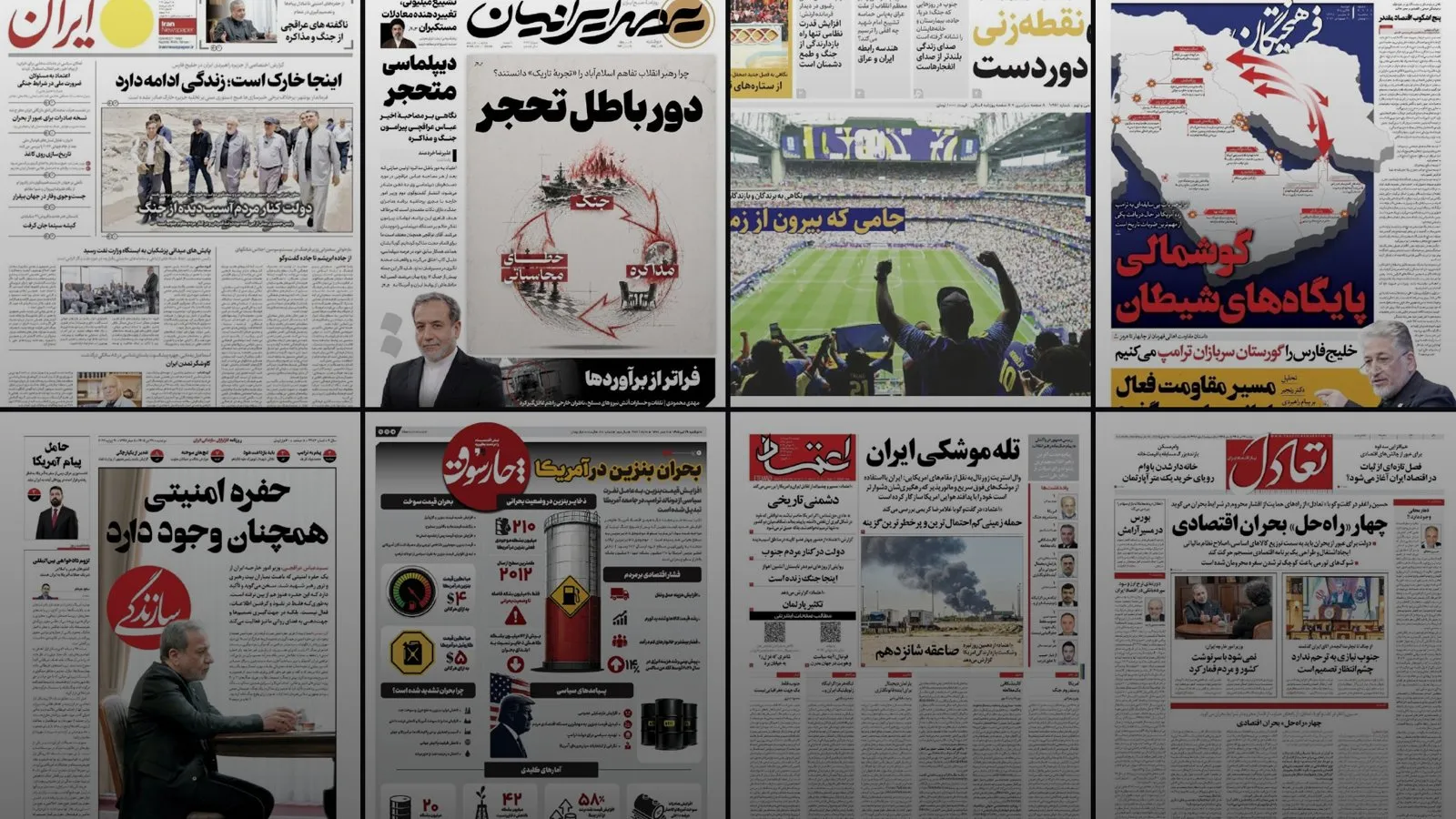
Bottom line: The Foreign Minister’s interview on the war and negotiation became the day’s cross-cutting story, and the hardline press used it to put the diplomatic track on trial (relabeling negotiation ‘dogmatism’ and invoking the Leader’s ‘dark experience’ verdict on the ceasefire memorandum), while the strike campaign against US bases in Jordan and Kuwait continued as attacker-sourced claim, a coordinated home-front-reassurance line declared the south stable, and the economic press turned the chokepoint squeeze outward into a claim of American gasoline pain.
Executive Summary
Day 139 is a diplomacy-on-trial edition: the single cross-cutting story is Foreign Minister Abbas Araghchi’s recent interview on the war and negotiation, and the edition’s most significant move is what the hardline press did with it. Sobh-e Iranian devotes its whole front page to a rebuttal, built around a ‘vicious circle’ graphic (War leads to Negotiation, Negotiation to Miscalculation, Miscalculation back to War) whose argument is that the diplomatic track does not end the cycle but powers it. Two signed op-eds, Alireza Kheradmand’s ‘Dogmatic Diplomacy’ and Mohammadreza Zaheri’s ‘A miscalculation catastrophe: the dogmatism of a naive foreign policy,’ invert the usual vocabulary so that it is now the negotiators, not their critics, who are branded rigid ideologues (tahajjor). The subhead enlists the Leader’s own verdict, asking why he deemed the ‘Islamabad understanding’ (the ceasefire memorandum suspended in the prior cycle) a ‘dark experience.’ This is the diplomatic-track sequel to yesterday’s Kayhan ‘fifth column’ editorial: having sought to criminalize the cost-of-war argument, the hardline camp now moves to delegitimize the negotiate-an-exit argument, and it borrows the leadership’s language to do so.
The same interview is carried to the opposite end by the government and reformist and economic titles, which is why it, and not a strike, organizes the day. The government daily Iran trails ‘Araghchi’s untold accounts of the war and the negotiation’ at the top of a page otherwise given to home-front reassurance; the reformist Sazandegi foregrounds his warning that the ‘security gap’ which enabled the bombing of the Leader’s residence and the assassination of the martyred predecessor ‘still exists,’ turning the interview into a demand for accountability for the February failure rather than a case against diplomacy; and the economic Ta’adol lifts his line that ‘one cannot gamble with the destiny of the country and its people’ as a caution against escalation. One interview thus anchors both the hardline case that negotiation is the error and the reformist case that the real error was the unaddressed intelligence breach.
Beneath the diplomacy fight, the strike campaign against US regional bases continued, still branded and still attacker-sourced. Qods leads on ‘pinpoint messages’ delivered to US bases on Jordanian soil; Farhikhtegan maps struck bases across Iraq, Kuwait, Jordan and the Gulf under ‘a chastening of Satan’s bases’ and threatens to make the Persian Gulf ‘the graveyard of Trump’s soldiers’; Vatan-e Emrooz frames an ‘Iranian equation’ of sustained pressure on US command centers and air defenses, naming the Al-Azraq base and a Kuwait desalination facility; and the IRGC wires brand the effort ‘Operation Nasr 2,’ waves 21 and 22, against Aqaba and Ali al-Salem. The English Iran Daily packages the campaign for foreign readers by anchoring its fatality claim to CENTCOM (‘two soldiers killed in Iranian strikes on Jordan’), the one US-attributed element in the edition, though it reaches readers only as an Iranian outlet’s rendering. Operation labeling is not uniform: Etemad still calls the effort ‘Saaegheh 16.’ Treat the continuing exchange as probable and every base-by-base and casualty tally, including the two US dead, as claim to be confirmed elsewhere.
Two quieter but coordinated lines fill out the page. A home-front-reassurance cluster runs across orientations: Iran kills an evacuation rumor about the Kharg crude-export island (‘this is Kharg; life goes on’), Jomhouri-ye Eslami has the Hormozgan governor declare ‘a full return of stability’ on all provincial transport routes, and Qods and Etemad file southern-resilience dispatches (‘the sound of life is louder than the blasts,’ ‘here, war is alive’) - reassurance that is now itself a message-discipline product. And the economic press turns the chokepoint doctrine outward: Chaharsoo devotes its front page to a claimed US ‘gasoline crisis’ (pump prices near four dollars, inventories at their lowest since 2012, political anger at Trump), Farhikhtegan advertises ‘twenty million barrels a day behind Hormuz and Bab-el-Mandeb,’ and Jam-e Jam keeps the domestic bill in view with a 4,200-megawatt grid loss and an 80 percent Gulf LNG decline. Net assessment: this is a line-hardening edition, not a fresh-escalation one. The verifiable development is rhetorical and internal - the leadership’s line has moved from repudiating a specific deal to putting negotiation itself on trial - while the battlefield claims outrun corroboration, the home front is being managed as a morale problem, and the economic titles keep both an outward leverage claim and the domestic cost of the war visibly on the same page. Note also what is absent: Israel and Lebanon are largely off the front pages this cycle, the confrontation on the page having narrowed to US bases, Jordan, Kuwait and the Strait of Hormuz.
Key Points
- KJ-1 [HIGH] The Foreign Minister’s interview became the day’s cross-cutting story, and the hardline press used it to put the diplomatic track itself on trial. Sobh-e Iranian’s entire front page - a ‘vicious circle of dogmatism’ graphic plus two signed op-eds (‘Dogmatic Diplomacy,’ ‘A miscalculation catastrophe’) - relabels negotiation as ‘tahajjor’ and anchors the charge to the Leader’s ‘dark experience’ verdict on the ceasefire memorandum, while Iran, Sazandegi and Ta’adol carry the same interview to opposite ends. Significance: the leadership line has moved from repudiating a specific deal to delegitimizing the act of negotiating, the diplomatic-track sequel to the prior edition’s ‘fifth column’ move against the cost-of-war argument; the domestic off-ramp is being narrowed rhetorically even as no new battlefield fact requires it.
- KJ-2 [MODERATE-HIGH] The strike campaign against US regional bases continued but remained attacker-sourced, and even its one US-attributed element reaches readers only as an Iranian rendering. Qods (‘pinpoint messages’ to Jordan), Farhikhtegan (struck-bases map), Vatan-e Emrooz (‘Iranian equation’ naming Al-Azraq and a Kuwait desalination plant), Sobh-e No (Darkhovin and Abadan strikes claimed) and the IRGC wires (‘Nasr 2’ waves 21-22 on Aqaba and Ali al-Salem) all sit on one side; Iran Daily anchors ‘two US soldiers killed in Jordan’ to CENTCOM but carries it as its own report. Operation labeling is inconsistent (‘Nasr 2’ versus Etemad’s ‘Saaegheh 16’). Significance: treat the continuing exchange as probable and every base-by-base target and casualty figure, including the two US dead, as messaging to be confirmed from outside this monitor.
- KJ-3 [MODERATE-HIGH] A coordinated home-front-reassurance line is the edition’s second guided message, indicating the leadership treats domestic morale as a front. Iran kills an evacuation rumor about the Kharg crude-export island; Jomhouri-ye Eslami has the Hormozgan governor declare ‘a full return of stability’ on all provincial transport routes; Qods and Etemad file southern-resilience dispatches; social-support items (health-insurance extension, farmer payments) reinforce the tone. Significance: reassurance calibrated this consistently across orientations is itself a message-discipline product, an implicit admission that economic anxiety and displacement in the south are vulnerabilities the leadership judges worth centrally managing rather than ignoring.
- KJ-4 [MODERATE-HIGH] The economic press is converting the Hormuz chokepoint doctrine into an outward economic-warfare argument while keeping the domestic cost visible. Chaharsoo’s front-page US ‘gasoline crisis’ (four-dollar pump prices, inventories at a 2012 low, anger at Trump) and Farhikhtegan’s ‘twenty million barrels behind Hormuz and Bab-el-Mandeb’ sell the squeeze as American pain; Jam-e Jam’s 4,200-megawatt grid loss and 80 percent Gulf LNG decline, and Ta’adol’s crisis-relief prescriptions, keep the self-inflicted cost on the same page. Significance: the coercion doctrine is now being marketed as a winning US-facing strategy, but the economic titles have not abandoned the counter-argument that the chokepoint pressure damages the economy it claims to defend - the restraint signal persists beneath the leverage claim.
- KJ-5 [MODERATE] Negative-evidence judgment: Israel and Lebanon are largely absent from the front pages this cycle, and the axis of confrontation on the page has narrowed to US bases, Jordan, Kuwait and the Strait of Hormuz. Gaza surfaces only as an attributed Kayhan item (a Palestinian figure’s count of Israeli ceasefire violations); no monitored front page leads on Israel or the Lebanese front. Significance: the messaging has consolidated around the US-Iran military-economic contest, and the near-total absence of the Israel and Lebanon flashpoints is a finding in its own right - a shift back to either would be a signal, and the current silence should be logged rather than read as de-escalation.
- KJ-6 [MODERATE] The succession-imagery vacuum noted in earlier editions continues to close: the current Leader is now routinely named in print. Farhikhtegan attributes the day’s resistance line directly to ‘Ayatollah Seyyed Mojtaba Khamenei,’ and the principlist titles route the Iraq-gratitude message and the ‘unity around the guardian’ theme (Sobh-e No) through his authority. Significance: the leadership is now comfortable foregrounding the current Leader by name and title, though the hardest deterrent and enforcement lines are still voiced through the flagship (Kayhan) and the IRGC wires rather than in his own words - the managed-succession pattern persists and remains worth tracking.
Macro Trends
- The diplomatic track is put on trial, not just a specific deal. The prior cycle repudiated the ceasefire memorandum; this one moves against negotiation as such. Sobh-e Iranian’s ‘vicious circle of dogmatism,’ with its two signed op-eds relabeling diplomacy ‘tahajjor’ and invoking the Leader’s ‘dark experience’ verdict, reframes the case for talks from a policy position into an ideological failing. This is the diplomatic-track analogue of the Kayhan ‘fifth column’ editorial: after the cost-of-war argument, the negotiate-an-exit argument is the next target of the message-policing campaign, and the leadership’s own language is being used as the instrument.
- One interview, two opposite uses, refracting the elite split. Foreign Minister Araghchi’s war-and-negotiation interview is the day’s cross-cutting text precisely because the camps read it against each other. The hardliners (Sobh-e Iranian) treat it as the confession of a naive diplomacy; the reformists (Sazandegi) foreground his ‘the security gap still exists’ warning to reopen accountability for the February assassination; the government daily and the economic press (Iran, Ta’adol) lift his ‘do not gamble with the country’s fate’ caution toward restraint. The same words anchor both the case against diplomacy and the case against the leadership’s own security record.
- The US-base strike campaign continues, rebranded and attacker-sourced. The kinetic line held its place below the diplomacy fight: ‘pinpoint messages’ to US bases in Jordan (Qods), a struck-bases map and a ‘graveyard of Trump’s soldiers’ threat (Farhikhtegan), an ‘Iranian equation’ of sustained pressure naming Al-Azraq and a Kuwait desalination plant (Vatan-e Emrooz), and ‘Operation Nasr 2’ waves 21-22 on the IRGC wires. The English Iran Daily anchored the two-US-dead claim to CENTCOM for foreign readers. The labeling is inconsistent (Nasr 2 versus Etemad’s ‘Saaegheh 16’) and every specific target and casualty figure remains single-side sourced.
- Reassurance as a managed product: the home front declared stable. A coordinated reassurance line ran across orientations: an official denial of any Kharg-island evacuation (Iran), a governor’s declaration of ‘full stability restored’ on Hormozgan’s transport routes (Jomhouri-ye Eslami), and southern-resilience dispatches (Qods, Etemad). Paired with health-insurance extensions and farmer payments, the effect is to treat domestic morale and economic anxiety as a front to be managed centrally, an implicit acknowledgment that the war’s home-front cost is a vulnerability the leadership judges worth actively countering.
- The chokepoint doctrine turned outward into an economic-warfare claim. The economic press kept both halves of the ledger on the page. Chaharsoo devotes its front to a claimed US ‘gasoline crisis’ (four-dollar pump prices, inventories at a 2012 low, political anger at Trump), and Farhikhtegan advertises ‘twenty million barrels a day behind Hormuz and Bab-el-Mandeb’ - selling the coercion doctrine as pain inflicted on the American consumer. Yet Jam-e Jam’s 4,200-megawatt grid loss and 80 percent Gulf LNG decline, and Ta’adol’s crisis-relief prescriptions, keep the domestic cost equally visible: the leverage claim and the self-inflicted-cost warning share the same page.
Front-Page Snapshot
- Sobh-e Iranian - “The Vicious Circle of Dogmatism” (Principlist / hardline) - Negotiation itself reframed as a self-defeating trap; a front-page attack on the Foreign Minister’s interview, invoking the Leader’s ‘dark experience’ verdict [HIGH]
- Iran - “This Is Kharg; Life Goes On” (Official government daily) - Home-front reassurance (no Kharg evacuation) plus a trail for ‘Araghchi’s untold accounts of the war and negotiation’ [MODERATE]
- Sazandegi - “The Security Gap Still Exists” (Reformist (Kargozaran)) - Araghchi’s warning turned into accountability for the February assassination; international legal claim against complicit Arab states [MODERATE]
- Ta’adol - “Four ‘Solutions’ to the Economic Crisis” (Economic) - Raghfar interview on the war’s household-budget cost; Araghchi’s ‘do not gamble with the country’s fate’ read toward restraint [LOW-MODERATE]
- Iran Daily (English) - “Armed Forces Escalate Retaliatory Campaign Against US Regional Bases” (State English daily) - US-base campaign messaged abroad; ‘CENTCOM: two soldiers killed in Jordan’; Araghchi on a reshaped security structure [HIGH]
- Qods - “Pinpoint Messages, Delivered Far Afield” (Conservative (Astan Quds Razavi)) - Jordan strikes as precise ‘messaging’; the Leader’s gratitude to Iraq; southern resilience [HIGH]
- Farhikhtegan - “A Chastening of Satan’s Bases” (Principlist (Azad University)) - Struck-bases map; ‘graveyard of Trump’s soldiers’; dual-chokepoint (Hormuz plus Bab-el-Mandeb) leverage; names Mojtaba Khamenei [SEVERE]
- Kayhan - “America in Shock at Iran’s Telling Blows” (Hardline flagship (Leader’s office / IRGC)) - ‘New rules of engagement’ on CENTCOM; US logistics ‘destroyed’; Operation Nasr 2; a borrowed French voice on Western decline [SEVERE]
- Vatan-e Emrooz - “The Iranian Equation Begins” (Hardline / principlist) - ‘Sustained pressure’ doctrine on US command centers and air defenses; Al-Azraq and a Kuwait desalination plant named; Hormuz threat [HIGH]
- Sobh-e No - “Unity Around the Command of the ‘Guardian’” (Principlist) - Internal cohesion behind the Leader’s authority over the active exchange; Darkhovin and Abadan strikes claimed [HIGH]
- Etemad - “Iran’s Missile Trap” (Reformist) - WSJ-sourced claim of neutralized US air defenses; ground assault called least likely; ‘Saaegheh 16’; southern front [MODERATE-HIGH]
- Jomhouri-ye Eslami - “Full Return of Stability Across All of Hormozgan’s Transport Routes” (Traditional / establishment) - Home-front recovery declared; Al-Mayadeen on rising US anti-war sentiment; health-insurance and farmer-payment reassurance [LOW-MODERATE]
- Jam-e Jam - “Grid Capacity Down 4,200 Megawatts After War Damage” (State broadcaster (IRIB)) - Infrastructure and energy cost of the war; ‘second war over Hormuz sovereignty’; 80 percent Gulf LNG decline [MODERATE]
- Chaharsoo - “The Gasoline Crisis in America” (Economic / business) - Chokepoint squeeze turned outward as US consumer pain (four-dollar pump prices, 2012-low inventories, anger at Trump) [MODERATE-HIGH]
Full report
The complete edition - per-paper front-page analysis and full translation appendices - is available as a PDF: Download the full report.
Compiled from Iranian front pages and outlet channels via open-source monitoring. Translations are editorial; named-figure attributions are verified against the source pages where possible.