Inside the Mechanism: Qatar Shuttles Between Araghchi and Witkoff as Its Half-Year Deficit Overruns the Annual Budget
Qatar has moved from carrying messages to operating inside the machinery of the U.S.-Iran exchange over Hormuz. According to Axios, as relayed by Al-Araby Al-Jadeed, Qatari mediators were due to meet Iranian Foreign Minister Abbas Araghchi and U.S. envoy Steve Witkoff separately on September 28, after President Trump rejected Tehran’s seven-day proposal. The report holds that schedule at moderate confidence because it rests on a single channel. The cost of the war is now plain in Doha’s own accounts. The first-half budget deficit of QAR 31.5 billion already exceeds the full-year plan, and QatarEnergy says two damaged LNG trains will take three years to repair. On the university-funding charge, Doha’s rebuttal is settled, and the argument in Washington has shifted to the Education Department’s delayed disclosure report, now due October 2.
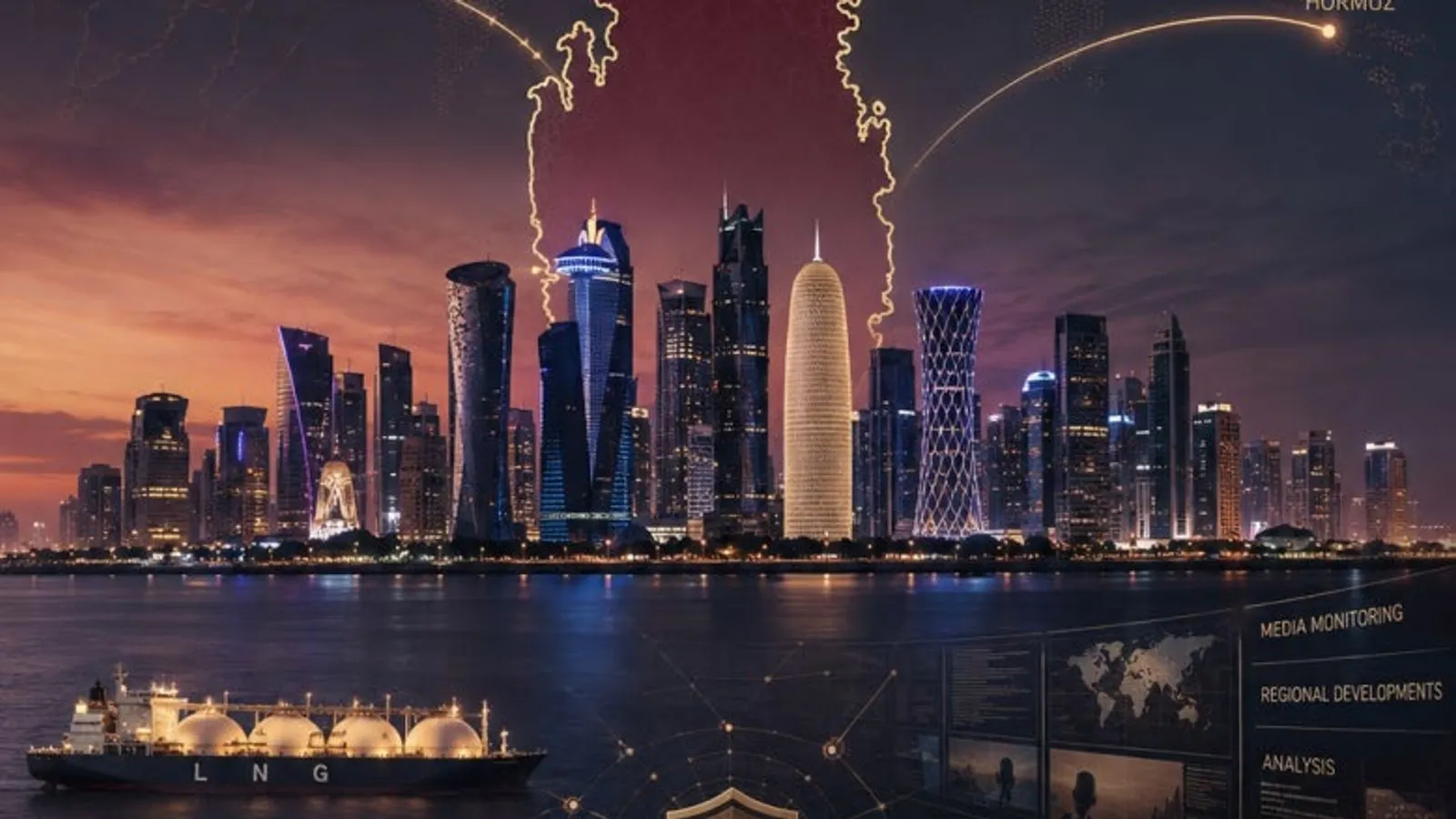
Qatar at the Center of the Hormuz Exchange
Al Jazeera Arabic led on September 28 with the report that Tehran is still waiting for a formal U.S. answer to its plan for reopening the strait. The network says Araghchi sent the plan through Qatar, that Tehran expects a final answer through Qatari and Pakistani mediators, and that Qatari officials have been shuttling between Araghchi and the U.S. negotiators. It gives Doha a central operational role but does not suggest a deal is close.
Al-Araby’s page 2 report, drawing on Axios, adds the schedule. A U.S. official and two regional sources said Qatari mediators would meet Araghchi and Witkoff separately on Monday, and Trump said he expects more talks this week. Araghchi told Iranian television that Iran will not drop its seven conditions and is waiting for the mediators to relay final positions. “We are waiting for the mediators to convey final positions,” he said. The announced conditions include a seven-day halt to hostilities across the region, including Lebanon, the release of at least $12 billion in frozen assets, an end to oil sanctions and to the U.S. naval blockade of Iranian ports, and the reopening of the strait after seven days.
The paper prints Tehran’s conditions and threats in full and summarizes Washington’s position. The report reads that imbalance as the paper’s editorial signal. Qatar is also missing from every list of states the paper describes as applying pressure on Iran. The same-day Hormuz-axis daily covers how the Iranian press is reading the standoff.
The Gulf Times offered a reminder that Qatar’s English-language press does not follow a single line on Iran. It gave prominent space to Qatar’s condemnation of the attack on an Emirati ADNOC vessel in Hormuz and carried an opinion essay sharply critical of Iranian doctrine. Qatar-based media can take a hawkish view of Tehran while the state mediates with it.
The University-Funding Charge Moves to Process
Doha’s answer to Prime Minister Benjamin Netanyahu’s accusation has not changed since September 24. That day Hamad Al-Muftah, deputy chief of mission in Washington, said on X that most reported Qatari funding pays for U.S. branch campuses in Education City, that the home universities keep academic control, and that Hamas officials are in Doha because Qatar serves as the negotiating channel Washington wanted. The Foreign Ministry, the Emir’s September 22 UN speech, and Al Jazeera’s institutional response all run along the same lines. The report finds narrative convergence and amplification. It does not find evidence that the content is centrally scripted.
Prime Minister Sheikh Mohammed bin Abdulrahman Al Thani added a sharper personal edge in his CNN interview, which aired September 26. He called Netanyahu’s government the biggest obstacle to the Gaza plan, said Israel is acting against the U.S.-brokered plan for Netanyahu’s political benefit, and denied that any Qatari money reached Hamas’s military wing. The report judges with high confidence that Doha is now contesting Israel’s election narrative directly, a month before the October 27 vote. The September 27 brief traced how Qatar’s Arabic press took up that line.
In Washington the argument has turned procedural. On September 25 the Education Department postponed, for the sixth time, its report naming foreign funders of U.S. universities, and the new date is October 2. Kenneth Marcus of the Brandeis Center called the delay unacceptable. The Section 117 portal already shows Qatar as the largest single foreign source, at about $6.6 billion, led by Cornell, Carnegie Mellon, and Texas A&M. Most of that money went to institutions with branch campuses in Qatar, the same point Al-Muftah makes. The report judges that the totals favor Doha and will continue to do so after October 2. Doha’s real exposure lies in contract terms, which the House Education and Workforce Committee released in March and which underpin the Brandeis Center’s referrals to the Justice Department on Northwestern and Georgetown. Neither referral has drawn a public response.
Board of Peace and UNRWA: Where State and Media Diverge
Official Qatar supports both the Board of Peace and UNRWA. At the General Assembly, Doha pledged $1 billion to the Board, promised to coordinate humanitarian and development work with it, and reaffirmed full support for UNRWA’s mandate. The Board, by contrast, restated on Friday that it will not work with UNRWA in Gaza.
Qatar-funded media take a harder line. Al Jazeera English asked on September 27 whether the Board follows Israeli lines. Al-Araby’s September 28 front page went further, calling the Board a partner in an American-Israeli plan to liquidate the UN agency, and its two-page spread nowhere mentions Qatar’s $1 billion pledge. The paper placed the prime minister’s CNN criticism of Israel’s ceasefire record inside that spread. That placement lets Doha’s criticism of Israel sit beside the paper’s criticism of the Board without either being attributed to the other.
The report describes this divergence with high confidence and interprets it with moderate confidence. Doha keeps its access and influence inside a U.S.-led mechanism, while the media it funds criticize that mechanism from a Palestinian-rights position. Public evidence cannot show whether this division of roles is deliberate or the product of separate mandates and editorial latitude. It does show that Qatar-linked media do not speak with one voice on the Board.
What Al-Araby Chose to Print
Issue 4410 gave Israel and Palestine unusual density and carried three items of note for Doha. The first is a page 9 column by economy editor Mustafa Abdel Salam arguing that the U.S. economic war on Iran has failed. He lists the states that have complied with U.S. aviation and banking pressure, among them Turkey, Oman, the United Arab Emirates, and Iraq, and Qatar does not appear. A senior staff editor of a Qatar-funded paper thus declared the U.S. pressure campaign a failure on the same day Qatari mediators met both sides.
The second is an opinion piece by editor-in-chief Ma’an al-Bayari rebuking Hamas for offering to mediate in Yemen. He argues that the movement has neither the standing nor the capacity for that file. The paper’s own editor criticized Hamas on a day when Doha hosts its officials.
The third item concerns Iraq. The Iraqi Oil Ministry has disclosed a contract under which the Qatari company Urbacon will supply high-octane gasoline to Iraq through the Syrian port of Baniyas, a route that bypasses Hormuz. Al-Araby also reported, citing three unnamed Iraqi officials, that Baghdad’s investigation links the drone attack on Saudi Arabia’s East-West pipeline to a cell tied to the IRGC and the Houthis operating from Maysan province. Other reporting corroborates the launch site and the investigation. The command chain remains the paper’s claim, and the report holds it at low to moderate confidence. The Iran-Saudi special report places that attack in the wider rivalry.
The War Economy Reaches the Budget
The Ministry of Finance reported a second-quarter deficit of QAR 21.2 billion ($5.8 billion), the widest since the end of 2016. Revenue fell 57 percent year on year, while spending was held near QAR 47 billion. The first-half shortfall of QAR 31.5 billion already exceeds the QAR 21.8 billion the December budget projected for the whole year on a $55 oil price. Quarterly LNG exports fell from about 20 million tonnes to under 2 million. The government has said its spending cuts spare salaries and capital projects. Contracts awarded to foreign companies fell 90 percent year on year, so foreign contractors are absorbing much of the adjustment. The report’s summary is that the gap is being financed and has not been closed.
Doha is repeating its 2017 playbook on a larger scale. Central bank data show that government foreign-currency deposits in local banks rose by QAR 46 billion ($13 billion) between February and June, more than offsetting a $3 billion fall in non-resident deposits and a drop in foreign borrowing. The Qatar Central Bank’s March package of repo facilities, a lower reserve requirement, and loan deferrals remains in force. Fitch removed Qatar from rating watch negative in early September. The IMF, however, now forecasts a full-year contraction of 8.6 percent.
Energy Minister Saad al-Kaabi set out the timelines at the Qatar Economic Forum in New York on September 20 and 21. QatarEnergy is producing very little LNG. The two Ras Laffan trains damaged in March, about 17 percent of export capacity, will take three years to repair. The damaged gas-to-liquids train returns in the first quarter of 2027, and the first North Field East train starts in the first half of 2027, but later trains depend on equipment that cannot reach Qatar through Hormuz. Normal operations for the undamaged plant could resume within weeks of the strait reopening. Even so, Qatar would remain at 83 percent of capacity until 2029. Force majeure on European cargoes now runs into early November, and Brent traded near $108 a barrel on the morning of September 28. The same-day Economic Press Review covers the Iranian side of the ledger.
The household burden falls unevenly. Desalination supplies close to 99 percent of Qatar’s water, and strategic reservoirs are the buffer against an oil slick reaching the intakes. Companies began cutting expatriate staff in the spring, with construction hit hardest. Qatari citizens are shielded by the protected public payroll, while expatriates, about nine in ten residents, carry most of the adjustment.
U.S. Influence Watch: FARA and CAIR
Justice Department records show active FARA registrants for Qatar Foundation and other Qatari principals, and no new Qatar-related filing appeared in the reporting window. FARA records a relationship. It does not establish effect.
CAIR’s national advocacy remains focused on Palestinian rights and on criticism of Israeli policy. CAIR is not registered under FARA for Qatar, and no court finding or Justice Department advisory says it must be. Claims that it acts as an unregistered Qatari agent remain allegations. The live process is at the state level. On September 11, Florida’s governor and cabinet approved a rule setting out how CAIR and other groups can be designated under a state law that took effect July 1. Two federal lawsuits against the state’s measures are pending. The report’s test for coordination remains strict. It would require documentary evidence such as common commissioning, message guidance, or funding tied to specific content, and none surfaced in the material reviewed (high confidence).
Key Points
- Doha’s rebuttal on university funding is settled and consistent across the Emir, the Foreign Ministry, the Washington embassy, and Al Jazeera. The Washington track has shifted to disclosure, with the Section 117 report due October 2 (high confidence).
- The prime minister’s CNN interview made the dispute personal, calling Netanyahu the main obstacle to the Gaza plan and denying any funding of Hamas’s military wing. Doha is now contesting Israel’s election narrative directly (high confidence).
- Official Qatar funds and coordinates with the Board of Peace, while Al Jazeera English and Al-Araby frame the Board’s exclusion of UNRWA as an Israeli objective (high confidence on the description, moderate on the interpretation).
- Qatari mediators are running separate meetings with Araghchi and Witkoff, and Tehran says it awaits final positions through them (moderate confidence, single-channel reporting on the schedule).
- The first-half deficit of QAR 31.5 billion exceeds the full-year budget projection. Spending is being protected, and the gap is being financed (high confidence).
- Government foreign-currency deposits in local banks rose by QAR 46 billion between February and June, offsetting outflows of non-resident deposits (high confidence).
- About 17 percent of LNG capacity will be out for three years, and later North Field East trains depend on Hormuz reopening. A reopened strait would restore volume within weeks but not the damaged trains (high confidence).
- Al-Araby’s issue 4410 tracks Doha’s interests without repeating Doha’s language, and it leaves Qatar off its list of states complying with U.S. pressure on Iran (high confidence).
- No public filing or finding links CAIR to Qatar. Florida’s designation rule and the Brandeis Center referrals are the live process items (high confidence).
- Al-Araby’s attribution of the Maysan drone attack on the East-West pipeline to an IRGC- and Houthi-linked cell remains a reported claim (low to moderate confidence).
What to Watch
- Whether Qatar confirms the separate meetings with Araghchi and Witkoff, and whether a revised Hormuz formula narrows the gap on sanctions, the blockade, sequencing, or the seven-day clock.
- Whether the Education Department publishes the foreign-source report on October 2, and whether Qatari messaging shifts from totals to contract terms.
- Whether Florida publishes CAIR designations in its Administrative Register, which would start a 30-day clock, and how the Eleventh Circuit handles the appeal of the injunction against the governor’s executive order.
- Whether Doha addresses the tension between its Board of Peace pledge and its support for UNRWA, or whether the Board changes its position on the agency.
- Third-quarter fiscal data, due around early December, and any statement on how the deficit will be financed.
- Whether loaded QatarEnergy transits continue for several days in a row, and whether force majeure notices to European buyers are extended past November.
- Whether the Foreign Ministry or the Emir repeats the prime minister’s election-framed criticism of Netanyahu, which would make it policy.
- Independent confirmation or contradiction of the IRGC and Houthi attribution for the Maysan drone cell.
This post summarizes the Qatar Watch daily intelligence report for September 28, 2026, covering the period from 10:12 on September 27 to 11:20 on September 28, Doha time. The report draws on QNA, Al-Arab, Al-Watan, Al-Sharq, Gulf Times, and The Peninsula; official Qatari social media accounts; Al Jazeera Arabic and English; Al-Araby Al-Jadeed’s print issue 4410 and website; Axios as relayed by Al-Araby; the Education Department’s Section 117 data, the Brandeis Center, and JINSA; Justice Department FARA records and Florida state records; the Ministry of Finance, the Qatar Central Bank, Bloomberg, MEES, AGBI, and Coface on the economy; and Oil & Gas Journal and The Peninsula on QatarEnergy. The report holds high confidence in its account of official statements, published media content, fiscal and central bank figures, and public records. It holds moderate confidence in its reading of coordination among Qatari institutions, in the mediation schedule, and in the pace of LNG recovery, and low to moderate confidence in the IRGC and Houthi attribution for the pipeline attack. Earlier posts in the series are collected on the Qatar Watch hub.