The House Voice: Al-Sharq Adopts Doha's Gaza Defense as Qatar Becomes an Israeli Campaign Issue and the Working Channel Holds
Qatar’s rebuttal of Israeli Prime Minister Benjamin Netanyahu now carries the institutional weight of its leading Arabic daily. On September 27, Al-Sharq published an unsigned house editorial that restates, point by point, the Gaza-funding defense that Prime Minister and Foreign Minister Sheikh Mohammed bin Abdulrahman Al Thani gave on CNN. The report judges with high confidence that Qatar has become a fixture of Israel’s election campaign and that Doha is answering on those terms, casting itself as a scapegoat of Israeli domestic politics. Beneath the public quarrel, an Israeli television report says the two governments’ working channel on Gaza remains open. The report holds that judgment at moderate confidence because the account rests on a single origin and neither government has confirmed it.
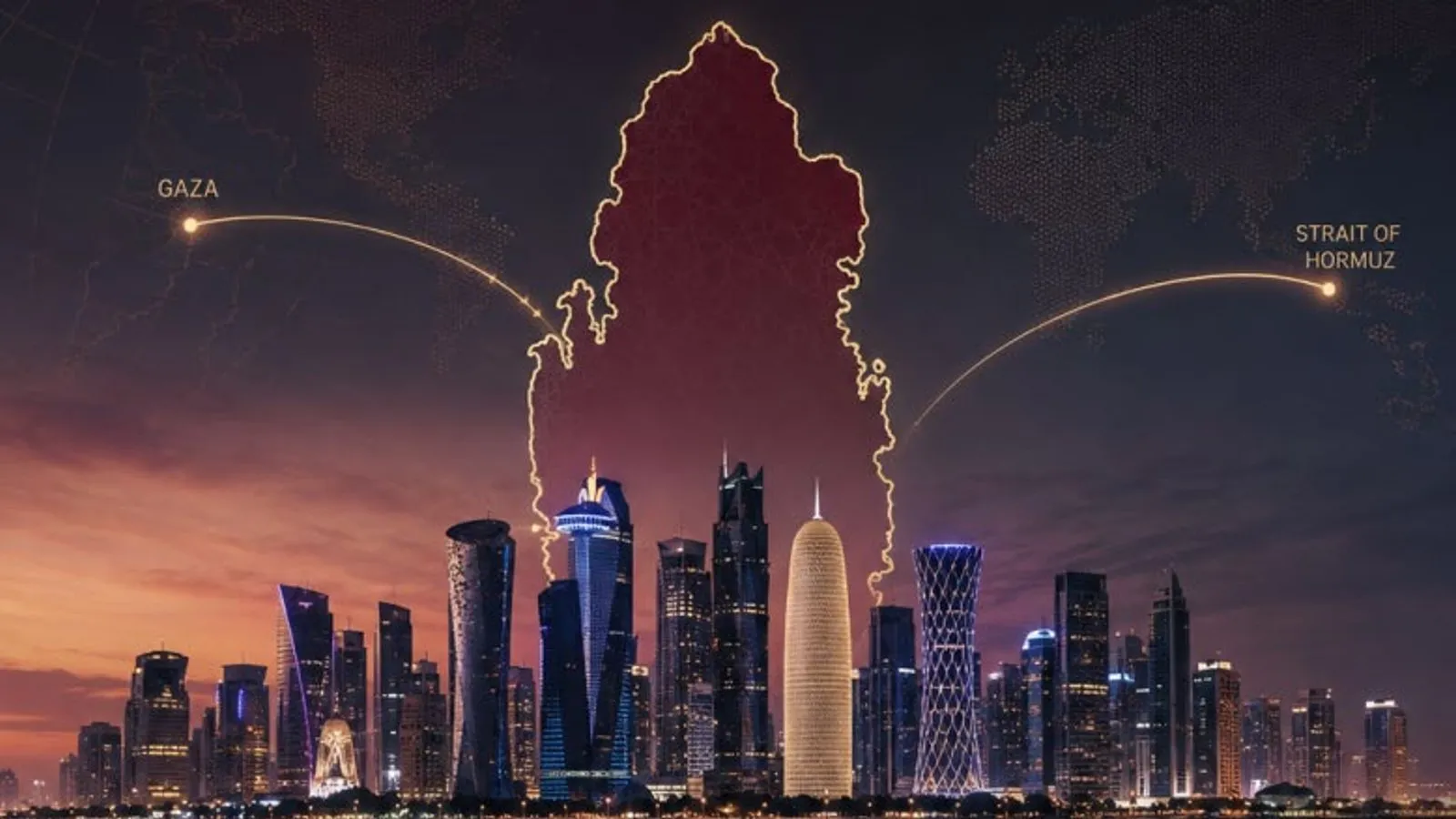
Al-Sharq Puts Its Own Name to the Defense
The main change overnight was in who is speaking for Qatar. Until Saturday, the sharpest Arabic rebuttals of Netanyahu’s September 24 UN speech appeared in signed columns. On Sunday, Al-Sharq’s editorial board adopted the prime minister’s CNN defense as the paper’s own position. The editorial, titled Qatar: The Truth in the Face of Smear Campaigns, says Qatari money for Gaza bought fuel for the power plant, supported poor families, and paid civil servants, all from lists reviewed by Israel and the United Nations. It calls the attempt to make Qatar a scapegoat in Israel’s internal contest unacceptable. An unsigned house editorial is one step closer to the state than a contributor’s column, which is why the report treats it as the strongest institutional signal of the morning.
The columns around it built a positive counterweight to Netanyahu. In Al-Sharq, Sheikh Dr. Saud bin Nasser Al Thani traced the history of UN theatrics and cast Netanyahu as a performer who brought colored pens and misleading maps to the rostrum for his home audience. Amal Abdulmalik and, in Al-Raya, Babiker Issa read the Emir’s September 22 speech as the voice of international law. The Qatar News Agency kept its Arabic and English wires on international law and mediation, with no stand-alone item on the influence charge or the Hamas-funding dispute.
The division of labor across languages is now clear. English-language outlets such as The Peninsula and Qatar Tribune present Qatar as mediator, U.S. defense partner, and rebutting party, and they led on Iran and Hormuz. Arabic outlets present Qatar as a wronged mediator and Netanyahu as a politician speaking to empty seats for domestic gain. Al-Araby Al-Jadeed, which Qatar funds, chose a syndicated cartoon of Netanyahu at a UN podium overflowing with blood, the same image of the rostrum that Al-Sharq’s columnist used. The report reads the choice as aligned with Doha’s framing (moderate confidence). The September 26 brief traced the first, official stage of this response.
Qatar in Israel’s Election Campaign
Qatar now features in the rhetoric of every major contender in Israel’s October 27 election. Netanyahu placed it on what he called an eighth front, the war over truth, and accused it of funding American universities and hostile media. Naftali Bennett said Netanyahu had missed a historic opportunity to declare Qatar an enemy state and has pledged to do so himself. Gadi Eisenkot, Netanyahu’s main rival, told Channel 12 that the prime minister’s handling of Qatari cash for Gaza amounted to treason or a gross breach of trust, and he called for an investigation.
Doha has pitched its answer to this audience. In his interview with Christiane Amanpour, which aired on September 25, Sheikh Mohammed called the Qatargate allegations absurd and accused successive Israeli governments of using Qatar as a scapegoat. He said Netanyahu is “the biggest obstacle right now in progressing this peace plan.” He cited Israeli control of more than 70 percent of the Strip and about 150 aid trucks a day against the 600 agreed. He called the claim that Qatari payments funded Hamas’s military wing baseless and said no money entered Gaza without the consent of the United Nations and the Israeli government. He also said Israeli officials were in Doha in September 2023 pressing for another round of funding. That last point is his claim, and the interview is not independent proof of the meeting.
The report draws a careful line here. Qatar’s defense is procedural, resting on coordination, approved categories, and Israeli consent. Critics ask whether the money was diverted, fungible, or strategically useful to Hamas despite those safeguards. These are separate claims that need separate evidence. The report expects the Qatari scapegoat line to harden as the election nears (high confidence).
A Working Channel Beneath the Rhetoric
Israel’s Channel 12 reported that Michael Eisenberg, Netanyahu’s personal envoy for Gaza, met Ali Al-Thawadi in New York on the eve of the UN speech. Al-Thawadi is a minister in the Prime Minister’s Office and Qatar’s member on the Gaza Executive Board. The two reportedly discussed implementation of the Gaza plan and the entry of aid. The account reached wider circulation through Cairo 24 and Yeshiva World News. Versions differ on whether the meeting took place on September 23 or 24, and neither government has commented. If the account is accurate, Netanyahu attacked Qatar in public while his envoy kept the Gaza channel open in private.
Official Qatar has not moved on the Board of Peace. Minister of State Mohammed Al-Khulaifi told a Gaza meeting that Qatar co-hosted with Jordan and the United Kingdom on September 25 that Doha will keep working with the Board on humanitarian needs, recovery, and reconstruction. At the General Assembly, the Board presented a $2.45 billion, six-month plan of 66 projects, starting in Rafah. Hamas condemned the Board’s refusal to work with UNRWA, and Al Jazeera English and Al-Araby carried the complaint as news. Al Jazeera’s report also cited AP that Board members are more open to the agency in private. The report judges with high confidence that Qatari-linked media coverage of the complaint reflects a plurality of views and gives no sign of a policy split.
Section 117, CAIR, and the Limits of the Evidence
On September 25, the Education Department postponed for a sixth time since July its publication of the names of all foreign sources from prior Section 117 reporting cycles. The new date is October 2. Each notice says only that the department agreed to delay and gives no reason. The Brandeis Center has filed a FOIA request and called the fifth delay unacceptable. For Qatar the stakes are direct. As the largest foreign source by value, with about $8.8 billion across some 1,300 transactions according to the Congressional Research Service, it would see names attached to more of the counterparties behind that total. The largest contract any institution has reported is Cornell’s roughly $1.1 billion agreement to run Weill Cornell Medicine-Qatar through 2032.
The report is explicit about what these records can show. Section 117 measures disclosure of gifts and contracts of $250,000 or more a year. The public figures, many of them tied to branch-campus operating contracts, establish scale. They do not establish the political purpose Netanyahu assigns to them, and they have no bearing on the Hamas-funding question (high confidence). A June 2026 JINSA study argues that the law was never designed to prevent influence. That argument is JINSA’s own. FARA filings document paid representation, and no new FARA development changed the picture in the period.
No CAIR development with a Qatar link surfaced (moderate confidence). The last link remains QNA’s September 15 feature on CAIR’s national conference, which CAIR listed in its own media digest the next day. The exchange shows editorial affinity and mutual amplification. It does not establish funding, lobbying, or an operational relationship between the State of Qatar and CAIR.
NAZA and the Information Front
The documentary NAZA, by Yuval Abraham and Rachel Szor and produced by The Guardian, had a sold-out North American premiere at the New York Film Festival on September 26, with a pro-Israel protest outside Lincoln Center. The same evening it won the audience award at San Sebastián. It opens in more than 50 territories from September 28. The Israeli government has moved to revoke the directors’ citizenship, and the IDF chief of staff has called the film a fabrication. Its allegations about targeting and civilian deaths are claims by the film and its sources, and Israeli officials dispute them.
The Qatar connection lies in timing and amplification. Netanyahu’s eighth-front framing groups Qatari-funded media with Israel’s adversaries in an information war. Al-Araby gave the film a full page on September 27. The report judges with high confidence that NAZA is gaining reach in the United States just as Netanyahu frames the media as a front line, and that its release gives Qatari-funded outlets a ready counter-narrative.
The War Economy Waits on the Iran Track
Qatar raised LNG tanker transits through Hormuz to a two-month high, loading tankers already inside the Gulf and sending some fuel to Kuwait to keep parts of Ras Laffan running at minimum rates. Traffic remains far below the prewar pace of about three cargoes a day. Energy Minister Saad Al-Kaabi says undamaged parts of the plant could return to full output within a couple of weeks of the strait reopening. The damaged trains, about 17 percent of capacity, would stay offline. QatarEnergy is buying U.S. LNG to keep its contracts alive.
The mediation track moved the other way. President Trump confirmed on September 26 that he had rejected Iran’s proposal to reopen the strait, and Al-Araby, citing The Wall Street Journal, reports that he expects to resume strikes after the November midterms. The same page reports that Tehran floated its seven-day truce idea at a meeting in Qatar on September 20. President Pezeshkian told Al Jazeera that Qatar and Pakistan are still carrying messages, though Tehran has no trust in Washington. As a result, Doha’s revenue and its mediation role now hang on the same negotiation (moderate confidence). The Hormuz-axis daily covers how the Iranian press read Trump’s rejection.
Prices make each cargo valuable. European gas fell below €72/MWh on September 25, Asian LNG stood at $25.82/MMBtu, and Brent settled at $104.32. However, volumes stay small. The second-quarter budget deficit reached QAR 21.2 billion ($5.8 billion), with revenue down 57 percent. Pump prices were unchanged in September and the Qatar Stock Exchange opened higher on September 27. Flat fuel prices and a calm market buy domestic stability at the cost of a wider deficit.
Key Points
- Al-Sharq has lifted the Gaza-funding defense into its house editorial, placing the rebuttal in the paper’s institutional voice (high confidence).
- Qatar has become a fixture of Israel’s election campaign through Netanyahu, Bennett, and Eisenkot, and Doha’s scapegoat line is likely to harden before October 27 (high confidence).
- The Israel-Qatar working channel on Gaza appears intact, based on a single-origin Channel 12 report that neither government has confirmed (moderate confidence).
- Qatar’s official support for the Board of Peace is unchanged, and Qatari-linked coverage of Hamas’s UNRWA complaint shows no policy split (high confidence).
- Section 117 data prove the scale of Qatari university funding but do not prove the political purpose Netanyahu alleges. The next publication date for donor names is October 2 (high confidence).
- There is no new CAIR development with a Qatar link (moderate confidence).
- NAZA is gaining reach in the United States as Netanyahu casts the media as a front in Israel’s war, and Qatari-funded outlets are amplifying it (high confidence).
- Al-Araby’s cartoon choice aligns with Doha’s framing of the speech (moderate confidence).
- The drag on LNG revenue continues despite higher tanker traffic, and recovery now depends on a U.S.-Iran track that Trump has just set back (moderate confidence).
What to Watch
- Whether QNA carries the prime minister’s Hamas-funding denial, which would move it from press amplification to the official wire.
- Confirmation or denial of the Eisenberg-Al-Thawadi meeting by either government.
- A formal Qatari position on the Board of Peace and UNRWA.
- Further Israeli campaign pledges on Qatar, especially from Bennett and Eisenkot, and any Qatari answer that names them.
- Whether the Education Department publishes the historical Section 117 donor names on October 2 or postpones again.
- Qatari LNG transit counts after Trump’s rejection of the Iranian Hormuz proposal.
This post summarizes the Qatar Watch morning intelligence report for September 27, 2026, covering the period from 10:00 on September 26 to 12:00 on September 27, Doha time. The report draws on Al-Sharq, Al-Raya, Al-Watan, Gulf Times, The Peninsula, and Qatar Tribune; QNA in Arabic and English; CNN, ANI, and Al-Araby Al-Jadeed’s print issue 4409 and website; Al Jazeera English and Arabic; the Education Department, Federal Student Aid, and Congressional Research Service on Section 117; Justice Department FARA records; Channel 12 as relayed by Cairo 24 and Yeshiva World News; JTA, Variety, and The Guardian on NAZA; and Bloomberg via gCaptain, Trading Economics, EnergyNow, and AGBI on energy and the budget. The report holds high confidence in its account of the Qatari press, the official statements, the Section 117 postponement, and Qatar’s place in Israel’s campaign. It holds moderate confidence in the reported Eisenberg-Al-Thawadi meeting, which rests on a single origin, and in its reading of editorial choices. The prime minister’s account of Israeli requests for continued funding is his own claim. Earlier posts in the series are collected on the Qatar Watch hub.