A Decision Taken in Tehran: Doha Hardens Its Public Line on Iran but Still Carries Its Hormuz Proposal
Qatar has put its sharpest public charge against Iran on record. Foreign ministry spokesman Majed Al Ansari told Al Arabiya that Iran’s strikes on the Gulf followed a deliberate political decision made in Tehran within hours of February 28, and he pledged full support for Saudi Arabia’s defense measures. At the same time, the Qatari channel still carries Iranian proposals. In Baghdad on October 17, Foreign Minister Abbas Araghchi said Iran had sent Washington, through Qatar, a seven-day plan to reopen the Strait of Hormuz. The report judges that Doha now stands publicly in the Gulf camp while keeping its mediation alive, and that its room to mediate is shrinking as the front against the Houthis widens.
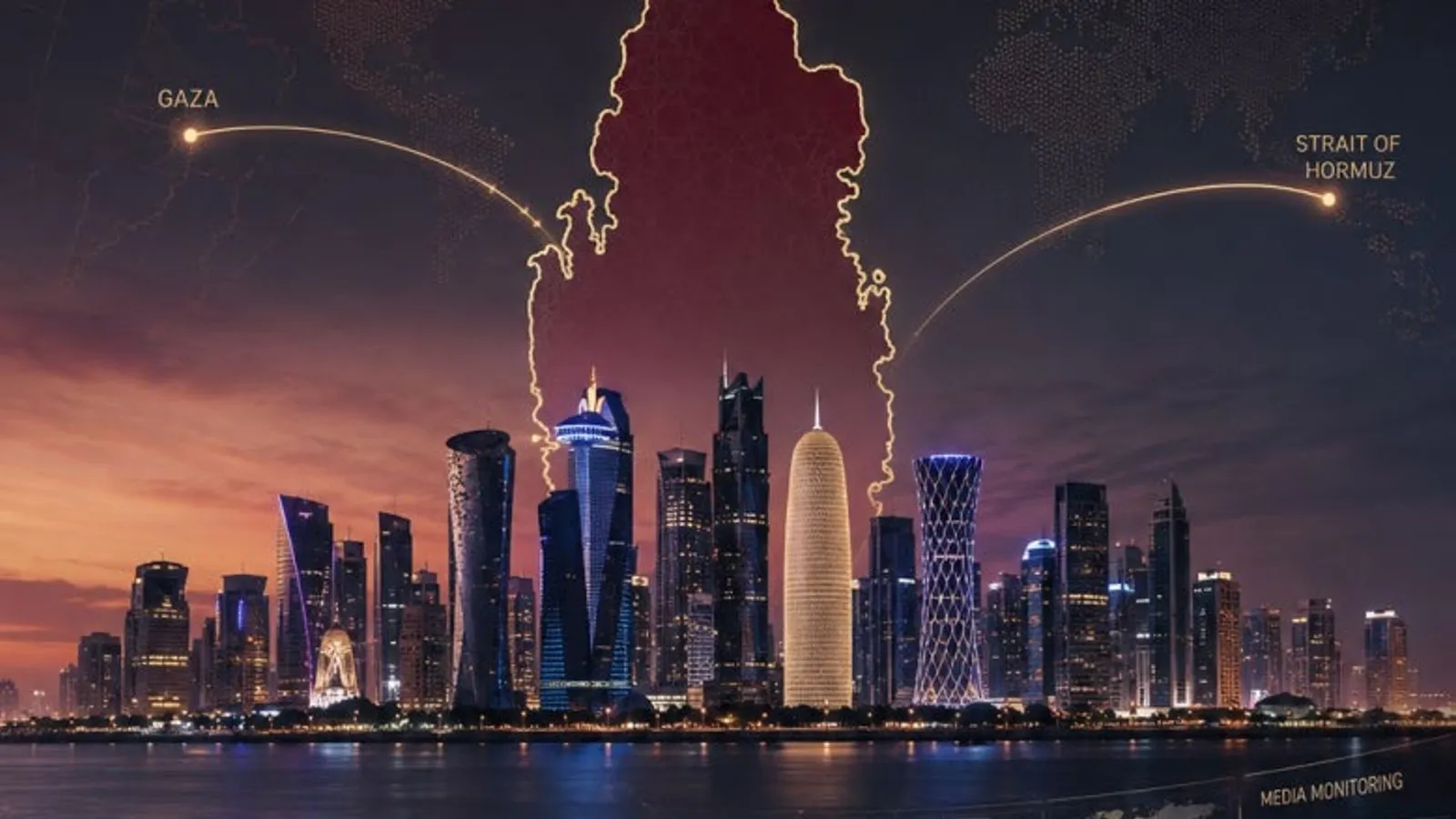
Iran: Qatar’s Sharpest Public Charge
Majed Al Ansari, adviser to the prime minister and the foreign ministry’s official spokesman, gave the interview to Al Arabiya and posted it on his X account. He said the decision to target the Gulf states was “taken in Tehran,” not in the Gulf, within a few hours of February 28. In his account, that decision turned Iran from a neighbor with which Qatar had hoped for normal relations into a threat, and the Gulf response amounts to resistance against it. He added that neither Iran nor anyone else can dictate how Qatar conducts its relations, declared full support for Saudi Arabia’s measures to defend its sovereignty, and called for a regional security system built on clear principles. He also credited Gulf forces, backed by the defense partnership with the United States, with performing well in the war.
On mediation, Al Ansari said peace is expensive and someone must bear its cost. However, he added that this does not mean Qatar accepts attacks on its territory. The Saudi outlet Ajel quoted him as saying Iran’s decision rests on wrong and desperate calculations.
The report assesses with high confidence that the language assigns blame for the breakdown to a single decision in Tehran and places Qatar in the Gulf camp in public. Doha keeps the Iranian channel open as a service to Washington and the region, but its standing in Tehran as a neutral broker is weaker for it. The statement extends the line Qatar took at the UN Security Council, which our October 17 brief covered. An Iranian response is the next thing to watch.
The Seven-Day Hormuz Plan
Addressing foreign ministers of the Organization of Islamic Cooperation in Baghdad on October 17, Araghchi said Iran had passed the U.S. administration, through the Qatari mediator, a specific seven-day proposal to reopen Hormuz and restore normal shipping if conditions are met. He said the choice now lies with Washington and that U.S. unilateral measures and attacks had derailed the June understanding. According to Gulf News, the strait would reopen on day six if Washington agrees, and negotiations would open on day seven. On the sidelines, Egypt’s Badr Abdelatty and Turkey’s Hakan Fidan urged Washington and Tehran to return to negotiations.
Neither Washington nor Doha has confirmed the terms. The report judges with moderate confidence that the plan shows the Qatari channel is working, but it does not show that a deal is near. Iran’s military messaging points the other way. Acting Defense Minister Majid Ebn-Reza said on October 17 that Iranian missiles set the terms of the war, and parliament has since confirmed Mehrdad Akhlaghi as defense minister. Iran’s side of the same day is covered in our Hormuz-axis update.
The sea lanes remain dangerous. The IRGC Navy said on October 17 that two tankers struck mines in Hormuz and declared the strait closed. These are IRGC claims and have not been independently confirmed. UKMTO reported a ship hit by an unidentified projectile 68 nautical miles northeast of Jubail, a second ship hit by a rocket-propelled grenade fired from a small boat, and an LNG carrier fired on from a small boat about 140 nautical miles southwest of Mukalla. The attack on the LNG carrier matters most for Qatar, because each incident raises war-risk premiums on Gulf LNG freight whether or not a Qatari vessel is hit.
Saudi Arabia, Egypt, and a Widening Gulf Front
President Abdel Fattah el-Sisi said on October 17 that Egypt would take any measure needed to defend Saudi Arabia if Riyadh asks, and he requested authority from parliament. Parliament meets in emergency session today. Under Article 152 of the constitution, sending forces on a combat mission abroad requires a two-thirds vote, and Egypt’s National Defense Council has approved a defensive deployment pending that vote. A former Egyptian assistant foreign minister told Al-Araby Al-Jadeed that defending Saudi territory against missiles and drones is different from joining ground operations. The coalition said it destroyed four drones and two ballistic missile launchers in its latest operations.
President Trump said on October 16 that Saudi Arabia will probably accept Israeli help against the Houthis. Al-Araby Al-Jadeed paired the remark with a diplomatic source’s account that Crown Prince Mohammed bin Salman does not want it. An Israeli role in the Saudi campaign, brokered by Washington, would put Qatar between its Gulf commitments and its standing in Tehran. Tehran, for its part, is courting Riyadh and warning it at the same time. Spokesman Esmaeil Baghaei offered to help end the conflict, while Mohammad Mokhber, an adviser to the Supreme Leader, warned Saudis that Washington has always been ready to sacrifice its allies.
GCC foreign ministers meet in Manama today for their 168th Ministerial Council, alongside the ninth GCC-Russia Strategic Dialogue. The communiqué’s language on Iran, Hormuz, and Saudi defense will show whether Qatar endorses the harder Gulf line in writing. The report finds no evidence of Qatari funding for Turkish or Pakistani forces in Saudi Arabia. The direction of travel is political. Al Ansari’s support for Saudi defense, set beside Egypt’s move toward deployment, places Qatar on the Gulf side of a widening front and narrows its room to mediate between Riyadh and the Houthis (moderate confidence).
Lebanon and Syria: From Investment to Security Talks
Qatar’s October 15 to 16 visit to Beirut set out an energy offer and a demand that the Lebanese army replace Israeli forces in the south. The file has now moved to the security track. Meeting French Foreign Minister Jean-Noël Barrot on October 17, President Joseph Aoun announced that a Lebanese military delegation will attend U.S.-hosted security talks in Tampa on October 20 to press for an end to Israeli strikes. With UN peacekeepers due to draw down in 2027, he asked partners to prevent a security vacuum, preferably by extending the mandate or keeping another international presence in the south. He also called for an international conference to support the army and internal security forces.
Qatar’s pledge to support the army fits Aoun’s request and gives Doha a voice in planning for the period after the UN force leaves. The report judges with moderate confidence that the Tampa meeting and the post-UNIFIL question will decide whether Qatar’s offer gains traction. Without a timetable for Israeli withdrawal and army deployment, investors will price southern projects as war-zone risk.
In southern Syria, Al-Araby Al-Jadeed, citing Syrian state media, reported that an Israeli column entered two villages in southern Quneitra on October 17, detained two civilians, and bulldozed farmland. The same day, Qatar’s UN mission told the General Assembly’s Second Committee that Qatar rejects any change to the legal or demographic status of the occupied Golan and demanded an Israeli withdrawal to the June 4, 1967 line. Doha has issued no statement specific to the Quneitra incursion.
Gaza and the West Bank
In its October 17 statement to the Second Committee, Qatar listed its immediate Gaza priorities: full implementation of the ceasefire, unobstructed aid, restored services, and early recovery and reconstruction. Conditions on the ground are moving the other way. Qatar’s 1.3 million liters of hospital fuel entered Gaza in early October, but the pressure point has shifted to trade. Al-Araby Al-Jadeed reports that the crossings have been closed to commercial goods since October 14, after traders protested a move to impose new fees, and that prices of basic goods are climbing fast. UN agencies warn that recent gains in child nutrition are fragile, and Israeli strikes continue. The report judges with moderate confidence that the ceasefire is failing on both trade and security.
In the West Bank, settlers attacked a European diplomatic delegation from France, Belgium, and Poland after an event in Taybeh on October 17, and Belgium condemned the attack. The same day, settlers injured six Palestinians in Masafer Yatta and fired on olive pickers in Deir Jarir.
Both Qatari-funded outlets told Arab readers this cycle not to expect Israel’s coming election to change Israeli policy. In Al-Araby Al-Jadeed, Mustafa Barghouti, Lamis Andoni, and Fatima Yassin argued in separate op-eds that a change of government would not alter policy on settlements or a Palestinian state. On Al Jazeera Arabic, Abdullah Marouf cautioned against reading Gadi Eisenkot’s poll lead as a change of government. The report observes that Doha’s official line stays with the ceasefire, aid access, and the 1967 framework. The gap between that line and the commentary in its funded media gives Qatar’s critics material to question its neutrality as a mediator.
Media: Qatari-Funded Outlets Target Trump Personally
Al-Araby Al-Jadeed’s October 18 edition presents Trump’s foreign policy as driven by the November 3 midterms and by fuel prices. Page 8 reports that he exempted Russia from the congressional sanctions law sponsored by Senator Lindsey Graham two days before it took effect, days after a diesel supply deal with Moscow that Kyiv called a betrayal. Page 5 relays an Axios report that U.S. Central Command has almost stopped striking Iranian anti-ship missile and drone launchers near Hormuz, on White House orders to avoid escalation before the midterms. The same page carries CENTCOM commander Adm. Brad Cooper’s statement that the U.S. naval blockade has denied Iran at least $25 billion in crude exports. The paper’s online cartoon, a syndicated work by Dutch cartoonist Tom Janssen, shows Trump trading Ukraine to Vladimir Putin for diesel. Because it is syndicated, the signal lies in the editors’ choice to run it on the same day as the page 8 report.
The coverage is negative toward Trump and consistent across Russia and Iran. U.S. institutions fare better: CENTCOM statements and Republican critics of the sanctions waiver appear as credible sources, and the paper does not question the U.S. military role in the Gulf. Official Qatari channels said nothing critical of Trump. The report assesses with moderate confidence that Doha protects the partnership and leaves the criticism to its media. As in earlier briefs, this alignment on themes does not by itself establish central editorial control.
Questions about Qatari influence in the U.S. media also resurfaced. On October 17, writer Eitan Fischberger published cached copies of an earlier agenda for CNN’s October 29 Global Perspectives forum in Doha, which CNN is hosting with Media City Qatar. The earlier session descriptions praised Qatar’s diplomacy, energy, culture, and sport, and that copy no longer appears on the live agenda. The report judges that the cached text reads like host-country promotion, which raises a fair question about who drafted it. However, the screenshots do not show that Media City Qatar wrote or removed it, and CNN has not responded publicly. On Section 117, no new filing or ruling has surfaced. The restraining order runs to October 29, and the Association of American Universities files its reply on October 20. Our Section 117 special report explains the order.
The War Economy: Gas Outpaces Oil
The Al-Attiyah Foundation’s weekly market note, carried by the Qatar Tribune, shows gas prices rising faster than oil. Asian spot LNG for December delivery reached $29.30 per million British thermal units, up from $26.50 a week earlier and the highest in nearly four years. The note records more transits through the strait and more loadings at Ras Laffan, but attacks on tankers and doubts over safe passage are holding prices up. Europe’s TTF benchmark settled at $28.86, up 8.5 percent on the week. With Gulf LNG flows at about 30 percent of pre-conflict levels, Europe will enter winter with storage at a record low of 74 percent. Brent closed the week at $109.86 a barrel, its highest close since May, and WTI at $101.41.
For Qatar, a near four-year high in Asian LNG prices softens part of the revenue loss on the cargoes that do sail. It cannot replace volume, because Qatari LNG exports remain a fraction of pre-war levels. The report judges with high confidence that gas prices, more than oil, are the signal that matters for Qatar.
The regional outlook shows a rebound from a low base. The IMF projected on October 15 that GCC output will shrink 4.8 percent in 2026 and grow 9.1 percent in 2027, staying below its pre-war path until 2030. The World Bank projects a 4.3 percent GCC contraction this year and 10.3 percent growth next year, led by Qatar at 26.7 percent. An economist quoted by Al-Araby Al-Jadeed noted that the jump reflects restored output from a low base and does not prove that diversification is working. No new Qatar-specific human rights report, court case, or policy change surfaced in the reporting window, which does not mean long-standing concerns about migrant workers have been resolved.
Key Points
- Qatar has hardened its public line on Iran, placing responsibility for the breakdown on a decision made in Tehran and rejecting any Iranian say over its alliances (high confidence).
- The Doha channel to Tehran remains open. Araghchi’s seven-day Hormuz plan went through Qatar, but neither Washington nor Doha has confirmed its terms (moderate confidence).
- Qatar’s room to mediate is shrinking as the front against the Houthis widens. Egypt is moving toward a defensive deployment and Doha has declared full support for Riyadh, while there is still no evidence linking Qatari money to Turkish or Pakistani forces (moderate confidence).
- Lebanon’s file now runs through security talks. The October 20 Tampa meeting and the post-UNIFIL question will decide whether Qatar’s army support and energy offer gain traction (moderate confidence).
- Qatari-funded media are aiming their criticism at Trump personally and tying his Russia and Iran decisions to the midterms, while official Qatari channels stay silent (moderate confidence).
- Gaza’s ceasefire is failing on trade and security, with commercial crossings closed, prices rising, and strikes continuing (moderate confidence).
- For Qatar, gas prices matter more than oil prices. Asian LNG is near a four-year high, and Europe enters winter with record-low storage (high confidence).
What to Watch
- Any Iranian reply to Al Ansari’s remarks, a U.S. response to the seven-day plan, and Qatari confirmation of its terms.
- The Manama communiqué on Iran and Saudi defense, and Egypt’s parliamentary vote and any deployment order.
- The October 20 Tampa talks, any timetable for Israeli withdrawal and Lebanese army deployment, and signed terms for the Qatari power projects.
- The reopening of Gaza’s crossings to commercial goods, any Qatari role in the fee dispute, and ceasefire violations.
- Mine and small-boat attacks on tankers and LNG carriers, Ras Laffan loadings, and war-risk premiums.
- Trump’s remarks on Qatar during the midterm campaign, any U.S. decision on Israeli help to Riyadh, and the AAU filing on October 20.
- Any CNN or Media City Qatar response on the agenda revision and the final October 29 speaker list.
- Qatari-funded commentary on coalition scenarios ahead of the late-October Knesset election.
This post summarizes the Qatar Watch daily intelligence brief for October 18, 2026. The report draws on the Qatar News Agency, The Peninsula, the Qatar Tribune, the October 18 print and online editions of Al-Araby Al-Jadeed, Al Jazeera Arabic opinion pages, Al Arabiya via Sarmad and Ajel, Reuters, Gulf News, ANI, ANA, EnergyNow, the CNN event agenda, and posts on X. IRGC mine claims and battlefield claims from Yemen are unverified, and the terms of the seven-day Hormuz plan have not been confirmed by Washington or Doha. Signed opinion pieces are attributed commentary and do not set Qatari state policy. Earlier posts in the series are collected on the Qatar Watch hub.